
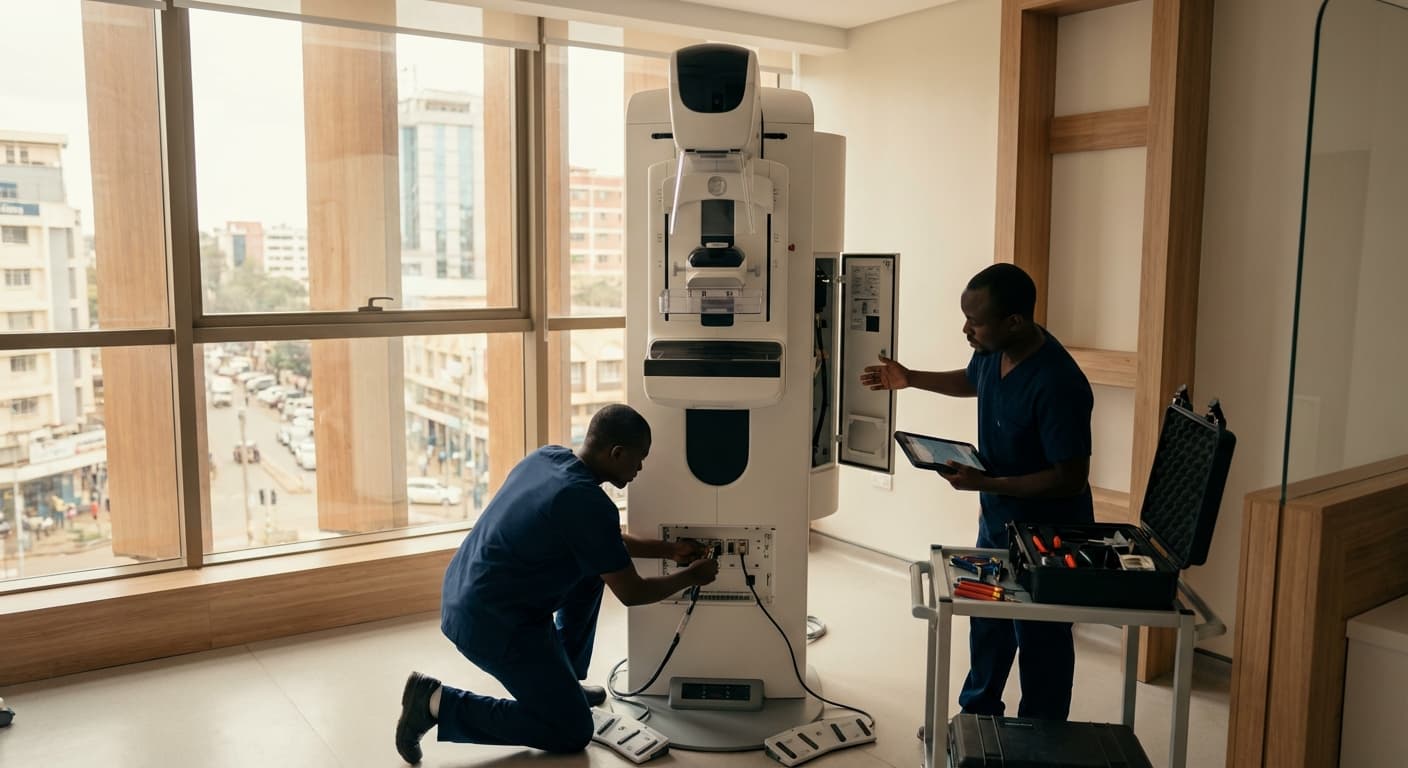
Mammography Installation Service in Benin
Engineering Excellence & Technical Support
Mammography Installation Service High-standard technical execution following OEM protocols and local regulatory frameworks.
Expert Mammography System Installation
Our certified technicians specialize in the seamless installation of state-of-the-art mammography equipment across Benin. We ensure optimal positioning, calibration, and integration for reliable diagnostic performance.
Adherence to International Standards
We meticulously follow global safety and quality standards, including IEC and FDA guidelines, during every mammography installation. This guarantees patient safety and diagnostic accuracy, meeting regulatory requirements in Benin.
Comprehensive Operator Training
Beyond installation, we provide thorough training for your radiology staff in Benin on the operation, basic maintenance, and troubleshooting of your new mammography system, empowering them for efficient use.
What Is Mammography Installation Service In Benin?
Mammography installation service in Benin refers to the comprehensive process of setting up, calibrating, and integrating mammography equipment within healthcare facilities in the Republic of Benin. This service ensures that the imaging systems are operational, meet regulatory standards, and are optimized for accurate diagnostic interpretation of breast tissue.
| Who Needs Mammography Installation Service | Typical Use Cases | ||||
|---|---|---|---|---|---|
| Hospitals (public and private) | Establishment of new diagnostic imaging departments or expansion of existing ones. | Replacement of outdated or malfunctioning mammography units. | Upgrading to advanced digital mammography systems (e.g., 3D mammography/tomosynthesis) for enhanced diagnostic capabilities. | Facilities undergoing renovation or relocation requiring equipment reinstallation. | Introduction of mammography services in areas previously lacking such capabilities. |
| Diagnostic imaging centers and clinics | Providing specialized breast imaging services to outpatients. | Complementing general radiology services with dedicated mammography capabilities. | Meeting growing demand for breast cancer screening and diagnosis. | Centres focused on women's health services. | |
| Government health initiatives and public health programs | Implementing nationwide breast cancer screening programs. | Equipping rural or underserved areas with essential diagnostic tools. | Ensuring equitable access to advanced medical technology. | ||
| Research institutions and academic medical centers | Acquiring state-of-the-art equipment for research purposes. | Facilitating the training of radiology residents and technologists. |
Key Components of Mammography Installation Service
- Site assessment and preparation: Evaluating the designated space for power requirements, structural integrity, radiation shielding, and environmental controls (temperature, humidity).
- Equipment delivery and unboxing: Safe transportation and careful unpacking of the mammography unit and associated accessories.
- Physical installation and connection: Mounting the equipment, connecting power, data, and networking cables, and integrating with existing Picture Archiving and Communication Systems (PACS) or imaging networks.
- System configuration and software setup: Installing and configuring the mammography system's operating software, including user profiles, imaging protocols, and quality control parameters.
- Calibration and performance testing: Executing stringent calibration procedures to ensure optimal image quality, accurate radiation output, and adherence to established performance benchmarks.
- Radiation safety compliance: Verification and certification of radiation shielding and dose monitoring systems to meet national and international safety regulations.
- Initial training for clinical and technical staff: Providing comprehensive instruction on equipment operation, image acquisition techniques, basic maintenance, and quality assurance protocols.
- Integration with PACS and reporting systems: Ensuring seamless data transfer and compatibility with hospital information systems for efficient workflow and diagnostic reporting.
- Post-installation validation and acceptance testing: Confirming that the installed system meets all functional and performance specifications before official handover.
Who Needs Mammography Installation Service In Benin?
Mammography installation services are crucial for ensuring the proper setup, calibration, and operational readiness of mammography equipment. These services are not just for new installations but also for upgrades, relocations, and essential maintenance. In Benin, the demand for such specialized services stems from the growing recognition of the importance of early breast cancer detection and the increasing investment in healthcare infrastructure.
| Customer Type | Relevant Departments/Units | Primary Need |
|---|---|---|
| Hospitals (Public & Private) | Radiology Department, Oncology Department, Women's Health Unit, Diagnostic Imaging Unit | New installations for expanded services, replacement of aging equipment, upgrades to digital mammography, post-relocation setup. |
| Diagnostic Imaging Centers/Clinics | Radiology Department, Mammography Suite | Setting up new clinics, expanding existing capacity, upgrading to advanced technologies, ensuring compliance with standards. |
| Government Health Initiatives/Public Health Programs | District Hospitals, Primary Health Centers, Mobile Screening Units | Deploying screening equipment across various locations, ensuring standardized installation and functionality for public health campaigns. |
| NGOs (Women's Health Focused) | Mobile Clinics, Community Health Centers, Specialized Women's Clinics | Equipping outreach programs, setting up specialized screening facilities, ensuring accessibility to mammography services in underserved areas. |
| Research Institutions/Universities | Radiology Department, Medical Research Laboratories, Teaching Hospitals | Installing equipment for clinical research, training medical professionals, advanced diagnostic studies. |
| Cancer Treatment Centers | Radiology Department, Diagnostic Imaging, Follow-up Care Units | Ensuring high-quality imaging for diagnosis, treatment planning, and monitoring of cancer patients. |
Target Customers and Departments for Mammography Installation Service in Benin
- Hospitals (Public and Private): These are primary beneficiaries, requiring installations in their radiology departments for screening and diagnostic purposes.
- Diagnostic Imaging Centers/Radiology Clinics: Independent centers focused on providing specialized imaging services are key clients.
- Government Health Initiatives and Public Health Programs: Initiatives aimed at widespread breast cancer screening will necessitate installations in various public health facilities.
- Non-Governmental Organizations (NGOs) focused on Women's Health: NGOs operating mobile clinics or specialized women's health centers may require installation services.
- Research Institutions and Universities with Medical Programs: For training and research purposes, these institutions might have dedicated mammography units.
- Referral Centers and Specialized Cancer Treatment Centers: Facilities that handle complex cases will need advanced and reliably installed mammography systems.
Mammography Installation Service Process In Benin
This document outlines the comprehensive workflow for mammography installation services in Benin, guiding clients from initial inquiry to the successful execution and completion of the installation. The process is designed to ensure a smooth, efficient, and compliant installation, meeting the specific needs of healthcare facilities.
| Stage | Description | Key Activities | Deliverables | Responsibility (Service Provider/Client) |
|---|---|---|---|---|
| The first point of contact where the client expresses interest and needs are discussed. | Client contacts service provider; initial needs assessment via phone/email; brief overview of services and requirements. | Understanding of client's needs, preliminary scope of work. | Client (Inquiry), Service Provider (Initial Consultation) |
| On-site evaluation to determine feasibility, technical requirements, and logistical considerations. | Site visit by technical team; assessment of space, power, ventilation, network infrastructure, and accessibility; discussion of specific model requirements; preliminary project planning. | Detailed site assessment report; proposed installation plan and timeline; identification of any potential challenges or required modifications. | Service Provider (Assessment & Planning), Client (Access & Information) |
| Formal proposal outlining costs, services, and terms based on the site assessment. | Preparation of detailed quotation (equipment, installation labor, training, warranty); negotiation of terms and pricing; signing of contract/service agreement. | Formal quotation; signed service agreement. | Service Provider (Quotation & Negotiation), Client (Review & Approval) |
| Acquisition and transportation of the mammography equipment and associated accessories. | Ordering of equipment from manufacturer/supplier; quality control checks; secure packaging; transportation to the client's facility in Benin; customs clearance if applicable. | Delivered mammography equipment and all necessary components; delivery confirmation. | Service Provider (Procurement & Logistics), Client (Receiving Point) |
| Ensuring the installation area meets all technical and safety requirements. | Implementation of any required civil works (e.g., reinforced flooring, shielding); electrical upgrades; HVAC adjustments; network connectivity setup; ensuring compliance with local regulations and manufacturer specifications. | Ready and compliant installation space; confirmed utilities and infrastructure. | Client (Primarily, with Service Provider Guidance) |
| Physical installation and connection of the mammography equipment. | Unpacking and positioning of the mammography unit; connection of power, network, and other essential services; assembly of accessories; initial configuration. | Physically installed and connected mammography system. | Service Provider (Installation) |
| Verification of equipment functionality and performance against industry standards. | Comprehensive functional testing; image quality assessment; calibration to ensure optimal performance and diagnostic accuracy; adherence to quality control protocols. | Calibrated and tested mammography system; performance reports; quality assurance certificates. | Service Provider (Testing & Calibration) |
| Educating the client's staff on the operation and basic maintenance of the equipment. | On-site training for radiographers, technicians, and relevant IT staff; covering operation, image acquisition, quality control procedures, and basic troubleshooting; handover of user manuals and documentation. | Trained staff; comprehensive user manuals; formal handover documentation. | Service Provider (Training), Client (Staff Participation & Sign-off) |
| Ongoing assistance and scheduled maintenance to ensure continued optimal performance. | Provision of warranty support; scheduled preventative maintenance visits; technical support for troubleshooting; availability of spare parts; service contract management. | Ongoing operational efficiency; minimized downtime; access to expert support. | Service Provider (Support & Maintenance), Client (Adherence to Maintenance Schedule) |
Key Stages of Mammography Installation Service
- Initial Inquiry and Consultation
- Site Assessment and Planning
- Quotation and Agreement
- Equipment Procurement and Delivery
- Site Preparation
- Installation and Setup
- Testing and Calibration
- Training and Handover
- Post-Installation Support and Maintenance
Mammography Installation Service Cost In Benin
Installing mammography equipment in Benin involves several cost considerations. The pricing can fluctuate significantly based on the type and brand of mammography unit, the complexity of the installation, the specific healthcare facility's infrastructure, and the service provider chosen. Factors influencing the final cost include the required modifications to the imaging room (e.g., lead shielding, electrical upgrades, HVAC systems), the need for specialized training for technicians and radiologists, ongoing maintenance agreements, and potential import duties or taxes on the equipment and parts. Prices are typically quoted in West African CFA Franc (XOF).
| Cost Component | Estimated Range (XOF) |
|---|---|
| Basic Digital Mammography Unit Installation (excluding unit cost) | 1,500,000 - 3,500,000 |
| Advanced Digital Mammography Unit Installation (excluding unit cost) | 3,000,000 - 7,000,000+ |
| Room Modifications (e.g., shielding, electrical) | 500,000 - 2,000,000+ |
| Technician/Radiologist Training (per session/group) | 300,000 - 800,000 |
| Ancillary Software Integration (e.g., PACS setup) | 200,000 - 600,000 |
Key Pricing Factors for Mammography Installation in Benin
- Type and Brand of Mammography Unit: Advanced digital mammography systems generally incur higher installation costs than older analog or less sophisticated digital models. Leading international brands might also come with higher service charges.
- Infrastructure Readiness: The existing electrical, ventilation, and structural integrity of the installation site play a crucial role. Significant upgrades or specialized room preparation (like radiation shielding) will increase the overall expense.
- Installation Complexity: This includes the physical placement of the unit, connection to existing IT networks for PACS (Picture Archiving and Communication System), and integration with other medical equipment.
- Service Provider Expertise: The experience and reputation of the installation service provider can impact pricing. Specialized medical equipment installers with proven track records might charge a premium.
- Training and Commissioning: Costs associated with training radiographers, radiologists, and biomedical engineers on the operation and maintenance of the new mammography system are often bundled into installation packages.
- Geographic Location within Benin: While less of a primary factor for the installation itself, logistical costs for the service team and equipment delivery might vary slightly between major cities (like Cotonou or Porto-Novo) and more remote areas.
- Ancillary Services and Maintenance Contracts: Many installation packages include an initial period of maintenance. The cost of extended service agreements and software updates also needs to be considered long-term.
Affordable Mammography Installation Service Options
Securing affordable mammography installation services is crucial for healthcare providers aiming to expand or upgrade their imaging capabilities without overstretching their budgets. This involves understanding various service models, particularly value bundles, and implementing smart cost-saving strategies. Value bundles offer a comprehensive package of services at a potentially lower combined cost than purchasing each component individually, while strategic planning and negotiation can significantly reduce overall expenses.
| Service Model/Strategy | Description | Cost-Saving Potential | Key Benefits |
|---|---|---|---|
| Value Bundles (OEM) | A package offered directly by the equipment manufacturer, often including the mammography unit, installation, warranty, and initial maintenance. | Moderate to High: Can offer discounts on bundled components. Predictable costs. | Streamlined process, integrated support, guaranteed compatibility. |
| Value Bundles (Third-Party) | Bundled services offered by independent providers, potentially combining equipment from various manufacturers with their installation and support. | High: Often more competitive pricing than OEM bundles. Flexibility in equipment choice. | Customizable solutions, potential for better pricing on refurbished or alternative equipment. |
| Phased Installation | Breaking down the installation process into stages, allowing for staggered payments and less upfront capital outlay. | High: Spreads costs over time, manages cash flow effectively. | Flexibility in budgeting, allows for adaptation as needs evolve. |
| Refurbished Equipment Packages | Bundles that include high-quality, pre-owned mammography machines that have been professionally refurbished and certified. | Very High: Significant cost reduction compared to new equipment. | Proven technology at a fraction of the cost, often includes warranty and support. |
| Negotiation and Bulk Purchasing | Actively negotiating prices with providers or, if part of a larger healthcare system, leveraging bulk purchasing power. | High: Direct impact on the price of equipment, services, and consumables. | Reduced per-unit costs, stronger vendor relationships. |
| Site Preparation Optimization | Carefully planning and executing site preparation to minimize delays and unexpected costs. This includes ensuring proper electrical, structural, and HVAC requirements are met efficiently. | Moderate: Prevents costly rework and delays, ensures smooth installation. | Efficient project management, reduced risk of budget overruns. |
| Service Level Agreement (SLA) Review | Thoroughly reviewing and negotiating maintenance and support contracts to ensure they align with actual needs and budget, potentially opting for tiered support. | Moderate: Avoids paying for unused or overly comprehensive service plans. Long-term cost management. | Tailored support, cost-effective maintenance. |
Key Considerations for Affordable Mammography Installation
- Understanding the components of installation (equipment, site preparation, calibration, training, maintenance).
- Evaluating different types of service providers (OEM, third-party, hybrid models).
- Assessing the long-term total cost of ownership, not just initial installation costs.
- Prioritizing essential features and avoiding unnecessary upgrades.
- Exploring financing and leasing options.
Verified Providers In Benin
In the pursuit of reliable healthcare in Benin, identifying verified providers is paramount. Franance Health stands out as a leading organization committed to credentialing and ensuring the highest standards of medical care. Their rigorous verification process and dedication to quality make them the premier choice for individuals seeking trustworthy healthcare services.
| Credential Aspect | Franance Health's Approach | Benefit for Patients |
|---|---|---|
| Medical License Verification | Thoroughly checks and validates active and unrestricted medical licenses. | Ensures providers are legally qualified to practice. |
| Educational Background | Verifies academic credentials from accredited institutions. | Confirms foundational knowledge and training. |
| Professional Experience | Assesses past performance and peer reviews. | Indicates practical skill and experience. |
| Specialty Certification | Validates board certifications and specialized training. | Guarantees expertise in specific medical areas. |
| Continuous Professional Development | Monitors ongoing training and adherence to current medical practices. | Ensures providers remain up-to-date with advancements. |
| Ethical Conduct and Disciplinary Records | Scans for any history of malpractice or disciplinary actions. | Protects patients from unqualified or unethical practitioners. |
Why Franance Health Credentials Matter:
- Uncompromising Quality Assurance: Franance Health's verification process meticulously assesses healthcare professionals and facilities, ensuring they meet stringent quality benchmarks.
- Patient Safety First: Their credentialing prioritizes patient safety through thorough background checks, education verification, and ongoing performance reviews.
- Expertise and Specialization: Franance Health identifies and validates providers with proven expertise in various medical fields, connecting patients with the right specialists.
- Trust and Transparency: The 'Franance Health Verified' mark signifies a commitment to transparency and ethical practices, offering peace of mind to patients.
- Access to Excellence: By partnering with Franance Health, patients gain access to a network of highly qualified and reputable healthcare providers across Benin.
Scope Of Work For Mammography Installation Service
This Scope of Work (SOW) outlines the requirements for the installation of a new mammography system. It details the technical deliverables, standard specifications, and project phases necessary for a successful and compliant implementation. The aim is to ensure the mammography system is installed, calibrated, and operational according to manufacturer guidelines, regulatory standards, and the client's specific operational needs.
| Deliverable | Description | Standard Specifications/Acceptance Criteria | Responsible Party |
|---|---|---|---|
| Site Readiness Report | Document confirming the facility meets all pre-installation requirements (e.g., power, shielding, space, HVAC, network). | Pre-installation checklist completed and signed off; photographs of site conditions; confirmation of environmental parameters (temperature, humidity). | Client/Facility Management, Vendor Site Engineer |
| Installation Plan | Detailed timeline and methodology for the physical installation of the mammography system. | Includes phased approach, resource allocation, risk mitigation strategies, and communication plan. Approved by Client and Vendor. | Vendor Project Manager |
| Physically Installed Mammography System | The mammography unit, including all components (detector, gantry, workstation, console), assembled and secured in its designated location. | Installed according to manufacturer's manual and site-specific layout. All connections made securely. No visible damage to components. | Vendor Installation Team |
| Calibrated System Performance | System calibrated to meet manufacturer's specifications for image quality, dose, and functionality. | All calibration procedures documented, including pre- and post-calibration measurements. Acceptance based on passing manufacturer's phantom tests and image quality assessments. | Vendor Field Service Engineer (FSE) |
| Integrated Ancillary Equipment | All required ancillary equipment (e.g., DICOM printer, PACS workstation) successfully connected and integrated with the mammography system. | Demonstrated successful image transfer to PACS; successful printing via DICOM printer. Network connectivity verified. | Vendor FSE, IT Department |
| Quality Assurance (QA) Test Report | Comprehensive report detailing all QA tests performed and their results. | Tests include: automatic exposure control (AEC) performance, spatial resolution, contrast resolution, low-contrast detectability, signal-to-noise ratio (SNR), laser imager calibration (if applicable). Results meet established clinical and regulatory benchmarks (e.g., ACR standards). | Vendor FSE, Client QC Personnel |
| User and Technical Training Materials | Documentation and training sessions for clinical staff and technical support. | Includes operation manuals, service manuals, troubleshooting guides, and hands-on training. Training attendance logs and competency assessments. | Vendor Application Specialist, Vendor FSE |
| Final Acceptance Certificate | Formal document signed by the client acknowledging successful installation and commissioning. | Signed upon successful completion of all installation, calibration, QA testing, and training. Includes a punch list of any outstanding items and their resolution plan. | Client Project Manager, Vendor Project Manager |
| As-Built Documentation | Record of the final installation, including any deviations from the original plan and network configurations. | Includes final system configuration settings, cabling diagrams, network IP addresses, and equipment serial numbers. Provided in electronic and/or hard copy format. | Vendor FSE, IT Department |
| Post-Installation Support Plan | Outline of support services to be provided post-handover. | Includes warranty period, contact information for support, response times, and service level agreements (SLAs). | Vendor Service Department |
Key Project Phases and Activities
- Site Preparation and Readiness Assessment
- System Delivery and Unpacking
- Physical Installation and Integration
- Electrical and Network Connectivity
- System Configuration and Calibration
- Quality Assurance Testing and Acceptance
- Training and Handover
- Post-Installation Support and Documentation
Service Level Agreement For Mammography Installation Service
This Service Level Agreement (SLA) outlines the response times and uptime guarantees for the Mammography Installation Service provided by [Your Company Name]. This SLA is an addendum to the Master Service Agreement (MSA) between [Your Company Name] and [Client Company Name].
| Service Component | Service Level Objective (SLO) | Measurement Method |
|---|---|---|
| Installation Delivery & Setup | Installation completion within [X] business days of equipment arrival at site. | Time from equipment delivery to initial system power-on and basic configuration completion. |
| Initial System Configuration & Testing | Completion of manufacturer-recommended calibration and quality assurance tests within [Y] business days of setup. | Time from system power-on to successful completion of all required initial tests. |
| Post-Installation Support & Training | Availability of technical support and operator training as per the Installation Project Plan. | Adherence to the agreed-upon schedule for support and training sessions. |
| System Uptime Guarantee (Post-Installation) | 99.5% uptime for the installed mammography system during its warranty period, excluding Scheduled Maintenance. | Calculated monthly as (Total Available Hours - Downtime Hours) / Total Available Hours * 100%. Available hours exclude Scheduled Maintenance and Client-induced downtime. |
| Critical Issue Response Time (during business hours) | Response within 2 business hours. | Time from when a Critical Issue Service Request is logged until a [Your Company Name] technician or support representative actively begins troubleshooting (e.g., remote access, phone call, dispatch). |
| Critical Issue Response Time (outside business hours/weekends) | Response within 4 business hours. | Time from when a Critical Issue Service Request is logged until a [Your Company Name] technician or support representative actively begins troubleshooting. |
| Routine Issue Response Time (during business hours) | Response within 4 business hours. | Time from when a Routine Issue Service Request is logged until a [Your Company Name] technician or support representative actively begins troubleshooting. |
| Critical Issue Resolution Goal | Resolution within 24 business hours. | Time from when a Critical Issue Service Request is logged until the system is restored to operational status. |
| Routine Issue Resolution Goal | Resolution within 48 business hours. | Time from when a Routine Issue Service Request is logged until the system is restored to operational status. |
Definitions
- Installation Service: The process of delivering, setting up, configuring, and testing a new mammography system at the Client's designated facility.
- Downtime: Any period during which the installed mammography system is unavailable for use due to a defect, malfunction, or failure that is the responsibility of [Your Company Name] under the terms of this SLA.
- Scheduled Maintenance: Planned maintenance activities, including software updates or hardware inspections, communicated to the Client in advance.
- Emergency Maintenance: Unscheduled maintenance required to address critical issues affecting system operation, undertaken with reasonable efforts to minimize disruption.
- Response Time: The maximum allowable time from when a Service Request is initiated by the Client until [Your Company Name] begins addressing the issue.
- Resolution Time: The maximum allowable time from when a Service Request is initiated until the issue is resolved and the mammography system is back in operational status, as defined by the manufacturer's specifications.
Frequently Asked Questions

Ready when you are
Let's scope your Mammography Installation Service in Benin project in Benin.

Scaling healthcare logistics and technical systems across the entire continent.