
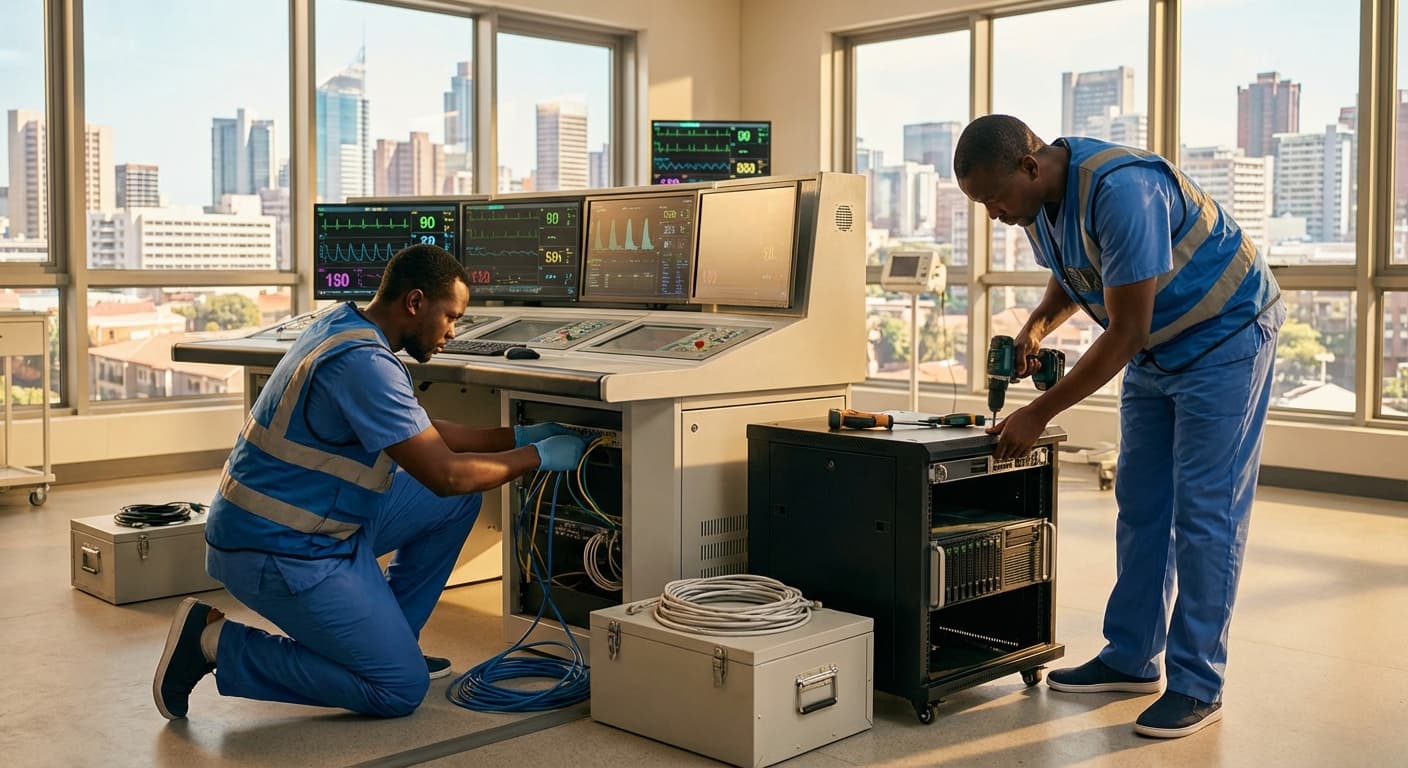
ICU Central Monitoring Station Installation Service in Benin
Engineering Excellence & Technical Support
ICU Central Monitoring Station Installation Service High-standard technical execution following OEM protocols and local regulatory frameworks.
Seamless Network Integration
We architect and implement robust, high-availability network infrastructure, ensuring reliable, real-time data transmission from patient monitors to the central station. Our expertise includes secure VLAN segmentation, redundant pathways, and optimized bandwidth allocation for uninterrupted critical care monitoring.
High-Performance Server Deployment
Our team specializes in setting up and configuring powerful, enterprise-grade servers for your ICU Central Monitoring Station. We ensure optimal hardware selection, RAID configurations for data redundancy, and efficient operating system and software installation for maximum performance and uptime.
Advanced Data Security & Compliance
We prioritize the utmost security of patient data. Our installations adhere to international data privacy standards, incorporating robust firewall configurations, access control mechanisms, and regular security audits to safeguard sensitive information against unauthorized access and cyber threats.
What Is Icu Central Monitoring Station Installation Service In Benin?
ICU Central Monitoring Station Installation Service in Benin refers to the comprehensive process of designing, procuring, installing, configuring, and commissioning a centralized monitoring system for Intensive Care Units (ICUs) within healthcare facilities located in Benin. This service ensures that critical patient physiological data from multiple ICU beds can be collected, displayed, and analyzed at a central console, enabling more efficient and proactive patient management. It involves the integration of patient monitoring devices, network infrastructure, display systems, and data management software.
| Who Needs This Service | Typical Use Cases | |||||
|---|---|---|---|---|---|---|
| Hospitals and Healthcare Facilities in Benin: Specifically, those with existing or planned Intensive Care Units (ICUs) that require enhanced patient monitoring capabilities. | New ICU Construction or Expansion: Implementing a new central monitoring system from scratch. | Upgrade of Existing Monitoring Systems: Replacing outdated or inadequate central monitoring solutions with more advanced technology. | Facilities Experiencing High Patient Load: To improve workflow efficiency and patient oversight. | Teaching Hospitals: For educational purposes and advanced clinical research. | Facilities Aiming for International Standards: To enhance the quality of care and patient safety. | Remote or Resource-Limited Settings: Enabling a smaller number of skilled staff to monitor a larger patient cohort effectively. |
| Real-time Multibed Monitoring: Simultaneous visualization of vital signs for multiple critically ill patients from a single console. | Early Detection of Patient Deterioration: Proactive identification of adverse trends through continuous data analysis and timely alarm generation. | Improved Clinical Response Times: Faster notification of critical events allows for quicker medical intervention. | Enhanced Communication and Collaboration: Centralized data access facilitates better communication among the ICU team. | Data Logging and Review: Recording of patient physiological data for trend analysis, incident investigation, and quality improvement initiatives. | Remote Monitoring Capabilities: In some advanced systems, enabling authorized personnel to review patient data remotely (with appropriate security measures). | Resource Optimization: Allowing fewer nursing staff to effectively oversee a greater number of patients, especially during off-peak hours. |
Key Components and Activities of ICU Central Monitoring Station Installation Service:
- System Design and Planning: Site assessment, network topology design, hardware and software selection based on hospital requirements and budget, compliance with relevant healthcare standards (e.g., IEC 60601 series).
- Hardware Procurement and Staging: Sourcing of central monitoring units, display screens (monitors), network switches, cabling, servers (if applicable), and patient monitoring devices (if not already present). Pre-configuration and testing of hardware in a controlled environment.
- Network Infrastructure Deployment: Installation of secure and reliable network cabling (e.g., Ethernet), configuration of network switches and routers, ensuring adequate bandwidth and Quality of Service (QoS) for real-time data transmission.
- Software Installation and Configuration: Deployment of central monitoring software, establishing communication protocols with bedside monitors (e.g., HL7, proprietary vendor protocols), user account management, and alarm parameter configuration.
- Device Integration: Connecting and configuring bedside patient monitors (e.g., for ECG, SpO2, NIBP, respiration, temperature, invasive pressures) to the central station, ensuring accurate data acquisition and display.
- System Testing and Validation: Comprehensive testing of all system functionalities, including data display accuracy, alarm generation and notification, data archiving, and network stability. Validation against predefined performance criteria.
- User Training: Providing in-depth training to clinical staff (nurses, physicians) on the operation, features, and troubleshooting of the central monitoring station.
- Documentation and Handover: Provision of detailed system documentation, including design specifications, installation records, user manuals, and maintenance guides. Formal handover of the operational system to the hospital.
- Post-Installation Support: Offering initial technical support and troubleshooting to address any immediate issues post-commissioning.
Who Needs Icu Central Monitoring Station Installation Service In Benin?
The installation of an ICU Central Monitoring Station (CMS) is a critical infrastructural upgrade for any healthcare facility aiming to provide advanced patient care. In Benin, as the healthcare sector continues to develop, several types of institutions and departments will benefit immensely from this service. A CMS allows for the continuous, real-time observation of multiple critically ill patients from a centralized location, enabling prompt medical intervention and improved patient outcomes.
| Customer Type | Relevant Departments | Why they need CMS Installation |
|---|---|---|
| Tertiary Hospitals and Referral Centers | Intensive Care Unit (ICU), Coronary Care Unit (CCU), Neonatal Intensive Care Unit (NICU), Surgical Intensive Care Unit (SICU), Medical Intensive Care Unit (MICU), Emergency Department (for acute stabilization) | These facilities handle the most severe cases, requiring continuous, high-level monitoring for multiple patients simultaneously. A CMS is essential for efficient management and immediate response to deteriorating conditions. |
| University Teaching Hospitals | Intensive Care Unit (ICU), Specialized ICUs (e.g., Neuro ICU, Pediatric ICU), Research Units | Beyond patient care, teaching hospitals often engage in medical research. A CMS can facilitate data collection and analysis, and provide a robust platform for training future medical professionals in critical care monitoring. |
| Large Private Hospitals | Intensive Care Unit (ICU), Critical Care Units, Surgical Recovery Units | To offer competitive and high-quality critical care services, private hospitals need advanced monitoring capabilities. A CMS enhances patient safety, optimizes staff allocation, and improves the hospital's reputation. |
| Government-funded Hospitals with significant patient loads | Intensive Care Unit (ICU), High Dependency Units (HDUs) | Many government hospitals in Benin serve a large population and often face resource constraints. A CMS can improve efficiency by allowing fewer staff to monitor more patients effectively, ensuring critical patients receive timely attention. |
| Specialized Medical Centers (e.g., cardiac, neurological, trauma) | Cardiac Intensive Care Unit (CICU), Neuro Intensive Care Unit (NICU), Trauma Intensive Care Unit | These centers focus on specific patient populations with complex needs. CMS installation is crucial for the specialized monitoring required for conditions like post-cardiac arrest, stroke, or severe trauma, enabling tailored interventions. |
Target Customers for ICU Central Monitoring Station Installation Service in Benin
- Tertiary Hospitals and Referral Centers
- University Teaching Hospitals
- Large Private Hospitals
- Government-funded Hospitals with significant patient loads
- Specialized Medical Centers (e.g., cardiac, neurological, trauma)
Icu Central Monitoring Station Installation Service Process In Benin
This document outlines the comprehensive workflow for the ICU Central Monitoring Station Installation Service Process in Benin, from initial inquiry to final execution and handover. This process is designed to ensure a smooth, efficient, and compliant installation that meets the highest standards of healthcare infrastructure.
| Phase | Stage/Activity | Description | Key Stakeholders | Deliverables/Outcomes | Estimated Timeline (Days) | ||||||||||||||||||||||||||||||||||||||||||||||||||||||||||||
|---|---|---|---|---|---|---|---|---|---|---|---|---|---|---|---|---|---|---|---|---|---|---|---|---|---|---|---|---|---|---|---|---|---|---|---|---|---|---|---|---|---|---|---|---|---|---|---|---|---|---|---|---|---|---|---|---|---|---|---|---|---|---|---|---|---|
| 1: Pre-Installation and Planning | Initial Inquiry & Needs Assessment | Client expresses interest; detailed discussion of requirements, existing infrastructure, and specific monitoring needs for the ICU. | Client (Hospital Administration, ICU Department Head, IT Department), Service Provider (Sales Team, Technical Consultants) | Understanding of scope, preliminary proposal, site visit scheduling. | 1-3 | ||||||||||||||||||||||||||||||||||||||||||||||||||||||||||||
| 1: Pre-Installation and Planning | Site Survey and Technical Assessment | On-site evaluation of the ICU environment, including power, network connectivity, space availability, structural integrity, and existing equipment compatibility. | Service Provider (Field Engineers, Technical Lead), Client (Facility Management, Biomedical Engineers) | Detailed site report, identification of potential challenges, confirmation of technical feasibility. | 2-5 | ||||||||||||||||||||||||||||||||||||||||||||||||||||||||||||
| 1: Pre-Installation and Planning | System Design and Proposal Finalization | Development of a tailored system design based on needs assessment and site survey. This includes defining the central monitoring station hardware, software, network architecture, and integration with existing devices. Finalized technical and commercial proposal. | Service Provider (System Architects, Project Managers, Sales Team), Client (Procurement Department, Technical Review Committee) | Approved system design document, finalized quotation, contract. | 5-10 | ||||||||||||||||||||||||||||||||||||||||||||||||||||||||||||
| 2: Procurement and Logistics | Equipment Procurement | Sourcing and ordering of all necessary hardware (servers, workstations, displays, network components) and software licenses from manufacturers and suppliers. | Service Provider (Procurement Department, Project Manager), Suppliers | Procured equipment and software. | 15-40 (depending on lead times) | 2: Procurement and Logistics | Logistics and Shipping | Arranging for secure transportation of all equipment from the supplier to the designated installation site in Benin, including customs clearance and import duties. | Service Provider (Logistics Team, Project Manager), Shipping Companies, Customs Agents | Equipment delivered to the site. | 10-20 (depending on international shipping) | 3: On-Site Installation and Configuration | Site Preparation | Ensuring the ICU environment is ready for installation, including any necessary structural modifications, power outlet installations, and network cabling runs as identified in the site survey. | Client (Facility Management, Contractors), Service Provider (Project Manager) | Prepared installation space. | 5-10 | 3: On-Site Installation and Configuration | Hardware Installation | Physical installation of servers, workstations, displays, network switches, and other hardware components in the designated central monitoring room and relevant ICU areas. | Service Provider (Installation Engineers, Technical Lead), Client (Biomedical Engineers) | All hardware components physically installed. | 3-7 | 3: On-Site Installation and Configuration | Network Configuration and Integration | Setting up the local area network (LAN) for the monitoring system, configuring IP addresses, ensuring secure data transmission, and integrating patient monitors and other medical devices with the central station. | Service Provider (Network Engineers, Software Engineers), Client (IT Department, Biomedical Engineers) | Functional network connectivity, integrated patient devices. | 5-10 | 3: On-Site Installation and Configuration | Software Installation and Configuration | Installing and configuring the central monitoring software, including setting up user accounts, defining alarm parameters, configuring data storage, and customizing display layouts. | Service Provider (Software Engineers, Technical Lead), Client (ICU Staff, IT Department) | Fully installed and configured monitoring software. | 3-7 | 4: Testing, Validation, and Training | System Testing and Validation | Rigorous testing of all system functionalities, including data acquisition, display, alarm generation, data archiving, and user interface. Validation against defined performance criteria and patient safety standards. | Service Provider (QA Engineers, Technical Lead), Client (Biomedical Engineers, ICU Staff) | Tested and validated system performance, performance reports. | 5-7 | 4: Testing, Validation, and Training | User Training | Comprehensive training for ICU nurses, physicians, and biomedical technicians on the operation, maintenance, and troubleshooting of the central monitoring system. | Service Provider (Trainers, Technical Experts), Client (ICU Staff, Biomedical Staff) | Trained personnel, training materials, attendance records. | 3-5 | 4: Testing, Validation, and Training | Acceptance Testing | Formal acceptance of the installed system by the client after successful testing and training, ensuring all contractual requirements are met. | Client (Project Manager, Department Head), Service Provider (Project Manager) | Signed acceptance certificate. | 1-2 | 5: Project Closure and Support | Project Handover and Documentation | Formal handover of the installed system to the client, along with all relevant documentation, including user manuals, technical schematics, warranty information, and maintenance procedures. | Service Provider (Project Manager), Client (Hospital Administration, Biomedical Department) | Complete project documentation package, handover meeting. | 1-3 | 5: Project Closure and Support | Post-Installation Support and Warranty | Providing ongoing technical support, troubleshooting, and warranty services as per the service agreement. This includes remote assistance and on-site visits if required. | Service Provider (Support Team, Field Engineers), Client (Biomedical Department, IT Department) | Resolved issues, operational system, documented support activities. | Ongoing (as per contract) |
ICU Central Monitoring Station Installation Service Process in Benin
- Phase 1: Pre-Installation and Planning
- Phase 2: Procurement and Logistics
- Phase 3: On-Site Installation and Configuration
- Phase 4: Testing, Validation, and Training
- Phase 5: Project Closure and Support
Icu Central Monitoring Station Installation Service Cost In Benin
Installing an ICU Central Monitoring Station in Benin involves a range of costs influenced by several key factors. These factors determine the overall investment required for setting up a robust and reliable system to monitor critically ill patients. The price can vary significantly depending on the complexity of the hospital's needs, the chosen technology, the number of beds to be monitored, and the vendor selected. Local currency is the West African CFA franc (XOF).
| Service Component | Estimated Price Range (XOF) | Notes |
|---|---|---|
| Basic ICU Central Monitoring System (e.g., 5-10 beds) | 15,000,000 - 30,000,000 | Includes basic patient monitors with standard parameters and a central station. |
| Intermediate ICU Central Monitoring System (e.g., 10-20 beds) | 30,000,000 - 60,000,000 | Offers more advanced parameters, potentially telemetry options, and robust software. |
| Advanced/Comprehensive ICU Central Monitoring System (e.g., 20+ beds, high-acuity) | 60,000,000 - 150,000,000+ | Features include advanced analytics, seamless HIS integration, high-resolution displays, and extensive data management. |
| Installation & Configuration per workstation/monitor | 200,000 - 500,000 | Covers physical setup, cabling, and initial software configuration. |
| Staff Training (per session/group) | 150,000 - 400,000 | Depends on the duration and complexity of the training. |
| Annual Maintenance Contract (AMC) (% of system cost) | 5% - 15% | Typically includes preventative maintenance, software updates, and priority support. |
Key Pricing Factors for ICU Central Monitoring Station Installation in Benin:
- {"item":"Number of Patient Monitors and Workstations: The more beds that need to be monitored, the higher the cost for the patient monitoring units and the central display workstations."}
- {"item":"Technology and Features: Advanced features like telemetry, integrated vital sign parameters (ECG, SpO2, NIBP, respiration, temperature), invasive pressure monitoring, and advanced alarm management systems will increase the price."}
- {"item":"Brand and Manufacturer: Reputable international brands often come with higher price tags due to their established quality, reliability, and after-sales support. Local or regional suppliers might offer more competitive pricing."}
- {"item":"Software and Data Management: The cost of the central monitoring software, including patient data storage, trend analysis, and potential integration with Hospital Information Systems (HIS) or Electronic Health Records (EHR), is a significant component."}
- {"item":"Installation and Configuration: This includes the physical setup of the monitoring units, cabling, network integration, and the configuration of the central station software according to hospital protocols."}
- {"item":"Training: Comprehensive training for medical staff and technicians on the operation and maintenance of the system is crucial and adds to the overall cost."}
- {"item":"Warranty and After-Sales Support: Extended warranties and service contracts for maintenance and repairs will impact the initial and ongoing expenses."}
- {"item":"Infrastructure Requirements: Any necessary upgrades to the hospital's electrical, networking, or structural infrastructure to support the new system will also contribute to the cost."}
- {"item":"Customization: Specific customization requests to meet unique hospital workflows or integration needs can lead to additional charges."}
Affordable Icu Central Monitoring Station Installation Service Options
Setting up an Intensive Care Unit (ICU) central monitoring station is a critical investment for any healthcare facility, ensuring continuous patient observation and timely intervention. While the initial outlay can seem substantial, there are numerous affordable installation service options and cost-saving strategies available. Understanding value bundles and exploring different approaches can significantly reduce the overall expense without compromising on quality or functionality. This guide outlines key considerations for affordable ICU central monitoring station installation.
| Value Bundle Options | Description | Cost-Saving Strategies | Benefit |
|---|---|---|---|
| Basic Monitoring Package | Includes essential patient monitors, a central display, and standard network integration. Ideal for facilities with existing infrastructure or a need for core functionality. | Phased implementation (start with a few beds and expand), refurbished equipment (certified and warrantied), negotiate bulk discounts on monitors. | Lower upfront investment, scalable as budget allows, reduces immediate financial strain. |
| Integrated System Bundle | Combines patient monitors, central station software, and network hardware. Often includes basic installation and training. Offers a more seamless setup. | Lease-to-own options for equipment, utilize existing IT infrastructure where possible, opt for cloud-based software solutions. | Streamlined procurement and installation, reduced integration complexities, potentially lower long-term software costs. |
| Comprehensive Care Package | Encompasses advanced patient monitors with integrated diagnostic capabilities, a robust central station with advanced analytics, full network deployment, and extended training/support. High-end functionality. | Partner with vendors offering bundled service and support contracts, explore government grants or healthcare technology financing programs, consider open-source software alternatives for certain modules (with expert implementation). | Maximizes patient safety and clinical efficiency, future-proofs the system, can lead to long-term operational efficiencies through advanced data insights. |
| Modular Upgrade Path | Focuses on installing a core system with the flexibility to add advanced features and more monitors over time. This is not a fixed bundle but a strategic approach. | Prioritize essential monitoring parameters initially, choose vendors with modular and backward-compatible systems, negotiate future upgrade pricing upfront. | Adapts to evolving clinical needs and budget constraints, avoids obsolescence, spreads costs over time. |
Key Components of an ICU Central Monitoring Station Installation:
- Patient Monitors (bedside units)
- Central Display Unit (for the nursing station)
- Network Infrastructure (cabling, switches, servers)
- Software (data management, alerting systems)
- Installation Labor (site preparation, setup, calibration)
- Training (for clinical and IT staff)
- Ongoing Maintenance and Support Contracts
Verified Providers In Benin
In Benin's evolving healthcare landscape, identifying trustworthy and qualified medical professionals is paramount for patient safety and effective treatment. Franance Health stands out as a beacon of excellence, offering a meticulously curated network of verified providers. This commitment to verification goes beyond a simple checklist; it involves a rigorous assessment of credentials, experience, and adherence to the highest ethical standards. Choosing a Franance Health verified provider ensures you are engaging with medical practitioners who have demonstrated their expertise and dedication to patient well-being, making them the best choice for your healthcare needs.
| Aspect of Verification | Franance Health's Standard | Benefit to Patients |
|---|---|---|
| Medical Licensure & Certification | Confirmed active and valid licenses/certifications from recognized authorities. | Ensures providers are legally qualified and meet minimum competency requirements. |
| Educational Background | Verification of degrees and postgraduate training from accredited institutions. | Confirms a strong foundational knowledge and specialized expertise. |
| Professional Experience | Thorough review of work history, practice affiliations, and references. | Indicates a proven track record of successful patient care and practical application of skills. |
| Disciplinary Records | Checks for any history of malpractice claims or disciplinary actions. | Safeguards against providers with compromised ethical standing or a history of negligence. |
| Specialty Competence | Validation of specific qualifications and certifications within their chosen medical field. | Ensures patients are seen by specialists with the most relevant and up-to-date knowledge for their condition. |
Why Franance Health Verified Providers are the Best Choice:
- Unwavering Commitment to Patient Safety
- Rigorous Credential Verification Process
- Access to Highly Experienced Professionals
- Adherence to Ethical Medical Practices
- Enhanced Trust and Peace of Mind
- Streamlined Healthcare Navigation
Scope Of Work For Icu Central Monitoring Station Installation Service
This Scope of Work (SOW) outlines the services required for the installation of an Intensive Care Unit (ICU) Central Monitoring Station. The project encompasses all necessary activities from site preparation to final system testing and handover. This SOW details the technical deliverables, standard specifications, and project phases to ensure a successful and compliant installation.
| Technical Deliverable | Description | Standard Specification/Reference |
|---|---|---|
| Site Survey Report | Detailed assessment of the existing infrastructure, network readiness, power availability, and physical space for the central monitoring station and associated cabling. | NFPA 99, hospital-specific electrical and IT standards. |
| Installation Drawings and Schematics | Comprehensive diagrams showing the placement of all monitoring units, workstations, servers, networking equipment, and cable pathways. Includes floor plans, wiring diagrams, and rack elevations. | IEEE standards for electrical drawings, industry best practices for network cabling diagrams. |
| Cabling Infrastructure | Installation of structured cabling (e.g., Cat6a or higher) for network connectivity, patient monitor data, and alarm signals. Includes cable testing and certification. | TIA/EIA-568 standards, ensuring signal integrity and compliance with data transmission requirements. |
| Central Monitoring Workstations | Installation and configuration of designated workstations for healthcare professionals to view patient data, alarms, and trends. Includes ergonomic setup and display calibration. | Manufacturer's specifications, ergonomic design guidelines, HIPAA compliance for data display. |
| Server and Network Equipment Installation | Rack-mounting and secure installation of central servers, network switches, routers, and firewalls. Includes proper ventilation and power management. | Rack-mount standards (e.g., EIA-310), network device manufacturer specifications, data center best practices. |
| Power Distribution and UPS System | Installation of dedicated power circuits and Uninterruptible Power Supply (UPS) systems to ensure continuous operation of critical monitoring equipment during power outages. | NFPA 70 (National Electrical Code), UL certification for power equipment, UPS manufacturer specifications for required runtime. |
| Alarm Management System Configuration | Configuration of the central monitoring system to manage, prioritize, and route patient alarms to appropriate personnel based on pre-defined protocols. | Hospital's alarm management policy, manufacturer's software configuration guides, ESI (Engineering Standards for Innovation) principles for alarm fatigue reduction. |
| Integration with Existing Systems | Seamless integration of the new central monitoring station with existing hospital IT infrastructure, including Electronic Health Records (EHR) systems, if applicable. | HL7 standards for healthcare data exchange, FHIR (Fast Healthcare Interoperability Resources) where applicable, hospital's IT integration protocols. |
| System Testing and Validation Report | Comprehensive documentation of all tests performed (e.g., connectivity, data accuracy, alarm functionality, system resilience) and their successful outcomes. Includes performance benchmarks. | HIPAA compliance for data integrity, hospital's quality assurance protocols, system manufacturer's validation procedures. |
| User Training Materials and Sessions | Development and delivery of training programs for clinical staff and IT support on the operation, maintenance, and troubleshooting of the central monitoring station. | Adult learning principles, hospital's training policy, manufacturer's training modules. |
| As-Built Drawings and Documentation | Finalized drawings reflecting the actual installed configuration, including all cable pathways, equipment locations, and system configurations. Includes operation and maintenance manuals. | Industry standards for record-keeping, manufacturer's documentation requirements, hospital's archiving policies. |
| Warranty and Support Documentation | Provision of all relevant warranty information for installed equipment and services, along with details of post-installation support and maintenance agreements. | Manufacturer's warranty terms, service level agreements (SLAs). |
Project Phases and Key Activities
- Phase 1: Planning and Design
- Phase 2: Site Preparation
- Phase 3: Equipment Installation and Cabling
- Phase 4: System Integration and Configuration
- Phase 5: Testing and Commissioning
- Phase 6: Training and Handover
Service Level Agreement For Icu Central Monitoring Station Installation Service
This Service Level Agreement (SLA) outlines the response times and uptime guarantees for the installation and initial configuration of the ICU Central Monitoring Station (CMS) service. This SLA applies to the critical installation and setup phase and aims to ensure minimal disruption to patient care during this vital process. It is understood that once operational, the CMS will have its own ongoing SLA for monitoring and maintenance, which is a separate agreement.
| Incident Severity | Response Time Guarantee | Uptime Guarantee (During Installation Phase) | Resolution Time Target |
|---|---|---|---|
| Critical Incident | 30 Minutes | 99.9% | 4 Hours (Temporary Fix) |
| Major Incident | 1 Hour | 99.5% | 8 Hours |
| Minor Incident | 4 Business Hours | N/A (Focus on scheduled support) | 2 Business Days |
Key Definitions
- Installation Service: The end-to-end process of setting up the ICU Central Monitoring Station hardware, software, and initial network connectivity within the designated ICU environment.
- Service Hours: 24 hours a day, 7 days a week, 365 days a year, including holidays.
- Downtime: Any period during which the ICU Central Monitoring Station is unavailable or unable to perform its core functions due to an issue originating from the installation service itself or the newly installed components. This excludes planned maintenance windows communicated in advance.
- Critical Incident: A system-wide failure of the ICU CMS, rendering it completely inoperable and impacting the monitoring of all ICU patients connected to it.
- Major Incident: A partial failure of the ICU CMS, impacting the monitoring of a significant subset of ICU patients or a critical subsystem.
- Minor Incident: An issue with the ICU CMS that does not significantly impact patient monitoring but requires attention (e.g., an alert not displaying correctly, a minor software glitch).
- Response Time: The time elapsed from when a critical incident is reported and acknowledged by the service provider to the initiation of active troubleshooting efforts.
- Resolution Time: The time elapsed from when a critical incident is reported to when the ICU CMS is restored to full operational functionality. This may be a temporary fix if a permanent solution requires more time.
- Uptime Guarantee: The percentage of time the ICU CMS is expected to be fully operational and available during the defined Service Hours.
- Service Provider: The entity responsible for the installation and initial configuration of the ICU CMS.
- Customer: The healthcare facility or department procuring the ICU CMS installation service.
Frequently Asked Questions

Ready when you are
Let's scope your ICU Central Monitoring Station Installation Service in Benin project in Benin.

Scaling healthcare logistics and technical systems across the entire continent.