
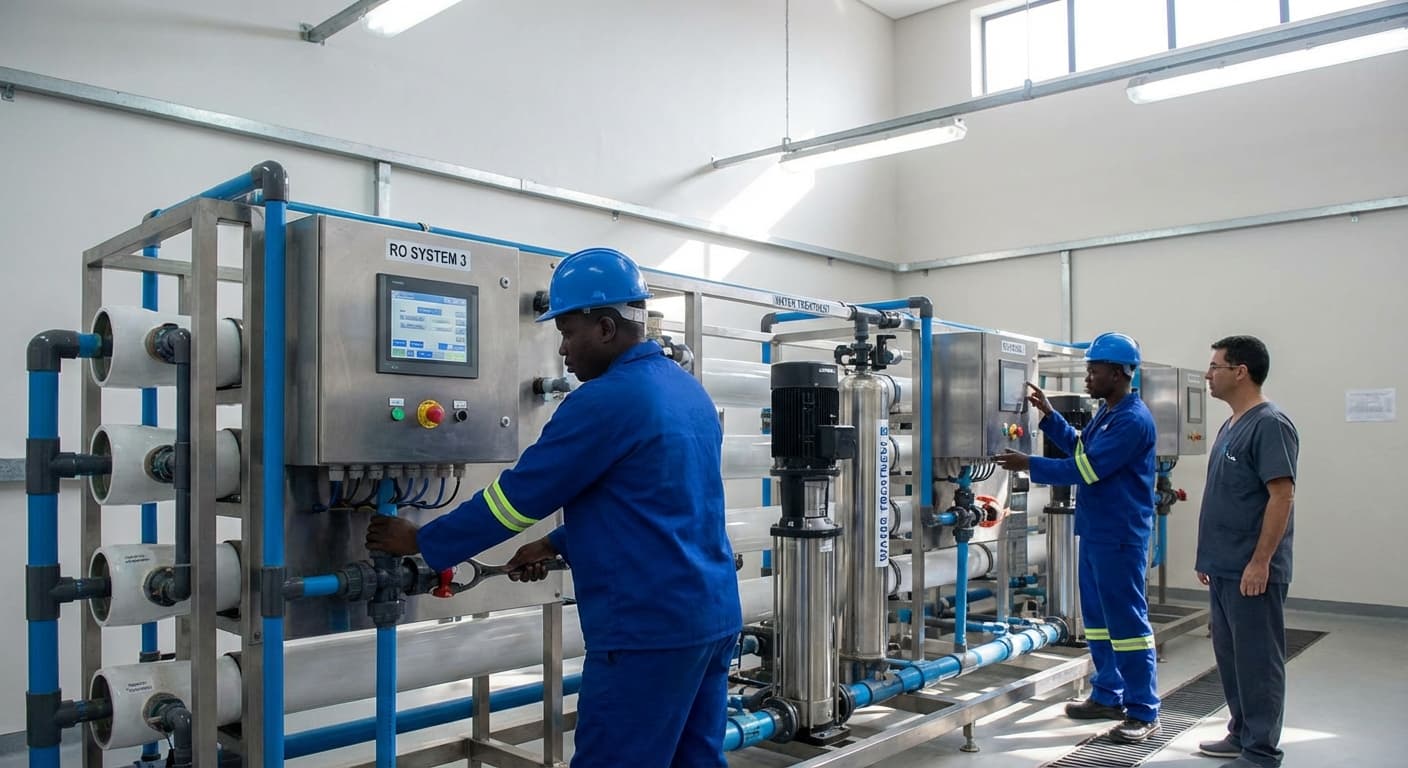
Dialysis RO/Water Treatment Plant Installation Service in Benin
Engineering Excellence & Technical Support
Dialysis RO/Water Treatment Plant Installation Service High-standard technical execution following OEM protocols and local regulatory frameworks.
Advanced RO Membrane Technology
We leverage state-of-the-art Reverse Osmosis (RO) membranes, engineered for superior water purification, ensuring the highest purity levels essential for dialysis and exceeding international standards for Benin's healthcare facilities.
Optimized Flow & Pressure Systems
Our installations feature meticulously designed flow and pressure management systems, guaranteeing consistent, reliable water delivery and optimal performance of dialysis machines, minimizing downtime and enhancing patient safety.
Robust Pre-treatment & Sterilization
We implement multi-stage pre-treatment processes and integrated sterilization protocols to effectively remove contaminants and pathogens, safeguarding the integrity of the purified water and the health of dialysis patients in Benin.
What Is Dialysis Ro/water Treatment Plant Installation Service In Benin?
Dialysis RO/Water Treatment Plant Installation Service in Benin refers to the comprehensive process of designing, procuring, installing, commissioning, and validating specialized water purification systems for hemodialysis facilities within Benin. These systems are engineered to produce ultra-pure water (UPW) meeting stringent international standards (e.g., AAMI, ISO) essential for safe and effective hemodialysis treatment. The service encompasses the entire lifecycle from initial site assessment and system selection to final operational handover and operator training. It is a critical infrastructural component ensuring the quality and safety of dialysis procedures, thereby mitigating risks of patient complications and enhancing treatment outcomes.
| Who Needs the Service | Typical Use Cases | ||||
|---|---|---|---|---|---|
| Nephrology Clinics & Hospitals: Healthcare facilities offering hemodialysis treatment for patients with End-Stage Renal Disease (ESRD). | New Dialysis Center Construction: Establishing a new facility from the ground up requires a complete water treatment system installation. | Existing Dialysis Center Upgrades/Replacements: Replacing aging or non-compliant water treatment systems to improve efficiency, safety, or meet evolving regulatory standards. | Mobile Dialysis Units: Mobile clinics require compact and efficient water treatment solutions for on-the-go operations. | Government Health Initiatives: Public health programs aiming to expand dialysis access and improve treatment quality in underserved regions. | Disaster Relief & Emergency Healthcare: Temporary dialysis setups in areas affected by natural disasters or public health emergencies. |
| Primary Hemodialysis Water Production: Generating the ultra-pure water required for direct use in hemodialysis machines. | Water Quality Assurance: Ensuring that the water used in dialysis is free from contaminants that could cause patient harm (e.g., pyrogens, endotoxins, chlorine, heavy metals). | Regulatory Compliance: Meeting national and international standards for dialysis water quality, which are critical for patient safety and facility accreditation. | System Reliability & Redundancy: Designing systems with built-in redundancy and fail-safes to prevent interruptions in dialysis treatment. | Cost-Effective Water Management: Optimizing water usage and minimizing operational costs through efficient purification processes. | Disease Prevention: Preventing dialysis-related infections and complications stemming from poor water quality. |
Key Components of Dialysis RO/Water Treatment Plant Installation Service
- Site Assessment & Water Analysis: Evaluating the existing water source (municipal, well, etc.), its quality parameters (TDS, hardness, chlorine, microbial load, heavy metals), and the facility's water demand. This forms the basis for system design.
- System Design & Engineering: Developing a bespoke purification strategy based on the water analysis and dialysis machine requirements. This includes selecting appropriate technologies such as pre-filtration (sediment, carbon), reverse osmosis (RO), deionization (DI), ultrafiltration (UF), and UV sterilization.
- Equipment Procurement & Supply: Sourcing and delivering all necessary components, including RO membranes, pumps, filters, tanks, piping, control panels, monitoring instruments, and sterilization equipment, from reputable manufacturers.
- Installation & Plumbing: Expert installation of all equipment, including precise piping and electrical connections, ensuring structural integrity and adherence to plumbing codes and facility layout.
- Electrical & Control System Integration: Connecting and configuring the plant's electrical supply, control systems, alarms, and data logging for operational monitoring and safety.
- Commissioning & Performance Testing: Rigorous testing of the installed system to verify its operational parameters, flow rates, water quality output (TOC, endotoxins, conductivity, microbial counts), and alarm functions.
- Validation & Documentation: Comprehensive validation protocols (IQ, OQ, PQ) to confirm that the system meets design specifications, performs reliably under operational conditions, and complies with regulatory requirements. This includes detailed documentation and certification.
- Operator Training: Thorough training of facility personnel on the operation, routine maintenance, troubleshooting, and basic disinfection procedures of the water treatment plant.
- After-Sales Support & Maintenance: Provision of ongoing technical support, spare parts, and scheduled maintenance services to ensure the long-term performance and reliability of the plant.
Who Needs Dialysis Ro/water Treatment Plant Installation Service In Benin?
This service is crucial for organizations and facilities in Benin that rely on highly purified water for critical operations. Dialysis centers, in particular, require ultra-pure water that meets stringent medical standards to prevent patient harm. Beyond healthcare, research laboratories, pharmaceutical manufacturers, and certain industrial processes also demand water of exceptional purity, making them key beneficiaries of these installation services. Ensuring the reliable and safe operation of these water treatment plants is paramount to maintaining health, safety, and operational integrity.
| Target Customer Group | Specific Departments/Roles Involved |
|---|---|
| Dialysis Centers | Nephrology Department, Biomedical Engineering, Facility Management, Procurement Department, Clinic Administrators |
| Hospitals and Medical Facilities | Infection Control Department, Central Sterilization Supply Department (CSSD), Biomedical Engineering, Pharmacy, Hospital Administration |
| Research Laboratories | Lab Managers, Principal Investigators, Laboratory Technicians, Facilities and Operations, Procurement |
| Pharmaceutical Manufacturing Plants | Quality Assurance (QA), Quality Control (QC), Production Department, Validation Engineers, Engineering and Maintenance, Procurement |
| Water Bottling Plants (Premium Segment) | Production Management, Quality Control, Operations, Maintenance, Procurement |
| Industrial Facilities with High-Purity Water Requirements | Process Engineers, Maintenance Managers, Operations Supervisors, Environmental Health and Safety (EHS), Procurement |
Who Needs Dialysis RO/Water Treatment Plant Installation Service in Benin?
- Dialysis Centers
- Hospitals and Medical Facilities
- Research Laboratories
- Pharmaceutical Manufacturing Plants
- Water Bottling Plants (Premium Segment)
- Industrial Facilities with High-Purity Water Requirements
Dialysis Ro/water Treatment Plant Installation Service Process In Benin
This document outlines the comprehensive service process for installing Dialysis Reverse Osmosis (RO) / Water Treatment Plants in Benin, from the initial inquiry to the successful execution of the project. Our aim is to provide a clear, efficient, and transparent workflow that ensures client satisfaction and the delivery of a high-quality, compliant water treatment solution for dialysis facilities.
| Phase | Key Activities | Deliverables/Outcomes | Timeline (Indicative) | Responsible Parties |
|---|---|---|---|---|
| 1. Inquiry & Initial Consultation | Receive and acknowledge client inquiry. Initial discussion to understand project scope, requirements, capacity, and location. Gather preliminary information about existing infrastructure and water sources. | Understanding of client needs. Identification of key project parameters. Basic project feasibility assessment. | 1-3 Business Days | Client, Sales/Technical Representative |
| 2. Site Assessment & Technical Evaluation | On-site visit by technical specialists to evaluate water quality (testing). Assess available space, power supply, plumbing, and drainage. Review architectural drawings and facility layout. Discuss specific operational requirements and compliance standards (e.g., WHO, local health regulations). | Detailed water analysis report. Comprehensive site survey report. Identification of potential challenges and constraints. Confirmation of technical feasibility. | 3-7 Business Days (depending on travel and testing) | Technical Team (Engineers, Technicians), Client Representatives |
| 3. Proposal Development & Quotation | Design of the optimal RO/Water Treatment system based on site assessment and requirements. Selection of appropriate technologies and components. Development of detailed system specifications. Preparation of a comprehensive quotation including equipment, installation, commissioning, and training costs. | Technical proposal with system design and specifications. Detailed bill of materials. Formal quotation and payment schedule. | 5-10 Business Days | Engineering Team, Procurement Team, Sales Team |
| 4. Contract Agreement & Project Kick-off | Review and negotiation of the proposal and contract terms. Signing of the Service Agreement. Formal project kick-off meeting to align on roles, responsibilities, and project plan. Establish communication channels. | Signed Service Agreement. Project execution plan. Designated project manager and key contacts. | 2-5 Business Days | Client, Legal Department, Project Management Team |
| 5. Procurement & Logistics | Ordering of all necessary equipment, components, and consumables from approved suppliers. Arrangement of international and local transportation of materials to Benin. Customs clearance and delivery to the client's site. | Procured equipment and materials. Logistics plan and tracking. Delivery confirmation at the site. | 4-12 Weeks (depending on lead times and shipping) | Procurement Team, Logistics Department, Local Partners |
| 6. Installation & Commissioning | Site preparation and civil works (if required). Installation of the RO/Water Treatment plant according to design and manufacturer specifications. Electrical and plumbing connections. System testing and initial calibration. Performance testing and validation of water quality parameters. | Fully installed and functional RO/Water Treatment plant. Commissioning report detailing performance test results. Compliance with specified water quality standards. | 2-6 Weeks (depending on system complexity and site readiness) | Installation Team (Technicians, Engineers), Project Manager, Quality Assurance Team |
| 7. Training & Handover | Comprehensive training for client's operational and maintenance staff on system operation, routine maintenance, and troubleshooting. Provision of user manuals and technical documentation. Formal handover of the installed system. | Trained client staff. Complete set of operational and maintenance manuals. Signed handover certificate. | 3-5 Business Days | Technical Trainers, Project Manager, Client Staff |
| 8. Post-Installation Support & Maintenance | Initial period of on-site support. Establishment of a preventive maintenance schedule. Provision of spare parts and consumables. Remote monitoring and troubleshooting (if applicable). Ongoing technical support and service contracts. | Successful system operation. Reduced downtime. Optimized system performance. Long-term client relationship. | Ongoing | Technical Support Team, Maintenance Department, Client |
Dialysis RO/Water Treatment Plant Installation Service Process in Benin
- Phase 1: Inquiry & Initial Consultation
- Phase 2: Site Assessment & Technical Evaluation
- Phase 3: Proposal Development & Quotation
- Phase 4: Contract Agreement & Project Kick-off
- Phase 5: Procurement & Logistics
- Phase 6: Installation & Commissioning
- Phase 7: Training & Handover
- Phase 8: Post-Installation Support & Maintenance
Dialysis Ro/water Treatment Plant Installation Service Cost In Benin
Installing a Reverse Osmosis (RO) and water treatment plant for dialysis in Benin involves a complex set of considerations that directly influence the overall cost. These plants are crucial for providing ultra-pure water essential for hemodialysis, ensuring patient safety and treatment efficacy. Several factors contribute to the pricing, ranging from the scale of the operation to the specific technological choices made. Understanding these elements is vital for accurate budgeting and procurement.
| Service Component | Estimated Cost Range (XOF - West African CFA franc) | Notes |
|---|---|---|
| **Small-Scale Dialysis Unit (e.g., 1-3 dialysis machines) | 5,000,000 - 15,000,000 | Basic RO system, pre-filters, adequate for limited use. Source water quality is a major factor here. |
| **Medium-Scale Dialysis Center (e.g., 4-8 dialysis machines) | 15,000,000 - 40,000,000 | More robust RO system, advanced pre-treatment, potentially with UV sterilization. Accounts for higher water demand and stricter purity. |
| **Large-Scale Dialysis Facility / Multiple Centers (e.g., 9+ dialysis machines) | 40,000,000 - 100,000,000+ | Complex, multi-stage treatment, high-capacity RO, advanced automation, potentially redundant systems, catering to significant patient volumes and demanding purity standards. |
| **Pre-Treatment Systems (e.g., Softeners, Sediment Filters) | 500,000 - 5,000,000+ | Highly dependent on source water quality. Can be a significant portion of the total cost if water is heavily contaminated. |
| **Post-Treatment & Sterilization (e.g., UV, Ozone) | 1,000,000 - 5,000,000+ | Essential for ensuring microbial purity. Cost increases with the sophistication of the sterilization method. |
| **Installation Labor & Commissioning | 1,000,000 - 10,000,000+ | Varies with project size, site accessibility, and the complexity of integration with existing infrastructure. Includes expert supervision. |
| **Logistics, Shipping, & Customs Duties | 500,000 - 5,000,000+ | Impacted by the size and weight of equipment, origin country, and current customs regulations in Benin. |
Key Pricing Factors for Dialysis RO/Water Treatment Plant Installation in Benin
- Plant Capacity and Flow Rate: The primary driver of cost is the volume of purified water the plant needs to produce per hour or day to meet the demands of the dialysis center(s). Larger capacities require bigger and more sophisticated equipment, leading to higher initial investment and installation costs.
- Level of Water Purity Required: Dialysis requires extremely high purity water, often meeting stringent international standards (e.g., AAMI). Achieving this level necessitates advanced filtration, RO membranes, and often post-treatment sterilization (e.g., UV or ozone). The complexity and number of treatment stages directly impact cost.
- Source Water Quality: The quality of the raw water available (e.g., municipal water, well water, boreholes) significantly affects the treatment process. Water with high levels of contaminants (e.g., hardness, turbidity, dissolved solids, heavy metals, bacteria) will require more extensive pre-treatment steps, including softening, sediment filtration, and potentially chemical treatment, increasing overall system complexity and cost.
- Equipment Manufacturer and Technology: Reputable international manufacturers often command higher prices due to their established quality, reliability, and after-sales support. The specific technologies employed (e.g., type of RO membranes, pump efficiency, control systems) also influence cost. Choosing established brands with proven track records is generally recommended for critical medical applications.
- Installation Complexity and Site Conditions: Factors such as the existing infrastructure at the dialysis center, the ease of access for delivery and installation, the need for specialized piping, electrical work, and plumbing modifications all contribute to installation labor and material costs.
- Ancillary Systems and Automation: The inclusion of automated monitoring systems, water quality sensors, alarms, data logging, and backup systems (e.g., redundant pumps, standby water tanks) adds to the overall project cost but enhances operational efficiency and safety.
- Permitting and Regulatory Compliance: Obtaining necessary permits and ensuring compliance with local health and environmental regulations can involve fees and potentially specialized consulting services.
- Logistics and Transportation: Shipping equipment to Benin, including customs duties, taxes, and local transportation from the port to the installation site, is a significant cost component.
- Installation Labor and Expertise: The cost of skilled technicians and engineers required for the installation, commissioning, and initial training of staff will vary based on their experience and the prevailing labor rates in Benin.
- After-Sales Support and Maintenance Contracts: While not strictly an installation cost, the provision of warranty, preventative maintenance contracts, and spare parts availability is often factored into the initial decision-making process and can influence the overall investment.
Affordable Dialysis Ro/water Treatment Plant Installation Service Options
Finding affordable Dialysis RO/Water Treatment Plant installation is crucial for healthcare facilities. This service ensures the delivery of purified water, essential for patient safety and treatment efficacy. We offer a range of solutions designed to meet diverse budgetary needs, focusing on value bundles and cost-saving strategies to make high-quality water treatment accessible.
| Cost-Saving Strategy | Description | Benefit |
|---|---|---|
| Phased Installation | Breaking down the installation into stages to align with budget cycles or operational needs. | Reduces immediate capital outlay and allows for incremental investment. |
| Component Prioritization | Focusing on essential, high-impact components initially and upgrading later. | Lower upfront cost while still meeting critical water quality standards. |
| Energy-Efficient Equipment | Selecting RO pumps and other components with lower energy consumption. | Reduces long-term operational costs (electricity bills). |
| Preventive Maintenance Packages | Bundling regular maintenance services with the installation. | Minimizes unexpected repair costs and prolongs equipment lifespan. |
| Bulk Purchasing Options | Leveraging our network to source high-quality components in bulk, passing savings to clients. | Direct reduction in equipment costs. |
| Modular System Design | Utilizing modular components that can be easily scaled or replaced. | Facilitates future upgrades or expansions without significant overhaul costs. |
Understanding Value Bundles
- Standard Value Bundle: Includes essential RO system components, basic installation, and initial water quality testing. Ideal for smaller clinics or those with existing infrastructure.
- Premium Value Bundle: Features advanced RO membranes, integrated softeners, UV sterilization, comprehensive installation, ongoing water quality monitoring, and extended warranty. Best for larger facilities prioritizing long-term reliability and compliance.
- Customizable Value Bundle: Allows clients to select specific components and service levels to perfectly match their unique requirements and budget, offering maximum flexibility.
Verified Providers In Benin
When seeking healthcare services in Benin, especially those related to specialized treatments or financial assistance for health, it's crucial to identify 'Verified Providers.' These are entities that have undergone a rigorous credentialing process, ensuring they meet specific standards of quality, ethics, and operational integrity. Franance Health, a prominent organization in this space, offers a comprehensive credentialing service that sets its accredited providers apart. Their verification process is designed to instill confidence in patients, assuring them that they are engaging with reputable and reliable healthcare partners.
| Credential Type | Verification Focus | Patient Benefit |
|---|---|---|
| Clinical Excellence | Medical expertise, treatment outcomes, patient safety protocols | Access to high-quality medical care |
| Ethical Compliance | Adherence to medical ethics, data privacy, patient rights | Protection and respectful treatment |
| Financial Transparency | Clear billing practices, fair pricing, ethical financial agreements | No hidden costs, predictable expenses |
| Operational Standards | Facility quality, equipment maintenance, staff qualifications | Safe and well-equipped healthcare environment |
| Patient Satisfaction | Feedback mechanisms, complaint resolution processes | Responsive and patient-centered services |
Why Franance Health Credentials Represent the Best Choice:
- Rigorous Vetting Process: Franance Health employs a multi-faceted evaluation system, scrutinizing everything from clinical expertise and facility standards to financial transparency and patient care protocols.
- Commitment to Ethical Practices: Verification signifies adherence to a strict code of ethics, ensuring patient rights are protected, and services are delivered with integrity.
- Enhanced Patient Trust and Safety: Knowing a provider is 'Franance Health Verified' offers peace of mind, reducing the risk of encountering fraudulent or substandard services.
- Access to Specialized Care: Many Franance Health verified providers are leaders in specific medical fields, offering advanced treatments and innovative solutions.
- Streamlined Access to Health Finance: For those utilizing health financing options, verified providers often have established partnerships with financial institutions, simplifying the process.
- Continuous Quality Monitoring: Franance Health doesn't just verify once; they often implement ongoing monitoring to ensure providers consistently maintain their high standards.
- International Recognition: Franance Health credentials can offer a level of assurance that is recognized beyond Benin's borders, valuable for expatriates or those seeking international best practices.
Scope Of Work For Dialysis Ro/water Treatment Plant Installation Service
This Scope of Work (SOW) outlines the requirements for the installation services of a Dialysis Reverse Osmosis (RO) / Water Treatment Plant. It details the technical deliverables, standard specifications, and responsibilities of the service provider. The objective is to ensure a fully functional and compliant water treatment system for dialysis operations.
| Technical Deliverable | Description | Standard Specification / Reference |
|---|---|---|
| Site Survey Report | Detailed assessment of the installation site, including space availability, power, water, drainage, and any potential challenges. | To be provided by the service provider within 5 business days of site visit. Includes photographic evidence and recommendations. |
| Foundation/Mounting Preparation | Ensuring the installation area is adequately prepared to support the weight and vibration of the RO/Water Treatment Plant. | Concrete slab of specified thickness and load-bearing capacity (refer to equipment manual). Vibration isolation pads as recommended. |
| RO/Water Treatment Plant Assembly | Proper assembly and connection of all modules, pumps, filters, membranes, and control systems as per manufacturer's instructions. | Adherence to the manufacturer's installation manual. All connections to be secure and leak-free. |
| Pre-treatment System Installation | Installation and connection of any pre-treatment units (e.g., sediment filters, carbon filters, water softeners) required for optimal RO performance. | As per manufacturer's specifications. Proper backwashing and regeneration functionality to be verified. |
| RO Membrane Module Installation | Correct installation and seating of RO membranes within their housings. | Manufacturer's recommended procedures. Membranes to be handled with care to avoid damage. |
| Post-treatment System Installation | Installation and connection of post-treatment units (e.g., UV sterilizer, post-carbon filter) to ensure purified water quality. | As per manufacturer's specifications. Sterilization and flow rate parameters to be verified. |
| Piping and Plumbing Connections | Connection of inlet water, purified water outlet, reject water, and drain lines using appropriate materials. | Materials: Food-grade PVC, SS 316L, or as specified by the manufacturer. All joints to be properly sealed and pressure-tested. |
| Electrical Wiring and Control Panel Installation | Connection of the RO/Water Treatment Plant to the main power supply, including control panel wiring and sensor integration. | Adherence to local electrical codes and standards. Proper grounding and safety features to be ensured. Control panel wiring diagrams to be followed precisely. |
| Instrumentation and Sensor Calibration | Installation and calibration of all pressure gauges, flow meters, conductivity meters, and other sensors. | Calibration to be performed using traceable standards. Readings to be within acceptable tolerances. |
| System Flushing and Sanitization | Thorough flushing of the entire system to remove any installation debris and subsequent sanitization. | Flushing until water quality parameters are met. Sanitization using approved chemicals and procedures. |
| Performance Testing and Validation | Running the system under operational load to verify performance against specified parameters. | Water quality testing (TDS, conductivity, microbial counts) to meet dialysis standards (e.g., AAMI, ISO). Flow rate and pressure tests to be conducted. |
| Leakage Test | Comprehensive check for any leaks in the piping, connections, and equipment under operating pressure. | Pressure testing as per manufacturer's guidelines. No visible leaks to be present. |
| Emergency Shut-down and Safety Feature Testing | Verification of all safety features, including emergency stop buttons, pressure relief valves, and alarms. | All safety mechanisms to function as designed and documented. |
| Operation and Maintenance Manuals | Provision of comprehensive O&M manuals for the installed system. | In English, hardcopy and/or electronic format. Including schematics, troubleshooting guides, and spare parts list. |
| As-Built Drawings | Updated technical drawings reflecting the final installed configuration of the RO/Water Treatment Plant. | Including P&ID (Piping and Instrumentation Diagrams), electrical schematics, and layout drawings. |
| Training Session for Site Personnel | Training for designated personnel on the operation, basic maintenance, and troubleshooting of the RO/Water Treatment Plant. | Minimum 4 hours duration. Includes hands-on demonstration and Q&A session. |
| Final Acceptance Certificate | Formal document acknowledging successful installation, testing, and commissioning of the system. | Signed by both the service provider and the client upon satisfactory completion. |
Key Stages of Installation Service
- Site Preparation and Assessment
- Delivery and Unpacking of Equipment
- Mechanical Installation
- Electrical Installation
- Plumbing and Piping
- System Testing and Commissioning
- Training and Handover
- Documentation
Service Level Agreement For Dialysis Ro/water Treatment Plant Installation Service
This Service Level Agreement (SLA) outlines the response times and uptime guarantees for the installation services of Dialysis Reverse Osmosis (RO)/Water Treatment Plants provided by [Your Company Name] to [Client Name]. This SLA aims to ensure minimal disruption to dialysis operations and maintain the high quality of water required for patient safety.
| Service Component | Response Time (for critical issues) | Escalation Protocol | Uptime Guarantee (post-installation) |
|---|---|---|---|
| Emergency Breakdown (e.g., complete system failure impacting immediate patient care) | Within 2 hours (remote diagnosis/initial response) | Tier 1 Support -> Tier 2 Engineer -> Project Manager | 99.5% (averaged over a calendar month) |
| Critical Malfunction (e.g., significant water quality deviation, partial system failure) | Within 4 business hours (remote diagnosis/initial response) | Tier 1 Support -> Tier 2 Engineer | 99.0% (averaged over a calendar month) |
| Non-Critical Issue (e.g., minor performance degradation, routine adjustment request) | Within 1 business day (remote diagnosis/initial response) | Tier 1 Support | N/A (focus on preventing critical issues) |
| Scheduled Maintenance & Calibration | As per agreed schedule, with minimum 48 hours' notice | N/A | N/A (scheduled downtime explicitly excluded from uptime calculations) |
Scope of Service
- Installation of new Dialysis RO/Water Treatment Plant units.
- Decommissioning and removal of existing RO/Water Treatment Plant units (if applicable).
- Integration with existing facility plumbing and electrical systems.
- Initial system testing, calibration, and handover.
- On-site training for facility staff on basic operation and maintenance.
Frequently Asked Questions

Ready when you are
Let's scope your Dialysis RO/Water Treatment Plant Installation Service in Benin project in Benin.

Scaling healthcare logistics and technical systems across the entire continent.