
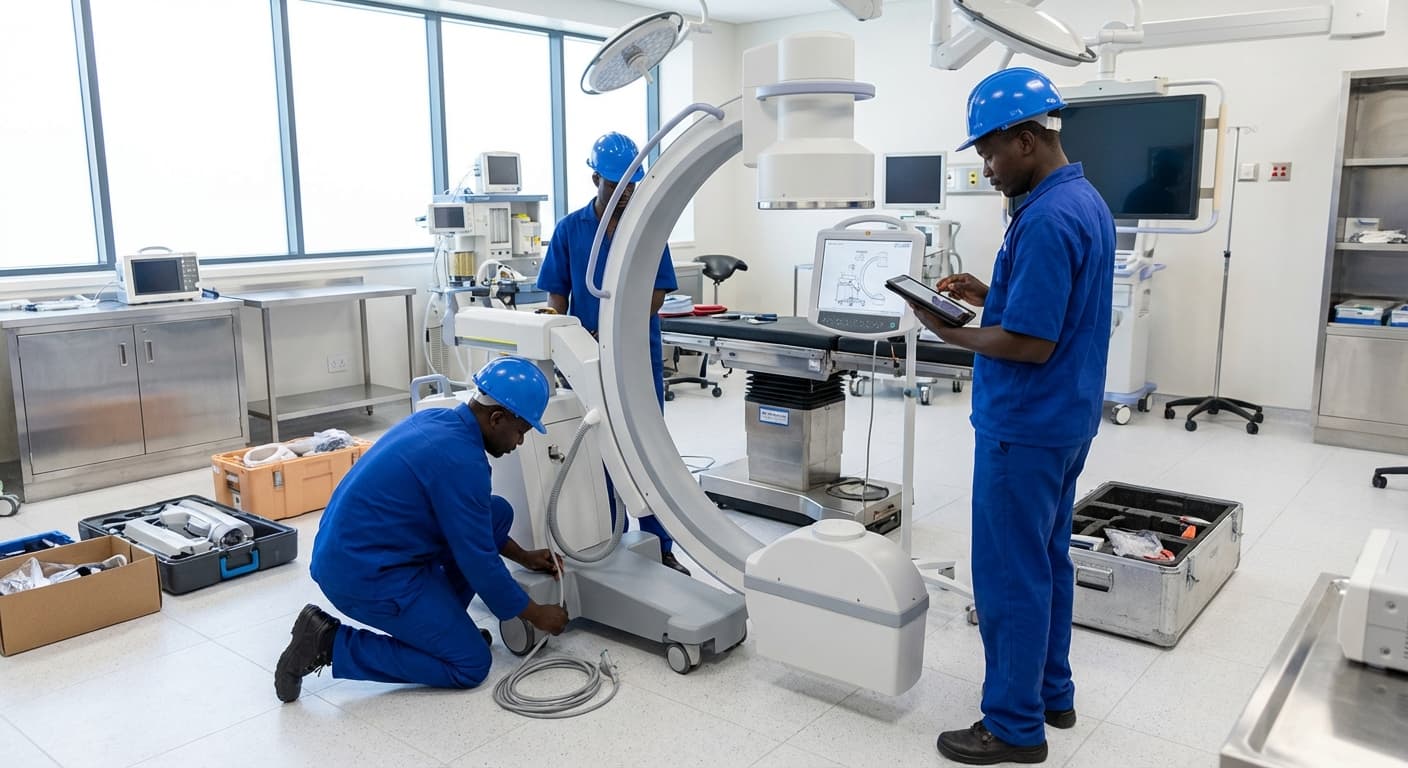
C-Arm Installation Service in Benin
Engineering Excellence & Technical Support
C-Arm Installation Service High-standard technical execution following OEM protocols and local regulatory frameworks.
Precision C-Arm Installation & Calibration
Our certified technicians ensure flawless C-arm setup and meticulous calibration in Benin's healthcare facilities. We adhere to strict industry standards for optimal imaging performance, radiation safety, and integration with your existing infrastructure, guaranteeing you a ready-to-use, high-performance system from day one.
Expert Site Assessment & Infrastructure Readiness
Before installation, our team conducts comprehensive site assessments in Benin, evaluating power, space, and environmental factors. We proactively identify and address any infrastructure requirements to guarantee a seamless and efficient installation process, minimizing downtime and ensuring your C-arm's long-term operational integrity.
Comprehensive Operator Training & Post-Installation Support
Beyond installation, we provide thorough training for your medical staff in Benin, covering C-arm operation, safety protocols, and basic troubleshooting. Our commitment extends to ongoing technical support, ensuring your team is confident and proficient, maximizing the value and lifespan of your C-arm investment.
What Is C-arm Installation Service In Benin?
C-Arm Installation Service in Benin refers to the professional provision of services for the procurement, setup, calibration, and integration of C-arm fluoroscopy imaging systems within healthcare facilities in the Republic of Benin. This encompasses a comprehensive process ensuring the C-arm is optimally positioned, electrically connected, digitally integrated (if applicable), and certified for safe and effective medical imaging procedures. The service ensures compliance with local regulatory standards and manufacturer specifications, facilitating immediate operational readiness.
| Who Needs C-Arm Installation Service? | Typical Use Cases | ||||||||
|---|---|---|---|---|---|---|---|---|---|
| Hospitals (Public and Private) | Orthopedic Surgery (fracture reduction, implant placement) | Cardiology (angiography, stent placement) | Pain Management Clinics | Neurosurgery (spinal procedures) | Gastroenterology (biliary and pancreatic procedures) | Urology (stone removal, stent placement) | Emergency Departments | Surgical Centers | Diagnostic Imaging Centers |
| Specialized Clinics (e.g., Orthopedic, Cardiac) | Intraoperative imaging for real-time guidance | Minimally invasive procedures | Diagnostic fluoroscopy | Interventional radiology | Pediatric imaging | Trauma cases | |||
| Medical Training and Research Institutions | Educational purposes for future healthcare professionals | Clinical research requiring imaging capabilities | |||||||
| Government Health Initiatives and Projects | Upgrading healthcare infrastructure in underserved regions | Establishing new diagnostic and treatment facilities |
Key Components of C-Arm Installation Service:
- Site Assessment and Planning: Evaluating the installation environment, including power supply, space requirements, radiation shielding considerations, and network infrastructure.
- Equipment Delivery and Unpacking: Safe transportation and careful unpacking of the C-arm system and associated components.
- Mechanical Assembly and Positioning: Physical assembly of the C-arm unit, including the gantry, image intensifier/flat panel detector, X-ray tube, and workstation, and precise positioning within the designated procedural suite.
- Electrical Connection and Power Conditioning: Connecting the C-arm to the facility's power grid, often with specialized power conditioning and uninterruptible power supply (UPS) systems to ensure stable operation and protect against power fluctuations.
- Imaging System Configuration and Calibration: Setting up the digital imaging chain, including detector calibration, image processing parameters, and optimizing image quality for diagnostic accuracy.
- Software Installation and Integration: Installing operating system software, C-arm application software, and integrating with Picture Archiving and Communication Systems (PACS) and Electronic Health Records (EHR) if required.
- Radiation Safety Checks and Compliance: Performing rigorous checks to ensure compliance with radiation safety regulations, including dose monitoring and interlock system verification.
- User Training: Providing comprehensive training to medical staff (radiologists, surgeons, technicians) on the operation, maintenance, and basic troubleshooting of the C-arm system.
- System Testing and Verification: Conducting a series of tests to confirm all functionalities are operational and meet performance benchmarks.
- Certification and Documentation: Issuing certification of successful installation and providing all necessary technical documentation and warranty information.
Who Needs C-arm Installation Service In Benin?
C-arm imaging systems are invaluable tools in modern medicine, providing real-time X-ray visualization crucial for a wide range of surgical procedures and diagnostic interventions. The proper installation and calibration of these sophisticated devices are paramount to ensuring patient safety, diagnostic accuracy, and efficient workflow. This service is essential for any healthcare facility in Benin that utilizes or plans to utilize C-arm technology.
| Target Customer Type | Key Departments/Applications Requiring C-Arm Installation | Specific Needs/Benefits of Professional Installation |
|---|---|---|
| Hospitals (Public and Private) | Orthopedics (fracture repair, joint replacement) Neurosurgery (spinal procedures, biopsies) Cardiology (angiography, pacemaker insertion) Urology (lithotripsy, stent placement) Pain Management (injections, nerve blocks) General Surgery (foreign body retrieval, drain placement) Emergency Medicine (trauma assessment, fracture reduction) | Ensuring correct radiation shielding and safety compliance. Optimizing system performance for critical, time-sensitive procedures. Integration with existing hospital infrastructure and PACS (Picture Archiving and Communication System). Minimizing downtime during setup and calibration. |
| Surgical Centers | Orthopedics (arthroscopy, minor fracture fixation) Pain Management (complex injections) Podiatry (foot and ankle surgery) Plastic Surgery (reconstructive procedures) | Efficient setup for high-volume outpatient procedures. Streamlining patient throughput. Ensuring immediate readiness for elective surgeries. |
| Diagnostic Imaging Clinics | Interventional Radiology (biopsies, drainages) Pain Management Clinics | Accurate imaging for interventional guidance. Precise positioning for diagnostic accuracy. Compliance with imaging quality standards. |
| Orthopedic Centers | All orthopedic surgical subspecialties | Specialized setup for orthopedic procedures. Optimizing imaging for bone and joint visualization. Ensuring longevity and reliability of the C-arm for frequent use. |
| Pain Management Clinics | Nerve blocks, epidural injections, facet joint injections | Precise needle placement for targeted pain relief. Real-time visualization for accurate administration of anesthetics and steroids. |
| Cardiovascular Centers | Angiography, angioplasty, stent placement, pacemaker insertion | High-resolution imaging for delicate vascular procedures. Integration with hemodynamic monitoring systems. Ensuring patient safety during invasive cardiac interventions. |
| Research and Academic Medical Institutions | Clinical trials, training, development of new procedures | Precise calibration for research data accuracy. Setup for optimal teaching and learning environments. Flexibility for integration with new technologies. |
Target Customers and Departments for C-Arm Installation Service in Benin:
- Hospitals (Public and Private)
- Surgical Centers
- Diagnostic Imaging Clinics
- Orthopedic Centers
- Pain Management Clinics
- Cardiovascular Centers
- Neurology Departments
- Emergency Departments
- Outpatient Surgical Facilities
- Research and Academic Medical Institutions
C-arm Installation Service Process In Benin
This document outlines the typical workflow for a C-Arm installation service in Benin, from the initial client inquiry to the successful execution and handover of the equipment. This process ensures a smooth and efficient installation, addressing all technical and logistical requirements specific to the region.
| Phase | Key Activities | Responsible Parties | Estimated Timeline (Benin Specific Considerations) |
|---|---|---|---|
| Client contacts service provider with C-Arm installation needs. Discusses specific C-Arm model, intended use, and location. Provider offers initial consultation and quotation. | Client, Service Provider Sales/Technical Team | 1-3 Business Days (Response times may vary) |
| Technical team visits the installation site in Benin to assess power requirements, space, environmental conditions (temperature, humidity), access routes, and potential structural modifications. Identifies any necessary preparatory work (e.g., electrical upgrades, flooring). | Service Provider Technical Team, Client Facilities Management | 3-7 Business Days (Includes travel time within Benin if required) |
| Procurement of C-Arm and accessories. Coordination of international shipping to Benin. Handling of customs clearance, import duties, and local transportation to the client's facility. This phase is crucial and may be subject to local regulations and port delays. | Service Provider Logistics Team, Freight Forwarders, Customs Brokers, Client | 2-6 Weeks (Highly variable depending on shipping method, customs processing, and availability of local agents) |
| Safe transportation of the C-Arm and accessories from the port/airport to the installation site. Careful unpacking and initial inspection for any transit damage. | Service Provider Logistics Team, Installation Technicians | 1-3 Business Days (Upon arrival in Benin) |
| Assembly of the C-Arm system according to manufacturer specifications. Connection to power and other required infrastructure. Initial calibration and setup of imaging parameters by certified technicians. Adherence to all safety protocols. | Service Provider Certified Installation Technicians | 2-5 Business Days |
| Comprehensive testing of all C-Arm functions, including imaging performance, radiation output, safety features, and connectivity. Verification against established quality benchmarks. Quality assurance checks. | Service Provider Certified Installation Technicians, Client Medical Physicist (if available) | 1-3 Business Days |
| On-site training for clinical staff and technicians on the operation, basic maintenance, and safety procedures for the C-Arm. Formal handover of the system with all necessary documentation. | Service Provider Application Specialist/Trainer, Client Clinical Staff | 1-2 Business Days |
| Provision of warranty information, service contracts, and contact details for ongoing support. Submission of final installation reports and any relevant certifications. | Service Provider Technical Support Team, Client | Ongoing (Support is continuous, documentation within 5 Business Days of handover) |
C-Arm Installation Service Process in Benin
- Initial Inquiry & Needs Assessment
- Site Survey & Preparation
- Logistics & Importation
- Equipment Delivery & Unpacking
- Installation & Calibration
- Testing & Verification
- Training & Handover
- Post-Installation Support & Documentation
C-arm Installation Service Cost In Benin
The cost of installing a C-arm in Benin can vary significantly based on several factors. These include the complexity of the installation, the specific model and features of the C-arm, the required infrastructure upgrades, and the chosen service provider. Generally, a basic installation might involve connecting the C-arm to existing power and imaging systems, while a more comprehensive service could include specialized room preparation, radiation shielding, and integration with hospital networks. The choice of the installation company also plays a crucial role, with larger, more established providers potentially charging more for their expertise and comprehensive support.
Factors influencing C-arm installation costs in Benin include:
- C-arm Model and Specifications: Higher-end C-arms with advanced imaging capabilities, robotic arms, or specialized applications will naturally incur higher installation costs due to their complexity and integration requirements.
- Site Preparation and Infrastructure: The existing state of the installation site is critical. If the room requires significant modifications such as structural changes, power upgrades, enhanced cooling systems, or specialized flooring, these will add to the overall expense.
- Radiation Shielding: Depending on the C-arm's power and the intended usage, appropriate radiation shielding for the room might be necessary. The cost of materials and labor for this can be substantial.
- Networking and PACS Integration: Connecting the C-arm to the hospital's Picture Archiving and Communication System (PACS) and other IT infrastructure requires specialized expertise and can influence the price.
- Geographic Location within Benin: While major cities might have a wider range of service providers, accessibility to remote areas could increase travel and logistical costs for the installation team.
- Service Provider's Reputation and Experience: Highly reputable companies with proven track records and specialized engineers may command higher prices, reflecting their reliability and expertise.
- Warranty and Support Packages: The inclusion of extended warranties or comprehensive post-installation support can also be factored into the initial service cost.
Estimated Cost Ranges in CFA Francs (XOF):
It's challenging to provide exact figures without specific project details, but general estimations for C-arm installation services in Benin can range from 3,000,000 XOF to 15,000,000 XOF or more. This broad range accounts for the diverse factors mentioned above. A straightforward installation of a standard C-arm in a well-prepared room might fall towards the lower end of this spectrum, while complex installations involving significant infrastructure development and advanced C-arm models would be at the higher end.
| Cost Component | Estimated Range (XOF) |
|---|---|
| Basic Installation (standard C-arm, minimal site prep) | 3,000,000 - 6,000,000 |
| Standard Installation (moderate site prep, basic integration) | 6,000,000 - 10,000,000 |
| Complex Installation (significant site upgrades, advanced C-arm, full integration) | 10,000,000 - 15,000,000+ |
| Radiation Shielding (materials and labor) | Variable (can add 1,000,000 - 5,000,000+) |
| Infrastructure Upgrades (power, cooling, structural) | Variable (highly dependent on existing site) |
Key Factors Influencing C-Arm Installation Costs in Benin
- C-arm Model and Specifications
- Site Preparation and Infrastructure Requirements
- Radiation Shielding Needs
- Networking and PACS Integration
- Geographic Location within Benin
- Service Provider's Reputation and Experience
- Included Warranty and Support Packages
Affordable C-arm Installation Service Options
Acquiring and installing a C-arm is a significant investment for any healthcare facility. Beyond the initial purchase price, installation costs can vary widely depending on the complexity of the procedure, the chosen service provider, and any necessary infrastructure upgrades. Fortunately, there are several affordable C-arm installation service options and strategies to help manage these expenses. Understanding value bundles and implementing smart cost-saving measures can make a substantial difference in the overall budget.
| Cost-Saving Strategy | Description | Potential Impact |
|---|---|---|
| Value Bundles | Many vendors offer bundled packages that combine C-arm purchase, installation, training, and initial maintenance. These bundles often provide a more predictable and potentially lower overall cost than procuring each service individually. | Reduced upfront and long-term costs through negotiated pricing and comprehensive service inclusion. |
| Negotiate Installation Fees | Don't accept the initial quote blindly. Research industry benchmarks and negotiate with the vendor for a more competitive installation price. | Direct reduction in installation expenses. |
| Phased Installation | For larger facilities or more complex setups, consider a phased installation approach. This can spread out costs over time and allow for adjustments based on initial phases. | Improved cash flow and flexibility in budget management. |
| Utilize In-House Expertise | If your facility has skilled biomedical engineers or IT staff, explore if they can handle certain aspects of the installation, such as basic cabling or network integration, under the vendor's supervision. | Significant savings on labor costs. |
| Prioritize Essential Services | Carefully assess which services are absolutely critical for immediate operation. Defer non-essential upgrades or enhancements to a later date if budget is a concern. | Reduced immediate expenditure and focus on core needs. |
| Compare Multiple Vendor Quotes | Always obtain quotes from several reputable C-arm installation service providers. This allows for direct price comparison and leverage for negotiation. | Secures the most competitive pricing. |
| Long-Term Service Agreements | While an upfront cost, a well-negotiated long-term service agreement can sometimes include installation at a discounted rate or provide more comprehensive support, preventing costly emergency repairs. | Potentially lower overall cost of ownership and predictable maintenance expenses. |
| Consider Refurbished C-arms with Installation Packages | For budget-conscious facilities, refurbished C-arms can offer significant savings. Ensure the refurbishment comes with a robust installation and warranty package from a trusted provider. | Lower capital expenditure combined with professional installation. |
| Leverage Existing Infrastructure | Thoroughly assess your current electrical, HVAC, and IT infrastructure. Minimizing the need for costly upgrades can significantly reduce installation costs. | Avoids expenses related to retrofitting or building new infrastructure. |
Key Components of C-Arm Installation Costs
- Site Assessment & Planning: Evaluating existing infrastructure (power, space, shielding) and creating an installation plan.
- Deinstallation/Removal of Old Equipment (if applicable): Disposing of or relocating previous C-arm units.
- C-Arm Transport & Logistics: Moving the C-arm from the vendor to the installation site.
- Physical Installation: Setting up the C-arm, including any required mounting, cabling, and calibration.
- Integration with Existing Systems: Connecting the C-arm to PACS, EMR, or other imaging networks.
- Testing & Calibration: Ensuring the C-arm functions optimally and meets diagnostic standards.
- Training: Educating clinical staff on the operation of the new C-arm.
- Post-Installation Support: Ongoing maintenance and troubleshooting.
Verified Providers In Benin
In Benin's rapidly evolving healthcare landscape, identifying trusted and qualified medical professionals is paramount. Franance Health stands out as a leading platform dedicated to verifying healthcare providers, ensuring patients have access to safe, effective, and ethical medical care. Their rigorous credentialing process is designed to build confidence and transparency, making them the go-to resource for anyone seeking reliable healthcare services in Benin. This commitment to quality assurance is why Franance Health credentials represent the best choice for patients and providers alike.
| Provider Type | Verification Criteria | Franance Health Advantage |
|---|---|---|
| Doctors (General Practitioners & Specialists) | Medical Degree, Medical License, Post-graduate qualifications, Registration with regulatory bodies, Peer reviews (where applicable) | Confirms medical expertise, legal authorization to practice, and adherence to ethical guidelines. |
| Nurses & Midwives | Nursing/Midwifery Diploma/Degree, Professional License, Clinical experience, Training in specialized areas | Ensures qualified and experienced personnel for patient care and support. |
| Pharmacists | Pharmacy Degree, Pharmacy License, Registration with the Pharmacy Board, Good Manufacturing Practices (GMP) compliance (for facilities) | Guarantees safe and accurate dispensing of medication and adherence to pharmaceutical regulations. |
| Dentists | Dental Degree, Dental License, Specialization certifications (if applicable), Clean disciplinary record | Confirms expertise in oral health and adherence to professional standards. |
| Therapists (Physiotherapists, etc.) | Relevant Degree/Diploma, Professional Registration, Clinical certifications, Evidence of continuing professional development | Verifies competency and up-to-date knowledge in rehabilitative and therapeutic services. |
| Healthcare Facilities (Clinics, Hospitals) | Operating License, Compliance with health regulations, Staff qualifications, Equipment maintenance records, Quality management systems | Ensures a safe and well-equipped environment for patient treatment and care. |
Why Franance Health Credentials Matter:
- Patient Safety & Trust: Rigorous vetting ensures providers meet established standards for competence and ethical practice, fostering greater patient confidence.
- Quality Assurance: A commitment to verifying qualifications, licenses, and disciplinary records guarantees access to skilled and legitimate healthcare professionals.
- Transparency & Accessibility: Franance Health provides a clear and accessible platform to find verified providers, simplifying the search for quality healthcare.
- Upholding Medical Standards: By endorsing qualified professionals, Franance Health contributes to raising and maintaining high standards of healthcare delivery in Benin.
- Empowering Patients: Patients can make informed decisions about their healthcare by easily identifying and accessing credentialed and reputable providers.
Scope Of Work For C-arm Installation Service
This Scope of Work (SOW) outlines the services required for the professional installation of a C-Arm imaging system. The objective is to ensure a safe, compliant, and fully functional installation that meets all manufacturer specifications and regulatory requirements. This SOW covers technical deliverables, standard specifications, and key activities involved in the C-Arm installation process.
| Technical Deliverable | Standard Specification | Description |
|---|---|---|
| Site Readiness Report | Manufacturer Guidelines, Local Codes | Detailed report confirming the suitability of the installation site, including power, cooling, shielding, and space requirements. Includes a checklist of pre-requisites. |
| C-Arm System Installation Report | Manufacturer's Installation Manual | Documentation detailing the successful physical assembly, mounting, and connection of the C-Arm unit and associated components. |
| Electrical Compliance Certificate | IEC 60601-1, Local Electrical Codes | Verification and certification that all electrical connections and grounding meet international and local safety standards for medical electrical equipment. |
| Network Connectivity Report | DICOM Standards, Hospital IT Policy | Confirmation of successful integration with the hospital's PACS/RIS, including image transfer protocols, speed, and data integrity checks. |
| System Calibration and QA Report | Manufacturer's Calibration Procedures, ACR Standards | Report detailing the results of system calibration, performance testing (e.g., image quality, dose output), and quality assurance checks against manufacturer and regulatory benchmarks. |
| Shielding Verification Report | Radiation Safety Standards (e.g., NCRP, ICRP) | Verification that radiation shielding is adequate to protect staff and patients, based on lead equivalence calculations and/or measurements. |
| User Training Completion Certificate | Manufacturer's Training Program | Confirmation that designated users have received comprehensive training on the operation, basic maintenance, and safety features of the C-Arm system. |
| Final Acceptance Certificate | Project Agreement | Formal document signed by the client acknowledging the successful completion of the installation and all contractual deliverables. |
| As-Built Drawings | Engineering Standards | Updated drawings reflecting the final installation of the C-Arm system, including cable routing and power outlet locations. |
| Operation and Maintenance Manuals | Manufacturer's Documentation | Complete set of original equipment manufacturer (OEM) manuals for operation, maintenance, and troubleshooting. |
Key Stages of C-Arm Installation
- Pre-Installation Survey and Planning
- Site Preparation and Infrastructure Verification
- C-Arm Equipment Delivery and Unpacking
- C-Arm System Assembly and Mounting
- Power and Electrical Connections
- Network and Data Connectivity
- System Configuration and Calibration
- Testing and Quality Assurance
- User Training and Handover
- Documentation and Compliance
Service Level Agreement For C-arm Installation Service
This Service Level Agreement (SLA) outlines the terms and conditions for the installation of C-Arm imaging systems. It defines the expected response times for critical issues and guarantees a specific level of service availability for the installed C-Arm system during its operational lifecycle, excluding scheduled maintenance and unforeseen circumstances beyond the reasonable control of the service provider.
| Issue Category | Response Time Target | Resolution Target (Initial Contact) | Uptime Guarantee (Monthly) |
|---|---|---|---|
| Critical Issue | 2 hours (during business hours) | 8 business hours | 99.5% |
| Major Issue | 4 business hours (during business hours) | 24 business hours | N/A (Monitored, but not tied to a specific guarantee) |
| Minor Issue | 8 business hours (during business hours) | 48 business hours | N/A (Monitored, but not tied to a specific guarantee) |
Key Definitions
- C-Arm System: The medical imaging device provided by the Customer and requiring installation.
- Installation Service: The process of setting up, configuring, and testing the C-Arm system at the Customer's site.
- Service Provider: The entity responsible for delivering the C-Arm installation service and ongoing support.
- Customer: The healthcare facility or organization receiving the C-Arm installation service.
- Critical Issue: A problem that renders the C-Arm system completely inoperable or significantly compromises its primary diagnostic function.
- Major Issue: A problem that degrades the C-Arm system's performance or functionality but does not render it completely inoperable.
- Minor Issue: A problem that does not affect the primary function or performance of the C-Arm system.
- Downtime: The period during which the C-Arm system is unavailable for use due to a Critical or Major Issue.
- Uptime Guarantee: The percentage of time the C-Arm system is expected to be operational and available for use.
Frequently Asked Questions

Ready when you are
Let's scope your C-Arm Installation Service in Benin project in Benin.

Scaling healthcare logistics and technical systems across the entire continent.