
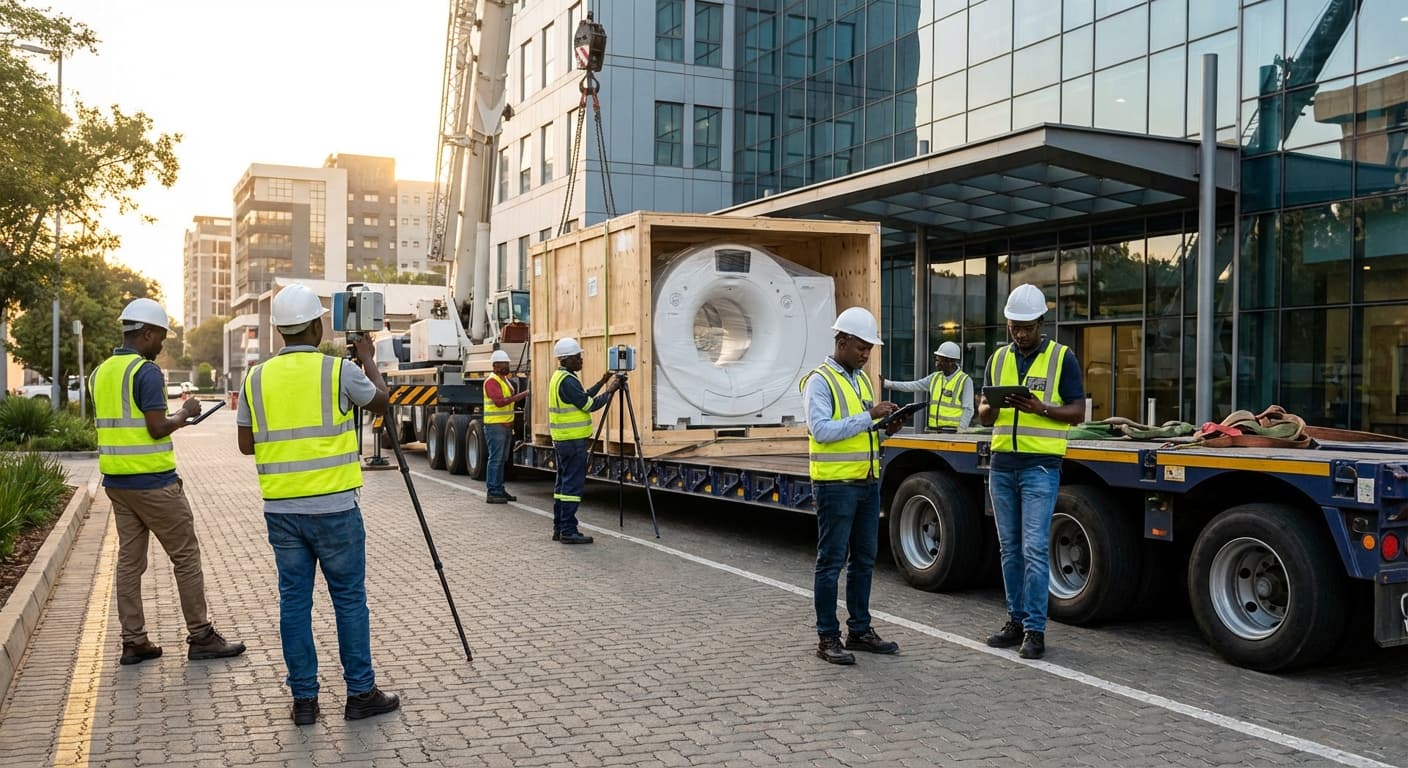
Route Survey & Rigging Plan Service for Heavy Medical Equipment in Benin
Engineering Excellence & Technical Support
Route Survey & Rigging Plan Service for Heavy Medical Equipment High-standard technical execution following OEM protocols and local regulatory frameworks.
Precision Route Survey & Obstacle Mapping
Leveraging advanced GPS and LiDAR technology, our route surveys meticulously map the most feasible transport paths for heavy medical equipment in Benin. We identify and document all potential obstacles including road width constraints, overhead clearances, gradient changes, bridge load capacities, and underground utilities, ensuring a clear and safe passage plan.
Expert Rigging & Load Stabilization Analysis
Our specialized rigging plans incorporate detailed analysis of the medical equipment's weight distribution, center of gravity, and fragility. We specify optimal lifting points, select appropriate lifting gear (cranes, gantry systems, specialized trailers), and design custom cradles and bracing for secure load stabilization, mitigating any risk of damage during transit and installation.
Comprehensive Risk Assessment & Contingency Planning
We conduct thorough risk assessments for every phase of the heavy medical equipment's relocation in Benin, from site access and loading to transit and final placement. Our service includes detailed contingency plans for unforeseen events such as adverse weather, temporary road closures, or equipment malfunctions, guaranteeing the integrity and timely delivery of critical medical infrastructure.
What Is Route Survey & Rigging Plan Service For Heavy Medical Equipment In Benin?
Route Survey & Rigging Plan Service for Heavy Medical Equipment in Benin is a specialized engineering and logistics process meticulously designed to ensure the safe, efficient, and compliant transportation and installation of oversized, heavy, and sensitive medical apparatus within Benin. This service encompasses a comprehensive assessment of the proposed transport route from the point of arrival (e.g., port, airport) to the final installation site, alongside the development of detailed rigging and lifting strategies for each stage of handling. The primary objective is to mitigate risks associated with structural integrity of infrastructure, public safety, equipment damage, and logistical delays, ensuring adherence to all relevant local and international regulations.
| Who Needs the Service? | Typical Use Cases | ||||
|---|---|---|---|---|---|
| Medical Institutions: Hospitals, clinics, diagnostic centers, research facilities in Benin requiring the import and installation of large-scale medical equipment. | Manufacturers and Suppliers of Medical Equipment: Companies needing to deliver and install complex and heavy medical systems for their clients in Benin. | Logistics and Heavy Haulage Companies: Specialized transport providers contracted for the movement of oversized medical equipment within Benin. | Government and Non-Governmental Organizations (NGOs): Entities involved in public health initiatives and infrastructure development requiring the deployment of advanced medical technology in Benin. | ||
| Magnetic Resonance Imaging (MRI) Scanners: Due to their significant weight, size, and sensitivity to environmental conditions, requiring careful route planning and specialized lifting to avoid magnetic interference and structural damage. | Computed Tomography (CT) Scanners: Similar to MRI, these systems are heavy and require precise placement and installation, often involving multiple components. | Linear Accelerators (LINACs) for Radiotherapy: Extremely heavy, requiring meticulous planning for transport, building penetration, and precise alignment within shielded bunkers. | Large X-ray Machines and Angiography Suites: Requiring significant structural considerations for floor loading and precise installation for optimal imaging performance. | Sterilization Equipment (e.g., large autoclaves): Often bulky and heavy, necessitating careful assessment of access points and installation locations within healthcare facilities. | Hospital Beds and Furniture (in bulk for large installations): While not always 'heavy,' the sheer volume and weight of a complete hospital fit-out can necessitate route and rigging planning for efficient delivery and placement. |
Key Components of Route Survey & Rigging Plan Service:
- Route Assessment: Involves detailed site reconnaissance to identify potential obstacles, clearances (height, width), load-bearing capacities of bridges, roads, and overpasses, and any necessary temporary infrastructure modifications. This includes GPS mapping, photographic documentation, and 3D laser scanning where applicable.
- Load Capacity Verification: Strict evaluation of the structural integrity of all infrastructure components along the proposed route, including road surfaces, bridges, tunnels, and building access points, to confirm they can safely support the combined weight of the equipment and transport vehicle.
- Permitting and Regulatory Compliance: Securing all necessary permits from governmental agencies, local authorities, and transportation departments for the movement of oversized and overweight loads, ensuring compliance with Benin's specific transport regulations.
- Traffic Management Planning: Development of comprehensive traffic control strategies, including temporary road closures, diversions, escort vehicle deployment, and traffic signal coordination, to minimize disruption and ensure public safety.
- Rigging and Lifting Plan Development: Engineering detailed plans for all lifting and rigging operations. This includes specifying appropriate lifting equipment (cranes, gantries, jacks), rigging gear (slings, shackles, spreader bars), load calculations, center of gravity determination, and safe operating procedures for personnel involved.
- Site-Specific Installation Planning: Analysis of the final installation location, including access, floor loading capacity, spatial constraints within the medical facility, and final positioning requirements for the equipment.
- Risk Assessment and Mitigation: Proactive identification of potential hazards throughout the entire process and development of contingency plans to address unforeseen challenges, such as adverse weather, equipment malfunction, or route obstructions.
- On-site Supervision and Execution: Provision of experienced personnel to oversee and execute all survey, rigging, transportation, and installation activities, ensuring adherence to the developed plans and safety protocols.
Who Needs Route Survey & Rigging Plan Service For Heavy Medical Equipment In Benin?
When transporting and installing heavy medical equipment in Benin, specialized Route Survey and Rigging Plan Services are crucial. These services ensure that the equipment reaches its destination safely, efficiently, and without damaging either the equipment or the infrastructure. This is particularly important for sophisticated and sensitive medical devices that require precise handling and installation.
| Target Customer/Department | Key Responsibilities & Needs | Specific Equipment Examples |
|---|---|---|
| Hospital Administration/Procurement | Budgeting for logistics, ensuring timely delivery, managing project timelines, minimizing risk of damage. | MRI machines, CT scanners, X-ray machines, linear accelerators, large-scale laboratory equipment. |
| Hospital Facilities Management/Engineering | Assessing building access points, structural integrity, space planning, ensuring safe installation and commissioning of equipment. | Sterilizers, surgical lights, operating tables, specialized diagnostic imaging systems. |
| Medical Equipment Manufacturers (e.g., Siemens Healthineers, GE Healthcare, Philips) | Ensuring brand reputation, customer satisfaction, seamless installation, adherence to technical specifications. | All types of heavy medical equipment they produce. |
| Government Health Ministry | National health infrastructure planning, equitable distribution of medical resources, oversight of public health projects. | Equipment for regional hospitals, mobile clinics, specialized treatment centers. |
| NGO Project Managers | Efficient use of donor funds, successful project implementation, providing essential medical services. | Donated or procured medical equipment for local clinics and hospitals. |
| Construction Project Managers | Coordinating with equipment installers, ensuring building readiness, verifying access for large equipment. | Medical imaging suites, operating room complexes, radiation therapy bunkers. |
| Logistics Managers | Planning optimal transport routes, managing customs clearance, coordinating with rigging teams, ensuring compliance with transport regulations. | Any heavy medical equipment requiring specialized transport. |
Target Customers & Departments for Route Survey & Rigging Plan Services in Benin
- {"title":"Hospitals & Healthcare Facilities","description":"This is the primary customer base. Hospitals, clinics, and specialized medical centers are constantly upgrading or acquiring new heavy medical equipment. They are responsible for the safe delivery and installation within their premises."}
- {"title":"Medical Equipment Manufacturers & Distributors","description":"Companies that manufacture or distribute heavy medical equipment will often contract these services to ensure their products are delivered and installed correctly at the client's site, maintaining their reputation for quality and service."}
- {"title":"Government Health Ministries & Agencies","description":"For public health initiatives, the procurement and deployment of large-scale medical equipment across various regions of Benin will necessitate these services. This includes setting up new health centers or equipping existing ones."}
- {"title":"Non-Governmental Organizations (NGOs) & Charities","description":"Organizations involved in healthcare development and aid in Benin often procure and install heavy medical equipment for underserved communities. They require reliable logistics and installation support."}
- {"title":"Construction & Infrastructure Development Companies","description":"When building or renovating healthcare facilities, these companies may subcontract route survey and rigging services to ensure the building's design accommodates the installation of future heavy medical equipment."}
- {"title":"Logistics & Freight Forwarding Companies","description":"Companies specializing in the transport of oversized and heavy cargo may partner with or subcontract route survey and rigging experts to handle the complexities of medical equipment logistics."}
Route Survey & Rigging Plan Service For Heavy Medical Equipment Process In Benin
This document outlines the comprehensive workflow for our Route Survey & Rigging Plan Service, specifically tailored for the process of delivering and installing heavy medical equipment in Benin. Our service ensures a safe, efficient, and compliant transit and placement of critical healthcare infrastructure. The workflow progresses systematically from initial client inquiry to the final successful execution of the rigging operation.
| Stage | Description | Key Activities | Deliverables | Key Stakeholders |
|---|---|---|---|---|
| Inquiry & Requirement Gathering | The initial contact from the client expressing their need for route survey and rigging services for heavy medical equipment. | Understanding project scope, equipment specifications (weight, dimensions, sensitivity), destination, timeline, and budget. Clarifying any specific client concerns or unique challenges. | Initial project brief, preliminary scope of work. | Client (Hospital, Ministry of Health, Equipment Supplier), Project Manager |
| Initial Assessment & Feasibility Study | A preliminary evaluation to determine the viability of the project and identify potential major hurdles. | High-level review of potential routes, accessibility of the destination, known infrastructure limitations, and regulatory landscape. Identifying any immediate red flags or showstoppers. | Feasibility report, Go/No-Go recommendation. | Project Manager, Technical Lead, Client |
| Detailed Route Survey | A comprehensive on-site investigation of the proposed transportation route from the port of entry to the final installation site. | Measuring road widths, bridge clearances, overhead obstructions (power lines, trees), gradient, road surface condition, turning radii, weight restrictions, and identifying potential bottlenecks. Assessing site access at the destination. | Detailed route report with maps, photographs, measurements, and potential hazard identification. | Survey Team, Logistics Coordinator, Client Representative |
| Rigging Plan Development | The meticulous creation of a detailed plan for the safe and efficient lifting, maneuvering, and placement of the medical equipment. | Determining lifting points, selecting appropriate rigging equipment (cranes, hoists, slings), calculating load capacities, developing lifting procedures, fall protection measures, and emergency response protocols. Considering environmental factors and site constraints. | Comprehensive rigging plan document including drawings, load calculations, equipment lists, and procedural steps. | Rigging Engineers, Safety Officer, Project Manager |
| Client Review & Approval | Formal presentation and discussion of the developed plans with the client for their understanding and agreement. | Presenting route survey findings and the rigging plan. Addressing client queries and incorporating any necessary feedback or modifications. Obtaining written approval of the finalized plans. | Approved route survey report and rigging plan. | Client, Project Manager, Technical Lead, Rigging Engineers |
| Permitting & Consents | Securing all necessary permits, approvals, and consents from relevant authorities and stakeholders. | Applying for transport permits, road closures, escorts, and any other local regulatory requirements. Negotiating with local authorities for any necessary temporary infrastructure modifications or traffic management. | All required permits and official consents. | Logistics Coordinator, Legal/Compliance Officer, Local Authorities |
| Pre-Execution Mobilization & Site Preparation | Mobilizing resources and preparing both the route and the destination site for the operation. | Assembling the rigging crew, delivering and inspecting all equipment, clearing the route of temporary obstructions (if permitted), preparing the installation area at the destination (e.g., reinforcing floors, creating access paths), and conducting a final site safety briefing. | Mobilized crew and equipment, prepared route and site. | Site Supervisors, Rigging Crew, Logistics Team, Client Site Manager |
| Equipment Transportation | The physical movement of the heavy medical equipment from the point of origin (e.g., port) to the installation site. | Executing the transportation according to the approved route plan, adhering to traffic regulations, maintaining communication with escorts and authorities, and managing any unforeseen delays or incidents. | Equipment safely delivered to the installation site. | Transportation Crew, Escorts, Logistics Coordinator, Client Representative |
| Rigging & Installation | The critical phase of lifting, maneuvering, and placing the medical equipment in its designated location. | Implementing the detailed rigging plan, executing lifts and placements with precision, ensuring safety protocols are strictly followed, and closely monitoring equipment and personnel. Performing initial placement and alignment. | Medical equipment successfully rigged and placed. | Rigging Crew, Site Supervisors, Safety Officer, Client Technical Team |
| Post-Execution & Handover | Concluding the operation and formally handing over the installed equipment to the client. | Completing any final adjustments, conducting a joint inspection with the client, documenting the successful completion, removing all temporary equipment and materials, and providing a final project report. Debriefing and lessons learned. | Final project report, signed handover documentation. | Project Manager, Client Representative, Technical Team |
Workflow Stages
- Inquiry & Requirement Gathering
- Initial Assessment & Feasibility Study
- Detailed Route Survey
- Rigging Plan Development
- Client Review & Approval
- Permitting & Consents
- Pre-Execution Mobilization & Site Preparation
- Equipment Transportation
- Rigging & Installation
- Post-Execution & Handover
Route Survey & Rigging Plan Service For Heavy Medical Equipment Cost In Benin
Estimating the precise cost of a route survey and rigging plan service for heavy medical equipment in Benin requires a nuanced understanding of several key factors. These services are crucial for ensuring the safe and successful transportation and installation of specialized, often oversized and delicate, medical machinery. The pricing will vary significantly based on the complexity of the equipment, the route's accessibility, the duration of the survey and planning, and the expertise of the service provider. Benin's local economic conditions and the specific region within the country can also influence these costs. It's important for clients to obtain detailed quotes based on their specific project requirements.
| Service Component | Estimated Price Range (XOF - Central African CFA franc) | Notes |
|---|---|---|
| Initial Route Assessment & Feasibility Study | 150,000 - 500,000 | Covers preliminary analysis of potential routes, identification of major challenges. |
| Detailed Route Survey (including measurements and obstacle identification) | 300,000 - 1,200,000 | Involves on-site inspections, detailed mapping, and identifying specific dimensions for clearance. |
| Rigging Plan Development (including equipment selection, lifting points, and safety protocols) | 400,000 - 1,500,000 | Dependent on the complexity of the equipment and the lifting operation. Includes detailed drawings and procedures. |
| Permit Application & Liaison | 100,000 - 400,000 | Covers administrative fees and the service provider's time in coordinating with authorities. |
| On-site Supervision during Rigging/Placement | 200,000 - 800,000 per day | Charged daily for the duration of the rigging and placement activities. |
| Comprehensive Project Management (including all aspects) | 1,000,000 - 5,000,000+ | A package price for end-to-end service, highly variable based on project scale. |
Key Pricing Factors for Route Survey & Rigging Plan Service in Benin
- Equipment Specifics: Size, weight, fragility, and any special handling requirements of the medical equipment are paramount.
- Route Complexity & Distance: The length of the route, the type of terrain (urban, rural, unpaved roads), and the presence of obstacles (bridges, narrow streets, power lines) significantly impact planning and execution.
- Accessibility and Infrastructure: The availability and condition of roads, loading/unloading zones, and proximity to potential port or airport facilities play a role.
- Survey and Planning Duration: The time required for detailed route assessment, including potential site visits, traffic analysis, and detailed rigging plan development.
- Rigging Complexity: The number of lifting points, the need for specialized lifting equipment (cranes, forklifts), and the precision required for positioning.
- Permits and Approvals: The administrative effort and potential costs associated with obtaining necessary permits from local authorities for transportation and road closures.
- Contingency Planning: The level of risk assessment and the inclusion of backup plans for unforeseen circumstances.
- Service Provider Expertise and Reputation: Highly specialized and experienced firms will command higher fees.
- Location within Benin: Costs might vary between major cities like Cotonou and more remote regions.
- Insurance: The cost of comprehensive insurance coverage for the equipment during transit and handling.
- Timelines and Urgency: Expedited services may incur additional charges.
Affordable Route Survey & Rigging Plan Service For Heavy Medical Equipment Options
Navigating the complexities of transporting and installing heavy medical equipment requires a specialized approach. Our Affordable Route Survey & Rigging Plan Service is designed to provide a comprehensive, cost-effective solution for healthcare providers, medical equipment manufacturers, and logistics companies. We understand the unique challenges associated with delicate and oversized items, ensuring safe and efficient transit and placement. Our service goes beyond basic transportation by offering detailed route analysis to identify potential obstacles and a meticulous rigging plan to guarantee secure handling and installation. This proactive approach minimizes risks, prevents costly damage, and ensures compliance with safety regulations. We offer flexible value bundles and employ strategic cost-saving measures to make essential route surveying and rigging planning accessible without compromising on quality or safety.
| Value Bundle Tier | Included Services | Cost-Saving Strategies Applied | Ideal For |
|---|---|---|---|
| Basic Essentials | Standard Route Survey (up to 50 miles), Basic Rigging Plan (for equipment up to 5,000 lbs) | Standardized templates, volume discounts for multiple basic plans, remote consultation options | Smaller clinics, single equipment moves, standard imaging devices |
| Comprehensive Care | Extended Route Survey (up to 150 miles), Detailed Rigging Plan (for equipment up to 15,000 lbs), Risk Assessment Report | Optimized route planning to avoid tolls/delays, use of pre-qualified rigging partners, bundled reporting | Hospitals, large medical centers, multiple equipment installations, complex medical imaging systems |
| Premium Partnership | Unlimited Route Survey Radius, Custom Rigging Plan (for all equipment weights), Full Site Survey & Access Planning, On-Site Supervision (optional) | Dedicated project manager, priority scheduling, long-term contract discounts, integrated logistics solutions | Major healthcare networks, critical infrastructure projects, international equipment transfers, ultra-heavy/sensitive equipment |
Key Components of Our Service:
- Comprehensive Route Survey: Detailed assessment of transportation routes, including road conditions, bridge capacities, overhead clearances, and potential traffic impediments.
- Detailed Rigging Plan: Development of a step-by-step plan for lifting, moving, and positioning heavy medical equipment, specifying equipment, techniques, and safety protocols.
- Risk Assessment & Mitigation: Identification of potential hazards and implementation of strategies to minimize risks during transit and installation.
- Regulatory Compliance Checks: Ensuring all plans adhere to relevant local, national, and international safety and transportation regulations.
- Site-Specific Planning: Tailored plans for both the departure and destination sites, accounting for internal building layouts and access points.
- Professional Consultation: Expert advice and guidance from experienced logistics and rigging professionals.
Verified Providers In Benin
Ensuring access to quality healthcare is paramount, and in Benin, identifying verified providers is crucial for public trust and well-being. Franance Health stands out as a leading entity in this landscape. Their rigorous credentialing process and commitment to upholding the highest standards in healthcare delivery make them the definitive choice for patients seeking reliable and expert medical services. This document explores what makes Franance Health a benchmark for verified providers in Benin and why their accreditation signifies the best in healthcare.
| Benefit to Patients | Franance Health's Contribution |
|---|---|
| Trust and Confidence: Patients can be assured that when they choose a Franance Health-verified provider, they are selecting a professional or facility that has met a high standard of scrutiny. | Franance Health's rigorous verification process acts as a trusted seal of approval, minimizing the risk of encountering unqualified or subpar healthcare services. |
| Access to Competent Professionals: The vetting process guarantees that providers possess the necessary skills and experience to address a wide range of health needs effectively. | Patients benefit from a network of healthcare professionals who are not only licensed but also demonstrably capable and experienced in their respective fields. |
| Ethical and Patient-Centered Care: Patients can expect their rights to be respected, their privacy protected, and their well-being to be the primary focus. | Franance Health's emphasis on ethical conduct ensures that accredited providers prioritize compassionate and patient-centric care delivery. |
| Up-to-Date Medical Practices: The requirement for continuous professional development means patients are receiving care informed by the latest medical knowledge and techniques. | By ensuring providers stay current, Franance Health contributes to better diagnostic accuracy, treatment efficacy, and overall patient outcomes. |
| Safe and Well-Equipped Facilities: For clinics and hospitals, verification ensures a safe and functional environment for treatment and recovery. | Patients can feel secure knowing that accredited facilities meet essential safety and resource standards for their medical procedures and stays. |
Key Pillars of Franance Health's Credentialing Process
- Stringent Qualification Verification: Franance Health meticulously vets the educational background, professional licenses, and certifications of all healthcare professionals seeking to be part of their network. This ensures that practitioners possess the foundational knowledge and legal authorization to practice.
- Experience and Competency Assessment: Beyond formal qualifications, Franance Health evaluates the practical experience and demonstrated competency of providers. This includes reviewing past performance, peer reviews, and where applicable, specialized skill assessments.
- Adherence to Ethical Standards: A cornerstone of their credentialing is the unwavering commitment to ethical medical practice. Providers must demonstrate a strong adherence to patient rights, confidentiality, and professional codes of conduct.
- Continuous Professional Development: Franance Health mandates ongoing learning and professional development for its accredited providers. This ensures they remain up-to-date with the latest medical advancements, techniques, and best practices.
- Infrastructure and Resource Evaluation: For healthcare facilities and clinics, Franance Health assesses the quality of infrastructure, equipment, and available resources to guarantee a safe and effective care environment.
- Patient Feedback and Quality Improvement: A system for collecting and analyzing patient feedback is integrated, allowing for continuous quality improvement and addressing any potential concerns proactively.
Scope Of Work For Route Survey & Rigging Plan Service For Heavy Medical Equipment
This Scope of Work (SOW) outlines the services required for a comprehensive route survey and rigging plan development for the safe and efficient transportation and installation of heavy medical equipment. This includes identifying potential challenges, developing detailed procedures, and ensuring compliance with all relevant safety standards and regulations.
| Task | Description | Deliverables | Standard Specifications/Considerations |
|---|---|---|---|
| Understand the dimensions, weight, fragility, and specific handling requirements of the medical equipment. Review site plans and available access points at both origin and destination. | Equipment Data Sheet compilation, Initial Site Assessment Report, Preliminary Route Identification. | Manufacturer's Installation Manual, Equipment Weight & Dimensions, Center of Gravity, Sensitivity to shock/vibration. |
| Conduct a detailed survey of the proposed transportation routes, both internal and external. Identify and document all potential obstacles, including but not limited to doorways, corridors, staircases, elevators, doorways, floor load capacities, ceiling heights, turning radii, and any structural limitations. | Detailed Route Survey Report (including photos/videos), Obstacle Register, Navigation Constraints Document. | Building plans, On-site measurements, Local regulations (e.g., road width, bridge heights), Traffic management considerations. |
| Perform a comprehensive risk assessment for each identified obstacle and handling phase. Develop specific mitigation strategies and contingency plans for each identified risk. | Risk Assessment Matrix, Mitigation Strategies Document, Contingency Plans. | HAZOP (Hazard and Operability Study) principles, FMEA (Failure Mode and Effects Analysis), OSHA (Occupational Safety and Health Administration) guidelines, Manufacturer's safety recommendations. |
| Develop a detailed rigging plan that outlines the specific lifting and moving techniques, equipment to be used (cranes, hoists, dollies, SPMTs, etc.), sling types, protective measures, and step-by-step procedures for each phase of the move. | Detailed Rigging Plan (including diagrams and illustrations), Equipment Specification Sheets, Personnel Roles & Responsibilities. | Load calculations, Working Load Limit (WLL) of all lifting gear, Manufacturer's rigging guidelines, Industry best practices (e.g., ASME standards for lifting equipment). |
| Create detailed method statements for each critical step of the operation. Develop Job Safety Analyses (JSAs) for all personnel involved, outlining hazards and control measures. | Method Statements Document, Job Safety Analysis (JSA) Forms. | Clear, concise language; visual aids; step-by-step instructions; hazard identification and control measures. |
| Consolidate all findings, plans, and recommendations into a comprehensive final report. Present the plan to stakeholders for review and approval. | Final SOW Report, Presentation Deck. | Clarity of information, completeness, adherence to project requirements, stakeholder buy-in. |
Key Objectives
- To accurately assess the feasibility of transporting and installing specified heavy medical equipment from origin to final destination.
- To identify and mitigate all potential risks associated with the movement and installation process.
- To develop a detailed and executable rigging plan, including method statements, equipment selection, and personnel requirements.
- To ensure the safety of personnel, the equipment, and the surrounding environment throughout the entire operation.
- To provide clear documentation for all stages of the route survey and rigging plan.
- To ensure compliance with all relevant local and international safety standards and manufacturer specifications.
Service Level Agreement For Route Survey & Rigging Plan Service For Heavy Medical Equipment
This Service Level Agreement (SLA) outlines the guaranteed response times and uptime for the Route Survey & Rigging Plan Service for Heavy Medical Equipment provided by [Your Company Name] (hereinafter referred to as 'Provider') to [Client Company Name] (hereinafter referred to as 'Client'). This SLA is an integral part of the overarching service agreement between the Provider and the Client.
| Service Component | Response Time Guarantee | Uptime Guarantee |
|---|---|---|
| Initial Consultation & Quote Request Acknowledgement | Within 4 business hours | N/A (Service delivery not applicable) |
| Route Survey Report Delivery (upon client providing necessary site access & information) | Within 3 business days from confirmed site access | N/A (Service delivery not applicable) |
| Rigging Plan Delivery (upon approval of route survey & provision of equipment specifications) | Within 2 business days from approved route survey & full specifications | N/A (Service delivery not applicable) |
| Emergency Technical Support (for urgent clarifications or minor adjustments during active survey/rigging phase) | Within 1 business hour | Not applicable for real-time on-site operations where physical presence dictates availability. 'Uptime' refers to system/platform availability for communication and reporting. |
| Service Availability (for accessing reports, plans, and communication channels) | N/A | 99.5% during standard business hours (9:00 AM - 5:00 PM Local Time, Monday-Friday, excluding public holidays) |
Scope of Service
- Route Survey for heavy medical equipment transportation.
- Development of detailed rigging plans for installation and de-installation.
- Site assessment and feasibility studies for equipment placement.
- Risk assessment and mitigation strategies related to transit and installation.
- Coordination with relevant authorities for permits and traffic management (if applicable and specified in the main agreement).
Frequently Asked Questions

Ready when you are
Let's scope your Route Survey & Rigging Plan Service for Heavy Medical Equipment in Benin project in Benin.

Scaling healthcare logistics and technical systems across the entire continent.