
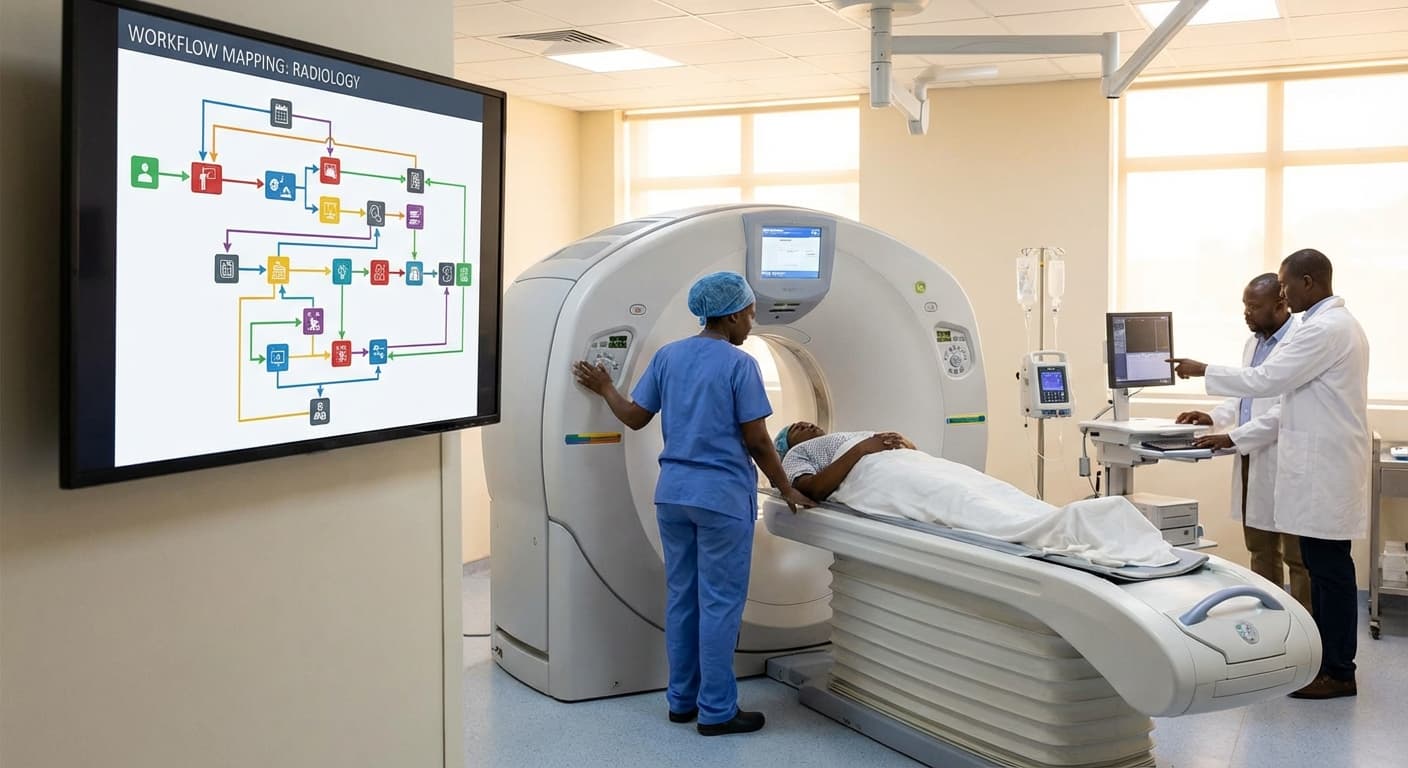
Department Workflow Mapping Service (Radiology/ICU/OT/Lab/Dialysis) in Benin
Engineering Excellence & Technical Support
Department Workflow Mapping Service (Radiology/ICU/OT/Lab/Dialysis) High-standard technical execution following OEM protocols and local regulatory frameworks.
Optimized Patient Flow in Radiology
Visualize and streamline the entire patient journey within the Radiology department, from appointment scheduling and imaging requests to report generation and follow-up. Identify bottlenecks and implement data-driven improvements for reduced wait times and enhanced throughput.
Critical Care Pathway Mapping in ICU
Map the complex and time-sensitive workflows within the Intensive Care Unit, including patient admission, monitoring, intervention protocols, and inter-departmental transfers. Ensure seamless coordination of care and rapid response to critical events.
Laboratory Sample Management & Turnaround Time
Detailed mapping of laboratory sample lifecycle, from collection and accessioning to testing, quality control, and result delivery. Identify opportunities to reduce turnaround times and minimize errors in diagnostic processes.
What Is Department Workflow Mapping Service (Radiology/icu/ot/lab/dialysis) In Benin?
Department Workflow Mapping Service (Radiology/ICU/OT/Lab/Dialysis) in Benin refers to the systematic analysis, documentation, and optimization of the operational processes within specialized healthcare departments. This service aims to identify bottlenecks, inefficiencies, and areas for improvement in patient flow, resource allocation, information management, and task execution specific to departments such as Radiology, Intensive Care Units (ICU), Operating Theatres (OT), Laboratories, and Dialysis Centers within healthcare facilities in Benin. The objective is to enhance service delivery, improve patient outcomes, reduce operational costs, and ensure compliance with established standards and regulations.
| Department | Who Needs This Service | Typical Use Cases |
|---|---|---|
| Radiology | Radiology departments, hospital administrators, medical imaging equipment vendors, regulatory bodies. | Optimizing patient scheduling for imaging modalities (X-ray, CT, MRI), improving report turnaround times, enhancing PACS integration, reducing radiation exposure protocols, streamlining contrast media management, and assessing new imaging technology implementation. |
| ICU | ICU management, hospital administrators, critical care physicians, nursing staff, quality improvement teams. | Improving patient handoff procedures between shifts, optimizing nurse-to-patient ratios based on acuity, streamlining medication administration workflows, enhancing communication protocols among the multidisciplinary team, managing equipment availability and maintenance, and reducing infection control risks. |
| Operating Theatre (OT) | Surgical department heads, hospital administrators, operating room nurses, anesthesiologists, surgical technicians, sterilization staff. | Optimizing surgical case scheduling, reducing operating room turnover times, improving instrument and equipment management, standardizing surgical checklists, enhancing sterile processing workflows, and analyzing surgical team coordination. |
| Laboratory | Laboratory directors, hospital administrators, phlebotomists, medical technologists, pathologists, quality control officers. | Streamlining sample collection and transport, improving test processing times, optimizing instrument utilization and maintenance, implementing laboratory information systems (LIS), enhancing quality control procedures, and managing reagent inventory. |
| Dialysis | Nephrology departments, dialysis center managers, hospital administrators, dialysis nurses, biomedical engineers. | Optimizing patient scheduling for dialysis sessions, improving access and egress for patients, standardizing dialysis machine setup and disinfection protocols, enhancing medication management for dialysis patients, managing water treatment systems, and ensuring compliance with infection control for hemodialysis. |
Key Components of Department Workflow Mapping Service:
- Process Identification and Documentation: Detailed mapping of all activities, from patient admission/request to service completion and reporting, including interdependencies and decision points.
- Stakeholder Analysis: Engagement with clinicians, technicians, administrative staff, and management to gather insights and validate process maps.
- Data Collection and Analysis: Quantifying process times, resource utilization, error rates, and patient wait times.
- Bottleneck Identification: Pinpointing areas where delays, inefficiencies, or resource constraints impede optimal workflow.
- Best Practice Integration: Benchmarking against national and international standards and adopting evidence-based methodologies.
- Technology Integration Assessment: Evaluating the current and potential role of information systems (e.g., PACS, LIS, HIS) in workflow efficiency.
- Re-engineering and Optimization: Designing and implementing improved workflows, standard operating procedures (SOPs), and training programs.
- Performance Monitoring and Control: Establishing metrics and systems for ongoing tracking and evaluation of workflow performance.
Who Needs Department Workflow Mapping Service (Radiology/icu/ot/lab/dialysis) In Benin?
In Benin, optimizing the efficiency and effectiveness of critical hospital departments is paramount to delivering high-quality patient care. Department Workflow Mapping Services are essential for radiology, intensive care units (ICUs), operating theaters (OTs), laboratories, and dialysis centers. These services provide a comprehensive visual representation of existing processes, identifying bottlenecks, redundancies, and areas for improvement. By streamlining workflows, these departments can reduce wait times, minimize errors, enhance resource utilization, and ultimately improve patient outcomes and staff satisfaction.
| Target Customer Segment | Key Departments Benefiting | Primary Needs Addressed |
|---|---|---|
| Public Hospitals (e.g., National Hospitals, Regional Hospitals) | Radiology, ICU, OT, Lab, Dialysis | Improving patient throughput, reducing operational costs, enhancing service delivery to a large patient population, meeting national healthcare standards. |
| Private Hospitals and Clinics | Radiology, ICU, OT, Lab, Dialysis | Gaining a competitive edge through enhanced efficiency and patient experience, attracting more patients, optimizing resource allocation, ensuring compliance with international best practices. |
| Specialized Medical Centers (e.g., Diagnostic Centers, Cardiac Centers) | Radiology, Lab, ICU (if applicable), OT (if applicable) | Streamlining specialized diagnostic and treatment pathways, improving accuracy and speed of results, enhancing patient safety in critical procedures. |
| Medical Research Institutions (with clinical components) | Lab, Radiology, ICU | Ensuring efficient data collection and processing for research, standardizing clinical protocols for research studies, facilitating collaboration between research and clinical teams. |
| Government Health Ministries and Agencies | All mentioned departments (through oversight of public facilities) | Developing and implementing national healthcare efficiency strategies, monitoring performance of public health institutions, identifying areas for investment and policy reform. |
Who Needs Department Workflow Mapping Service in Benin?
- Hospitals and healthcare facilities in Benin seeking to improve operational efficiency.
- Radiology departments aiming to optimize patient flow, imaging scheduling, and report turnaround times.
- ICUs looking to enhance patient monitoring, staff communication, and response protocols.
- Operating theaters striving to improve surgical scheduling, instrument sterilization, and post-operative care coordination.
- Laboratories focused on streamlining specimen handling, testing processes, and results delivery.
- Dialysis centers aiming to optimize patient scheduling, treatment protocols, and equipment maintenance.
Department Workflow Mapping Service (Radiology/icu/ot/lab/dialysis) Process In Benin
This document outlines the standard workflow for the Department Workflow Mapping Service (DWMS) for various departments (Radiology, ICU, OT, Lab, Dialysis) within healthcare facilities in Benin. The service aims to analyze, document, and optimize operational processes to improve efficiency, patient care, and resource utilization.
| Stage | Description | Key Activities | Responsible Parties | Deliverables | Typical Timeline |
|---|---|---|---|---|---|
| Inquiry and Initial Contact | The process begins when a healthcare facility in Benin expresses interest in the Department Workflow Mapping Service. | Contacting the DWMS provider, initial discussions about service offerings. | Healthcare Facility Management/Department Head, DWMS Provider Sales/Consultant | Initial understanding of service, availability of information. | 1-3 Business Days |
| Needs Assessment and Scoping | Understanding the specific needs, challenges, and goals of the requesting department. | On-site or remote meetings, interviews with key personnel, review of existing documentation, site visit (if applicable). | DWMS Consultant, Department Head, Key Staff (nurses, technicians, doctors, administrators). | Clearly defined project scope, objectives, and desired outcomes. | 1-2 Weeks |
| Proposal Development and Agreement | A tailored proposal outlining the scope of work, methodology, timeline, deliverables, and cost is prepared. | Drafting proposal, presenting to the facility, negotiation, contract signing. | DWMS Provider, Healthcare Facility Management. | Formal Proposal, Signed Contract/Memorandum of Understanding (MOU). | 1-2 Weeks |
| Data Collection and Analysis | Gathering detailed information about the current operational processes within the target department. | Observation of daily operations, interviews with staff at all levels, review of patient flow, equipment usage, documentation, IT systems, and resource allocation. | DWMS Consultant Team, Department Staff. | Raw data (observations, interview notes, documentation), preliminary insights. | 2-4 Weeks |
| Workflow Mapping and Documentation | Visually representing the current state of workflows using standardized notation and documentation. | Creating flowcharts, process maps, swimlane diagrams, defining roles and responsibilities, documenting decision points and handoffs. | DWMS Analyst/Consultant. | Current State Workflow Maps, Detailed Process Documentation. | 2-3 Weeks |
| Gap Analysis and Recommendation Development | Identifying inefficiencies, bottlenecks, redundancies, and areas for improvement within the mapped workflows. | Analyzing current state maps against best practices and organizational goals, brainstorming potential solutions, identifying risks and benefits of proposed changes. | DWMS Consultant Team, potentially involving subject matter experts. | List of identified gaps, proposed solutions, potential impact assessments. | 1-2 Weeks |
| Validation and Feedback Session | Presenting the findings, recommendations, and proposed future state workflows to stakeholders for review and input. | Facilitating workshops, presentations, soliciting feedback, addressing concerns. | DWMS Consultant Team, Department Staff, Facility Management. | Validated workflow maps, refined recommendations, stakeholder buy-in. | 1 Week |
| Final Report and Implementation Plan | Compiling all findings, recommendations, and actionable steps into a comprehensive report. | Writing the final report, developing a phased implementation plan with timelines, responsibilities, and key performance indicators (KPIs). | DWMS Consultant Team. | Final Report, Detailed Implementation Plan. | 1-2 Weeks |
| Monitoring and Evaluation (Optional) | Providing support to ensure successful implementation and measure the impact of the changes. | Post-implementation reviews, data collection on KPIs, providing further recommendations or adjustments. | DWMS Consultant Team, Department Staff, Facility Management. | Performance reports, impact assessments, revised recommendations. | Ongoing (as per agreement) |
Service Workflow Stages
- Inquiry and Initial Contact
- Needs Assessment and Scoping
- Proposal Development and Agreement
- Data Collection and Analysis
- Workflow Mapping and Documentation
- Gap Analysis and Recommendation Development
- Validation and Feedback Session
- Final Report and Implementation Plan
- Monitoring and Evaluation (Optional)
Department Workflow Mapping Service (Radiology/icu/ot/lab/dialysis) Cost In Benin
The cost of Department Workflow Mapping Services in Benin, specifically for departments such as Radiology, Intensive Care Unit (ICU), Operating Theatre (OT), Laboratory, and Dialysis, is not a standardized or widely published figure. Several dynamic factors influence the final pricing, making it highly project-specific. These services involve a deep dive into existing processes, identification of inefficiencies, and the design of optimized workflows, requiring expert analysis and significant effort.
| Department Type | Estimated Cost Range (XOF) | Notes |
|---|---|---|
| Radiology | 1,500,000 - 4,000,000 | Complexity of imaging modalities, patient scheduling, and reporting processes. |
| ICU | 2,000,000 - 5,500,000 | High patient acuity, critical care protocols, multidisciplinary team coordination, and advanced monitoring systems. |
| OT (Operating Theatre) | 1,800,000 - 5,000,000 | Surgical scheduling, instrument sterilization, surgical team collaboration, and post-operative care pathways. |
| Laboratory | 1,200,000 - 3,500,000 | Sample handling, testing procedures, quality control, and result reporting, including specialized testing. |
| Dialysis | 1,000,000 - 3,000,000 | Patient scheduling, treatment protocols, machine maintenance, and infection control. |
Key Factors Influencing Department Workflow Mapping Costs in Benin
- Department Size and Complexity: Larger departments with more intricate processes, diverse staff roles, and a higher volume of patient interactions will naturally require more extensive mapping and analysis.
- Number of Stakeholders Involved: The more individuals and teams that need to be consulted and interviewed (doctors, nurses, technicians, administrators, etc.), the more time and resources are allocated to the project.
- Scope of the Mapping Project: A comprehensive workflow mapping that includes all aspects from patient entry to discharge, including IT systems integration, will be more costly than a project focused on a specific bottleneck.
- Current State of Documentation: If existing workflows are poorly documented or non-existent, the consultants will need to spend more time observing, interviewing, and deducing current processes.
- Desired Future State Complexity: Designing and documenting an 'ideal' future workflow that incorporates new technologies, stringent quality control measures, or advanced patient care protocols will be more involved and thus more expensive.
- Consultant Expertise and Experience: The reputation, specialized knowledge, and years of experience of the consulting firm or individual will directly impact their rates. Highly sought-after experts command higher fees.
- Project Timeline and Urgency: Expedited projects with tight deadlines may incur additional charges due to the need for increased resource allocation and potential overtime.
- Geographic Location within Benin: While less of a primary driver, travel and accommodation costs for consultants if they need to be physically present at multiple sites within Benin can add to the overall expense.
- Reporting and Deliverable Requirements: The level of detail, format of reports, and the number of revisions required for the final deliverables will influence the consulting hours.
- Inclusion of Training and Implementation Support: If the service extends beyond mapping to include training staff on new workflows or providing initial implementation support, the cost will increase significantly.
Affordable Department Workflow Mapping Service (Radiology/icu/ot/lab/dialysis) Options
Our Affordable Department Workflow Mapping Service is designed to optimize operations across critical hospital departments including Radiology, ICU, Operating Theatre (OT), Laboratory, and Dialysis. By meticulously analyzing and documenting your current workflows, we identify inefficiencies, bottlenecks, and areas for improvement. This leads to enhanced patient care, reduced costs, and improved staff satisfaction. We offer flexible value bundles and implement strategic cost-saving measures tailored to your department's unique needs.
| Department | Typical Workflow Mapping Focus Areas | Potential Cost-Saving Strategies | Value Bundle Example |
|---|---|---|---|
| Radiology | Patient scheduling and registration, imaging acquisition, image processing and interpretation, reporting turnaround time, equipment utilization, PACS integration. | Optimized scheduling to reduce idle equipment time, standardized reporting templates, improved image transfer and archival processes, reduced re-takes due to standardized protocols. | Radiology Productivity Booster: Workflow mapping + Lean Optimization + Reporting Turnaround Time Reduction. |
| ICU | Patient admission and transfer, patient monitoring and data management, medication administration, communication protocols (physician-rounds, nurse handoffs), equipment utilization and maintenance. | Streamlined admission/transfer checklists, improved electronic monitoring data integration, optimized nurse-to-patient ratios based on workflow analysis, reduced alarm fatigue through intelligent alert systems. | ICU Efficiency Suite: Workflow mapping + Digital Integration + Communication Protocol Enhancement. |
| Operating Theatre (OT) | Surgical scheduling, patient preparation and positioning, instrument and equipment management, surgical team communication, sterile processing workflows, post-operative handoff. | Optimized surgical scheduling to minimize downtime between cases, standardized instrument trays, improved inventory management for surgical supplies, reduced sterile processing turnaround time. | OT Throughput Accelerator: Workflow mapping + Patient Throughput Enhancement + Sterile Processing Optimization. |
| Laboratory | Sample collection and accessioning, testing procedures and turnaround times, quality control processes, result reporting and distribution, instrument calibration and maintenance. | Automated sample tracking and labeling, optimized specimen transport, standardized testing protocols to reduce variability, efficient result reporting via EMR integration, reduced manual data entry. | Lab Precision Package: Workflow mapping + Lean Optimization + Result Reporting Automation. |
| Dialysis | Patient scheduling and preparation, dialysis treatment process, equipment setup and cleaning, medication administration during treatment, patient monitoring, staff allocation. | Optimized patient scheduling to maximize chair utilization, standardized treatment protocols, efficient cleaning and disinfection cycles, streamlined staff assignments based on patient needs, reduced supply waste. | Dialysis Flow Master: Workflow mapping + Patient Throughput Enhancement + Staff Allocation Optimization. |
Value Bundles & Cost-Saving Strategies
- Lean Workflow Optimization: Focuses on identifying and eliminating waste (e.g., redundant steps, unnecessary waiting times, excess inventory) within your departmental processes.
- Digital Transformation Integration: Seamlessly incorporates technology solutions (e.g., EMR integration, automated reporting, digital imaging) to streamline workflows and improve data accuracy.
- Patient Throughput Enhancement: Analyzes and redesigns processes to expedite patient movement through the department, reducing wait times and improving resource utilization.
- Interdepartmental Synergy: Maps workflows between departments to identify and resolve communication gaps and handoff issues, ensuring smoother patient transitions.
- Staff Training & Empowerment: Develops clear, visual workflow documentation for training purposes and empowers staff to contribute to continuous improvement initiatives.
Verified Providers In Benin
Ensuring access to quality healthcare is paramount, and in Benin, this means identifying and trusting Verified Providers. Among these, Franance Health stands out as a premier choice due to its unwavering commitment to excellence, patient-centric approach, and comprehensive credentialing. This document outlines the key aspects of Franance Health's credentials and elucidates why they represent the best choice for your healthcare needs in Benin.
| Credential Category | Franance Health's Commitment & Evidence |
|---|---|
| Professional Licensure & Certification | All practitioners hold valid, unencumbered licenses from the Ministry of Health and relevant professional bodies. Certificates of specialization from accredited institutions are verified. |
| Educational Background | Verification of degrees and diplomas from recognized universities and medical schools, both national and international. |
| Clinical Experience | Thorough review of previous work history, including verifiable references and documented practice periods. |
| Continuing Medical Education (CME) | Mandatory participation in ongoing training and educational programs to stay abreast of the latest medical advancements and techniques. |
| Ethical Conduct & Professionalism | Adherence to a strict code of ethics. Background checks and reference verification to ensure a high standard of integrity. |
| Specialty Expertise | Verification of specific certifications and training for specialists in fields such as cardiology, pediatrics, surgery, and more. |
Why Franance Health is the Best Choice for Verified Providers in Benin
- Rigorous Credentialing Process: Franance Health adheres to stringent vetting procedures for all its healthcare professionals, ensuring they meet the highest standards of expertise and ethical conduct.
- Highly Qualified Medical Staff: Their network comprises doctors, nurses, and specialists with extensive experience, advanced training, and recognized qualifications from reputable institutions.
- Commitment to Patient Safety and Quality: Franance Health prioritizes patient well-being through continuous quality improvement initiatives, adherence to international best practices, and a focus on patient feedback.
- Comprehensive Service Offerings: From general medicine to specialized treatments, Franance Health provides a wide spectrum of medical services, catering to diverse healthcare requirements.
- Patient-Centric Approach: They are dedicated to delivering compassionate, personalized care, fostering strong patient-provider relationships, and ensuring clear communication throughout the treatment journey.
- Technological Integration: Leveraging modern medical technologies and digital health solutions, Franance Health enhances diagnostic accuracy, treatment efficiency, and patient accessibility.
Scope Of Work For Department Workflow Mapping Service (Radiology/icu/ot/lab/dialysis)
This Scope of Work (SOW) outlines the services to be provided for a comprehensive workflow mapping initiative across key hospital departments: Radiology, Intensive Care Unit (ICU), Operating Theatre (OT), Laboratory (Lab), and Dialysis. The primary objective is to systematically document, analyze, and optimize existing operational workflows within these departments. This will involve identifying bottlenecks, inefficiencies, areas for improvement, and opportunities for standardization and technology integration. The services will include data gathering, process mapping, analysis, and the delivery of detailed technical documentation and recommendations. Standard specifications will be adhered to for all deliverables to ensure consistency, clarity, and usability.
| Technical Deliverable | Description | Standard Specifications | Department Applicability |
|---|---|---|---|
| Current State Workflow Maps | Detailed visual representations of existing processes, including all steps, decision points, roles, and systems involved. | Utilize standard BPMN (Business Process Model and Notation) 2.0 or equivalent visual modeling tools. Maps should be clear, concise, and easily understandable. Include input/output of each process. Version control and naming conventions to be established. | Radiology, ICU, OT, Lab, Dialysis |
| Process Narratives & Descriptions | Textual documentation that complements the workflow maps, providing detailed explanations of each process, its purpose, and key operational aspects. | Clear, concise language. Logical flow and organization. Include purpose, scope, responsible parties, inputs, outputs, and key performance indicators (KPIs) for each process. Standard template to be provided. | Radiology, ICU, OT, Lab, Dialysis |
| Bottleneck & Inefficiency Analysis Report | A comprehensive report detailing identified bottlenecks, redundancies, and inefficiencies within the current workflows, supported by data and observations. | Quantifiable data where possible (e.g., wait times, error rates). Categorization of inefficiencies (e.g., time, resources, communication). Root cause analysis where feasible. Executive summary and detailed findings. | Radiology, ICU, OT, Lab, Dialysis |
| Future State Workflow Recommendations | Proposed optimized workflow diagrams and descriptions, outlining the ideal state after implementing recommended improvements. | Same notation standards as Current State Maps. Clearly highlight changes and improvements. Include rationale for proposed changes. Address stakeholder feedback. | Radiology, ICU, OT, Lab, Dialysis |
| Technology Integration Opportunities Report | Identification of potential areas where technology can enhance efficiency, accuracy, and patient safety, including specific system recommendations. | Focus on interoperability, data standardization, and user experience. Prioritize recommendations based on impact and feasibility. Include a high-level cost-benefit consideration for significant recommendations. | Radiology, ICU, OT, Lab, Dialysis |
| Standard Operating Procedures (SOPs) Drafts | Draft SOPs for key optimized processes, ensuring standardization and consistent execution of tasks across departments. | Adherence to hospital's existing SOP template and formatting guidelines. Clear, actionable steps. Include responsibilities, scope, and review mechanisms. | Radiology, ICU, OT, Lab, Dialysis |
| Stakeholder Workshop Summaries | Documentation of insights, feedback, and decisions made during stakeholder engagement sessions. | Record of attendees, key discussion points, decisions, and action items. Objective and impartial reporting. Distributed promptly after each workshop. | Radiology, ICU, OT, Lab, Dialysis |
| Final Project Report & Presentation | A consolidated report summarizing all findings, recommendations, and delivered artifacts. Accompanying presentation for key stakeholders. | Executive summary, detailed findings, implemented recommendations, future considerations. Clear and impactful presentation slides. Address the project's overall success and lessons learned. | Radiology, ICU, OT, Lab, Dialysis |
Key Objectives of Workflow Mapping Service
- To accurately document current state workflows for each specified department.
- To identify critical pain points, redundancies, and inefficiencies within existing processes.
- To propose optimized future state workflows that enhance efficiency, safety, and patient care.
- To identify opportunities for technology adoption, automation, and system integration.
- To establish standardized procedures and best practices for improved operational consistency.
- To provide a foundational understanding for subsequent process improvement initiatives and system implementations.
Service Level Agreement For Department Workflow Mapping Service (Radiology/icu/ot/lab/dialysis)
This Service Level Agreement (SLA) outlines the performance standards for the Department Workflow Mapping Service (DWMS), specifically for the Radiology, Intensive Care Unit (ICU), Operating Theater (OT), Laboratory, and Dialysis departments. The DWMS aims to optimize patient care pathways and operational efficiency through detailed process analysis and documentation.
| Service Component | Response Time Target | Uptime Guarantee | Description |
|---|---|---|---|
| Initial Consultation and Requirements Gathering | Within 2 business days of request receipt | N/A (Service request-based) | Scheduling and conducting initial meetings to understand departmental needs and scope of mapping. |
| Data Collection and Analysis (On-site/Remote) | Within 5 business days of agreed-upon start date | N/A (Service request-based) | Gathering information through observation, interviews, and document review. |
| Draft Workflow Documentation Delivery | Within 10 business days of data collection completion | N/A (Service request-based) | Providing initial drafts of current-state workflow maps and preliminary findings. |
| Feedback Incorporation and Revision | Within 5 business days of receiving feedback on draft documentation | N/A (Service request-based) | Updating workflow maps and recommendations based on departmental input. |
| Final Workflow Mapping Report Delivery | Within 5 business days of final feedback approval | N/A (Service request-based) | Delivering the comprehensive final report including current-state, proposed future-state, and recommendations. |
| Post-Implementation Support (Consultation) | Within 3 business days for urgent queries, 5 business days for non-urgent queries | N/A (Service request-based) | Providing ongoing consultation for implementation of recommendations. |
| DWMS Portal/Platform Availability (if applicable) | N/A | 99.5% (excluding scheduled maintenance) | Ensuring the availability of any associated digital platforms used for collaboration and documentation sharing. |
| Scheduled Maintenance Window | N/A | To be communicated at least 48 hours in advance | Regular maintenance to ensure optimal performance of DWMS tools and systems. |
Service Scope and Objectives
- The DWMS provides comprehensive mapping of existing workflows within designated departments.
- Objectives include identification of bottlenecks, inefficiencies, and areas for improvement.
- Deliverables include documented current-state workflows, proposed future-state workflows, and actionable recommendations.
- The service is applicable to Radiology, ICU, OT, Laboratory, and Dialysis departments.
Frequently Asked Questions

Ready when you are
Let's scope your Department Workflow Mapping Service (Radiology/ICU/OT/Lab/Dialysis) in Benin project in Benin.

Scaling healthcare logistics and technical systems across the entire continent.