
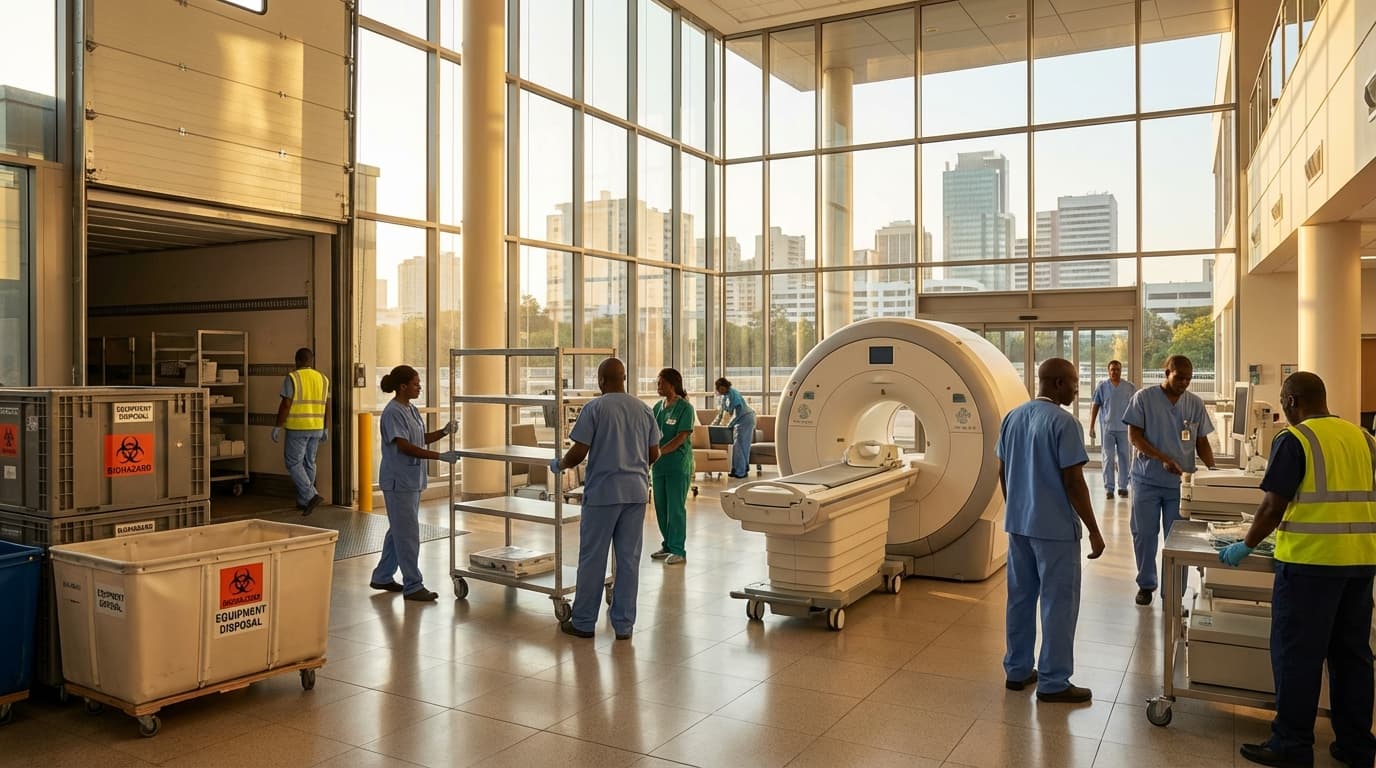
Heavy Medical Equipment De-Installation Service (MRI/CT/Cath Lab) in Angola
Engineering Excellence & Technical Support
Heavy Medical Equipment De-Installation Service (MRI/CT/Cath Lab) High-standard technical execution following OEM protocols and local regulatory frameworks.
Precision De-Installation for Sensitive Imaging
Our specialized technicians utilize advanced, non-invasive techniques to meticulously de-install complex medical imaging equipment such as MRI, CT, and Cath Labs in Angola. We ensure component integrity and adherence to manufacturer specifications, guaranteeing a safe and efficient process for relocation or disposal.
Regulatory Compliance & Safety Assurance
We are fully compliant with Angolan health and safety regulations for medical equipment handling. Our team employs rigorous safety protocols and provides comprehensive documentation for all de-installation projects, ensuring full accountability and minimizing risks for our clients and the environment.
Logistics Mastery for High-Value Assets
Beyond de-installation, we offer seamless logistical solutions for heavy medical equipment in Angola. From specialized packaging to secure transportation coordination, we manage the entire process, ensuring your high-value assets reach their next destination intact and on schedule.
What Is Heavy Medical Equipment De-installation Service (Mri/ct/cath Lab) In Angola?
Heavy Medical Equipment De-Installation Service (MRI/CT/Cath Lab) in Angola refers to the specialized process of safely and systematically dismantling, packaging, and preparing large-scale, high-value medical imaging and interventional systems such as Magnetic Resonance Imaging (MRI) scanners, Computed Tomography (CT) scanners, and Cardiac Catheterization (Cath) Laboratories for relocation, storage, or disposal within or from Angola. This service requires highly skilled technicians with expertise in electrical, mechanical, and magnetic fields, along with adherence to stringent safety protocols and regulatory compliance specific to medical equipment and the Angolan context.
| Who Needs This Service? | Typical Use Cases | |||
|---|---|---|---|---|
| Hospitals and Healthcare Facilities: Undergoing facility upgrades, renovations, or relocation of imaging departments. | Medical Equipment Vendors/Distributors: Facilitating the relocation of equipment between different customer sites or for refurbishment/servicing purposes. | Asset Management Companies: Managing the lifecycle of medical equipment, including decommissioning and relocation. | Government Health Ministries/Agencies: Overseeing the transfer or decommissioning of public healthcare infrastructure. | Research Institutions: Relocating advanced imaging systems for new research projects or facility changes. |
| Facility Relocation/Expansion: Moving existing MRI, CT, or Cath Lab suites to a new wing or a different hospital. | Equipment Upgrade or Replacement: De-installing older generation systems to make way for newer, more advanced models. | Temporary Shutdown for Major Maintenance: Removing equipment to facilitate extensive repairs or infrastructure upgrades within the facility. | Asset Liquidation/Sale: De-installing equipment for sale on the secondary market or for disposal. | Emergency Facility Closure: Safely decommissioning and removing sensitive equipment from a facility ceasing operations. |
Key Aspects of Heavy Medical Equipment De-Installation:
- Site Assessment and Planning: Thorough evaluation of the equipment's physical location, structural limitations, access routes, and power/cooling infrastructure. Development of a detailed de-installation plan, including safety procedures, timelines, and resource allocation.
- System Shutdown and Safing: Controlled power-down procedures, discharge of stored energy (e.g., cryogens in MRI, high-voltage capacitors in CT), and neutralization of magnetic fields to ensure personnel safety.
- Component Disassembly: Systematic deconstruction of the equipment into transportable modules. This involves precision dismantling of complex subsystems, including RF coils, gradient coils, X-ray tubes, detector arrays, patient tables, gantry components, and console units.
- Cryogen Management (MRI): For superconducting MRI magnets, specialized handling of liquid helium and nitrogen, including venting, warming, and potential for re-liquefaction or safe disposal/transport of cryogens.
- Shielding and Containment: Removal or mitigation of radiation shielding (in CT/Cath Lab) and magnetic shielding (in MRI) as required for safe disassembly and transport.
- Packaging and Crating: Use of custom-designed, shock-absorbent packaging and robust crating to protect sensitive components during transit. This often involves specialized materials and techniques to prevent damage from vibration, impact, and environmental factors.
- Logistics and Transportation Planning: Coordination with specialized heavy-haul transportation providers, ensuring compliance with Angolan road regulations and permits for oversized or overweight equipment.
- Documentation and Certification: Meticulous record-keeping of the entire de-installation process, including serial numbers, component lists, photographic evidence, and certification of compliance with safety standards.
- Environmental and Regulatory Compliance: Adherence to Angolan environmental regulations for waste disposal (e.g., refrigerants, oils) and specific medical equipment handling mandates.
Who Needs Heavy Medical Equipment De-installation Service (Mri/ct/cath Lab) In Angola?
De-installation of heavy medical equipment such as MRI scanners, CT scanners, and Cath Labs is a highly specialized and critical process. This service is essential when facilities in Angola are undergoing renovation, relocation, upgrades, or decommissioning of existing imaging and interventional suites. It requires a meticulous approach to ensure safety, prevent damage to valuable machinery, and comply with regulatory standards. The process involves expert technicians, specialized tools, and a deep understanding of the complex engineering and electrical systems within these advanced medical devices. This service is not a routine maintenance task but a project-based undertaking crucial for the smooth transition of advanced healthcare infrastructure in Angola.
| Target Customer Type | Primary Departments Involved | Reasons for De-Installation |
|---|---|---|
| Public Hospitals | Radiology Department, Cardiology Department, Engineering/Facilities Management, Procurement | Renovations, Equipment Upgrades, Relocation of Services, Facility Closure |
| Private Hospitals & Diagnostic Centers | Imaging Department, Interventional Suite, Facilities Management, IT Department, Administration | Facility Expansion, Technology Upgrades, Relocation of Services, Lease Expirations, Equipment Decommissioning |
| Specialty Imaging Centers | Radiology Department, Technical Operations, Facilities Management | Service Line Consolidation, Equipment Replacement, Relocation to Larger Premises |
| Research Institutions | Medical Research Labs, Imaging Core Facilities, Technical Support | Project Completion, Equipment Obsolescence, Transition to New Research Projects |
| Government Health Ministries/Agencies | Infrastructure Planning, Public Health Projects, Procurement Departments | National Health System Modernization, Establishing New Healthcare Facilities, Decommissioning of Old Government Facilities |
| Medical Equipment Installers/Dealers | Service Department, Logistics, Sales | Handling Trade-Ins, Preparing Equipment for Resale/Refurbishment, Managing Client Relocations |
Target Customers and Departments for Heavy Medical Equipment De-Installation Service in Angola
- Hospitals (Public and Private)
- Specialty Imaging Centers
- Diagnostic Clinics
- Research Institutions
- Government Health Ministries/Agencies (for public health infrastructure projects)
- Medical Equipment Installers/Dealers (for asset recovery or relocation)
Heavy Medical Equipment De-installation Service (Mri/ct/cath Lab) Process In Angola
This document outlines the detailed workflow for the Heavy Medical Equipment De-Installation Service (MRI/CT/Cath Lab) in Angola, from the initial inquiry to the successful completion of the de-installation. Our service ensures a meticulous and compliant process, minimizing disruption and maximizing the safety and integrity of high-value medical imaging and interventional equipment. We understand the unique logistical and regulatory landscape of Angola and tailor our approach accordingly.
| Stage | Description | Key Activities | Deliverables/Outcomes | Responsibility (Primary) | Timeline (Estimated) |
|---|---|---|---|---|---|
| The client contacts our company with a request for de-installation services for MRI, CT, or Cath Lab equipment in Angola. | Receive and acknowledge inquiry, understand client's immediate needs, discuss project scope, identify equipment type and location. | Initial understanding of project requirements, confirmation of service availability. | Client, Service Provider Sales/Operations | 1-2 Business Days |
| A comprehensive on-site assessment is conducted at the client's facility in Angola. | Detailed inspection of the equipment, access routes, power requirements, structural considerations, surrounding infrastructure, local regulations review, risk assessment. | Detailed site survey report, identification of potential challenges, preliminary planning input. | Service Provider Technical Lead, Project Manager | 3-7 Business Days (depending on complexity and travel) |
| Based on the site survey and client requirements, a detailed proposal and quotation are prepared. | Outline of services, scope of work, methodology, timeline, cost breakdown, terms and conditions, safety protocols. | Formal proposal document, itemized quotation, proposed schedule. | Service Provider Project Manager, Sales Team | 2-5 Business Days (after site survey) |
| Upon acceptance of the proposal, a formal contract is signed, and in-depth project planning commences. | Contract negotiation and signing, detailed project plan development (resource allocation, scheduling, risk mitigation), obtain necessary permits/approvals in Angola, client coordination for site access. | Signed contract, comprehensive project plan, confirmed permits/approvals, agreed-upon schedule. | Client, Service Provider Project Manager | 5-10 Business Days |
| All necessary preparations are made before the physical de-installation begins. | Mobilization of specialized tools and equipment, procurement of consumables, team briefing, safety induction for on-site personnel, confirmation of power disconnection procedures, quarantine/isolation of the equipment area. | Ready-to-deploy team and equipment, confirmed safety measures, secured work area. | Service Provider Project Manager, Technical Team | 2-5 Business Days (prior to de-installation date) |
| The core de-installation process is executed by our skilled technicians. | Systematic disconnection of power and data cables, disassembly of components according to manufacturer guidelines, careful handling and securing of all parts, compliance with safety and environmental regulations. | De-installed equipment components, safely disassembled and ready for packaging. | Service Provider Technical Team, Site Supervisor | Variable (depends on equipment type and complexity, e.g., 3-10 Days) |
| All de-installed components are meticulously packaged for safe transport. | Use of specialized anti-static materials, custom-built crates, protective wrapping, labeling of all packages with clear identification and handling instructions. | Securely packaged and crated equipment components, ready for transit. | Service Provider Logistics Team, Technical Team | 1-3 Business Days (concurrent with de-installation or immediately after) |
| The packaged equipment is transported from the de-installation site to its next destination within Angola. | Coordination of specialized transport vehicles, route planning, customs clearance (if applicable for internal transfers), secure loading and unloading, real-time tracking (where feasible). | Equipment safely transported to the designated destination. | Service Provider Logistics Team, Transport Partner | Variable (depends on distance and accessibility) |
| Comprehensive documentation is provided, and the project is formally handed over. | Final de-installation report, inventory of all de-installed and packed items, photographic evidence of the process, waste disposal certificates (if applicable), final sign-off from client. | Complete project documentation package, signed handover confirmation. | Service Provider Project Manager, Client Representative | 1-2 Business Days (after completion of transportation) |
| A follow-up is conducted to ensure client satisfaction and address any further needs. | Client feedback collection, addressing any outstanding queries, providing recommendations for future services. | Client satisfaction, potential for future business. | Service Provider Account Manager, Project Manager | Within 1 Week of Handover |
Workflow Stages
- Inquiry & Initial Consultation
- Site Survey & Assessment
- Proposal & Quotation
- Contract Agreement & Planning
- Pre-De-installation Preparations
- Equipment De-installation
- Packaging & Crating
- Logistics & Transportation (within Angola)
- Documentation & Handover
- Post-Service Follow-up
Heavy Medical Equipment De-installation Service (Mri/ct/cath Lab) Cost In Angola
De-installing heavy medical equipment such as MRI, CT scanners, and Cath Labs in Angola is a specialized and complex process that requires experienced technicians, specific tools, and adherence to strict safety protocols. The cost is not a flat fee and can vary significantly based on several crucial factors. These factors influence the overall pricing and require careful consideration when budgeting for such a service. Angola's economic landscape, logistical challenges, and the need for specialized expertise contribute to the pricing structure.
| Equipment Type | Estimated De-Installation Cost Range (USD) | Estimated De-Installation Cost Range (AOA) | Key Contributing Factors |
|---|---|---|---|
| MRI Scanner | $15,000 - $40,000+ | Approx. 9,000,000 - 24,000,000+ Kz | High magnetic field, large size, complex superconducting magnet, specialized shielding, intricate dismantling. |
| CT Scanner | $10,000 - $30,000+ | Approx. 6,000,000 - 18,000,000+ Kz | Gantry system, X-ray tube, detectors, heavy components, radiation safety considerations. |
| Cath Lab System | $8,000 - $25,000+ | Approx. 4,800,000 - 15,000,000+ Kz | C-arm, imaging system, patient table, power injector, plumbing (if applicable), radiation shielding. |
Key Factors Influencing Heavy Medical Equipment De-Installation Costs in Angola
- Equipment Type and Complexity: Different machines have varying levels of complexity in their construction and de-installation requirements. MRI machines, with their powerful magnetic fields, and CT scanners, with intricate gantry systems, often demand more specialized handling and safety measures than, for instance, certain older Cath Lab components. The sheer size and weight of these units are primary drivers of cost.
- Dismantling and Reassembly Requirements: The scope of work is a major cost determinant. Does the service only involve de-installation, or does it also include packaging, transportation preparation, and potentially reassembly at a new site? More extensive services will naturally incur higher costs.
- Logistical Challenges (Access, Location, Transportation): Angola's infrastructure can present significant logistical hurdles. The ease of access to the equipment's current location within a hospital or clinic, the proximity to major transportation routes, and the availability of suitable heavy-duty transport vehicles are critical. Remote locations or areas with poor road conditions will increase mobilization and transportation costs.
- Specialized Tools and Equipment: De-installing heavy medical equipment often requires very specific tools, cranes, hydraulic jacks, and other specialized lifting and dismantling apparatus. The cost of renting or owning these specialized tools contributes to the overall service fee.
- Technician Expertise and Certification: The de-installation of such sensitive and expensive equipment requires highly skilled and certified technicians with experience in medical imaging and interventional cardiology systems. The availability of such qualified personnel in Angola, and their associated labor rates, will directly impact the pricing.
- Safety and Regulatory Compliance: Adherence to stringent safety regulations during the de-installation process is paramount. This includes managing radiation hazards (for CT and Cath Labs), magnetic field containment (for MRI), and general heavy lifting safety protocols. Compliance often requires specialized training and equipment, adding to the cost.
- Timeframe and Urgency: Projects that require expedited de-installation due to facility closures or urgent relocations may incur premium charges for overtime or weekend work, and for prioritizing resources.
- Site Preparation and Engineering Surveys: In some cases, an initial site survey and preparation might be necessary to ensure a safe and efficient de-installation. This could involve reinforcing floors, ensuring adequate power supply disconnection, or clearing access routes.
- Insurance and Risk Management: Comprehensive insurance coverage for the valuable equipment during the de-installation process is essential and contributes to the overall cost. Managing the inherent risks associated with heavy lifting and complex machinery also influences pricing.
- Geographic Location within Angola: Costs can vary between major cities like Luanda and more remote provinces due to differences in operational costs, labor availability, and transportation expenses.
Affordable Heavy Medical Equipment De-installation Service (Mri/ct/cath Lab) Options
When planning the de-installation of heavy medical equipment like MRI, CT, or Cath Lab systems, cost is a significant consideration. Beyond the basic service fee, understanding value bundles and implementing cost-saving strategies can dramatically impact your overall expenditure. Our affordable de-installation services focus on providing transparent pricing, expert handling, and tailored solutions to meet your budget without compromising safety or efficiency. We offer flexible options to ensure you receive the best value for your investment, from specialized rigging to comprehensive project management.
| Cost-Saving Strategy | Description | Potential Savings |
|---|---|---|
| Advance Planning & Scheduling | Booking de-installation well in advance allows for better resource allocation and potentially lower rates compared to last-minute requests. | Up to 10-15% |
| Bundle Services | Opting for value bundles that include site preparation or logistics coordination can be more cost-effective than hiring multiple separate vendors. | Variable, often 5-10% savings on bundled components |
| Off-Peak Scheduling | Scheduling de-installation during non-peak hours or seasons can sometimes lead to reduced labor costs. | Up to 5-10% |
| Minimize Site Modifications | Careful pre-de-installation assessment to identify and reduce the need for extensive and costly structural changes. | Can vary significantly depending on equipment and facility |
| Clear Communication & Access | Ensuring clear pathways, readily available utility shut-offs, and detailed site information upfront prevents delays and costly rework. | Reduces overtime and inefficient labor usage |
| Equipment Condition Assessment | Providing accurate details about the equipment's condition and any specific challenges beforehand allows for precise quoting and efficient planning. | Prevents unexpected costs due to unforeseen issues |
| Utilize Existing Infrastructure | Where possible, leverage existing doorways, corridors, and elevator access to minimize the need for specialized equipment. | Reduces reliance on expensive rigging |
Key Value Bundles for Heavy Medical Equipment De-Installation
- {"title":"Basic De-Installation","description":"Includes professional dismantling of the core system components, disconnection of utilities, and initial packing for transport. Ideal for straightforward removals where minimal site preparation is required."}
- {"title":"Comprehensive De-Installation & Site Preparation","description":"Combines expert de-installation with essential site preparation services such as minor wall modifications, floor protection, and debris removal. This bundle streamlines the process and reduces the need for additional contractors."}
- {"title":"Full-Service De-Installation & Logistics Coordination","description":"Our premium offering. Encompasses de-installation, site preparation, and full coordination with your chosen transportation and installation partners. We manage the entire process from start to finish, ensuring seamless transition and minimizing your administrative burden."}
- {"title":"Emergency/Rush De-Installation","description":"For time-sensitive projects, this bundle prioritizes rapid deployment of our expert team. While a premium will apply, it ensures your timeline is met with minimal disruption."}
Verified Providers In Angola
In Angola's evolving healthcare landscape, identifying reliable and trustworthy medical providers is paramount. Franance Health has emerged as a leading force, distinguishing itself through a rigorous credentialing process and a steadfast commitment to quality care. This commitment translates into a superior patient experience, making Franance Health-verified providers the optimal choice for individuals seeking dependable medical services in Angola.
| Franance Health Verified Provider Benefit | Description |
|---|---|
| Enhanced Patient Safety | Ensures providers meet stringent safety protocols and have a proven track record of safe patient care. |
| Improved Diagnostic Accuracy | Verifies that providers possess up-to-date knowledge and employ best practices in diagnosis. |
| Effective Treatment Plans | Confirms that providers are skilled in developing and implementing evidence-based treatment strategies. |
| Patient-Centered Approach | Identifies providers who prioritize patient well-being, communication, and shared decision-making. |
| Access to Specialists | Facilitates finding highly qualified specialists within the Franance Health network. |
Why Franance Health Credentials Matter:
- Rigorous Vetting Process: Franance Health employs a comprehensive evaluation of healthcare professionals, examining their educational background, board certifications, clinical experience, and adherence to ethical standards.
- Commitment to Quality: Verification signifies a provider's dedication to maintaining high standards of medical practice, patient safety, and continuous professional development.
- Patient Trust and Confidence: The Franance Health seal provides an immediate assurance of quality, empowering patients to make informed decisions about their healthcare with greater confidence.
- Access to Excellence: By choosing a Franance Health-verified provider, patients gain access to a network of highly qualified and reputable healthcare professionals dedicated to delivering optimal outcomes.
- Upholding Ethical Standards: Franance Health's verification process includes a thorough review of a provider's disciplinary history and commitment to patient privacy and confidentiality.
Scope Of Work For Heavy Medical Equipment De-installation Service (Mri/ct/cath Lab)
This Scope of Work (SOW) outlines the requirements for the professional de-installation of heavy medical imaging equipment, specifically Magnetic Resonance Imaging (MRI), Computed Tomography (CT) scanners, and Cardiac Catheterization (Cath Lab) systems. The service encompasses all necessary technical procedures, safety protocols, and documentation to ensure a successful and compliant de-installation. The goal is to safely disconnect, dismantle (where applicable), prepare for transport, and document the state of the equipment at the de-installation site. This SOW is intended to be used by qualified and experienced medical equipment de-installation service providers.
| Service Description | Details & Requirements | Technical Deliverables | Standard Specifications |
|---|---|---|---|
| Site Assessment and Planning | Pre-de-installation site visit by certified technicians to assess equipment location, access routes, power requirements, and potential hazards. Development of a detailed de-installation plan, including a risk assessment and mitigation strategies. | Site assessment report, de-installation plan, risk assessment document. | Adherence to manufacturer's site preparation guidelines. Compliance with local building codes and safety regulations. Identification of all required tools, equipment, and personnel. |
| Equipment Identification and Verification | Confirmation of the specific equipment to be de-installed (make, model, serial number) against provided documentation. Verification of operational status (if applicable and safe to do so). | Equipment manifest, verification checklist. | Match serial numbers and model numbers with provided purchase orders or asset lists. Documentation of any pre-existing damage. |
| Power Down and Safing Procedures | Systematic and safe shutdown of all power sources, including main power breakers and internal system power supplies. Discharge of residual energy in high-voltage components (e.g., capacitors in CT and Cath Lab systems, cryogen levels in MRI). | Power down log, safing procedure checklist. | Adherence to manufacturer-specific power down sequences. Use of appropriate safety equipment and lockout/tagout procedures. Verification of zero voltage and discharged energy levels. |
| Disconnection of Ancillary Systems | Safe disconnection of all associated peripheral equipment, including but not limited to: control consoles, workstations, patient monitoring systems, X-ray generators (for CT/Cath Lab), cooling systems, RF coils (for MRI), and imaging detectors. | Ancillary system disconnection log. | Proper labeling and securing of all disconnected cables and components. Prevention of damage to connectors and wiring. |
| Component Dismantling (if required) | Controlled dismantling of the main system components into manageable sections for transport, as per manufacturer's recommendations and safety protocols. This may include removal of gantry covers, patient table assemblies, magnet shielding (for MRI), etc. | Dismantling procedure log, labeled component inventory. | Use of manufacturer-approved dismantling procedures. Secure storage of removed components and hardware. Prevention of damage to internal components and sensitive parts. |
| Preparation for Transport | Secure packaging and protection of all de-installed components and accessories to prevent damage during transit. Use of specialized lifting and handling equipment as required. | Packaging and crating documentation, equipment readiness for transport confirmation. | Use of appropriate protective materials (e.g., foam, bubble wrap, custom crates). Secure tie-down points for lifting and transit. Compliance with transportation regulations for heavy equipment. |
| Cryogen Management (MRI Specific) | Safe and controlled venting or transfer of cryogens (e.g., Helium) from the MRI magnet according to manufacturer's specifications and environmental regulations. This may involve specialized equipment and trained personnel. | Cryogen venting/transfer log, environmental compliance documentation. | Strict adherence to manufacturer's procedures for cryogen handling. Compliance with all relevant environmental protection laws. Verification of complete cryogen removal or safe transfer. |
| Documentation and Reporting | Comprehensive documentation of the entire de-installation process, including photographs/videos, logs of all steps performed, equipment condition reports, and a final de-installation certificate. This includes ensuring all manufacturer-specific warranty and service records are updated. | Final de-installation report, photographic/video evidence, de-installation certificate. | Detailed and accurate records of all activities. Clear photographic evidence of equipment condition pre, during, and post de-installation. Completion of all required manufacturer service forms and documentation. |
| Site Restoration (Basic) | Removal of all debris and waste generated during the de-installation process. Basic cleaning of the immediate work area. | Site clean-up confirmation. | Disposal of waste according to environmental regulations. Leave the site in a safe and tidy condition. |
| Safety and Compliance | Strict adherence to all applicable safety regulations (e.g., OSHA, local safety standards), manufacturer guidelines, and facility protocols. Ensuring all personnel involved are properly trained and certified. | Safety compliance checklist, personnel certification records. | Implementation of a robust safety program. Use of appropriate Personal Protective Equipment (PPE). Regular safety briefings. Compliance with manufacturer's Service Manuals and Technical Bulletins. |
Key Objectives
- To safely and efficiently de-install specified medical imaging equipment.
- To ensure all safety regulations and manufacturer guidelines are adhered to.
- To minimize disruption to the healthcare facility's operations.
- To prepare equipment for secure transportation.
- To provide comprehensive documentation of the de-installation process.
Service Level Agreement For Heavy Medical Equipment De-installation Service (Mri/ct/cath Lab)
This Service Level Agreement (SLA) outlines the response times and uptime guarantees for the de-installation of heavy medical equipment, specifically MRI, CT, and Cath Lab systems. This SLA is designed to ensure timely and efficient service, minimizing disruption to operations during the de-installation process.
| Service Type | Response Time (Business Hours) | Uptime Guarantee (during active de-installation) | Notes |
|---|---|---|---|
| MRI De-installation | 24 Hours | N/A (De-installation is inherently a downtime event) | Specific scheduling and site preparation coordination required. Downtime is defined by the project timeline agreed upon. |
| CT Scanner De-installation | 24 Hours | N/A (De-installation is inherently a downtime event) | Specific scheduling and site preparation coordination required. Downtime is defined by the project timeline agreed upon. |
| Cath Lab De-installation | 24 Hours | N/A (De-installation is inherently a downtime event) | Specific scheduling and site preparation coordination required. Downtime is defined by the project timeline agreed upon. |
Key Definitions
- Service Request: A formal request submitted by the Client for the de-installation of specified medical equipment.
- Response Time: The maximum time allowed from the acknowledgment of a Service Request until a qualified technician is dispatched or available to commence work.
- Downtime (for de-installation): The period during which the equipment is being actively de-installed and is unavailable for use or relocation.
- Force Majeure: Events beyond the reasonable control of either party, including but not limited to natural disasters, acts of war, pandemics, or government actions, that may impact service delivery.
- Client: The entity requesting and receiving the de-installation service.
- Provider: The entity performing the de-installation service.
Frequently Asked Questions

Ready when you are
Let's scope your Heavy Medical Equipment De-Installation Service (MRI/CT/Cath Lab) in Angola project in Angola.

Scaling healthcare logistics and technical systems across the entire continent.