
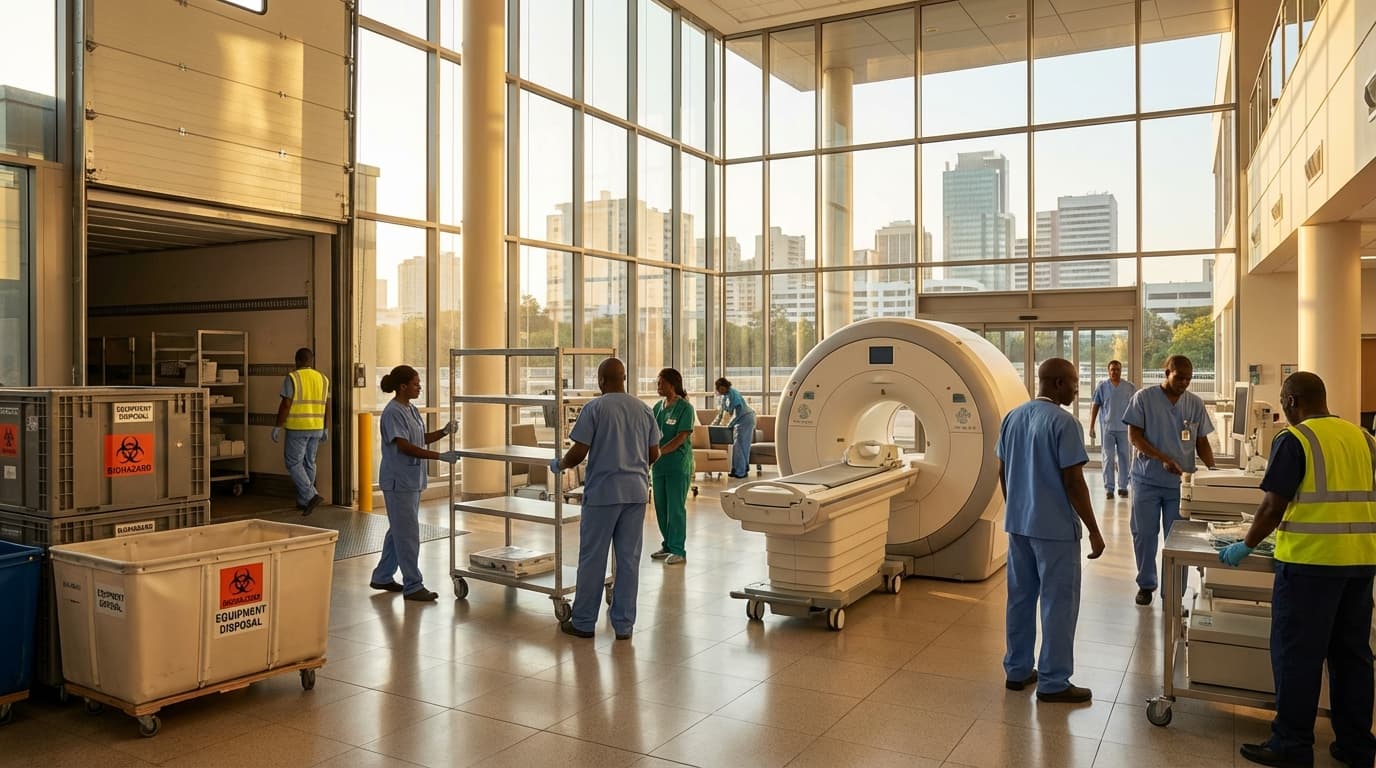
Decommissioning Service for Medical Devices in Angola
Engineering Excellence & Technical Support
Decommissioning Service for Medical Devices High-standard technical execution following OEM protocols and local regulatory frameworks.
Advanced Data Sanitization & Compliance
Our decommissioning service employs industry-leading data sanitization techniques, ensuring complete and irreversible erasure of all sensitive patient and operational data from medical devices. This process adheres to Angolan data protection regulations and international best practices, guaranteeing compliance and safeguarding against privacy breaches during the disposal lifecycle.
Environmentally Conscious & Sustainable Disposal
We prioritize responsible environmental stewardship in all our medical device decommissioning operations in Angola. Our processes include meticulous segregation of reusable components, hazardous materials management, and partnerships with certified recycling facilities. This minimizes landfill waste and promotes the sustainable lifecycle of medical equipment, aligning with global environmental standards.
End-to-End Regulatory Navigation & Documentation
Navigating the complex regulatory landscape for medical device decommissioning in Angola can be challenging. Our expert team provides comprehensive support, from initial asset inventory and risk assessment to obtaining necessary permits and providing detailed, auditable documentation for each decommissioned device. We ensure full compliance with all Angolan health and environmental authorities.
What Is Decommissioning Service For Medical Devices In Angola?
Decommissioning service for medical devices in Angola refers to the systematic and documented process of safely and permanently removing medical devices from service. This encompasses a series of technical procedures, administrative actions, and regulatory compliance measures to ensure that the device is no longer functional, is rendered unidentifiable as a medical device, and its components are disposed of or repurposed in an environmentally sound and secure manner. The overarching objective is to mitigate risks associated with continued use, obsolescence, data security breaches, and environmental contamination.
| Who Needs Decommissioning Services? | Typical Use Cases | ||||||
|---|---|---|---|---|---|---|---|
| Healthcare Facilities: Hospitals (public and private), clinics, diagnostic laboratories, imaging centers, dental practices, and specialized medical centers operating in Angola. | End-of-life obsolescence: Devices that have reached the end of their operational lifespan and are no longer supported by the manufacturer or meet current clinical standards. | Technological upgrades: Replacement of older equipment with newer, more advanced medical technologies. | Facility closure or relocation: Decommissioning of all medical devices when a healthcare facility ceases operations or moves to a new location. | Lease terminations: Returning leased medical equipment at the end of the contractual period. | Device malfunction or damage: Irreparable damage or persistent malfunctions rendering a device unusable for its intended purpose. | Regulatory non-compliance: Devices that fail to meet updated safety, efficacy, or regulatory standards mandated by the Ministry of Health. | Contractual obligations: Fulfillment of requirements stipulated in service agreements or purchase contracts related to device disposal. |
Key Components of Medical Device Decommissioning Services:
- Asset inventory and tracking: Comprehensive cataloging of all devices slated for decommissioning, including serial numbers, model information, location, and maintenance history.
- Data sanitization/destruction: Secure erasure or physical destruction of all sensitive patient and operational data stored on the device's internal memory, adhering to international standards (e.g., HIPAA, GDPR principles).
- Mechanical disabling: Physical rendering of the device non-operational to prevent unauthorized reactivation or misuse. This can involve component removal, structural alteration, or disabling of critical power sources.
- Decontamination and cleaning: Removal of biohazardous materials, chemicals, or radioactive isotopes to ensure safe handling and disposal.
- Environmental impact assessment and disposal: Identification of appropriate disposal pathways, including recycling, reclamation of valuable materials, or hazardous waste management, in compliance with Angolan environmental regulations.
- Documentation and certification: Generation of a detailed decommissioning record, including asset disposition, data sanitization certificates, and compliance statements, for audit and regulatory purposes.
- Regulatory compliance: Adherence to Angolan Ministry of Health (Ministério da Saúde) regulations, as well as international best practices for medical device management and disposal.
Who Needs Decommissioning Service For Medical Devices In Angola?
Decommissioning services for medical devices are essential for ensuring the safe, compliant, and environmentally responsible disposal or repurposing of outdated, damaged, or no-longer-needed medical equipment in Angola. This process is critical for healthcare facilities to maintain data security, avoid legal liabilities, and adhere to international and national regulations. The demand for these services spans across various healthcare institutions and their respective departments.
| Department/Area | Specific Needs for Decommissioning | Example Devices |
|---|---|---|
| Radiology/Imaging | Secure data erasure from imaging systems (PACS), proper disposal of components with hazardous materials (e.g., X-ray tubes). | MRI machines, CT scanners, X-ray machines, Ultrasound machines, PACS workstations. |
| Surgical Wards/Operating Rooms | Sterilization and secure disposal of complex surgical instruments, anesthesia machines, and patient monitoring systems. | Surgical lasers, electrosurgical units, anesthesia machines, surgical lights, patient monitors. |
| Intensive Care Units (ICUs) & Emergency Rooms (ERs) | Decommissioning of life-support equipment, ventilators, and continuous monitoring devices with sensitive patient data. | Ventilators, defibrillators, infusion pumps, cardiac monitors, dialysis machines. |
| Laboratory Services | Secure data wiping from analytical instruments, safe disposal of chemical reagents and biohazards. | Automated analyzers, centrifuges, microscopes, PCR machines, incubators. |
| Information Technology (IT) Department | Crucial for data security. Ensures all sensitive patient information (PHI) is securely erased from networked medical devices and associated computers. | PACS servers, EMR workstations, network-connected diagnostic devices, medical imaging viewers. |
| Biomedical Engineering/Maintenance Department | Responsible for the inventory and technical aspects of decommissioning, including asset tagging, functional testing (if applicable), and physical dismantling. | All types of medical equipment, with a focus on end-of-life assessment. |
| Procurement/Purchasing Department | Involved in the lifecycle management of medical equipment, from acquisition to decommissioning, ensuring compliance with disposal policies. | Not directly involved in the physical act, but sets policies and budgets for decommissioning. |
| Administration/Management | Oversees compliance, budget allocation, and ensures adherence to regulatory requirements and data privacy laws. | All departments requiring decommissioning services. |
Target Customers and Departments Requiring Medical Device Decommissioning in Angola
- {"title":"Hospitals (Public and Private)","description":"Large-scale facilities with a high volume and diversity of medical equipment, requiring regular upgrades and replacements."}
- {"title":"Clinics and Health Centers","description":"Smaller healthcare providers that still accumulate medical devices and need a structured approach to their disposal."}
- {"title":"Diagnostic Laboratories","description":"Facilities focused on medical testing, utilizing specialized equipment that requires secure data removal and disposal."}
- {"title":"Research Institutions and Universities (with Medical Programs)","description":"Organizations involved in medical research or training that possess and utilize various medical devices."}
- {"title":"Government Health Ministries and Agencies","description":"Entities responsible for overseeing healthcare infrastructure and enforcing regulations related to medical device management."}
- {"title":"Medical Device Manufacturers and Distributors (in Angola)","description":"Companies that may need to decommission older stock, returned devices, or demonstration units."}
Decommissioning Service For Medical Devices Process In Angola
This document outlines the comprehensive workflow for decommissioning medical devices in Angola, ensuring regulatory compliance, environmental safety, and data security. The process begins with an initial inquiry and concludes with the final disposition of the device.
| Step | Description | Key Activities | Responsible Party | Key Considerations/Deliverables |
|---|---|---|---|---|
| The process begins when a healthcare facility or organization expresses interest in decommissioning medical devices. | Initial contact, clarification of needs, device inventory discussion, regulatory overview. | Client (Healthcare Facility), Service Provider | Understanding client's specific requirements, scope of work, and regulatory environment (e.g., Ministry of Health regulations). |
| A thorough assessment of the devices and the decommissioning environment is conducted to create a detailed plan. | On-site visit, inventory verification, risk assessment, safety protocols development, environmental impact evaluation, scheduling. | Service Provider (with client input) | Detailed decommissioning plan, risk mitigation strategies, resource allocation, accurate timeline. |
| Based on the assessment, a formal quotation is provided, and an agreement is finalized. | Cost estimation, proposal submission, contract negotiation, service level agreement (SLA) finalization. | Service Provider, Client | Clear pricing, defined scope of services, payment terms, legal and contractual obligations. |
| For devices storing sensitive patient data, secure data erasure or physical destruction is performed. | Identification of data-bearing devices, application of certified data wiping software (e.g., DoD 5220.22-M, NIST 800-88), physical media destruction (shredding, degaussing). | Service Provider | Compliance with data privacy regulations (if applicable), auditable data destruction records. |
| The actual process of disconnecting, dismantling, and preparing the medical devices for removal. | Safe disconnection from power and other utilities, disassembly (if required), labelling, packaging. | Service Provider | Adherence to safety standards, prevention of damage, proper segregation of device components. |
| Secure and compliant transportation of decommissioned devices to the designated disposal or recycling facility. | Arrangement of specialized transport, adherence to hazardous material transport regulations (if applicable), tracking of shipments. | Service Provider | Secure chain of custody, minimized transit risks, timely delivery. |
| Environmentally responsible and regulatory-compliant disposal or recycling of the medical devices. | Segregation of materials (metals, plastics, electronic components), utilization of certified recycling partners, secure landfill for non-recyclable components, adherence to Angolan environmental regulations. | Service Provider | Waste manifests, recycling certificates, adherence to environmental protection laws, reduction of environmental footprint. |
| Comprehensive documentation is generated to verify the entire decommissioning process. | Creation of detailed logs, asset de-registration records, data sanitization certificates, disposal/recycling certificates. | Service Provider | Auditable records, proof of compliance, risk mitigation for the client. |
| A final report is provided to the client summarizing the entire decommissioning service. | Executive summary, detailed breakdown of activities, certifications, environmental impact report, recommendations (if any). | Service Provider | Client satisfaction, regulatory compliance evidence, historical record for the facility. |
Decommissioning Service for Medical Devices Process in Angola: Workflow
- Inquiry & Consultation
- Site Assessment & Planning
- Quotation & Agreement
- Data Sanitization & Removal
- Physical Decommissioning
- Transportation & Logistics
- Secure Disposal/Recycling
- Documentation & Certification
- Final Reporting
Decommissioning Service For Medical Devices Cost In Angola
Decommissioning medical devices in Angola involves a multi-faceted process that goes beyond simple disposal. It requires specialized handling to ensure compliance with environmental regulations, data security, and the safe removal of potentially hazardous materials. The cost of these services is influenced by a variety of factors, making it difficult to provide a single, definitive price. However, understanding these factors allows for a more accurate estimation of the investment required.
Key pricing factors include:
- Device Type and Complexity: Larger, more complex, or specialized medical equipment (e.g., MRI machines, CT scanners, X-ray units) will invariably incur higher decommissioning costs due to the intricate disassembly, specialized handling, and potential for hazardous material containment (e.g., lead shielding, refrigerants). Simpler devices like standard examination tables or basic laboratory equipment will be less expensive.
- Quantity of Devices: Bulk decommissioning projects often benefit from economies of scale. While the per-unit cost might decrease with larger volumes, the overall project cost will naturally increase. Conversely, decommissioning a single unit will have a higher per-unit cost.
- Condition of Devices: Devices that are in good working order but are being replaced might be easier to decommission than those that are severely damaged, contaminated, or have undergone significant wear and tear. The latter may require more labor-intensive dismantling and specialized disposal methods.
- Hazardous Materials Assessment and Disposal: Many medical devices contain substances classified as hazardous, such as mercury, lead, certain chemicals, or radioactive components. Identifying, safely extracting, and disposing of these materials according to Angolan environmental regulations is a significant cost driver. Specialized waste management companies are often contracted for this purpose.
- Data Destruction and Security: Electronic medical devices store sensitive patient data. A critical component of decommissioning is the secure erasure or physical destruction of this data to comply with privacy laws and prevent breaches. The methods employed for data destruction (e.g., secure software wiping, physical shredding) influence the cost.
- Logistics and Transportation: The location of the medical facility within Angola and the accessibility of the devices for removal play a role. Costs associated with transportation to a designated recycling or disposal facility, including fuel, labor, and specialized equipment for moving heavy machinery, are factored in.
- Regulatory Compliance and Documentation: Ensuring all decommissioning activities adhere to Angolan national and local environmental, health, and safety regulations is paramount. This includes obtaining necessary permits, certificates of disposal, and maintaining detailed records. The administrative effort and potential consultation fees add to the overall cost.
- Service Provider Expertise and Certification: Reputable decommissioning service providers often hold relevant certifications and possess specialized training. Their experience in handling medical waste and electronic decommissioning translates to higher quality service but may come with a premium.
Estimated Cost Ranges in Angolan Kwanza (AOA):
It is challenging to provide precise figures without specific details of the devices and project scope. However, based on the factors above, the following ranges can be considered as a general guideline for decommissioning services in Angola. These figures are approximate and can vary significantly.
- Small, non-hazardous devices (e.g., basic lab equipment, non-electronic patient monitoring units): AOA 50,000 - AOA 250,000 per unit.
- Medium-sized electronic devices (e.g., standard ultrasound machines, basic laboratory analyzers): AOA 200,000 - AOA 750,000 per unit.
- Large or complex electronic devices (e.g., MRI, CT scanners, X-ray machines, advanced surgical equipment): AOA 1,000,000 - AOA 5,000,000+ per unit. Costs can escalate substantially for highly specialized or large-scale systems.
- Bulk decommissioning projects: Per-unit costs would typically fall within the lower end of the respective ranges for each device category, with additional project management and logistics fees applied.
Note: These estimates do not typically include the cost of replacing the decommissioned equipment. It is highly recommended to obtain multiple quotes from qualified and certified decommissioning service providers in Angola to get accurate pricing for specific needs.
| Device Category | Estimated Cost Range (AOA) |
|---|---|
| Small, Non-Hazardous Devices (e.g., basic lab equipment, non-electronic monitoring units) | 50,000 - 250,000 |
| Medium-Sized Electronic Devices (e.g., standard ultrasound, basic lab analyzers) | 200,000 - 750,000 |
| Large or Complex Electronic Devices (e.g., MRI, CT, X-ray, advanced surgical equipment) | 1,000,000 - 5,000,000+ |
Factors Influencing Medical Device Decommissioning Costs in Angola
- Device Type and Complexity
- Quantity of Devices
- Condition of Devices
- Hazardous Materials Assessment and Disposal
- Data Destruction and Security
- Logistics and Transportation
- Regulatory Compliance and Documentation
- Service Provider Expertise and Certification
Affordable Decommissioning Service For Medical Devices Options
Decommissioning medical devices is a critical but often overlooked aspect of healthcare operations. Proper decommissioning ensures data security, environmental compliance, and cost-effectiveness when devices reach the end of their lifecycle. Finding affordable services is paramount for budget-conscious healthcare providers. This guide outlines options for affordable decommissioning, focusing on value bundles and strategic cost-saving measures.
| Value Bundle Component | Description | Cost-Saving Strategy/Benefit |
|---|---|---|
| Data Sanitization & Destruction | Secure wiping of all patient data to NIST 800-88 standards or physical destruction of storage media. | Bundling: Included as a standard service, avoiding separate data destruction vendor fees. Strategy: Negotiate bulk discounts for high-volume data destruction. |
| Environmental Disposal & Recycling | Proper handling and disposal of hazardous components (e.g., batteries, mercury) and responsible recycling of non-hazardous materials. | Bundling: Integrated service prevents outsourcing to multiple waste management companies. Strategy: Partner with providers who have established recycling partnerships, potentially offering rebates for valuable materials. |
| Asset Tracking & Inventory Management | Detailed tracking of devices throughout the decommissioning process, including serial numbers, asset tags, and disposal certificates. | Bundling: Streamlines internal asset management and provides auditable records. Strategy: Leverage provider's existing asset management tools to reduce internal administrative overhead. |
| Documentation & Certification | Provision of certificates of data destruction, environmental compliance, and chain of custody documentation. | Bundling: Ensures all necessary compliance documentation is provided in one package. Strategy: Standardized documentation reduces the need for custom reporting and associated costs. |
| Logistics & Transportation | Scheduled pickup and transportation of devices from the healthcare facility to the decommissioning center. | Bundling: Consolidates transportation needs, potentially offering route optimization. Strategy: Coordinate decommissioning schedules with other departments or facilities to maximize truckload efficiency and reduce per-device shipping costs. |
Key Considerations for Affordable Medical Device Decommissioning
- Data Security and HIPAA Compliance: Ensuring all sensitive patient data is securely and irretrievably wiped is non-negotiable and a primary driver of service cost.
- Environmental Regulations (EPA, State Specific): Proper disposal of hazardous materials and adherence to recycling protocols prevent costly fines and environmental damage.
- Device Lifespan and Usage: The type, age, and condition of the device will influence decommissioning complexity and associated costs.
- Logistics and Transportation: The distance to the decommissioning facility and the volume of devices impact overall expenses.
- Service Provider Expertise and Reputation: Choosing a reputable provider with proven experience in medical device decommissioning is crucial for both compliance and cost control.
Verified Providers In Angola
In Angola's evolving healthcare landscape, identifying reliable and high-quality medical providers is paramount. Franance Health stands out as a beacon of trust, offering a curated network of verified professionals and facilities. Their rigorous credentialing process ensures that every provider within their network meets stringent standards for expertise, experience, and ethical practice. This commitment to verification provides patients with peace of mind, knowing they are receiving care from the best in the field. Choosing Franance Health means choosing unparalleled quality, accessibility, and a patient-centered approach to healthcare in Angola.
| Credentialing Aspect | Franance Health's Standard | Benefit to Patients |
|---|---|---|
| Medical License Verification | Thorough check against official Angolan licensing bodies. | Ensures providers are legally qualified to practice. |
| Educational Background & Certifications | Verification of degrees, diplomas, and specialized certifications. | Confirms up-to-date knowledge and specialized skills. |
| Professional Experience & Work History | Detailed review of past employment and practice history. | Assesses practical experience and areas of expertise. |
| Peer Reviews & Reputation Check | Collection of feedback from other medical professionals and reputation analysis. | Indicates a provider's standing within the medical community. |
| Ethical Conduct & Disciplinary Records | Screening for any history of malpractice or ethical breaches. | Guarantees adherence to professional ethics and patient safety. |
Why Franance Health Represents the Best Choice for Verified Providers in Angola:
- Rigorous Credentialing: Franance Health employs a comprehensive vetting process that scrutinizes the qualifications, licenses, and professional history of all its partner providers.
- Expertise and Experience: We ensure that our network comprises highly skilled and experienced medical professionals across various specialties.
- Commitment to Quality Care: Our focus is on partnering with providers who demonstrate a dedication to delivering excellent patient outcomes and upholding the highest ethical standards.
- Patient-Centric Approach: Franance Health prioritizes the patient experience, connecting individuals with providers who offer compassionate and personalized care.
- Accessibility and Convenience: We aim to make accessing trusted healthcare services easier and more convenient for everyone in Angola.
Scope Of Work For Decommissioning Service For Medical Devices
This Scope of Work (SOW) outlines the requirements for the decommissioning of medical devices. The service provider is responsible for the safe, secure, and compliant removal of specified medical equipment from the client's facility. This includes all activities from initial site assessment and planning to final disposal or transfer of devices, adhering to relevant regulations and manufacturer guidelines. Technical deliverables will include detailed documentation, and standard specifications will be followed throughout the process.
| Technical Deliverable | Description | Standard Specification/Reference |
|---|---|---|
| Decommissioning Plan | A detailed plan outlining the sequence of operations, resource allocation, safety protocols, and timelines for each device or group of devices. | ISO 14001 (Environmental Management), Facility-specific policies, Manufacturer's service manuals |
| Device Inventory and Verification Report | A comprehensive list of all devices to be decommissioned, including serial numbers, model numbers, asset tags, and their current status. | Client's asset management system, Manufacturer's documentation |
| Data Sanitization Certificate | Confirmation that all patient data, administrative data, and configuration settings have been securely erased from devices according to industry standards. | HIPAA (Health Insurance Portability and Accountability Act) Security Rule, NIST SP 800-88 Revision 1 (Guidelines for Media Sanitization), Manufacturer's data erasure procedures |
| Decommissioning Completion Report | A summary report detailing the successful decommissioning of each device, including dates of completion, any deviations from the plan, and confirmation of successful data sanitization. | Client's internal reporting requirements, ISO 9001 (Quality Management) |
| Waste Manifest/Disposal Certificate | Documentation proving the proper and legal disposal or transfer of decommissioned devices and their components, particularly for hazardous materials. | EPA (Environmental Protection Agency) regulations (e.g., RCRA), Local environmental regulations, Certified e-waste recyclers |
| Asset Transfer/Disposal Records | Records of where each device has been transferred (e.g., donation, resale) or disposed of, including recipient information or disposal facility details. | Client's internal asset tracking procedures, Chain of custody documentation |
| Environmental Compliance Audit Report (if applicable) | A report detailing adherence to environmental regulations during the decommissioning process, especially concerning hazardous materials. | Local environmental agency guidelines, Hazardous waste management protocols |
Key Stages of Decommissioning Service
- Site Assessment and Planning
- Device Identification and Inventory
- Data Sanitization and Security
- Physical Decommissioning and Removal
- Environmental Compliance and Waste Management
- Documentation and Reporting
- Post-Decommissioning Verification
Service Level Agreement For Decommissioning Service For Medical Devices
This Service Level Agreement (SLA) outlines the response times and uptime guarantees for the Decommissioning Service of Medical Devices provided by [Your Company Name] to [Client Company Name]. This agreement is effective from [Start Date] to [End Date].
| Service Component | Response Time Target | Uptime Guarantee | Escalation Procedure |
|---|---|---|---|
| Critical Incident Reporting & Acknowledgment | 30 minutes during Business Hours; 2 hours outside Business Hours | N/A (Focus is on rapid response and resolution) | Immediate escalation to Senior Management for Critical Incidents. |
| Major Incident Reporting & Acknowledgment | 1 hour during Business Hours; 4 hours outside Business Hours | N/A (Focus is on rapid response and resolution) | Escalation to Team Lead for Major Incidents. |
| Minor Incident Reporting & Acknowledgment | 4 business hours during Business Hours | N/A (Focus is on response and resolution) | Standard ticketing system queue. |
| Decommissioning Service Portal/Platform (if applicable) | N/A (Service is typically initiated via request) | 99.5% during Business Hours | Automated alerts to IT Operations for downtime exceeding 15 minutes. |
| Support Personnel Availability for Service Initiation | During Business Hours | 100% availability for receiving and logging service requests | On-call support rotation for critical and major incidents outside Business Hours. |
Key Definitions
- Decommissioning Service: The process of safely and securely retiring medical devices from service, including data sanitization, physical disposal, and regulatory compliance documentation.
- Response Time: The maximum time allowed for [Your Company Name] to acknowledge and initiate action on a reported service request.
- Uptime Guarantee: The guaranteed availability of the Decommissioning Service portal/platform (if applicable) or the availability of support personnel to initiate service requests.
- Critical Incident: A situation where the Decommissioning Service is completely unavailable or a significant number of devices are impacted, preventing their timely decommissioning and posing a compliance or operational risk.
- Major Incident: A situation where the Decommissioning Service is degraded, impacting the efficiency or speed of decommissioning for a substantial number of devices, but not rendering the service completely unusable.
- Minor Incident: A situation where a single device or a small group of devices experience a minor issue that does not prevent their decommissioning but may cause a slight delay or require additional steps.
- Business Hours: [Specify Business Hours, e.g., Monday to Friday, 9:00 AM to 5:00 PM, excluding public holidays in [Specify Location]].
Frequently Asked Questions

Ready when you are
Let's scope your Decommissioning Service for Medical Devices in Angola project in Angola.

Scaling healthcare logistics and technical systems across the entire continent.