
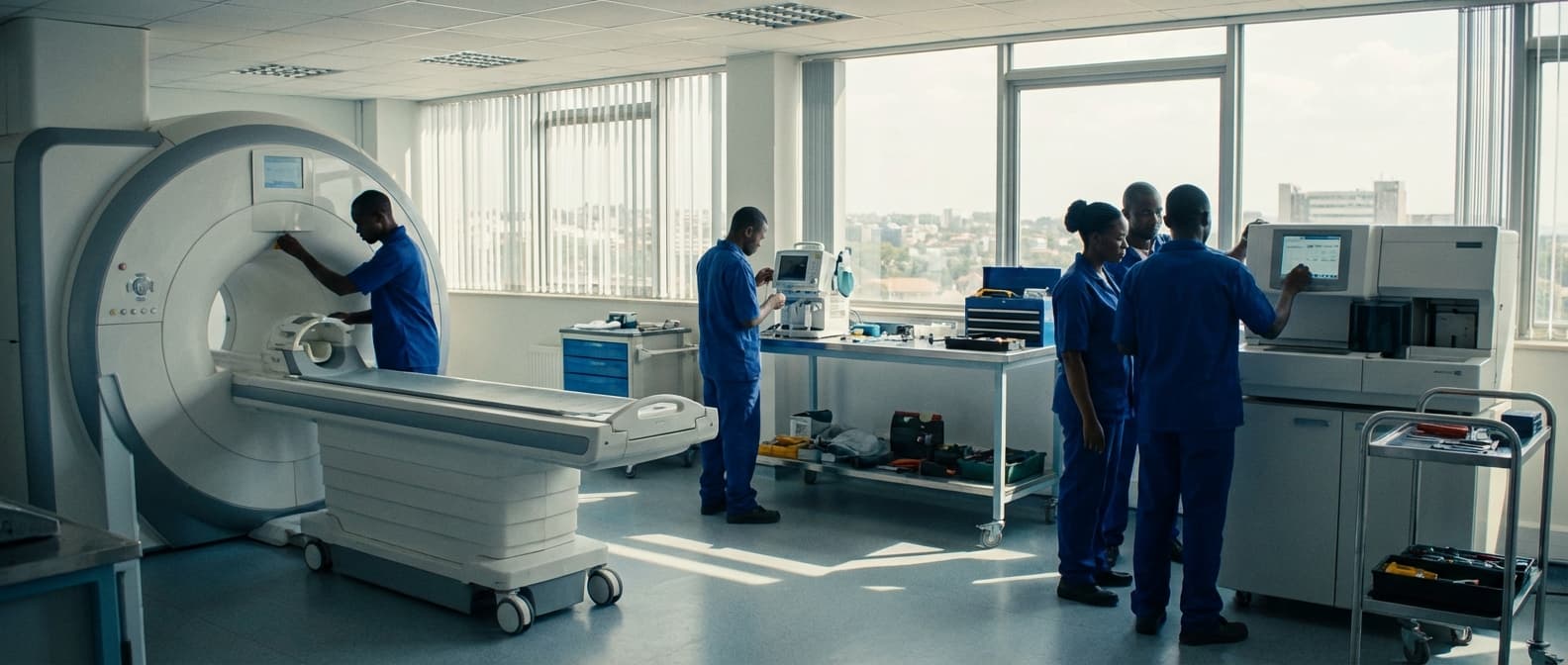
Uptime, Downtime & Root-Cause Analysis Reporting Service in Angola
Engineering Excellence & Technical Support
Uptime, Downtime & Root-Cause Analysis Reporting Service High-standard technical execution following OEM protocols and local regulatory frameworks.
Real-Time Uptime Monitoring & Alerting
Leverage our advanced infrastructure monitoring to gain immediate visibility into your service availability across Angola. Receive instant, actionable alerts on any deviations from expected uptime, minimizing the impact of potential disruptions.
Comprehensive Downtime Event Analysis
We provide granular data and detailed reports on every downtime incident, including duration, affected services, and customer impact across Angola. Understand the scope of each outage with clarity.
Proactive Root-Cause Identification & Prevention
Our service goes beyond simply reporting. We employ sophisticated analytics to pinpoint the precise root cause of downtime events in Angola, enabling you to implement targeted preventative measures and improve system resilience.
What Is Uptime, Downtime & Root-cause Analysis Reporting Service In Angola?
Uptime, Downtime, and Root-Cause Analysis (RCA) Reporting Services in Angola are critical components of ensuring the reliability, availability, and performance of IT infrastructure and business operations. These services provide structured methodologies and reporting mechanisms to monitor system availability, identify the duration and impact of outages, and systematically investigate the underlying causes of failures. This facilitates proactive problem-solving, prevents recurrence, and drives continuous improvement in operational resilience.
Uptime refers to the period during which a system or service is operational and accessible to users. It is typically measured as a percentage of the total time over a specified period (e.g., 99.9% uptime over a month). High uptime is a key indicator of system stability and user satisfaction.
Downtime is the inverse of uptime, representing the period during which a system or service is unavailable or non-functional. Downtime incurs direct financial losses due to lost productivity, missed opportunities, and potential reputational damage.
Root-Cause Analysis (RCA) is a systematic process used to identify the fundamental underlying causes of an incident or problem, rather than just addressing the immediate symptoms. The goal of RCA is to implement corrective actions that prevent the issue from reoccurring.
| Typical Use Cases | Description | Impact of Service | Uptime/Downtime Measurement | RCA Focus |
|---|---|---|---|---|
| E-commerce Platform Availability | Ensuring online stores are accessible to customers for transactions. | Directly impacts revenue generation and customer conversion rates. | Percentage of time the e-commerce website and payment gateways are operational. | Identifying causes of website crashes, database failures, or payment processing errors. |
| Telecommunications Network Reliability | Maintaining continuous service for voice, data, and internet connectivity. | Crucial for national communication, business operations, and public safety. | Measured by call drop rates, network latency, and service availability across various regions. | Investigating causes of network congestion, equipment malfunctions, or fiber cuts. |
| Financial Transaction Processing | Ensuring the uninterrupted flow of financial transactions (e.g., banking, stock trading). | Essential for market stability, customer trust, and regulatory compliance. | Downtime in minutes or seconds can result in significant financial losses. | Analyzing causes of system outages, data corruption, or security breaches affecting transaction integrity. |
| Cloud Service Provider Performance | Monitoring the availability and performance of cloud-hosted applications and data. | Affects the operational continuity of numerous client businesses. | Measured against contractual SLAs, often with penalties for breaches. | Diagnosing issues related to server failures, network latency, or software defects within the cloud infrastructure. |
| Critical Infrastructure Operations | Ensuring the continuous operation of essential services like power grids, water treatment, and transportation systems. | Directly impacts public safety, economic stability, and societal well-being. | Downtime can have catastrophic consequences. | Thorough RCA to prevent future failures in complex, interconnected systems. |
| Software as a Service (SaaS) Application Stability | Verifying that SaaS applications are consistently available and performing as expected for end-users. | Impacts user productivity and adoption rates. | Uptime percentage and response times for key application features. | Identifying bugs, infrastructure issues, or scaling problems affecting application performance. |
Who Needs Uptime, Downtime & RCA Reporting Services in Angola?
- Businesses heavily reliant on IT infrastructure for core operations (e.g., financial services, telecommunications, e-commerce).
- Organizations with Service Level Agreements (SLAs) that stipulate specific uptime guarantees.
- Companies seeking to improve customer satisfaction and trust by minimizing service disruptions.
- IT departments responsible for managing and maintaining complex systems and applications.
- Operations and engineering teams tasked with ensuring system availability and performance.
- Risk management and compliance officers aiming to mitigate operational risks.
- Managed Service Providers (MSPs) offering outsourced IT support and infrastructure management.
- Government agencies and critical infrastructure operators where continuous service availability is paramount.
Who Needs Uptime, Downtime & Root-cause Analysis Reporting Service In Angola?
Organizations in Angola grappling with network disruptions, operational inefficiencies, and the need for proactive problem-solving require robust Uptime, Downtime & Root-Cause Analysis Reporting services. This service is crucial for identifying the underlying reasons for service interruptions, optimizing system performance, and minimizing business losses.
| Customer Segment | Key Challenges Addressed | Benefits of Reporting Service |
|---|---|---|
| Telecommunications Providers | Network outages, dropped calls, slow data speeds, service degradation. | Improved service reliability, reduced customer churn, faster issue resolution, optimized network performance. |
| Financial Institutions | ATM downtime, online banking failures, transaction processing errors, security breaches leading to downtime. | Enhanced customer trust, prevention of financial losses, regulatory compliance, robust transaction integrity. |
| Energy & Utilities | Power grid instability, disruptions in oil & gas operations, SCADA system failures. | Ensured continuous service delivery, optimized resource management, minimized operational risks, improved safety. |
| Government Agencies | Public service portal outages, data system failures, communication disruptions. | Improved citizen services, efficient governance, enhanced national security, cost savings on emergency repairs. |
| Large Enterprises | Server failures, application downtime, cloud service interruptions, data loss. | Minimized business interruption, increased employee productivity, protected revenue streams, optimized IT investment. |
| ISPs & Cloud Providers | Internet connectivity issues, slow bandwidth, server downtime, service availability. | Guaranteed service level agreements (SLAs), competitive advantage, improved customer satisfaction, efficient resource allocation. |
Target Customers & Departments for Uptime, Downtime & Root-Cause Analysis Reporting in Angola
- {"items":["Telecommunications Providers","Financial Institutions (Banks, Insurance Companies)","Energy & Utilities Companies (Oil & Gas, Power Distribution)","Government Agencies & Public Services","Large Enterprises with Critical IT Infrastructure","Internet Service Providers (ISPs)","Cloud Service Providers"],"title":"Target Customer Segments"}
- {"items":["IT Operations & Infrastructure Management","Network Operations Center (NOC)","Service Desk & Support Teams","Systems Administration","DevOps & Site Reliability Engineering (SRE)","Risk Management & Compliance","Business Continuity & Disaster Recovery Planning","Engineering & Technical Support","Senior Management & Decision Makers"],"title":"Key Departments Requiring This Service"}
Uptime, Downtime & Root-cause Analysis Reporting Service Process In Angola
This document outlines the standard workflow for the Uptime, Downtime & Root-Cause Analysis (RCA) Reporting Service offered in Angola. The process is designed to be efficient and transparent, ensuring clients receive comprehensive analysis and actionable insights following any service disruption.
| Phase | Key Activities | Deliverables | Typical Timeline (Angola Context) |
|---|---|---|---|
| Inquiry & Service Activation | Client contact, consultation, SLA agreement, service request initiation. | Confirmed service request, agreed SLA. | Within 24 hours of initial contact. |
| Data Collection & Initial Assessment | Gathering logs, metrics, user reports; preliminary incident categorization. | Initial incident classification, preliminary impact assessment. | Within 4-8 hours of service activation. |
| Deep Dive Analysis & Root Cause Identification | Detailed data analysis, hypothesis testing, cause validation. | Identified root cause(s) and contributing factors. | 48-72 hours (depending on complexity). |
| Report Generation & Documentation | Compiling RCA report with all required sections. | Draft RCA report. | 24 hours after root cause identification. |
| Report Delivery & Presentation | Formal report submission, optional presentation to client. | Final RCA report, presentation deck (if applicable). | Within 48 hours of report completion. |
| Follow-up & Verification | Checking implementation of recommendations, monitoring effectiveness. | Confirmation of implemented measures, ongoing monitoring reports. | Ongoing, as per agreement (e.g., 1-4 weeks post-incident). |
Uptime, Downtime & Root-Cause Analysis Reporting Service Workflow in Angola
- 1. Inquiry & Service Activation:
- Client identifies a service disruption or expresses interest in proactive RCA services.
- Client contacts the service provider via designated channels (email, phone, portal).
- Initial consultation to understand the nature of the disruption, scope, and client's objectives.
- Service provider assesses feasibility and resource availability.
- Service Level Agreement (SLA) is reviewed or established, defining reporting timelines, deliverables, and costs.
- Formal service request or contract is initiated.
- 2. Data Collection & Initial Assessment:
- Service provider initiates immediate data collection from relevant systems, logs, and monitoring tools.
- This includes network traffic logs, server performance metrics, application error logs, infrastructure health indicators, and user reports.
- Preliminary assessment to categorize the disruption (e.g., hardware failure, software bug, network issue, human error).
- Estimation of the downtime duration and impact.
- 3. Deep Dive Analysis & Root Cause Identification:
- Dedicated RCA team is assigned to the case.
- Detailed analysis of collected data to pinpoint the exact cause of the incident.
- May involve correlation of events across different systems and timelines.
- Hypothesis testing and validation of potential root causes.
- Collaboration with client's technical teams may be required for specific insights or access.
- 4. Report Generation & Documentation:
- Comprehensive RCA report is compiled.
- Key elements of the report include:
- Incident Summary (description, timeline, impact)- Root Cause(s) identified- Contributing factors- Corrective actions taken (immediate and ongoing)- Preventative measures recommended- Lessons learned- Report is reviewed internally for accuracy and completeness.
- 5. Report Delivery & Presentation:
- The final RCA report is delivered to the client within the agreed SLA timeframe.
- A presentation of the report can be scheduled to walk the client through the findings, answer questions, and discuss recommendations.
- This may involve key stakeholders from both the service provider and the client.
- 6. Follow-up & Verification:
- Service provider may follow up with the client to ensure recommended preventative measures are being implemented.
- Verification of the effectiveness of implemented solutions through ongoing monitoring.
- Post-incident review to assess the overall satisfaction with the RCA service.
Uptime, Downtime & Root-cause Analysis Reporting Service Cost In Angola
Accurately determining the cost of Uptime, Downtime & Root-Cause Analysis (RCA) Reporting Services in Angola requires a nuanced understanding of various pricing factors. Service providers typically structure their fees based on the complexity, scope, and duration of the analysis, as well as the client's specific infrastructure and needs. Angola's economic landscape, currency fluctuations (primarily the Angolan Kwanza - AOA), and the availability of specialized expertise also play a significant role. While precise, universally applicable price lists are rare due to customization, we can outline the key drivers and provide estimated ranges in Angolan Kwanza.
| Service Type / Complexity | Estimated Price Range (AOA - Angolan Kwanza) |
|---|---|
| Single Incident Basic RCA (e.g., short downtime, limited systems) | 150,000 - 500,000 AOA |
| Single Incident Advanced RCA (e.g., complex infrastructure, significant downtime, multiple root causes) | 500,000 - 1,500,000 AOA |
| Recurring Downtime Analysis & Reporting (Monthly/Quarterly) | 250,000 - 1,000,000+ AOA per period (depending on scope and frequency) |
| Proactive Uptime Monitoring & Reporting Service (Managed Service - Annual Contract) | 1,000,000 - 5,000,000+ AOA per year (highly dependent on infrastructure size and complexity) |
| On-Demand Expert RCA Consultation (Hourly/Daily Rate) | 30,000 - 100,000+ AOA per hour/day |
Key Pricing Factors for Uptime, Downtime & RCA Reporting Services in Angola
- {"title":"Scope of Service","description":"This is the most significant factor. Does the service cover a single incident, a recurring issue, or a comprehensive, proactive monitoring and reporting solution? The depth of analysis (e.g., basic incident log review vs. in-depth infrastructure tracing) directly impacts cost."}
- {"title":"Complexity of Infrastructure","description":"The number of systems, applications, network devices, and cloud services involved. A complex, distributed environment will require more time and expertise for thorough RCA."}
- {"title":"Data Volume and Retention","description":"The amount of log data, performance metrics, and other telemetry that needs to be collected, processed, and analyzed. Longer data retention periods also increase costs."}
- {"title":"Service Level Agreements (SLAs)","description":"The required response times, resolution times, and reporting frequency. Higher availability and faster turnaround times often command premium pricing."}
- {"title":"Technology Stack","description":"The specific technologies and platforms in use (e.g., on-premises servers, specific cloud providers, custom applications). Some technologies may require specialized tools or expertise."}
- {"title":"Expertise and Experience","description":"The skill level and experience of the RCA analysts and consultants. Highly specialized and experienced professionals will naturally be more expensive."}
- {"title":"Duration of Engagement","description":"Whether it's a one-time incident analysis, a short-term project, or a long-term managed service contract."}
- {"title":"Reporting Format and Customization","description":"The level of detail, customization, and visualization required in the reports. Standardized reports will be less expensive than highly tailored ones."}
- {"title":"Local Market Conditions","description":"The prevailing rates for IT services and skilled labor in Angola, influenced by inflation and the demand for such services."}
- {"title":"Provider Reputation and Size","description":"Larger, well-established providers may have higher overheads but also potentially greater resources and standardized methodologies. Smaller, specialized firms might offer more competitive pricing for niche services."}
Affordable Uptime, Downtime & Root-cause Analysis Reporting Service Options
This service offers comprehensive reporting for uptime, downtime, and root-cause analysis (RCA) to ensure your systems remain operational and to quickly identify and resolve issues. We provide flexible options to fit various budgets and needs, emphasizing value through bundled services and cost-saving strategies.
| Value Bundle | Included Services | Ideal For | Monthly Cost (USD, example) | Cost-Saving Strategies |
|---|---|---|---|---|
| Basic Uptime Observer | Core Uptime Monitoring, Basic Downtime Alerts, Weekly Summary Reports | Small businesses, startups, essential services | $49 | Focus on essential monitoring, automated basic reporting reduces manual effort. |
| Standard Performance Tracker | Advanced Uptime Monitoring, Detailed Downtime Logs, Monthly RCA Snapshot, Trend Identification | Growing businesses, mid-sized operations, SaaS providers | $129 | Bundled RCA with downtime analysis offers higher value, proactive identification saves on reactive fixes. |
| Premium Resilience Suite | All Standard Features, In-depth RCA Investigations, Proactive Health Checks, Quarterly Strategic Reviews, SLA Compliance Reporting | Large enterprises, mission-critical systems, regulated industries | $299+ | Comprehensive suite prevents costly downtime, strategic reviews optimize long-term IT investments, dedicated support minimizes emergency response costs. |
| On-Demand RCA Add-on | Per-Incident Root-Cause Analysis Investigation and Report | Clients who need occasional deep dives without a full suite | $75 per incident | Pay-as-you-go for specific needs, avoids recurring costs for infrequent but critical investigations. |
Key Service Features & Benefits
- Proactive Uptime Monitoring: Real-time tracking of system availability with customizable alerts.
- Detailed Downtime Analysis: Comprehensive reports on outage duration, impact, and affected services.
- Root-Cause Identification: In-depth investigations to pinpoint the origin of issues.
- Actionable Recommendations: Clear steps to prevent recurrence and improve system resilience.
- Trend Analysis: Insights into recurring problems and opportunities for optimization.
- Customizable Reporting: Tailored reports to meet your specific operational and business needs.
Verified Providers In Angola
In the Angolan healthcare landscape, identifying truly verified and reliable providers is paramount for ensuring quality care and patient safety. Franance Health stands out as a leading entity, meticulously credentialing healthcare professionals and facilities across the nation. Their rigorous verification process not only confirms qualifications and licenses but also assesses adherence to ethical standards and best practices, making Franance Health-credentialed providers the benchmark for excellence.
| Credentialing Aspect | Franance Health's Approach | Patient Benefit |
|---|---|---|
| Licensing and Certification | Thorough validation of all relevant national and international medical licenses and certifications. | Ensures providers are legally qualified and possess the fundamental expertise. |
| Professional Experience | In-depth review of work history, including past performance and any disciplinary actions. | Identifies experienced and reliable healthcare professionals with a history of good practice. |
| Education and Training | Verification of academic credentials and ongoing professional development programs. | Guarantees providers are knowledgeable about current medical practices and advancements. |
| Ethical Standards | Assessment of adherence to medical ethics and professional conduct codes. | Promotes patient trust and ensures providers act with integrity and respect. |
| Facility Standards (where applicable) | Evaluation of clinic and hospital infrastructure, equipment, and operational protocols. | Ensures a safe and well-equipped environment for treatment and procedures. |
Why Franance Health Credentials Represent the Best Choice:
- Uncompromising Quality Assurance: Franance Health's multi-stage vetting process goes beyond basic licensing, delving into professional history, peer reviews, and ongoing training to ensure practitioners meet the highest clinical standards.
- Patient Safety First: Their verification protocols are designed to mitigate risks by identifying and selecting providers with proven track records and a commitment to patient well-being.
- Transparency and Trust: Franance Health provides a transparent framework, allowing patients to confidently select healthcare providers who have met their stringent criteria.
- Access to Leading Experts: By partnering with Franance Health, patients gain access to a network of Angola's most skilled and reputable doctors, specialists, and healthcare facilities.
- Continuity of Care: Franance Health's commitment extends to ensuring that credentialed providers are up-to-date with medical advancements, facilitating consistent and high-quality patient care.
Scope Of Work For Uptime, Downtime & Root-cause Analysis Reporting Service
This Scope of Work (SOW) outlines the requirements for a Uptime, Downtime & Root-Cause Analysis (RCA) Reporting Service. This service aims to provide comprehensive reporting on system availability, identify instances of service interruption, and conduct thorough investigations to determine the underlying causes of such downtime. The objective is to enhance system reliability, minimize future incidents, and ensure transparency in service performance.
| Category | Description | Technical Deliverables | Standard Specifications / Key Performance Indicators (KPIs) | ||||
|---|---|---|---|---|---|---|---|
| Uptime Monitoring & Reporting | Continuous tracking of system availability and performance against defined service level objectives (SLOs). | Automated uptime reports (daily, weekly, monthly). | Uptime Percentage: >= 99.9% (or as defined by SLOs). | Availability Status Dashboards (real-time). | Mean Time Between Failures (MTBF): [Specify target value]. | Response Time to Outage Detection: < [Specify time, e.g., 5 minutes]. | |
| Downtime Incident Management | Identification, logging, and categorization of all service interruptions. | Incident Tickets with detailed information (timestamp, duration, affected services, impact). | Downtime Duration per Incident: < [Specify threshold for triggering RCA]. | Incident Prioritization based on severity and impact. | Time to Acknowledge Incident: < [Specify time, e.g., 15 minutes]. | Time to Resolve Incident: < [Specify target resolution time based on severity]. | |
| Root-Cause Analysis (RCA) | In-depth investigation of downtime incidents to identify contributing factors and underlying causes. | Formal RCA Reports (for incidents exceeding defined thresholds). | RCA Report Content: Incident summary, timeline, impact assessment, identified root cause(s), contributing factors, corrective actions, preventative measures. | RCA Completion Timeline: Within [Specify days, e.g., 3-5 business days] of incident resolution. | Identification of primary and secondary root causes. | Effectiveness of Corrective Actions: [Specify mechanism for tracking, e.g., re-testing, monitoring]. | |
| Reporting & Communication | Dissemination of uptime, downtime, and RCA findings to relevant stakeholders. | Executive Summary Reports (monthly/quarterly). | Trend Analysis Reports (identifying recurring issues). | Action Item Tracking & Closure Reports. | Clarity and Conciseness of Reports. | Timeliness of Report Delivery: As per agreed schedule. | Stakeholder Satisfaction with Reporting: [Specify feedback mechanism, e.g., survey]. |
| Data Management & Repository | Establishment of a centralized system for storing and accessing historical incident and RCA data. | Secure Data Storage for Incident Logs and RCA Reports. | Data Accessibility for Auditing and Trend Analysis. | Data Retention Period: [Specify duration, e.g., 5 years]. |
Service Objectives
- Accurately monitor and report on system uptime and availability.
- Promptly identify and log all instances of service downtime.
- Conduct detailed Root-Cause Analysis (RCA) for all significant downtime events.
- Provide actionable recommendations to prevent recurrence of downtime.
- Deliver clear, concise, and timely reports to stakeholders.
- Establish and maintain a repository of historical downtime and RCA data.
Service Level Agreement For Uptime, Downtime & Root-cause Analysis Reporting Service
This Service Level Agreement (SLA) outlines the commitments for the Uptime, Downtime & Root-Cause Analysis Reporting Service provided by [Your Company Name] (hereinafter referred to as 'Provider') to [Client Name] (hereinafter referred to as 'Customer'). This agreement defines the expected uptime, acceptable downtime, and the procedures for root-cause analysis reporting.
| Service Metric | Guarantee | Response Time (for reporting incidents) | Downtime Credit (for Monthly Uptime Percentage below guarantee) |
|---|---|---|---|
| Monthly Uptime Percentage | 99.9% | N/A | See Credit Policy |
| Scheduled Downtime Notification | Minimum 48 hours in advance | N/A | N/A |
| RCA Report Delivery (for critical incidents) | Within 24 business hours of service restoration | N/A | N/A |
| RCA Report Delivery (for major incidents) | Within 72 business hours of service restoration | N/A | N/A |
Key Definitions
- Uptime: The total percentage of time the Service is available and operational, excluding Scheduled Downtime and Unscheduled Downtime.
- Downtime: The total percentage of time the Service is unavailable and not operational.
- Scheduled Downtime: Planned periods of unavailability for maintenance, upgrades, or other service enhancements. Customer will be notified in advance.
- Unscheduled Downtime: Unplanned periods of unavailability due to unforeseen issues, technical failures, or emergencies.
- Monthly Uptime Percentage: Calculated as ((Total Minutes in Month - Unscheduled Downtime Minutes) / Total Minutes in Month) * 100.
- Root-Cause Analysis (RCA): A structured process for identifying the fundamental reasons behind a service disruption.
- RCA Report: A document detailing the cause, impact, and corrective actions taken for a service disruption.
Frequently Asked Questions

Ready when you are
Let's scope your Uptime, Downtime & Root-Cause Analysis Reporting Service in Angola project in Angola.

Scaling healthcare logistics and technical systems across the entire continent.