
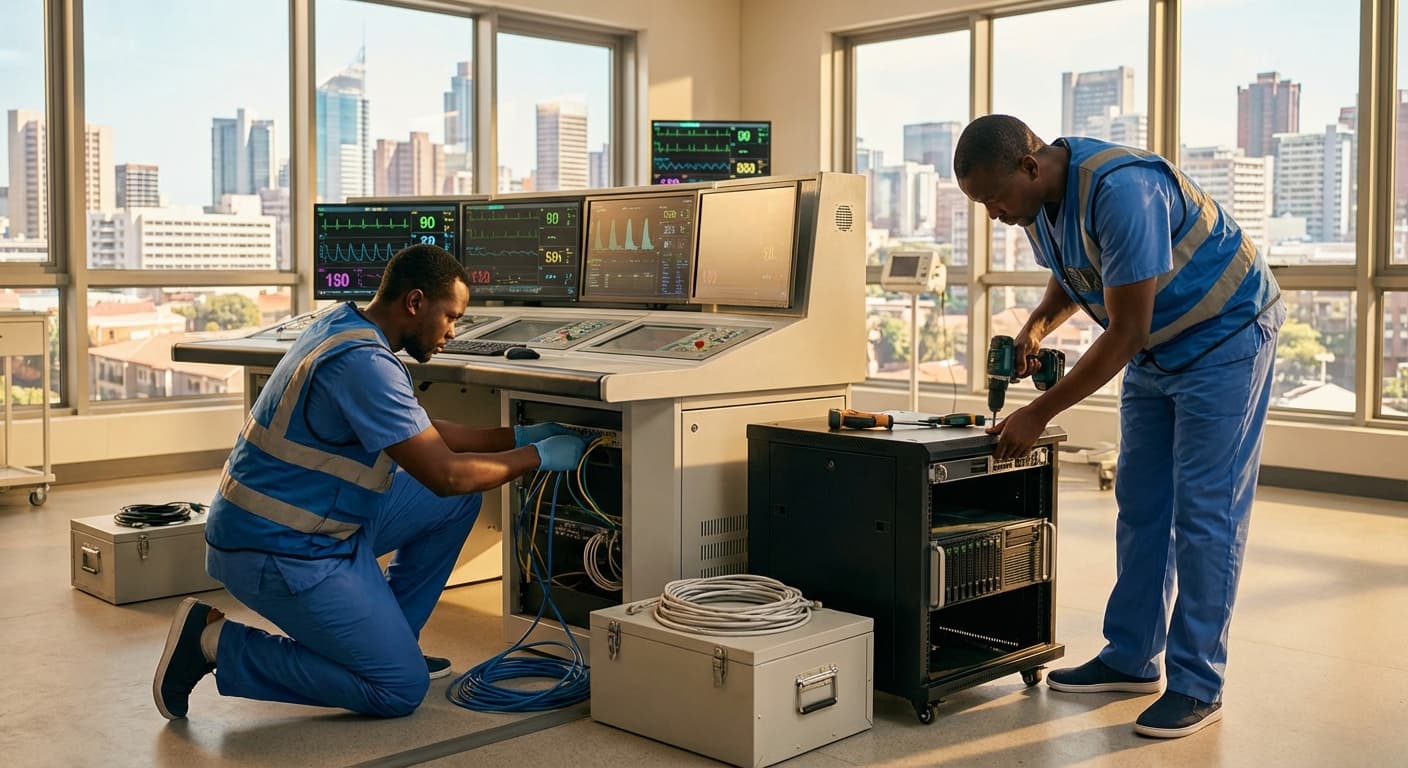
ICU Central Monitoring Station Installation Service in Angola
Engineering Excellence & Technical Support
ICU Central Monitoring Station Installation Service High-standard technical execution following OEM protocols and local regulatory frameworks.
Centralized Patient Data Hub
Seamless integration of patient vital signs from multiple ICU beds into a single, high-resolution display, enabling real-time, comprehensive patient assessment and faster clinical decision-making.
Robust Network Infrastructure
Deployment of a highly reliable, secure, and scalable network designed to transmit critical patient data with ultra-low latency, ensuring uninterrupted monitoring and immediate alerts in high-pressure ICU environments.
Advanced Alert Management & User Interface
Implementation of an intuitive and customizable alert system that prioritizes critical events, coupled with a user-friendly interface for efficient waveform analysis, trend review, and quick access to patient history.
What Is Icu Central Monitoring Station Installation Service In Angola?
ICU Central Monitoring Station Installation Service in Angola refers to the specialized provision of hardware, software, and technical expertise required to establish and commission a centralized patient monitoring system within Intensive Care Units (ICUs) in healthcare facilities across Angola. This service encompasses the design, procurement, installation, configuration, integration, and initial testing of a network of patient monitors, data servers, workstations, and associated communication infrastructure. The objective is to enable real-time, comprehensive surveillance of critical patient physiological parameters from a dedicated monitoring station, facilitating rapid clinical intervention and improved patient outcomes. The service addresses the complexities of integrating diverse medical device manufacturers' equipment with a unified monitoring platform, ensuring data integrity, security, and accessibility for authorized medical personnel.
| Stakeholder/Entity | Requirement/Benefit |
|---|---|
| Hospitals/Healthcare Facilities in Angola (particularly ICUs) | Enhanced patient safety through continuous physiological monitoring; earlier detection of patient deterioration; improved workload management for nursing staff; facilitated multidisciplinary team collaboration; compliance with international patient care standards. |
| ICU Physicians and Intensivists | Real-time access to critical patient data; ability to monitor multiple patients simultaneously; improved diagnostic accuracy; informed clinical decision-making; timely intervention capabilities. |
| ICU Nursing Staff | Reduced need for constant bedside presence for basic monitoring; improved situational awareness; proactive response to alarms; reduced risk of missed critical events; efficient data recording and retrieval. |
| Hospital IT Departments | Integration with existing hospital IT infrastructure; management of a critical medical data network; ensuring data security and privacy; system maintenance and troubleshooting support. |
| Medical Device Manufacturers/Vendors (as service providers) | Providing specialized expertise in their respective monitoring technologies; ensuring compatibility and seamless integration of their devices; offering comprehensive installation and support packages. |
Key Components of ICU Central Monitoring Station Installation Service
- Site Survey and Needs Assessment: Evaluating existing infrastructure, power, networking capabilities, and specific ICU requirements to tailor the system design.
- System Design and Architecture: Developing a detailed blueprint for the central monitoring system, including network topology, server specifications, workstation placement, and data flow.
- Hardware Procurement and Deployment: Sourcing and installing patient bedside monitors, central monitoring servers, clinical workstations, alarms, and networking devices (switches, routers, cabling).
- Software Installation and Configuration: Setting up the central monitoring software, configuring patient profiles, alarm thresholds, data storage protocols, and user access controls.
- Network Integration: Establishing secure and reliable network connectivity between bedside monitors and the central server, often involving existing hospital IT infrastructure or dedicated networks.
- Device Integration and Interoperability: Ensuring seamless data acquisition from a range of bedside monitors, ventilators, infusion pumps, and other critical care devices, adhering to industry standards like HL7 or DICOM where applicable.
- Alarm Management System Setup: Configuring audible and visual alarms for critical physiological deviations, ensuring timely notification to nursing staff and physicians.
- Data Archiving and Retrieval: Implementing robust data storage solutions for historical patient data, enabling review, analysis, and research purposes.
- System Testing and Validation: Conducting comprehensive performance testing, including functionality, data accuracy, alarm response times, and network stability, prior to clinical handover.
- User Training and Education: Providing in-depth training to ICU physicians, nurses, and IT support staff on the operation, maintenance, and troubleshooting of the central monitoring system.
- Post-Installation Support and Maintenance: Offering ongoing technical assistance, software updates, and hardware maintenance services.
Who Needs Icu Central Monitoring Station Installation Service In Angola?
The installation of an ICU Central Monitoring Station (CMS) is a critical infrastructure upgrade for healthcare facilities in Angola. This service is essential for hospitals aiming to enhance patient care, improve medical team efficiency, and ensure timely critical interventions for critically ill patients. A CMS allows a team of nurses to remotely monitor vital signs of multiple ICU patients simultaneously, leading to earlier detection of deteriorating conditions and proactive medical responses. This not only saves lives but also optimizes resource allocation within the ICU.
| Target Customer Segment | Specific Departments/Units Requiring Service |
|---|---|
| Public Hospitals (Government-funded) | Ministry of Health-designated tertiary care hospitals, regional hospitals with dedicated ICUs. |
| Private Hospitals | For-profit hospitals with advanced ICU facilities, hospitals catering to specific patient demographics. |
| Non-Governmental Organization (NGO) Healthcare Facilities | Hospitals operated by NGOs focusing on specialized medical care or disaster relief. |
| Large Industrial/Mining Companies with On-site Medical Facilities | Companies with substantial workforces requiring advanced medical support, especially in remote locations. |
| Military and Defense Healthcare Services | Hospitals and medical centers serving military personnel and their families. |
Who Needs ICU Central Monitoring Station Installation Service in Angola?
- Hospitals undergoing expansion or renovation of their Intensive Care Units.
- Healthcare facilities looking to upgrade their existing patient monitoring systems for enhanced capabilities.
- Government and private hospitals committed to improving the quality of critical care services.
- Organizations seeking to centralize patient data and improve workflow efficiency in their ICUs.
- Hospitals in remote or underserved areas that require remote monitoring to extend specialized care.
Icu Central Monitoring Station Installation Service Process In Angola
This document outlines the detailed workflow for the ICU Central Monitoring Station Installation Service Process in Angola, from initial inquiry to final execution. It is designed to ensure a structured, efficient, and compliant installation, meeting the specific needs and regulatory requirements of healthcare facilities in Angola.
| Phase | Key Activities | Responsible Parties | Deliverables | Key Considerations (Angola) |
|---|---|---|---|---|
| Client expresses interest. Initial discussions to understand basic needs, facility type, and location. Introduction to service capabilities. | Client, Service Provider (Sales/Technical Representative) | Initial understanding of client requirements, preliminary scope definition. | Language proficiency (Portuguese is official, English common in business), understanding of local business etiquette. |
| Detailed site visit to assess infrastructure (power, network, space), existing systems, and specific ICU monitoring needs. In-depth discussions with clinical staff and IT. Gathering technical specifications and compliance requirements. | Service Provider (Technical Team, Project Manager), Client (Clinical Staff, IT Department, Facility Management) | Comprehensive site survey report, detailed technical requirements document, risk assessment. | Understanding of Angolan healthcare infrastructure standards, potential for power fluctuations, need for robust networking solutions. Local customs regarding site access and approvals. |
| Based on the assessment, develop a detailed technical proposal including system design, equipment list, installation plan, timeline, and cost breakdown. Provide a formal quotation. | Service Provider (Project Manager, Technical Team, Procurement) | Formal Proposal, Detailed Bill of Materials (BOM), Project Timeline, Quotation. | Clear pricing in local currency (Angolan Kwanza - AOA) or agreed international currency. Inclusion of all relevant taxes and import duties for Angola. |
| Review of the proposal and quotation. Negotiation of terms, conditions, payment schedules, and service level agreements (SLAs). Finalization and signing of the installation contract. | Service Provider (Legal/Commercial Team), Client (Legal/Procurement Department) | Signed Installation Contract, Payment Schedule. | Ensuring contract adheres to Angolan legal framework. Understanding of payment processing procedures in Angola. Confirmation of warranty terms. |
| Detailed project plan development. Coordination of logistics, including customs clearance for imported equipment, transportation within Angola, and site access permits. Resource allocation and team scheduling. | Service Provider (Project Manager, Logistics Team), Client (Facility Management) | Detailed Project Plan, Logistics Plan, Risk Mitigation Strategy, Site Access Permits. | Navigating Angolan customs procedures and import regulations. Understanding of transportation infrastructure and potential delays. Coordination with local authorities for site access if required. |
| Procurement of all necessary hardware and software components. Ensuring compliance with relevant standards. Secure transportation and delivery to the installation site in Angola. | Service Provider (Procurement Team, Logistics Team), Vendors | All installed equipment and software, Delivery confirmation. | Working with reliable freight forwarders familiar with Angolan ports and borders. Ensuring proper documentation for customs clearance is accurate and complete. |
| On-site installation of the central monitoring station hardware, network cabling, and software. Configuration of the system according to the agreed technical specifications and facility requirements. Integration with existing hospital infrastructure. | Service Provider (Installation Technicians, Network Engineers, Software Specialists) | Installed and configured central monitoring station. | Adherence to local electrical and safety codes. Ensuring secure data transmission and compliance with any local data privacy regulations. Minimizing disruption to ongoing ICU operations. |
| Thorough testing of all system functionalities, including data acquisition, alarm management, patient data display, and network connectivity. Verification against performance specifications. Commissioning of the system for operational use. | Service Provider (Testing Team, Project Manager), Client (Clinical Staff, IT Department) | Test reports, Commissioning certificate. | Ensuring system performance under various load conditions. Validating alarms and critical functionalities with clinical staff present. |
| Comprehensive training for clinical staff (nurses, doctors) and IT personnel on the operation, maintenance, and basic troubleshooting of the central monitoring station. Formal handover of the system, documentation, and warranties. | Service Provider (Trainers, Project Manager), Client (Clinical Staff, IT Department) | Training materials, User manuals, Training completion certificates, System handover documentation. | Providing training in a language understandable to the end-users. Tailoring training content to specific user roles and responsibilities. |
| Provision of ongoing technical support, remote monitoring, software updates, and preventive maintenance as per the agreed SLA. Ensuring long-term reliability and performance of the central monitoring station. | Service Provider (Support Team, Maintenance Technicians) | Ongoing technical support, maintenance reports, software updates. | Establishing clear communication channels for support requests. Understanding potential challenges with remote access to equipment in Angola. Availability of local or regional support resources. |
ICU Central Monitoring Station Installation Service Process Workflow in Angola
- Phase 1: Initial Inquiry and Consultation
- Phase 2: Site Assessment and Requirements Gathering
- Phase 3: Proposal Development and Quotation
- Phase 4: Contract Negotiation and Agreement
- Phase 5: Pre-Installation Planning and Logistics
- Phase 6: Equipment Procurement and Delivery
- Phase 7: Installation and Configuration
- Phase 8: Testing and Commissioning
- Phase 9: Training and Handover
- Phase 10: Post-Installation Support and Maintenance
Icu Central Monitoring Station Installation Service Cost In Angola
The cost of installing an ICU Central Monitoring Station in Angola can vary significantly due to a multitude of factors. These stations are critical for real-time patient data aggregation and analysis in intensive care units, requiring specialized equipment and expertise. When budgeting for such a project, it's essential to consider the following key pricing determinants:
Key Pricing Factors:
- Scope and Complexity of the System: The number of patient beds to be monitored, the types of physiological parameters to be tracked (e.g., ECG, SpO2, NIBP, respiration, temperature, invasive pressures), and the integration with existing hospital IT infrastructure will directly impact the cost. A more comprehensive system with advanced features will be more expensive.
- Brand and Quality of Equipment: Leading international brands often command higher prices due to their reputation for reliability, advanced technology, and comprehensive support. The specific models and their features (e.g., screen resolution, data storage capacity, remote access capabilities) will also influence cost.
- Installation and Configuration Services: This includes the physical installation of monitoring units at each bedside, the central workstation, network cabling, power infrastructure setup, and the complex configuration of software for data display, alarm management, and trend analysis. The labor involved for skilled technicians and engineers is a significant cost component.
- Software Licensing and Integration: The cost of the central monitoring software, including any necessary licenses for additional features or user access, is crucial. Integration with Electronic Health Records (EHR) systems, Picture Archiving and Communication Systems (PACS), or other hospital information systems (HIS) adds to the complexity and cost.
- Training: Comprehensive training for medical staff (doctors, nurses, technicians) on operating the central monitoring system, understanding the data, and responding to alarms is often bundled into the service package or offered as a separate, but essential, cost.
- Warranty and Maintenance: The duration and scope of the warranty offered by the vendor, as well as ongoing maintenance and support contracts, will contribute to the overall investment. Angolan context might see higher costs for imported parts and specialized technician travel for maintenance.
- Customization and Special Requirements: Any unique customization requests, such as specific reporting formats, integration with specialized medical devices not commonly found, or adherence to particular Angolan healthcare regulations, can increase the price.
- Logistics and Shipping: For international vendors, the cost of shipping equipment to Angola, along with potential import duties and taxes, needs to be factored in.
- Vendor Location and Reputation: Local vendors might offer more competitive pricing due to lower overheads and reduced logistical complexities. However, established international vendors might offer superior technology and support, justifying a higher price.
- Current Market Conditions in Angola: Economic stability, currency exchange rates (e.g., Kwanza to USD/EUR), and the general demand for medical equipment in Angola can influence pricing.
Estimated Cost Ranges in Angolan Kwanza (AOA):
It's challenging to provide precise figures without specific project details, but a general estimation for the installation of a standard ICU Central Monitoring Station in Angola, encompassing equipment, software, and installation services, could range from AOA 30,000,000 to AOA 150,000,000 or more. This wide range reflects the varying factors mentioned above.
- Basic/Small Scale System (e.g., 4-8 beds): Could be in the lower to mid-range, approximately AOA 30,000,000 - AOA 60,000,000.
- Mid-Range System (e.g., 8-16 beds) with standard features: Likely falls between AOA 60,000,000 - AOA 100,000,000.
- Advanced/Large Scale System (e.g., 16+ beds) with advanced features, extensive integration, and premium brands: Can easily exceed AOA 100,000,000 and go up to AOA 150,000,000 or significantly higher for highly customized or enterprise-level solutions.
Important Note: These are broad estimates. Obtaining detailed quotes from multiple reputable vendors specializing in medical equipment installation in Angola is crucial for accurate budgeting. It's advisable to clearly define your hospital's specific needs and technical requirements before soliciting proposals.
| System Scale/Features | Estimated Cost Range (AOA) |
|---|---|
| Basic/Small Scale (4-8 beds) | 30,000,000 - 60,000,000 |
| Mid-Range (8-16 beds) with standard features | 60,000,000 - 100,000,000 |
| Advanced/Large Scale (16+ beds) with advanced features & integration | 100,000,000 - 150,000,000+ |
Factors Influencing ICU Central Monitoring Station Installation Costs in Angola
- Scope and Complexity of the System (Number of beds, parameters)
- Brand and Quality of Equipment (Reputation, technology)
- Installation and Configuration Services (Labor, expertise)
- Software Licensing and Integration (Software features, EHR/HIS integration)
- Training for Medical Staff
- Warranty and Maintenance Packages
- Customization and Special Requirements
- Logistics, Shipping, Duties, and Taxes
- Vendor Location and Reputation
- Current Market Conditions and Currency Exchange Rates in Angola
Affordable Icu Central Monitoring Station Installation Service Options
Installing an Intensive Care Unit (ICU) central monitoring station is a critical investment for any healthcare facility. This system allows for real-time tracking of vital signs for multiple patients, improving response times and overall patient care. When considering installation services, understanding value bundles and cost-saving strategies is essential for optimizing your budget without compromising on quality or functionality.
| Cost-Saving Strategy | Description | Potential Savings |
|---|---|---|
| Bundle Discounts | Purchasing a comprehensive value bundle from a single vendor often comes with discounted pricing compared to procuring individual components and services separately. | 10-25% on bundled hardware and software, potential for additional discounts on installation and support. |
| Phased Installation | If budget is a significant constraint, consider a phased approach. Install the core system first and then gradually add advanced features or expand to more beds as funds become available. Negotiate future upgrade pricing upfront. | Spreads out capital expenditure, allows for budget reallocation, and avoids large upfront costs. |
| Leasing vs. Purchasing | Explore leasing options for the central monitoring station hardware. This can reduce upfront capital outlay and may include maintenance and upgrade plans within the lease agreement. | Lower initial investment, predictable monthly costs, potential for easier upgrades at the end of the lease term. |
| Negotiate Training Packages | Ensure comprehensive training is included in the installation package. Well-trained staff can maximize system efficiency, reduce errors, and minimize the need for costly external support later. | Reduced need for external trainers, improved staff proficiency, minimized downtime due to user error. |
| Consider Refurbished or Certified Pre-Owned Equipment | For non-critical components or for facilities with tighter budgets, inquire about certified pre-owned or refurbished monitoring units. Ensure they come with a warranty. | Significant savings (20-50% or more) on hardware costs, but requires careful vendor selection and warranty verification. |
| Long-Term Support Agreements | Negotiate multi-year service and support agreements upfront. This often provides a lower per-year cost than annual renewals and ensures consistent support. | Stabilizes operational costs, potential for discounted rates on extended coverage. |
| Open-Platform Solutions | Opt for systems with open platforms that allow for integration with a wider range of third-party devices and software. This can prevent vendor lock-in and offer more competitive pricing for future additions. | Greater flexibility in choosing compatible devices, competitive pricing from multiple vendors for peripherals. |
Understanding Value Bundles
- Core Monitoring Package: This typically includes the central monitoring station hardware, necessary software licenses, and the installation of basic patient monitoring units at each bedside. It's the foundational offering.
- Enhanced Care Bundle: This bundle often builds upon the core package by adding advanced features like integrated EKG analysis, waveform trending, and more sophisticated alarm management systems. It may also include extended warranty periods or priority technical support.
- Data Integration & Reporting Bundle: For facilities focused on data analytics and research, this bundle incorporates integration with existing Electronic Health Records (EHRs), custom reporting tools, and potentially data archiving solutions. This can streamline workflow and provide valuable insights.
- Comprehensive Solution Bundle: This is the most inclusive option, combining hardware, software, advanced features, data integration, and often includes extensive training for clinical staff and IT personnel, as well as ongoing maintenance and support services for a set period.
- Scalability & Future-Proofing Bundle: Some providers offer bundles designed with future expansion in mind. This might include modular hardware that can be easily upgraded or software that supports additional functionalities as your needs evolve.
Verified Providers In Angola
When seeking healthcare services in Angola, especially those requiring specialized or high-quality care, identifying verified and reputable providers is paramount. Franance Health stands out as a leading organization, offering a network of credentialed professionals and facilities. Their rigorous vetting process ensures that all associated healthcare providers meet stringent international standards for quality, safety, and expertise. This commitment to excellence makes Franance Health credentials a strong indicator of reliable and effective medical care, positioning them as the best choice for individuals and families prioritizing their well-being in Angola.
| Credentialing Aspect | Franance Health's Approach | Benefit to Patients |
|---|---|---|
| Professional Qualifications | Verification of medical degrees, licenses, and board certifications from accredited institutions. | Ensures providers possess the necessary academic and practical expertise. |
| Clinical Experience | Thorough review of work history, areas of specialization, and documented patient outcomes. | Guarantees providers have practical, proven experience in their fields. |
| Ethical Conduct | Background checks and assessment of professional references to ensure integrity and adherence to medical ethics. | Protects patients from malpractice and unethical practices. |
| Facility Standards | Evaluation of medical facilities for compliance with safety regulations, equipment, and hygiene protocols. | Ensures a safe and conducive environment for treatment and recovery. |
| Continuing Medical Education (CME) | Requirement for providers to engage in ongoing professional development to stay updated on the latest medical advancements. | Guarantees patients receive care informed by current medical knowledge and techniques. |
Why Franance Health Credentials Represent the Best Choice:
- Rigorous Vetting Process: Franance Health employs a multi-faceted approach to credentialing, assessing qualifications, experience, ethical conduct, and adherence to best practices.
- International Standards: Providers are evaluated against globally recognized benchmarks for healthcare quality and patient safety.
- Comprehensive Network: Access to a wide range of specialists, hospitals, and clinics, all pre-screened for excellence.
- Patient-Centric Approach: Focus on ensuring that credentialed providers prioritize patient outcomes, satisfaction, and ethical treatment.
- Transparency and Trust: Clear criteria for credentialing build trust and provide patients with confidence in their healthcare choices.
- Continuous Quality Assurance: Ongoing monitoring and re-evaluation of providers to maintain high standards.
Scope Of Work For Icu Central Monitoring Station Installation Service
This Scope of Work (SOW) outlines the requirements for the installation service of an Intensive Care Unit (ICU) Central Monitoring Station. The service includes the physical installation, configuration, testing, and commissioning of all hardware and software components required for a fully functional central monitoring system. This SOW details the technical deliverables, standard specifications, and project phases to ensure a successful deployment.
| Technical Deliverable | Description | Standard Specification / Requirement | Verification Method |
|---|---|---|---|
| Central Monitoring Workstation(s) | Installation and setup of dedicated computer workstations for central monitoring staff. | High-performance workstations with dual monitors (minimum 24-inch), sufficient processing power (e.g., Intel Core i7 or equivalent), 16GB RAM, SSD storage (minimum 512GB), and compatible operating system (e.g., Windows 10 Pro or later). | Physical inspection, system boot, OS verification, hardware component check (e.g., CPU-Z, Task Manager). |
| Network Infrastructure Cabling | Installation and termination of network cables to connect bedside monitors, servers, and workstations. | Category 6a (or higher) Ethernet cabling, properly labeled and tested for signal integrity. Adherence to hospital IT network standards and best practices for cable management. Minimum 1Gbps network speed. | Cable testing (e.g., Fluke Networks DSX-5000 or equivalent), visual inspection of termination and labeling, network connectivity test. |
| Central Monitoring Software Suite | Installation and configuration of the central monitoring software application on designated servers and workstations. | Latest stable version of the vendor-provided software, installed according to vendor guidelines. Includes patient data acquisition, alarm management, data archiving, and reporting modules. | Software installation verification, module activation check, user account creation (test accounts). |
| Database Server Configuration | Setup and configuration of the database server for storing patient vital signs and historical data. | Robust database server (e.g., SQL Server, Oracle) with adequate storage capacity and performance. Includes database setup, backup strategy implementation, and security hardening. | Database connectivity test, storage capacity verification, backup job status check, security audit (basic). |
| Alarm Notification System Integration | Integration of the central monitoring system with existing or new alarm notification devices (e.g., pagers, mobile devices, visual alarms). | Seamless integration with hospital's communication protocols (e.g., HL7, specific vendor APIs). Alarms must be reliably transmitted with appropriate priority levels. | End-to-end alarm testing from bedside to notification device, verification of alarm content and priority, response time measurement. |
| System Integration and Interoperability | Ensuring seamless data flow between bedside monitors, central station, electronic health records (EHR), and other connected medical devices. | Adherence to relevant interoperability standards (e.g., HL7, FHIR). Real-time data synchronization and accurate representation of patient status. | Data validation across systems, functional testing of data transfer, confirmation of data consistency. |
| User Workstation Setup and Configuration | Configuration of individual user workstations with personalized settings, user profiles, and access controls. | Secure user login, configurable display layouts, and user-specific settings. Compliance with hospital IT security policies. | User login test, layout customization check, security policy adherence verification. |
| System Performance Testing | Verification of system responsiveness, data processing speed, and alarm latency under simulated high-load conditions. | System must maintain optimal performance during peak ICU activity. Alarm latency should be within defined limits (e.g., < 5 seconds). | Stress testing with simulated patient data, performance monitoring tools, latency measurement. |
| Backup and Disaster Recovery Setup | Implementation of regular data backups and a defined disaster recovery plan for the central monitoring system. | Automated daily backups to an offsite location or redundant storage. Documented DR plan with defined RTO/RPO. | Backup job verification, simulated DR test (optional, based on contract), DR plan documentation review. |
| User Training Materials | Provision of comprehensive training materials for clinical staff and IT support personnel. | User manuals, quick reference guides, and presentation slides tailored to the installed system and hospital workflows. | Review of training materials for accuracy, clarity, and completeness. |
| As-Built Documentation | Provision of detailed documentation of the installed system, including network diagrams, equipment locations, and configuration settings. | Accurate and up-to-date documentation reflecting the final installed system. Includes hardware inventory, software versions, and IP addressing scheme. | Review and approval of as-built drawings and documentation. |
Project Phases and Key Activities
- Phase 1: Planning and Design Validation
- Phase 2: Site Preparation and Infrastructure Setup
- Phase 3: Hardware Installation and Cabling
- Phase 4: Software Installation and Configuration
- Phase 5: System Integration and Testing
- Phase 6: Commissioning and Training
- Phase 7: Project Closeout and Documentation
Service Level Agreement For Icu Central Monitoring Station Installation Service
This Service Level Agreement (SLA) outlines the response times and uptime guarantees for the installation service of the ICU Central Monitoring Station. This SLA is designed to ensure minimal disruption to critical patient care during the installation process and to provide assurance of system availability post-installation.
| Issue Severity | Response Time Target | Uptime Guarantee (Post-Installation) |
|---|---|---|
| Critical Issue (During Installation & Post-Installation) | Within 1 hour | 99.9% (Excluding scheduled maintenance) |
| Major Issue (Post-Installation) | Within 4 business hours | N/A (Focus is on Critical Issue uptime) |
| Minor Issue (Post-Installation) | Within 1 business day | N/A (Focus is on Critical Issue uptime) |
Key Definitions
- Installation Service: The complete process of setting up and configuring the ICU Central Monitoring Station, including hardware installation, software deployment, network integration, and initial testing.
- Central Monitoring Station (CMS): The integrated system responsible for collecting, displaying, and alarming patient vital signs from multiple ICU beds.
- Critical Issue: An operational problem with the CMS that prevents or significantly impairs the monitoring of patient vital signs, posing an immediate risk to patient safety.
- Major Issue: An operational problem with the CMS that degrades performance or affects the monitoring of a subset of patients, but does not pose an immediate critical risk to patient safety.
- Minor Issue: An operational problem with the CMS that is cosmetic, does not affect core functionality, or affects non-critical features.
- Downtime: Any period during which the CMS is unavailable for its intended use due to a fault or maintenance, excluding scheduled maintenance windows.
- Response Time: The time elapsed from when a support request is logged with the Service Provider until the Service Provider begins actively working to resolve the issue.
- Resolution Time: The time elapsed from when a support request is logged until the issue is resolved and the CMS is fully operational. (Note: Resolution times are not guaranteed in this SLA but will be strived for.)
- Scheduled Maintenance: Pre-planned periods for system updates, upgrades, or preventive maintenance, communicated in advance to the Client.
Frequently Asked Questions

Ready when you are
Let's scope your ICU Central Monitoring Station Installation Service in Angola project in Angola.

Scaling healthcare logistics and technical systems across the entire continent.