
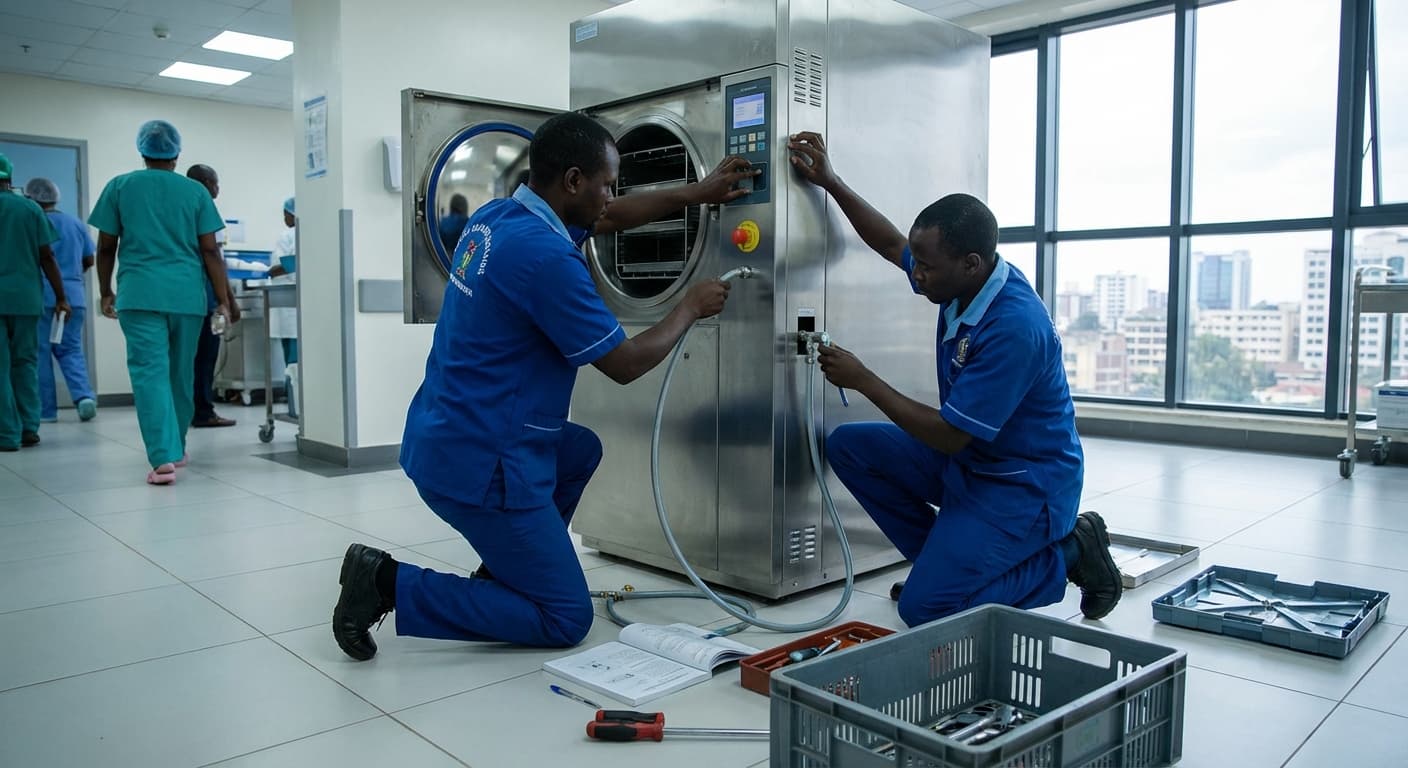
Autoclave & Sterilizer Installation Service in Angola
Engineering Excellence & Technical Support
Autoclave & Sterilizer Installation Service High-standard technical execution following OEM protocols and local regulatory frameworks.
Expert Autoclave & Sterilizer Calibration
Our certified technicians ensure your autoclaves and sterilizers meet stringent regulatory standards through precise calibration, guaranteeing optimal sterilization cycles and device longevity in Angolan healthcare facilities.
Integrated Sterilization System Design
We design and implement integrated sterilization workflows, seamlessly connecting autoclaves and sterilizers with supporting infrastructure to enhance efficiency and patient safety for medical institutions across Angola.
Compliance & Certification Support
Navigate Angolan health regulations with confidence. We provide comprehensive documentation and support for certification and compliance requirements, ensuring your sterilization installations meet all local and international standards.
What Is Autoclave & Sterilizer Installation Service In Angola?
Autoclave & Sterilizer Installation Service in Angola refers to the specialized provision of professional services for the procurement, setup, calibration, and validation of autoclaves and other sterilization equipment within the Angolan market. This encompasses a comprehensive process ensuring that the installed equipment meets stringent safety, efficacy, and regulatory standards required for critical sterilization applications. The service typically involves site assessment, equipment selection guidance, physical installation, electrical and plumbing connections, operational testing, performance verification, and operator training. The objective is to guarantee the reliable and effective sterilization of medical instruments, laboratory consumables, and other critical materials, thereby mitigating the risk of infection transmission and ensuring product integrity.
| Who Needs Autoclave & Sterilizer Installation Service in Angola? | Typical Use Cases |
|---|---|
| Hospitals and Clinics: For sterilization of surgical instruments, medical devices, and patient care equipment. | Operating Rooms: Sterilization of reusable surgical tools and implants. |
| Dental Practices: Sterilization of dental instruments and equipment. | Dental Offices: Maintaining aseptic conditions for dental procedures. |
| Laboratories (Medical, Research, Industrial): Sterilization of glassware, media, consumables, and waste. | Research Facilities: Ensuring sterile conditions for experiments and sample preparation. |
| Pharmacies: Sterilization of equipment for compounding and preparation of sterile products. | Compounding Pharmacies: Creating sterile medications and pharmaceutical preparations. |
| Veterinary Clinics and Hospitals: Sterilization of surgical instruments and equipment. | Animal Healthcare Facilities: Ensuring sterile environments for animal surgeries and treatments. |
| Manufacturing Facilities (Pharmaceutical, Food & Beverage, Cosmetics): Sterilization of equipment and packaging components. | Biotechnology Companies: Sterilizing production equipment and consumables. |
Key Components of Autoclave & Sterilizer Installation Service
- Site Assessment and Planning: Evaluation of the installation location, power supply, water and drainage availability, ventilation requirements, and spatial constraints.
- Equipment Procurement and Delivery: Sourcing, purchasing, and safe transportation of the selected sterilization equipment.
- Physical Installation: Mounting and securing the autoclave or sterilizer in its designated operational area.
- Utility Connections: Establishing safe and compliant connections to electrical power, water supply, and drainage systems.
- Pre-Operational Testing: Initial checks to ensure all mechanical and electrical components are functioning correctly.
- Calibration and Commissioning: Precise adjustment of operating parameters (temperature, pressure, time) to meet manufacturer specifications and established sterilization protocols.
- Performance Qualification (PQ): Rigorous testing using biological and chemical indicators to validate the sterilizer's ability to achieve and maintain effective sterilization cycles.
- Operator Training: Comprehensive instruction for end-users on safe operation, routine maintenance, troubleshooting, and cycle management.
- Documentation and Certification: Provision of installation reports, calibration certificates, and validation documentation for regulatory compliance.
- Post-Installation Support: Offering ongoing technical assistance, maintenance recommendations, and troubleshooting services.
Who Needs Autoclave & Sterilizer Installation Service In Angola?
Maintaining sterile environments is paramount in numerous sectors across Angola. The reliable installation of autoclaves and sterilizers is crucial for ensuring the safety and efficacy of processes in healthcare, research, and various industrial applications. This service guarantees that vital equipment is set up correctly, calibrated, and integrated seamlessly into existing infrastructure, minimizing downtime and maximizing operational efficiency.
| Customer Type | Key Departments/Functions Requiring Installation | Specific Needs/Applications |
|---|---|---|
| Hospitals | Operating Theatres, Central Sterile Supply Department (CSSD), Intensive Care Units (ICUs), Emergency Rooms, Dental Clinics | Sterilization of surgical instruments, anesthesia equipment, dressings, syringes, and other medical consumables. |
| Clinics & Health Centers | Treatment Rooms, Minor Surgery Areas | Sterilization of instruments for general consultations, minor procedures, and wound care. |
| Research Laboratories | Microbiology Labs, Molecular Biology Labs, Biochemistry Labs | Sterilization of media, glassware, pipette tips, and waste materials for research experiments. |
| Diagnostic Laboratories | Pathology Labs, Clinical Chemistry Labs, Hematology Labs | Sterilization of sample collection tools, culture media, and laboratory equipment for accurate diagnostics. |
| Pharmaceutical Companies | Quality Control Labs, Production Facilities, R&D Departments | Sterilization of media, equipment, containers, and waste generated during drug manufacturing and research. |
| Biotechnology Companies | Cell Culture Labs, Fermentation Facilities | Sterilization of bioreactors, culture vessels, media, and other components for bioprocesses. |
| Veterinary Clinics | Surgical Suites, Examination Rooms | Sterilization of surgical instruments, dental tools, and general medical equipment for animal care. |
| Medical Device Manufacturers | Sterilization Departments, Quality Assurance | Terminal sterilization of finished medical devices (e.g., catheters, implants, surgical kits). |
| Educational Institutions | Science Departments, Medical Schools, Nursing Schools | Sterilization of lab equipment, glassware, and consumables for teaching and student research. |
Target Customers and Departments for Autoclave & Sterilizer Installation in Angola
- {"title":"Healthcare Facilities","description":"Hospitals, clinics, dental practices, and specialized medical centers are primary consumers of autoclave and sterilizer installation services. These facilities rely on sterile instruments and equipment to prevent healthcare-associated infections (HAIs) and ensure patient safety during surgical procedures, examinations, and diagnostic tests."}
- {"title":"Laboratories (Research & Diagnostic)","description":"Research institutions, university laboratories, and diagnostic testing centers require sterile environments and equipment for experiments, sample preparation, and reliable testing. Proper installation of autoclaves is essential for sterilizing glassware, media, and other laboratory consumables."}
- {"title":"Pharmaceutical & Biotechnology Companies","description":"Companies involved in drug manufacturing, vaccine production, and biotechnological research need stringent sterile conditions to prevent contamination and ensure product quality. Autoclaves are vital for sterilizing production equipment, laboratory supplies, and waste."}
- {"title":"Food & Beverage Industry","description":"Certain segments of the food and beverage industry, particularly those involved in producing sterile packaged goods (e.g., canned foods, baby food), may require sterilization of packaging materials or processing equipment to ensure product safety and shelf life."}
- {"title":"Veterinary Clinics & Animal Hospitals","description":"Similar to human healthcare, veterinary facilities depend on sterile instruments and equipment for surgical procedures, examinations, and routine care of animals to prevent the spread of diseases."}
- {"title":"Manufacturing of Medical Devices","description":"Companies producing medical devices, especially those that come into contact with patients or are used in sterile procedures, require autoclaves for terminal sterilization of their products."}
- {"title":"Educational Institutions","description":"Universities and colleges with science, medical, and nursing programs often have laboratories that require autoclaves for practical training and research activities."}
Autoclave & Sterilizer Installation Service Process In Angola
This document outlines the comprehensive workflow for Autoclave & Sterilizer Installation Services in Angola, detailing each stage from initial client inquiry to the final successful execution of the installation. Our process is designed for clarity, efficiency, and client satisfaction, ensuring all steps are managed professionally.
| Stage | Description | Key Activities | Client Involvement | Deliverables |
|---|---|---|---|---|
| Initial contact from the client expressing interest in autoclave/sterilizer installation services. | Receive and acknowledge client inquiry. Understand client's needs, equipment type, location, and timeline. Provide preliminary information and answer initial questions. | Provide necessary details about their facility, equipment, and expectations. Ask clarifying questions. | Understanding of client requirements. Preliminary service scope. |
| A thorough evaluation of the installation site to ensure all requirements are met and to plan the logistics. | Visit the client's site in Angola. Assess space, power supply, water/drainage, ventilation, access routes, and any specific site conditions. Develop a detailed installation plan, risk assessment, and safety protocols. | Grant access to the site. Provide relevant building plans and access to technical personnel. Confirm site readiness. | Detailed site assessment report. Comprehensive installation plan. Safety and risk assessment document. |
| Formalizing the scope of work, timeline, and costs based on the site assessment. | Prepare a detailed quotation including equipment, labor, materials, travel, and any potential unforeseen costs. Present quotation to the client. Negotiate terms and conditions. Finalize and sign the service agreement/contract. | Review quotation and contract. Provide feedback and negotiate terms. Sign the agreement. | Formal quotation. Signed service agreement/contract. |
| Ensuring all necessary equipment, tools, and materials are procured and transported to the site. | Procure the autoclave/sterilizer (if not supplied by client), spare parts, consumables, installation materials, and specialized tools. Arrange for secure transportation to the Angolan site, managing customs and import procedures if applicable. Coordinate delivery schedule. | Confirm equipment specifications and delivery details. Provide necessary documentation for customs if required. | Procured equipment and materials. Confirmed delivery logistics. |
| The physical installation and setup of the autoclave/sterilizer according to manufacturer specifications and safety standards. | Unpack and inspect the equipment. Prepare the installation area. Install the main unit, connect utilities (power, water, drainage, ventilation), and perform initial mechanical and electrical hookups. Secure the unit and ensure it meets all safety regulations. | Ensure site access for installation team and equipment. Provide on-site assistance as needed. Ensure availability of utility connections. | Installed autoclave/sterilizer unit. Completed utility connections. |
| Verifying the correct functioning and performance of the installed equipment. | Perform comprehensive operational tests, including pre-operational checks, functional tests, performance validation, and calibration. Run test cycles to ensure the equipment meets specified sterilization parameters. Document all test results. | Observe testing procedures. Provide access to required test materials and personnel. Confirm test results. | Commissioning report. Test and calibration certificates. Verified operational performance. |
| Educating the client's personnel on the operation, maintenance, and safety of the new equipment. | Conduct thorough training sessions for the client's operators and maintenance staff. Cover daily operation, routine maintenance, troubleshooting common issues, safety procedures, and record-keeping. Formally hand over the installed equipment and associated documentation. | Assign personnel for training. Actively participate in training. Confirm understanding of procedures. | Trained personnel. Operations and maintenance manual. Warranty information. Final handover documentation. |
| Providing ongoing support and addressing any immediate post-installation queries or issues. | Offer a period of post-installation support to address any immediate concerns or questions. Provide contact information for future service needs. Schedule follow-up visits if necessary. | Report any immediate issues or concerns. Confirm satisfaction with the installation. | Resolved post-installation queries. Established ongoing support channel. |
Autoclave & Sterilizer Installation Service Process in Angola
- Inquiry & Consultation
- Site Assessment & Planning
- Quotation & Agreement
- Logistics & Procurement
- Installation & Setup
- Testing & Commissioning
- Training & Handover
- Post-Installation Support
Autoclave & Sterilizer Installation Service Cost In Angola
Installing an autoclave or sterilizer in Angola involves various costs that depend on several factors. These can range from the complexity of the unit itself to the accessibility of the installation site and the need for specialized ancillary equipment or services. Understanding these elements will help in estimating the overall investment required for a professional installation.
| Installation Service Component | Estimated Cost Range (Angolan Kwanza - AOA) | Notes |
|---|---|---|
| Basic Installation (Small Lab Autoclave) | 150,000 - 400,000 AOA | Includes unit placement, basic electrical and water hook-up, initial testing. Assumes readily available services. |
| Standard Installation (Medium-Sized Unit) | 400,000 - 1,000,000 AOA | May include minor site preparation, dedicated electrical circuit, basic plumbing adjustments, and exhaust connection. |
| Complex Installation (Large Industrial Sterilizer/Autoclave) | 1,000,000 - 5,000,000+ AOA | Can involve significant site modifications, new plumbing/drainage, advanced ventilation, specialized electrical work (e.g., dedicated transformers), and integration with existing building systems. |
| Ancillary Equipment Installation (e.g., Water Purifier, Special Shelving) | 50,000 - 300,000 AOA | Cost varies based on the complexity and number of additional items. |
| Site Preparation (Minor Electrical/Plumbing Upgrades) | 100,000 - 500,000 AOA | Dependent on the extent of existing infrastructure limitations. |
| Site Preparation (Major Structural/Ventilation Work) | 500,000 - 2,000,000+ AOA | If significant construction or specialized ventilation is required. |
| Transportation and Logistics (within major cities) | 30,000 - 150,000 AOA | Cost for moving the unit to the installation site. |
| Transportation and Logistics (remote areas) | 150,000 - 700,000+ AOA | Significantly higher due to travel time, fuel, and potential for specialized transport. |
Factors Influencing Autoclave & Sterilizer Installation Costs in Angola
- Type and Size of Autoclave/Sterilizer: Larger, more complex, or industrial-grade units will naturally incur higher installation costs than smaller, simpler laboratory models.
- Site Preparation: This includes any necessary modifications to the installation area, such as reinforced flooring, electrical upgrades, plumbing adjustments, or ventilation system enhancements.
- Electrical Requirements: The power demands of the sterilizer and the existing electrical infrastructure at the site are crucial. Upgrades to circuits, transformers, or generators may be needed.
- Plumbing and Drainage: Many autoclaves require a water supply and a drainage system. The complexity of connecting to existing plumbing or installing new lines will impact costs.
- Ventilation and Exhaust Systems: Proper ventilation is often essential for safe and efficient operation. This can involve installing exhaust hoods, ductwork, or specialized air handling units.
- Ancillary Equipment: This might include water purification systems, specialized shelving, or data logging equipment that needs to be integrated with the sterilizer.
- Location and Accessibility: Installation in remote or difficult-to-access locations within Angola can increase labor and transportation costs.
- Service Provider's Expertise and Reputation: Highly experienced and reputable installation companies may charge more but often provide superior service and reliability.
- Warranty and Maintenance Packages: Some installation services include initial maintenance checks or offer extended warranty packages, which will factor into the overall price.
- Permits and Regulatory Compliance: Depending on the specific application and location, obtaining necessary permits and ensuring compliance with local regulations might add to the cost.
Affordable Autoclave & Sterilizer Installation Service Options
Ensuring proper sterilization of medical equipment is paramount for patient safety and regulatory compliance. Autoclave and sterilizer installation is a critical first step, and finding a reliable and affordable service is essential for healthcare facilities of all sizes. This guide explores value bundles and cost-saving strategies to help you navigate the process without compromising on quality or expertise.
| Value Bundle Component | Description | Potential Cost Savings |
|---|---|---|
| Basic Installation Package | Includes standard hookups, initial testing, and basic operational training. | Lower upfront cost for essential services. |
| Comprehensive Installation & Training | Covers basic installation plus in-depth user training, initial maintenance checks, and warranty registration support. | Reduces potential training-related errors and facilitates proactive maintenance, saving on future repair costs. |
| Turnkey Installation Solution | A complete package from site assessment and custom installation planning to full equipment setup, testing, training, and even waste disposal of old units. | Streamlines the entire process, saving time and project management overhead. May include discounted bundled pricing for multiple services. |
| Bundled with Extended Warranty | Installation service bundled with a multi-year extended warranty on the autoclave/sterilizer. | Offers peace of mind and predictable maintenance costs, often at a reduced price compared to purchasing separately. |
| Bundled with Preventative Maintenance Plan | Installation included as part of an ongoing preventative maintenance contract. | Ensures the equipment remains in optimal condition, preventing major breakdowns and extending its lifespan. Often offers significant discounts on both installation and ongoing service. |
Why Professional Autoclave & Sterilizer Installation Matters
- Ensures proper functioning and longevity of the equipment.
- Minimizes the risk of sterilization failures, protecting patient health.
- Meets regulatory compliance standards (e.g., FDA, OSHA).
- Prevents costly downtime and repairs due to incorrect installation.
- Maximizes the efficiency and effectiveness of your sterilization processes.
Verified Providers In Angola
When seeking healthcare services in Angola, especially those requiring specialized knowledge and trustworthy practitioners, identifying verified providers is paramount. Franance Health stands out as a leading organization that rigorously vets and endorses healthcare professionals and facilities. Their commitment to upholding stringent standards ensures that individuals have access to the highest quality of care. This document outlines why Franance Health credentials represent the best choice for patients in Angola, highlighting their verification processes, the benefits of choosing credentialed providers, and a glimpse into their network.
| Category | Franance Health Verified Provider Benefits | Why it's the Best Choice |
|---|---|---|
| Expertise & Qualifications | Providers undergo thorough checks of medical education, licenses, and certifications. | Ensures access to genuinely qualified and skilled healthcare professionals. |
| Patient Safety | Verification includes assessment of adherence to safety protocols and ethical standards. | Minimizes risks and provides peace of mind regarding the care received. |
| Trust & Reliability | Franance Health's endorsement signifies a trusted and vetted healthcare provider. | Builds confidence and reduces the uncertainty in choosing a doctor or facility. |
| Specialized Care Access | Often highlights providers with specific areas of expertise and advanced training. | Facilitates finding the right specialist for complex medical conditions. |
| Quality of Service | Credentials reflect a commitment to high standards of medical practice and patient care. | Promotes a better overall healthcare experience and positive health outcomes. |
Why Franance Health Credentials Matter:
- Rigorous Verification Process: Franance Health employs a multi-stage verification system that scrutinizes educational backgrounds, professional licenses, certifications, and practice history of healthcare providers. This thoroughness minimizes the risk of encountering unqualified individuals.
- Commitment to Quality and Safety: By partnering with Franance Health, patients are assured that providers have demonstrated a commitment to best practices, patient safety protocols, and ethical conduct, aligning with international healthcare standards.
- Enhanced Trust and Transparency: The Franance Health credentialing process brings a layer of transparency to the healthcare landscape. Patients can have greater confidence in the expertise and reliability of the providers they choose.
- Access to Specialized Expertise: Franance Health often focuses on identifying providers with specific specializations and advanced skills, ensuring that complex medical needs can be met by qualified professionals.
- Streamlined Healthcare Navigation: Knowing that a provider is Franance Health credentialed simplifies the decision-making process, reducing the burden on individuals to independently assess a provider's qualifications.
- Continuous Monitoring: Franance Health's commitment extends beyond initial credentialing. They often engage in ongoing monitoring of their affiliated providers to ensure continued adherence to their standards.
Scope Of Work For Autoclave & Sterilizer Installation Service
This Scope of Work (SOW) outlines the services required for the professional installation of a new Autoclave and Sterilizer unit at [Client Facility Name], located at [Client Facility Address]. The objective is to ensure the safe, efficient, and compliant installation of the equipment, meeting all manufacturer specifications and relevant industry standards.
| Deliverable | Description | Standard Specification / Reference |
|---|---|---|
| Site Readiness Report | A comprehensive report detailing the assessment of the installation site, including confirmation of adequate space, structural integrity, utility availability, and any pre-installation requirements met. | Manufacturer's Installation Manual, Local Building Codes, Client Facility Guidelines |
| Equipment Placement and Anchoring | Safe and secure positioning of the Autoclave and Sterilizer unit in its designated location, including any necessary anchoring to prevent movement and ensure stability. | Manufacturer's Installation Manual, OSHA Safety Standards |
| Utility Connections (Electrical) | Professional connection of the unit to the designated electrical power supply, adhering to voltage, amperage, and circuit protection requirements. Includes proper grounding. | Manufacturer's Electrical Specifications, NEC (National Electrical Code), Local Electrical Codes |
| Utility Connections (Water Supply & Drainage) | Connection to the potable water supply and discharge/drainage system. Includes installation of appropriate backflow prevention devices and compliance with water quality standards. | Manufacturer's Plumbing Specifications, NSF/ANSI Standards, Local Plumbing Codes, EPA Guidelines |
| Utility Connections (Gas/Steam - if applicable) | Connection to the specified gas or steam supply line, ensuring proper pressure regulation, leak detection, and safety protocols. | Manufacturer's Gas/Steam Specifications, CGA (Compressed Gas Association) Standards, Local Gas Codes |
| Utility Connections (Ventilation - if applicable) | Connection to the ventilation or exhaust system, ensuring proper air flow for safe operation and removal of exhaust gases. | Manufacturer's Ventilation Specifications, ASHRAE Standards, Local Building Ventilation Codes |
| System Start-up and Initial Testing | Performing initial start-up procedures and conducting a series of functional tests to verify all operational parameters, safety interlocks, and control systems are functioning correctly. | Manufacturer's Operational Manual, Test Protocols |
| Calibration Report | Verification and adjustment of critical parameters (e.g., temperature, pressure, time) to ensure accuracy and consistency according to manufacturer specifications and relevant standards. | Manufacturer's Calibration Procedures, ISO 17025 (if applicable for metrology) |
| User Training Session | A practical training session for designated client personnel covering basic operation, daily checks, safety protocols, error message interpretation, and basic troubleshooting. | Manufacturer's User Manual, Client Facility SOPs |
| As-Built Drawings/Documentation | Provision of updated or as-built documentation reflecting the final installation, including utility connection points and any deviations from original plans. | Client Facility Documentation Standards |
| Installation Completion Certificate | A formal document signed by both parties confirming the satisfactory completion of the installation services according to this SOW. | Standard Project Management Practice |
| Operation & Maintenance Manuals | Delivery of all original manufacturer-provided Operation and Maintenance (O&M) manuals for the installed equipment. | Manufacturer Supplied Documentation |
| Warranty Information | Clear documentation outlining the warranty period and terms for the installed equipment and the installation services. | Manufacturer's Warranty Statement, Service Provider's Warranty Policy |
Key Service Components
- Site assessment and readiness verification.
- Unpacking, inspection, and positioning of the Autoclave and Sterilizer unit.
- Connection to required utilities (electrical, water, drainage, gas, ventilation, etc.).
- Initial system testing and calibration.
- User training on basic operation and safety procedures.
- Documentation and handover of all relevant materials.
Service Level Agreement For Autoclave & Sterilizer Installation Service
This Service Level Agreement (SLA) outlines the response times and uptime guarantees for the Autoclave & Sterilizer Installation Service provided by [Your Company Name]. It is designed to ensure timely and reliable installation of your critical equipment.
| Service Component | Target Response Time (during Service Hours) | Target Resolution Time (during Service Hours) | Uptime Guarantee (Post-Installation) | Notes |
|---|---|---|---|---|
| Initial Installation Scheduling & Confirmation: | 1 Business Day | N/A | N/A | Confirmation of appointment date and time. |
| On-Site Installation Completion: | N/A | Per agreed project timeline | N/A | Installation will be completed within the timeframe specified in the Service Order Agreement. |
| Post-Installation System Check & Handover: | N/A | Within 2 Business Days of installation completion | N/A | Includes functional testing and user training. |
| Reporting of Installation-Related Defects/Malfunctions: | 2 Business Hours | 6 Business Hours | N/A | Applies to issues directly caused by the installation process within the first 30 days post-installation. |
| Uptime Guarantee (Post-Installation for Installation-Related Issues): | N/A | N/A | 99.5% Uptime | This guarantee applies to the operational status of the autoclave/sterilizer as it relates to the installation performed by [Your Company Name] for the first 90 days post-installation. |
Definitions
- Installation Service: The service of professionally installing a new autoclave or sterilizer unit, including necessary plumbing, electrical, and ventilation connections, and initial testing.
- Customer: The entity purchasing or receiving the Installation Service.
- Scheduled Installation: An installation appointment mutually agreed upon by the Customer and [Your Company Name].
- Unscheduled Downtime: Any period during which the installed autoclave/sterilizer is non-operational due to a defect or malfunction attributable to the installation process itself.
- Response Time: The maximum time allowed for [Your Company Name] to acknowledge and begin working on a reported issue.
- Resolution Time: The maximum time allowed for [Your Company Name] to resolve a reported issue and restore the installed equipment to full operational status.
- Service Hours: [Specify your operating hours, e.g., Monday - Friday, 9:00 AM - 5:00 PM Local Time, excluding public holidays.]
- Business Day: A day within Service Hours, excluding weekends and public holidays.
Frequently Asked Questions

Ready when you are
Let's scope your Autoclave & Sterilizer Installation Service in Angola project in Angola.

Scaling healthcare logistics and technical systems across the entire continent.