
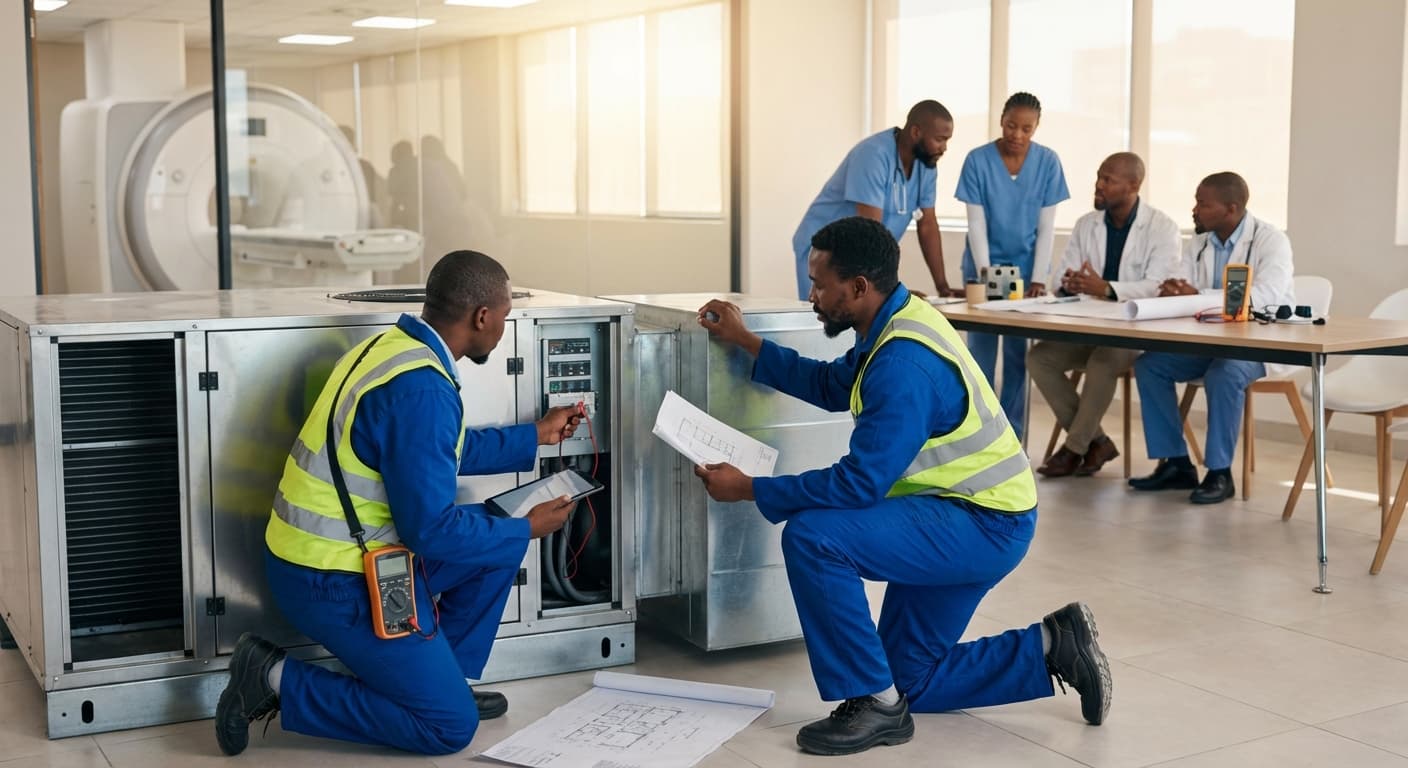
Site Readiness Assessment Service (Space/Access/HVAC/Power/Shielding) in Angola
Engineering Excellence & Technical Support
Site Readiness Assessment Service (Space/Access/HVAC/Power/Shielding) High-standard technical execution following OEM protocols and local regulatory frameworks.
Optimized Site Selection for Space & Access in Angola
Leveraging our deep understanding of Angolan geography and infrastructure, we conduct detailed site surveys to identify locations offering optimal satellite dish orientation, minimal signal obstruction, and seamless physical access for installation and maintenance teams, ensuring reliable connectivity for critical operations.
HVAC & Power Resilience Assessments for Angolan Climate
Our technical experts perform rigorous assessments of HVAC systems and power infrastructure, factoring in Angola's specific climate conditions (humidity, temperature extremes) and power grid reliability. We identify potential vulnerabilities and recommend robust solutions to guarantee uninterrupted operation and prevent costly downtime.
Comprehensive Shielding and Environmental Risk Evaluation in Angola
We provide expert analysis of electromagnetic shielding requirements and potential environmental risks (e.g., seismic activity, flood zones) across Angola. Our assessments ensure that proposed sites meet stringent safety and operational integrity standards, safeguarding your valuable equipment and data.
What Is Site Readiness Assessment Service (Space/access/hvac/power/shielding) In Angola?
The Site Readiness Assessment Service (Space/Access/HVAC/Power/Shielding) in Angola is a comprehensive technical evaluation designed to determine the suitability of a proposed or existing location for the installation, operation, and maintenance of critical infrastructure, typically related to telecommunications, data centers, industrial processes, or specialized research facilities. This service meticulously examines key environmental and logistical factors to ensure the site can support the proposed technological deployment without compromise to performance, reliability, or safety.
The assessment comprises a detailed analysis of the following critical domains:
- Space: Evaluation of available physical area, floor loading capacity, ceiling height, and structural integrity to accommodate equipment racks, machinery, cabling infrastructure, and operational personnel. This includes assessing the potential for future expansion.
- Access: Examination of ingress and egress points for personnel, equipment, and vehicles. This involves analyzing the suitability of roadways, loading docks, elevators, and internal pathways for the safe and efficient movement of heavy or sensitive materials.
- HVAC (Heating, Ventilation, and Air Conditioning): Assessment of existing or required environmental control systems. This includes evaluating temperature and humidity regulation capabilities, air filtration, redundancy, and the capacity to dissipate heat generated by installed equipment to maintain optimal operating conditions and prevent thermal failure.
- Power: Comprehensive analysis of the electrical infrastructure. This includes verifying the availability, capacity, and stability of the utility power supply, the adequacy of backup power systems (e.g., UPS, generators), power distribution within the facility, and the grounding and protection schemes to prevent surges and outages.
- Shielding: Evaluation of electromagnetic interference (EMI) and radio frequency interference (RFI) mitigation strategies. This involves assessing the site's susceptibility to external interference and the need for or effectiveness of internal shielding measures to protect sensitive electronic equipment from disruptive signals.
Who Needs It:
This service is essential for organizations planning to deploy or upgrade infrastructure in Angola that requires specific environmental conditions, robust utility support, and secure physical accommodations. This includes, but is not limited to:
- Telecommunications companies (mobile operators, internet service providers) establishing new base stations, data centers, or Points of Presence (PoPs).
- Cloud service providers and hyperscalers planning data center facilities.
- Industrial enterprises requiring specialized production or research environments.
- Government agencies and defense organizations implementing secure communication or operational facilities.
- Financial institutions or critical service providers requiring highly reliable and secure infrastructure.
- Research and development institutions with specialized equipment requiring controlled environments.
Typical Use Cases:
- New Data Center Construction: Ensuring the selected site has sufficient space, power, cooling, and access for construction and future operation. Verifying compliance with structural and environmental regulations.
- Telecommunications Network Expansion: Assessing potential sites for cell towers or equipment shelters, including power availability, site access for maintenance, and protection against environmental factors.
- Industrial Automation Deployment: Evaluating factory floor space, power requirements, and environmental controls for sophisticated manufacturing or processing machinery.
- Upgrade or Retrofit Projects: Determining the feasibility and scope of upgrading existing facilities to accommodate new, more power-hungry, or environmentally sensitive equipment.
- Disaster Recovery Site Selection: Identifying and validating alternative sites that meet stringent requirements for uptime, connectivity, and environmental stability.
- Research Facility Establishment: Ensuring laboratories and testing environments meet precise temperature, humidity, and electromagnetic shielding specifications.
- Secure Facility Development: Assessing physical security aspects, access control, and potential vulnerabilities related to power and environmental integrity.
| Domain | Description | Key Considerations |
|---|---|---|
| Space | Evaluation of physical footprint and structural capacity. | Floor loading, ceiling height, room dimensions, expansion potential, seismic considerations. |
| Access | Assessment of logistical and physical entry points. | Road access, loading docks, elevator capacity, pathway clearance, security checkpoints. |
| HVAC | Analysis of environmental control systems for thermal and air quality management. | Cooling capacity (BTU/hr), temperature/humidity setpoints, redundancy, filtration levels, heat dissipation. |
| Power | Comprehensive review of electrical supply, distribution, and backup capabilities. | Utility voltage/frequency, available Amperage/kW, UPS capacity, generator fuel supply, PDU configuration, grounding resistance. |
| Shielding | Evaluation of protection against electromagnetic and radio frequency interference. | Site proximity to interference sources, material composition, need for RF-shielded rooms, Faraday cage integrity. |
Key Assessment Domains
- Space (physical area, load capacity, structural integrity)
- Access (ingress/egress, logistics, transportation)
- HVAC (environmental control, temperature, humidity, air filtration)
- Power (utility supply, backup systems, distribution, grounding)
- Shielding (EMI/RFI mitigation)
Who Needs Site Readiness Assessment Service (Space/access/hvac/power/shielding) In Angola?
A Site Readiness Assessment Service is crucial for any organization planning to establish or expand operations in Angola that require specific infrastructure and environmental controls. This service ensures that a proposed site meets the necessary technical and logistical requirements before significant investment is made. Key aspects evaluated include space availability and suitability, physical access for construction and ongoing operations, HVAC (Heating, Ventilation, and Air Conditioning) systems for environmental control, reliable power supply and distribution, and shielding requirements for sensitive equipment or data centers.
| Target Customer Segment | Relevant Departments/Roles | Key Considerations for Assessment |
|---|---|---|
| Telecommunications | Network Planning, Operations, Infrastructure Management, Real Estate | Site accessibility, Power redundancy, HVAC for equipment, Physical security, Space for expansion, Shielding for sensitive antennas |
| Data Centers/Cloud | IT Infrastructure, Operations, Engineering, Facilities Management, Security | Power capacity and reliability, Cooling systems (HVAC), Physical space (white space, support areas), Network connectivity, Physical access controls, Fire suppression readiness, Earthquake/Environmental resilience |
| Mining/Oil & Gas | Operations, Engineering, Facilities, HSE (Health, Safety, Environment), Logistics | Remote site access, Power generation/distribution, HVAC for control rooms and labs, Environmental control for equipment, Communication infrastructure, Security, Water and waste management |
| Financial Institutions | IT Operations, Facilities Management, Security, Branch Operations, Risk Management | Power stability and backup, HVAC for server rooms and vaults, Physical security, Secure access, Space planning, Network infrastructure |
| Manufacturing/Industrial | Operations, Engineering, Production Planning, Facilities Management, Supply Chain | Power capacity for machinery, HVAC for production areas and labs, Material handling access, Storage space, Environmental controls for product quality, Waste management |
| Healthcare | Facilities Management, IT Department, Clinical Engineering, Hospital Administration, Procurement | Uninterruptible power supply (UPS) for medical equipment, HVAC for operating rooms, labs, and pharmacies, Patient and staff access, Sterilization and waste management, Security |
| Government/Public Sector | Public Works, Infrastructure Development, IT Department, Security Agencies, Administrative Departments | Public accessibility, Power reliability, HVAC for sensitive equipment and offices, Communication infrastructure, Security protocols, Compliance with national standards |
| R&D Institutions | Laboratory Management, IT Infrastructure, Facilities Engineering, Research Leads, Procurement | Precise environmental controls (HVAC), Stable power for sensitive experiments, Specialized shielding (if required), Secure access to labs, Space for equipment and personnel |
| Logistics/Warehousing | Operations Management, Facilities, Supply Chain, Inventory Management | Loading dock access, Forklift maneuverability, HVAC for temperature-sensitive goods, Power for automated systems, Warehouse space, Security |
Target Customers and Departments in Angola Needing Site Readiness Assessment
- {"item":"Telecommunications Companies","description":"For new cell towers, data centers, and network infrastructure deployment. They need to ensure adequate power, cooling, and physical security at remote or urban locations."}
- {"item":"Data Center Operators and Cloud Service Providers","description":"Require robust power, precise climate control (HVAC), physical space, and secure access for their critical infrastructure. Shielding might be important for specific sensitive equipment."}
- {"item":"Mining and Oil & Gas Companies","description":"For establishing remote operational bases, processing facilities, and exploration sites. Reliable power, HVAC for controlled environments (labs, control rooms), and secure access are paramount, especially in challenging terrains."}
- {"item":"Financial Institutions","description":"For new branch locations, data processing centers, or secure vaults. Power stability, physical security, and appropriate environmental controls are essential."}
- {"item":"Manufacturing and Industrial Enterprises","description":"When setting up new factories or expanding existing ones, requiring precise environmental conditions for production lines, machinery, and storage. Power capacity and reliable access are also key."}
- {"item":"Healthcare Providers (Hospitals, Clinics)","description":"For new facilities or upgrades requiring stable power for medical equipment, precise temperature and humidity control for sensitive areas (laboratories, pharmacies), and easy access for patients and staff."}
- {"item":"Government Agencies and Public Sector Projects","description":"For national infrastructure development, secure communication centers, or administrative buildings. They need to ensure sites meet standards for power, access, and environmental control."}
- {"item":"Research and Development Institutions","description":"Requiring specialized environments for experiments, laboratories, and sensitive equipment, necessitating precise HVAC and stable power. Shielding might be a requirement for certain research."}
- {"item":"Logistics and Warehousing Companies","description":"For establishing new distribution centers or warehouses where temperature-controlled storage (HVAC) and efficient physical access are critical."}
Site Readiness Assessment Service (Space/access/hvac/power/shielding) Process In Angola
This document outlines the typical workflow for a Site Readiness Assessment Service in Angola, covering key aspects like Space, Access, HVAC, Power, and Shielding. The process is designed to ensure a smooth and efficient deployment or upgrade of infrastructure.
| Phase | Key Activities | Deliverables | Responsible Parties | Considerations in Angola |
|---|---|---|---|---|
| Inquiry & Initial Consultation | Client submits an inquiry detailing their requirements (e.g., new site build, equipment upgrade). Initial call/meeting to understand scope, objectives, and any preliminary constraints. Discussion of service offerings and general project timelines. | Project brief, initial understanding of client needs. | Client, Service Provider (Sales/Project Manager) | Clear communication of service scope, potential language barriers (Portuguese is the official language), and local business etiquette. |
| Site Survey & Data Collection | Detailed on-site inspection of the proposed location. Assessment of physical space, accessibility for equipment and personnel, existing HVAC capacity, power availability and quality, and any existing shielding requirements (e.g., for RF or EMI). Collection of detailed measurements, photographs, and relevant documentation (e.g., building plans). | Raw site data (measurements, photos, reports on existing infrastructure). | Service Provider (Field Engineers/Technicians) | Logistics for travel to remote areas, obtaining site access permits, safety protocols, understanding local power grid fluctuations, awareness of local environmental conditions (e.g., heat, humidity). |
| Analysis & Reporting | Review of collected data to identify any gaps, deficiencies, or potential risks. Analysis of HVAC performance, power load calculations, structural integrity for space, and shielding effectiveness. Compilation of a comprehensive Site Readiness Report. | Comprehensive Site Readiness Report detailing findings, identified issues, and initial risk assessments. | Service Provider (Engineers/Analysts) | Interpretation of data considering local building codes and standards, potential for using locally sourced materials if upgrades are needed. |
| Recommendation & Design | Based on the report, development of specific recommendations for site upgrades or modifications. This may include HVAC system enhancements, power infrastructure improvements (generators, UPS), structural modifications for space, or installation of shielding solutions. Detailed design proposals and cost estimates are prepared. | Recommendations for upgrades, detailed design proposals, cost estimates. | Service Provider (Design Engineers/Project Manager) | Availability and cost of specialized equipment and materials locally, lead times for imports, potential for local skilled labor for implementation. |
| Approval & Planning | Presentation of the Site Readiness Report and recommendations to the client for review and approval. Discussion of proposed solutions, budget, and timeline. Once approved, detailed project planning commences, including procurement, resource allocation, and scheduling. | Client approval, detailed project plan, procurement schedule. | Client, Service Provider (Project Manager/Client Stakeholders) | Client's internal approval processes, understanding of typical project approval cycles in Angola. |
| Execution & Implementation | Implementation of approved recommendations. This involves physical work such as HVAC upgrades, power system installations, structural modifications, and shielding deployment. Coordination with local contractors and suppliers. | Completed site modifications and installations. | Service Provider (Project Manager/Site Supervisors), Local Contractors | Management of local workforce, ensuring quality control, navigating import/customs procedures for materials, adherence to safety regulations. |
| Verification & Handover | Post-implementation testing and verification of all upgraded systems to ensure they meet specified requirements and standards. Final site walk-through with the client. Documentation of all work performed and handover of relevant project documentation and warranties. | Verification reports, final site acceptance documentation, project close-out documents. | Service Provider (Project Manager/Quality Assurance), Client | Ensuring all documentation is clear and comprehensive for the client's records, final quality checks performed to international standards. |
Site Readiness Assessment Service Workflow in Angola
- Inquiry & Initial Consultation
- Site Survey & Data Collection
- Analysis & Reporting
- Recommendation & Design
- Approval & Planning
- Execution & Implementation
- Verification & Handover
Site Readiness Assessment Service (Space/access/hvac/power/shielding) Cost In Angola
Assessing site readiness for projects in Angola, particularly those requiring specialized infrastructure like space, access, HVAC, power, and shielding, involves a complex interplay of factors that influence cost. These factors range from the geographical location and existing infrastructure to the specific project requirements and the expertise of the service provider.
Key Pricing Factors:
- Geographical Location: Angola is a vast country, and costs can vary significantly between major cities like Luanda and more remote regions. Accessibility, transportation of equipment and personnel, and local labor rates will all be impacted by the site's location.
- Scope of Assessment: The depth and breadth of the assessment are paramount. A basic assessment of existing space and power will be less expensive than a comprehensive evaluation including detailed HVAC load calculations, complex power distribution analysis, and advanced shielding simulations. The number of systems to be assessed (e.g., multiple data halls, specialized research facilities) also impacts cost.
- Existing Infrastructure Audit: The extent to which existing infrastructure can be leveraged will influence the cost. If significant upgrades are needed, the assessment will naturally be more involved and costly than if the site is already well-equipped.
- Specialized Equipment & Technology: For HVAC, power, and shielding assessments, the need for specialized diagnostic equipment, energy modeling software, or electromagnetic field (EMF) measurement tools will add to the overall expense.
- Data Collection & Analysis: The methodology for data collection (e.g., on-site measurements, historical data review, interviews) and the complexity of the data analysis required will determine the man-hours involved.
- Reporting & Documentation: The level of detail and format of the final report and recommendations will affect the time spent by the consultants.
- Service Provider Expertise & Reputation: Experienced and reputable engineering or consulting firms with specialized knowledge in site readiness assessments for the specific industry (e.g., data centers, telecommunications, research facilities) will typically command higher fees.
- Project Timeline & Urgency: Expedited assessments or projects with tight deadlines may incur additional charges due to the need for rapid deployment of resources.
- Regulatory Compliance: If the assessment needs to consider specific Angolan building codes, electrical standards, or environmental regulations, this will add to the complexity and cost.
- Travel & Logistics: For remote sites, travel and accommodation costs for the assessment team can be substantial.
Estimated Cost Ranges in Angolan Kwanza (AOA):
It's crucial to understand that these are estimates and actual costs can fluctuate significantly. The Angolan market for highly specialized technical assessments can be less standardized than in more developed economies, leading to wider potential ranges.
For a typical Site Readiness Assessment Service (covering Space, Access, HVAC, Power, and Shielding), the cost in Angola can be broadly categorized as follows:
- Small to Medium Scale Project (e.g., assessment of a single server room or a small facility): This would involve a more focused assessment, potentially relying more on visual inspection and existing documentation. The cost might range from 500,000 AOA to 2,500,000 AOA.
- Medium to Large Scale Project (e.g., assessment of multiple data halls, a research laboratory, or a significant industrial facility): This would involve more in-depth analysis, potentially including on-site measurements, simulations, and detailed engineering reviews. The cost could range from 2,500,000 AOA to 15,000,000 AOA or higher.
- Very Large or Highly Specialized Projects (e.g., assessment for mission-critical infrastructure, advanced telecommunications hubs, or facilities with stringent shielding requirements): These projects demand extensive expertise, specialized equipment, and comprehensive reporting. Costs can easily exceed 15,000,000 AOA and reach upwards of 50,000,000 AOA or more, depending on the complexity and unique demands.
Note: The exchange rate of the Angolan Kwanza (AOA) to major international currencies can fluctuate. It's essential to obtain specific quotes from local service providers based on your project's unique requirements.
| Service Component | Typical Scope of Assessment | Estimated Cost Range (AOA) |
|---|---|---|
| Space | Review of current footprint, future expansion potential, floor load capacity, ceiling height, environmental considerations (temperature, humidity). | 200,000 - 1,000,000 |
| Access | Evaluation of entry points, loading docks, internal movement paths, security checkpoints, suitability for equipment delivery and maintenance. | 150,000 - 750,000 |
| HVAC | Assessment of existing cooling/heating capacity, airflow, humidity control, redundancy, energy efficiency, and ability to meet project-specific thermal loads. | 300,000 - 2,500,000 |
| Power | Analysis of utility supply capacity, UPS systems, generator backup, PDU distribution, grounding, surge protection, and redundancy. | 400,000 - 3,000,000 |
| Shielding | Evaluation of electromagnetic interference (EMI), radio frequency interference (RFI), potential radiation sources, and requirements for shielding materials and design. | 300,000 - 2,000,000 |
| Comprehensive Assessment (All Components) | Integrated evaluation of all listed components, detailed analysis, reporting, and recommendations. | 500,000 - 50,000,000+ |
Key Components of a Site Readiness Assessment
- Space Suitability & Scalability
- Physical Access & Security
- HVAC System Capacity & Redundancy
- Power Availability, Reliability & Distribution
- Shielding Requirements (EMI/RFI, Radiation)
Affordable Site Readiness Assessment Service (Space/access/hvac/power/shielding) Options
Our Affordable Site Readiness Assessment Service provides a comprehensive evaluation of your facility's preparedness for new equipment or infrastructure. We meticulously analyze critical aspects including Space, Access, HVAC, Power, and Shielding requirements. Our goal is to identify potential bottlenecks and ensure a smooth, cost-effective deployment. We offer flexible value bundles tailored to your specific needs, along with strategic cost-saving recommendations throughout the assessment process.
| Value Bundle Name | Included Assessments | Key Benefits | Starting Price (USD) |
|---|---|---|---|
| Essential Site Check | Space, Access | Identifies basic physical constraints and logistical challenges. Ideal for small-scale deployments. | $500 |
| Standard Infrastructure Audit | Space, Access, HVAC, Power | Comprehensive assessment of critical infrastructure, ensuring environmental and power readiness. Most popular for general IT upgrades. | $950 |
| Advanced Facility Readiness | Space, Access, HVAC, Power, Shielding | Full-spectrum evaluation including specialized shielding needs for sensitive equipment or environments. Best for complex or high-tech installations. | $1,500 |
| Customizable Assessment | Select any combination of assessments | Tailored to your unique requirements, ensuring you only pay for what you need. | Quote-Based |
Key Assessment Areas:
- Space: Evaluating physical footprint, layout efficiency, and future expansion potential.
- Access: Assessing suitability for equipment delivery, installation, and maintenance pathways.
- HVAC: Analyzing current cooling/heating capacity, airflow, and humidity control for environmental stability.
- Power: Determining power availability, capacity, redundancy, and distribution for electrical demands.
- Shielding: Evaluating electromagnetic, radiofrequency, or physical shielding requirements based on equipment needs.
Verified Providers In Angola
In Angola's evolving healthcare landscape, distinguishing between legitimate and potentially unreliable health service providers can be a significant challenge for individuals seeking quality care. This is where verified providers, such as those credentialed by Franance Health, emerge as a crucial element in ensuring patient safety and satisfaction. Franance Health's rigorous credentialing process acts as a robust filter, guaranteeing that partner providers meet stringent standards for medical expertise, ethical practice, and operational integrity. This not only streamlines access to trusted healthcare but also fosters a more transparent and reliable system for all.
| Credentialing Aspect | Franance Health Standard | Benefit to Patients |
|---|---|---|
| Medical License Verification | Thorough checks against national and international licensing bodies. | Ensures providers are legally qualified and authorized to practice. |
| Professional Qualifications | Verification of educational background, certifications, and specialized training. | Confirms expertise and specialized knowledge in their respective fields. |
| Clinical Experience and Competency | Assessment of practical experience and review of patient outcomes (where applicable). | Indicates a proven track record of successful patient care. |
| Ethical Practice and Reputation | Background checks for any disciplinary actions and peer reviews. | Guarantees adherence to ethical guidelines and a positive professional reputation. |
| Facility Standards | Evaluation of infrastructure, equipment, and hygiene protocols. | Ensures a safe, clean, and well-equipped environment for treatment. |
| Continuing Medical Education (CME) | Requirement for providers to engage in ongoing professional development. | Confirms providers stay updated with the latest medical advancements and techniques. |
Why Franance Health Credentials Matter
- Unwavering Commitment to Quality: Franance Health meticulously vets providers to ensure they adhere to the highest medical and ethical standards, guaranteeing you receive competent and compassionate care.
- Enhanced Patient Safety: Our credentialing process includes background checks, verification of licenses, and assessments of clinical outcomes, minimizing risks associated with unqualified practitioners.
- Access to Trusted Specialists: We identify and partner with leading healthcare professionals across various disciplines, ensuring you can find the right expert for your specific needs.
- Streamlined Healthcare Experience: By choosing a Franance Health-credentialed provider, you bypass the uncertainty of searching for reliable care, saving you time and reducing stress.
- Promoting Healthcare Integrity: Our commitment to transparency and rigorous standards contributes to a more trustworthy and accessible healthcare ecosystem in Angola.
Scope Of Work For Site Readiness Assessment Service (Space/access/hvac/power/shielding)
This Scope of Work (SOW) outlines the services for a Site Readiness Assessment, focusing on critical infrastructure elements: Space, Access, HVAC, Power, and Shielding. The objective is to evaluate the suitability of the proposed site for a new deployment (e.g., data center, server room, lab, etc.) by identifying any deficiencies and providing recommendations for remediation. The assessment will be performed by qualified technical personnel, and the findings will be documented in technical deliverables adhering to standard specifications.
| Technical Deliverable | Description | Standard Specification / Content |
|---|---|---|
| Site Readiness Assessment Report | A comprehensive document detailing the findings of the assessment across all evaluated categories. | Executive Summary, Detailed Findings per Category (Space, Access, HVAC, Power, Shielding), Deficiencies Log, Remediation Recommendations (with estimated costs and timelines where applicable), Site Layout Drawings (annotated), Equipment Inventory (if applicable), Risk Assessment. |
| Site Survey Checklist | A detailed checklist used during the site visit to systematically record observations and measurements. | Specific criteria for each category, including dimensions, capacities, types of existing equipment, environmental readings (temperature, humidity), power outlet types and quantities, access point specifications, and shielding measurements (if applicable). |
| Recommendations Document | A focused document detailing proposed solutions for identified deficiencies. | Clear descriptions of required upgrades/modifications, vendor recommendations (optional), estimated budget, implementation timeline, and expected outcomes. |
| Annotated Site Plan / CAD Drawing | A visual representation of the site with key areas and infrastructure marked. | Indication of equipment placement, cable pathways, power outlets, HVAC vents, access routes, and any proposed structural changes. |
Scope of Work Activities
- Space Assessment: Evaluating physical dimensions, layout, load-bearing capacity, and any required structural modifications.
- Access Assessment: Reviewing entry points, pathways for equipment movement, security considerations, and any necessary upgrades.
- HVAC Assessment: Analyzing current cooling capacity, airflow, humidity control, and determining if sufficient capacity exists or needs to be augmented.
- Power Assessment: Verifying available power capacity, distribution infrastructure, UPS capabilities, generator backup, and grounding.
- Shielding Assessment: Evaluating the need for and presence of any required electromagnetic, RF, or radiation shielding based on the intended use of the space.
- Identification of Gaps and Deficiencies: Documenting any areas where the existing site infrastructure does not meet the project requirements.
- Recommendations for Remediation: Providing actionable steps and proposed solutions to address identified gaps and deficiencies.
- Development of Technical Deliverables: Compiling all findings and recommendations into a comprehensive report.
Service Level Agreement For Site Readiness Assessment Service (Space/access/hvac/power/shielding)
This Service Level Agreement (SLA) outlines the response times and uptime guarantees for the Site Readiness Assessment Service. This service encompasses the evaluation of Space, Access, HVAC, Power, and Shielding requirements for a given site.
1. Definitions
- Site Readiness Assessment Service (SRAS): The service provided to evaluate and report on the suitability of a site based on Space, Access, HVAC, Power, and Shielding requirements.
- Customer: The entity or individual requesting the SRAS.
- Provider: The entity providing the SRAS.
- Service Hours: Standard business hours, typically Monday to Friday, 9:00 AM to 5:00 PM in the Provider's local time zone, excluding public holidays.
- Scheduled Maintenance: Pre-announced periods where the SRAS may be temporarily unavailable for updates or essential maintenance.
- Downtime: The period when the SRAS is unavailable to the Customer, excluding Scheduled Maintenance and events outside the Provider's reasonable control.
- Response Time: The maximum time allowed for the Provider to acknowledge a Customer request or issue and begin initial troubleshooting or assessment work.
- Uptime Guarantee: The minimum percentage of time the SRAS is expected to be available.
2. Service Scope
The SRAS includes the assessment of:
- Space: Availability of adequate physical space for equipment, personnel, and future expansion.
- Access: Ease of physical access for equipment installation, maintenance, and personnel.
- HVAC: Suitability and capacity of existing heating, ventilation, and air conditioning systems to meet environmental requirements.
- Power: Availability, capacity, and reliability of electrical power infrastructure.
- Shielding: Assessment of existing or required electromagnetic, RF, or other forms of shielding.
3. Response Times
The following response times apply during Service Hours for acknowledged requests related to the SRAS. Requests received outside of Service Hours will be addressed on the next business day.
| Service Area | Severity Level | Response Time (Business Hours) |
| :------------------- | :------------------ | :----------------------------- |
| General Inquiry | All | 8 Business Hours |
| Assessment Request | High (Critical Site) | 4 Business Hours |
| Assessment Request | Medium (Standard Site)| 8 Business Hours |
| Clarification Request| All | 12 Business Hours |
- Severity Levels:
* **High (Critical Site):** Issues that prevent or severely impact the ability to conduct the assessment, or represent a significant risk to the project timeline.
* **Medium (Standard Site):** Issues that may cause minor delays or require additional effort but do not halt the assessment process.
4. Uptime Guarantees
The Provider commits to the following uptime for the SRAS infrastructure and reporting platform:
- Monthly Uptime Guarantee: 99.5%
This guarantee excludes Scheduled Maintenance. The Provider will provide at least 48 hours' notice for any Scheduled Maintenance.
5. Service Credits
In the event that the Provider fails to meet the Monthly Uptime Guarantee, the Customer may be eligible for service credits. Specific service credit calculations and eligibility will be detailed in a separate Service Credit Policy document.
6. Exclusions
This SLA does not cover:
- Downtime caused by factors outside the Provider's reasonable control, including but not limited to, force majeure events (e.g., natural disasters, acts of war, terrorism), internet service provider failures, or Customer-induced issues.
- Downtime related to Scheduled Maintenance.
- Issues arising from Customer's failure to provide necessary information or access in a timely manner.
- Third-party software or hardware failures not directly managed by the Provider.
7. Reporting and Monitoring
The Provider will monitor the availability of the SRAS infrastructure and reporting platform and will provide regular reports to the Customer upon request.
8. Review and Amendments
This SLA will be reviewed annually and may be amended by mutual agreement between the Provider and the Customer. Any amendments must be in writing and signed by both parties.
| Service Area | Severity Level | Response Time (Business Hours) |
|---|---|---|
| General Inquiry | All | 8 Business Hours |
| Assessment Request | High (Critical Site) | 4 Business Hours |
| Assessment Request | Medium (Standard Site) | 8 Business Hours |
| Clarification Request | All | 12 Business Hours |
Service Level Agreement for Site Readiness Assessment Service
- Definitions
- Service Scope
- Response Times
- Uptime Guarantees
- Service Credits
- Exclusions
- Reporting and Monitoring
- Review and Amendments
Frequently Asked Questions

Ready when you are
Let's scope your Site Readiness Assessment Service (Space/Access/HVAC/Power/Shielding) in Angola project in Angola.

Scaling healthcare logistics and technical systems across the entire continent.