
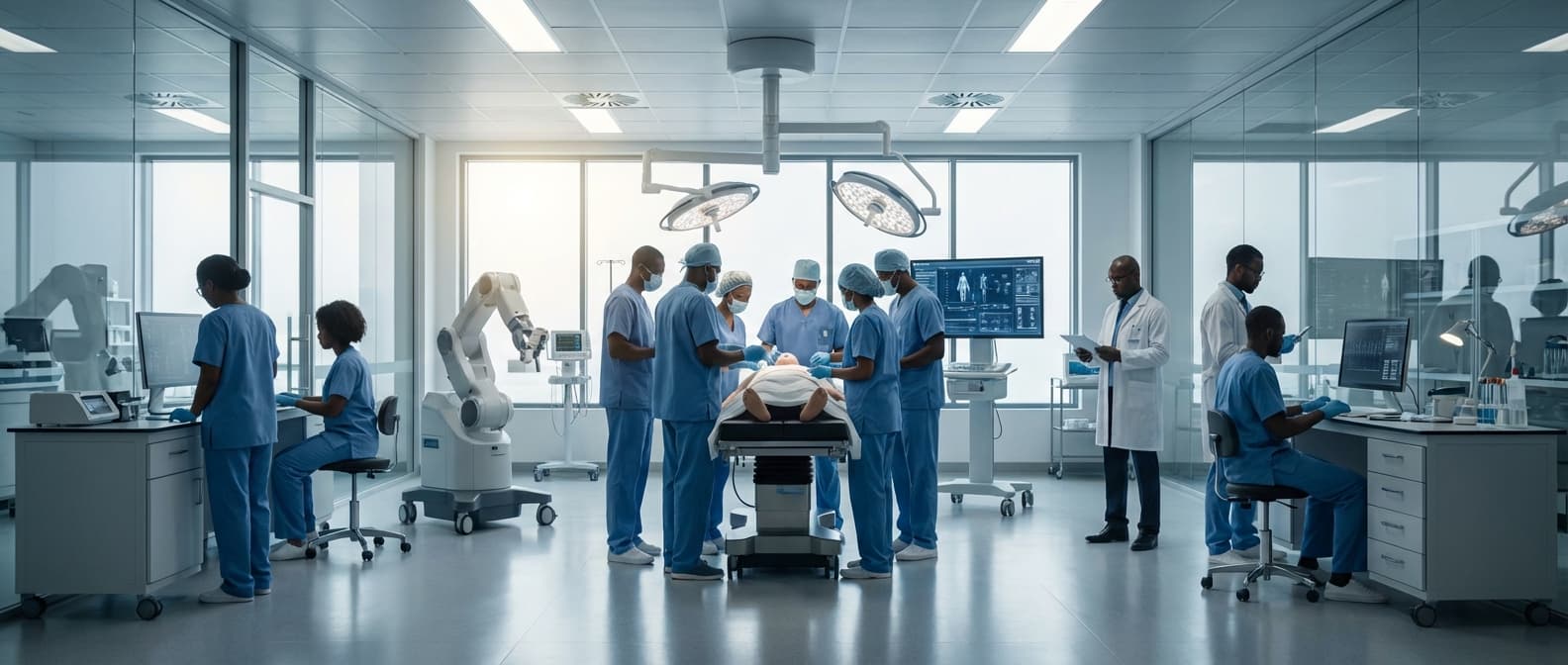
Biomedical Engineering Consulting in Angola
Engineering Excellence & Technical Support
Equipment selection, procurement and implementation consulting High-standard technical execution following OEM protocols and local regulatory frameworks.
Biomedical Device Integration & Cybersecurity
We specialize in the seamless integration of advanced biomedical devices into Angolan healthcare facilities, ensuring interoperability and adherence to international standards. Our expertise extends to robust cybersecurity protocols, safeguarding sensitive patient data and critical medical infrastructure from evolving threats, thereby enhancing patient safety and operational efficiency.
Healthcare Facility Design & Equipment Planning
Leveraging cutting-edge biomedical engineering principles, we provide comprehensive consulting services for the design and equipping of new healthcare facilities and the modernization of existing ones in Angola. This includes optimizing workflow, selecting appropriate medical equipment based on clinical needs and budget, and ensuring compliance with local regulations and best practices for optimal patient care delivery.
Clinical Engineering & Technical Training Programs
Our services encompass the establishment and management of robust clinical engineering departments in Angolan hospitals. We develop and deliver tailored technical training programs for biomedical technicians and clinical staff, empowering local expertise in device maintenance, calibration, and safe operation, leading to reduced downtime, improved equipment lifespan, and enhanced patient outcomes.
What Is Biomedical Engineering Consulting In Angola?
Biomedical Engineering Consulting in Angola encompasses the provision of specialized technical and scientific expertise to organizations involved in healthcare, medical technology, and related life science sectors. This service involves the application of engineering principles and design methodologies to address challenges and opportunities within the Angolan healthcare ecosystem. Consultants offer strategic advice, problem-solving, and implementation support across a spectrum of biomedical engineering domains, aiming to enhance healthcare delivery, optimize medical device utilization, and foster innovation. The scope of services typically includes needs assessment, technology evaluation, project management, regulatory compliance guidance, facility planning, and training. The ultimate objective is to improve patient outcomes, operational efficiency, and the adoption of advanced medical technologies within the Angolan context.
| Who Needs Biomedical Engineering Consulting in Angola? | Typical Use Cases |
|---|---|
| Government Ministries of Health & Public Health Agencies: Seeking to modernize national healthcare systems, establish procurement frameworks, and ensure equitable access to medical technology. | Developing national strategies for medical equipment acquisition and maintenance. Assessing the technological needs of public hospitals and clinics. Establishing regulatory pathways for medical devices. Designing public health infrastructure projects. |
| Hospitals and Healthcare Providers (Public & Private): Aiming to optimize their medical device inventory, improve maintenance protocols, enhance patient safety, and integrate new technologies. | Conducting audits of existing medical equipment. Implementing preventive maintenance programs. Selecting and procuring new diagnostic or therapeutic equipment. Designing workflows for the efficient use of medical devices. Troubleshooting complex equipment failures. |
| Medical Device Manufacturers and Distributors: Seeking to navigate the Angolan market, establish distribution channels, ensure product compliance, and provide after-sales support. | Gaining market entry intelligence and regulatory guidance. Developing service and maintenance strategies for their products. Training local technical staff. Assessing the feasibility of local assembly or manufacturing. |
| Research Institutions and Universities: Focused on advancing medical research, developing new healthcare technologies, and establishing biomedical engineering programs. | Advising on the acquisition and integration of research-grade equipment. Assisting in the design of laboratory infrastructure. Providing expertise for curriculum development in biomedical engineering. |
| International Development Organizations and NGOs: Involved in healthcare initiatives and infrastructure development projects within Angola. | Providing technical oversight for healthcare projects. Ensuring the appropriate selection and deployment of medical equipment in aid projects. Assessing the sustainability of healthcare technologies introduced. |
Key Facets of Biomedical Engineering Consulting in Angola
- Needs Assessment and Gap Analysis for Healthcare Infrastructure
- Medical Device Procurement and Lifecycle Management
- Technology Strategy and Roadmap Development
- Regulatory Affairs and Compliance Advisory (e.g., ANVISA equivalents, national standards)
- Biomedical Equipment Maintenance and Management Program Design
- Healthcare Facility Design and Renovation Planning (from an engineering perspective)
- Training and Capacity Building for Biomedical Personnel
- Risk Management and Quality Assurance in Medical Device Deployment
- Feasibility Studies for New Healthcare Technologies and Services
- Integration of Digital Health Solutions
Who Needs Biomedical Engineering Consulting In Angola?
Biomedical engineering consulting in Angola plays a crucial role in advancing healthcare infrastructure and services. It bridges the gap between technological innovation and practical medical application, ensuring that healthcare providers have access to efficient, safe, and advanced medical equipment and systems. This expertise is vital for improving patient care, optimizing operational efficiency within healthcare facilities, and fostering a robust local healthcare ecosystem.
| Target Customer | Key Departments/Needs |
|---|---|
| Hospitals (Public and Private) | Biomedical Engineering Department (for equipment maintenance, calibration, procurement, lifecycle management); Clinical Departments (for selection and integration of specialized equipment); IT Department (for integration of medical devices with hospital information systems); Facilities Management (for infrastructure requirements of medical equipment). |
| Clinics and Diagnostic Centers | Procurement and selection of diagnostic and therapeutic equipment; Installation and commissioning; Training of staff on new equipment; Maintenance and repair services. |
| Research Institutions and Universities | Acquisition and maintenance of specialized research equipment; Development of custom biomedical devices for research projects; Guidance on laboratory setup and safety protocols. |
| Government Health Ministries and Agencies | Development of national healthcare technology strategies; Standardization of medical equipment procurement and maintenance policies; Regulatory compliance and quality assurance for medical devices; Infrastructure planning for public health facilities. |
| Medical Equipment Manufacturers and Distributors | Market entry strategy and regulatory navigation; After-sales service and technical support network development; Product adaptation and localization for the Angolan market; Training for local technical staff. |
| Non-Governmental Organizations (NGOs) involved in healthcare | Needs assessment for medical equipment in underserved areas; Procurement and donation management of medical devices; Training and capacity building for healthcare workers in remote settings; Ensuring the sustainability of medical equipment donations. |
| Companies developing or implementing health IT solutions | Integration of medical devices with electronic health records (EHRs) and other health information systems; Cybersecurity for connected medical devices; User interface design and usability testing for health tech applications. |
Who Needs Biomedical Engineering Consulting in Angola?
- Hospitals (Public and Private)
- Clinics and Diagnostic Centers
- Research Institutions and Universities
- Government Health Ministries and Agencies
- Medical Equipment Manufacturers and Distributors
- Non-Governmental Organizations (NGOs) involved in healthcare
- Companies developing or implementing health IT solutions
Biomedical Engineering Consulting Process In Angola
The Biomedical Engineering consulting process in Angola, like in many other regions, follows a structured workflow designed to effectively address the unique needs of healthcare institutions and technology providers. This process typically begins with an initial inquiry and culminates in the successful execution and integration of recommended solutions. The workflow is iterative, often involving feedback loops to ensure alignment with client objectives and regulatory compliance within the Angolan healthcare landscape.
| Stage | Description | Key Activities | Deliverables | Considerations for Angola |
|---|---|---|---|---|
| The starting point where a potential client expresses interest in biomedical engineering consulting services. | Receive inquiry, schedule initial meeting, understand broad client needs, discuss service offerings. | Brief understanding of client challenge, preliminary service scope discussion. | Establish clear communication channels, understand local business etiquette, identify primary contact person. |
| A deep dive into the client's specific challenges, goals, and existing infrastructure. | Conduct site visits, interview stakeholders, review existing documentation (inventory, maintenance records, protocols), identify pain points and opportunities. | Detailed problem statement, documented needs and requirements, identified stakeholders. | Understand the current state of healthcare infrastructure, identify specific medical equipment needs, assess existing technical expertise within the institution. |
| Formulating a tailored solution based on the needs assessment. | Define project objectives, outline proposed services, estimate timelines, develop a cost breakdown, define key performance indicators (KPIs). | Detailed project proposal, scope of work, estimated budget, proposed timeline. | Align proposals with national healthcare priorities, consider import/export regulations for medical equipment, factor in potential infrastructure limitations (power, connectivity). |
| Formalizing the consulting engagement. | Review and negotiate proposal terms, finalize contract details (payment terms, deliverables, intellectual property), sign agreement. | Signed consulting contract, Service Level Agreement (SLA). | Ensure contract language is clear and legally binding in Angola, clarify currency and payment methods. |
| Collecting all necessary data for analysis and solution development. | Gather technical specifications, operational data, financial information, user feedback, relevant regulatory documents. | Comprehensive data repository, compiled technical and operational information. | Access to local regulatory bodies (e.g., Ministry of Health), understanding of Angolan standards for medical device safety and efficacy. |
| Interpreting collected data to develop effective solutions. | Analyze equipment performance, assess workflow inefficiencies, identify technology gaps, design optimized processes, develop technical specifications for new systems. | Analysis reports, conceptual designs, workflow diagrams, technical recommendations. | Considerations for local climate (e.g., temperature, humidity) affecting equipment performance, adaptability of solutions to existing hospital systems. |
| Identifying and recommending appropriate medical technologies. | Research and evaluate available medical devices and software, compare vendors, assess cost-effectiveness, consider maintenance and support availability. | Technology evaluation matrix, recommended technology list, vendor comparison report. | Prioritize equipment that is robust, user-friendly, and has readily available spare parts and trained service technicians in Angola. |
| Developing a detailed roadmap for putting solutions into practice. | Create detailed implementation plans, define resource allocation, develop risk mitigation strategies, establish communication protocols for the implementation phase. | Implementation plan, risk assessment matrix, communication plan. | Coordinate with local authorities, plan for potential logistical challenges in transporting and installing equipment. |
| Putting the designed solutions into action. | Procure and install equipment, configure software, integrate systems, conduct pilot testing, manage project timelines and resources. | Installed and functional equipment/systems, successful integration. | Overcome logistical hurdles, ensure proper customs clearance, manage on-site installation teams effectively. |
| Ensuring end-users can effectively operate and maintain new systems. | Develop training materials, conduct user training sessions, provide technical training for maintenance staff, create standard operating procedures (SOPs). | Trained staff, training manuals, documented SOPs. | Tailor training to local language proficiency and existing skill sets, ensure accessibility of training materials. |
| Assessing the success of the implementation and formally transferring ownership. | Monitor system performance, collect feedback, evaluate against KPIs, conduct final project review, provide handover documentation. | Performance reports, evaluation summaries, final project report, handover documentation. | Establish mechanisms for ongoing data collection and reporting on equipment utilization and maintenance. |
| Providing ongoing assistance after the project completion. | Offer technical support, address any emerging issues, provide ongoing maintenance advice, conduct follow-up consultations as needed. | Ongoing support, resolved issues, client satisfaction. | Develop long-term support relationships, facilitate access to remote technical assistance, ensure continuous improvement cycles. |
Biomedical Engineering Consulting Workflow in Angola
- Inquiry & Initial Consultation
- Needs Assessment & Problem Definition
- Proposal Development & Scoping
- Contract Negotiation & Agreement
- Information Gathering & Data Collection
- Analysis & Solution Design
- Technology Evaluation & Selection
- Implementation Planning & Strategy
- Execution & Deployment
- Training & Capacity Building
- Monitoring, Evaluation & Handover
- Post-Implementation Support & Follow-up
Biomedical Engineering Consulting Cost In Angola
Biomedical engineering consulting costs in Angola can vary significantly based on several factors. These include the scope and complexity of the project, the experience and specialization of the consultant, the duration of the engagement, and the specific needs of the client (e.g., a hospital, a research institution, a manufacturer, or a government agency). Angola's economic conditions and the prevailing market rates for professional services also play a crucial role in pricing. Local currency (Angolan Kwanza - AOA) is used for billing, but international consultants might also quote in USD, with a conversion rate applied. Factors influencing the cost include:
- Project Scope & Complexity: Simple advice versus detailed design, installation, validation, or regulatory affairs support will command different price points.
- Consultant's Expertise & Reputation: Highly specialized consultants with a proven track record and international experience will charge premium rates.
- Engagement Duration: Short-term advisory roles will be priced differently than long-term project management or training engagements.
- Travel & Accommodation: If the consultant needs to travel within Angola or internationally, these costs will be factored in.
- Reporting & Deliverables: The extent and detail of reports, documentation, and presentations required.
- Urgency: Rush projects may incur higher fees.
- Client Type & Budget: Larger organizations or those with significant funding may have different budget expectations than smaller startups or NGOs.
Pricing Ranges in Angolan Kwanza (AOA):
It's important to note that these are estimates, and actual quotes can differ. Exchange rates for AOA can fluctuate. As of recent data, the exchange rate is approximately 1 USD = 600 AOA, but this is subject to change.
- Hourly Rates: Can range from 30,000 AOA to 150,000+ AOA per hour, depending on the consultant's profile and specialization.
- Daily Rates: Typically range from 240,000 AOA to 1,200,000+ AOA per day.
- Project-Based Fees: These are highly variable. For smaller, well-defined projects, fees might start from 1,000,000 AOA. Larger, more complex projects (e.g., hospital equipment planning, regulatory compliance strategy) could range from 10,000,000 AOA to 50,000,000+ AOA or even higher, depending on the scale and duration.
- Retainer Agreements: For ongoing advisory services, monthly retainers could vary from 500,000 AOA to 3,000,000+ AOA per month, offering access to consultants for a set number of hours or specific services.
Note: These figures are indicative. It is highly recommended to obtain detailed proposals from multiple consulting firms or independent consultants to compare services and pricing for your specific needs in Angola. Consider seeking consultants with experience in the Angolan market and understanding of local regulations and healthcare infrastructure.
| Service Type | Estimated Range (AOA) | Notes |
|---|---|---|
| Hourly Rate (Junior Consultant) | 30,000 - 60,000 | General advice, basic analysis |
| Hourly Rate (Senior/Specialist Consultant) | 60,000 - 150,000+ | In-depth expertise, complex problem-solving, regulatory affairs |
| Daily Rate | 240,000 - 1,200,000+ | Full-day on-site or remote work |
| Small Project Fee | 1,000,000 - 5,000,000 | Market assessment, feasibility studies, equipment selection advice |
| Medium Project Fee | 5,000,000 - 20,000,000 | Equipment planning, installation oversight, initial validation |
| Large/Complex Project Fee | 20,000,000 - 50,000,000+ | Hospital infrastructure development, comprehensive regulatory compliance, long-term project management |
| Monthly Retainer | 500,000 - 3,000,000+ | Ongoing advisory, limited hours per month |
Key Pricing Factors for Biomedical Engineering Consulting in Angola
- Project Scope and Complexity
- Consultant's Experience and Specialization
- Duration of Engagement
- Client Type and Budget
- Travel and Accommodation Expenses
- Required Reporting and Deliverables
- Urgency of the Project
- Market Demand and Local Economic Conditions
Affordable Biomedical Engineering Consulting Options
Biomedical engineering consulting can be a significant investment, but several affordable options exist for startups, small businesses, and even larger organizations seeking cost-effective expertise. Understanding value bundles and implementing smart cost-saving strategies are key to maximizing your return on investment.
Value Bundles are pre-packaged sets of services designed to address specific project needs or stages. Instead of hiring consultants piecemeal, you can opt for a bundle that offers a comprehensive solution at a potentially discounted rate. These bundles often group complementary services, such as initial feasibility studies, regulatory pathway assessment, and preliminary design reviews. They provide clarity on scope and cost upfront, facilitating better project planning and budgeting. By anticipating common project phases, consultants can create efficient workflows for these bundles, leading to cost savings that are passed on to the client.
Cost-saving strategies involve a proactive approach to engaging consultants and managing the consulting relationship. This can include leveraging part-time or fractional consultants for specialized tasks, seeking out consultants with experience in emerging markets or lower-cost geographical regions, and thoroughly defining project scope to avoid scope creep. Collaboration tools, remote work capabilities, and clearly defined deliverables also contribute to efficiency and cost reduction.
| Cost-Saving Strategy | Description | Potential Benefits |
|---|---|---|
| Fractional/Part-Time Consulting | Engaging consultants for a set number of hours or days per week/month, rather than full-time. | Reduced overall cost, access to specialized expertise on demand, avoids overhead of full-time hires. |
| Remote Collaboration & Work | Utilizing video conferencing, project management software, and cloud-based document sharing. | Eliminates travel costs, expands access to a global talent pool, increases consultant flexibility. |
| Clear & Well-Defined Scope | Precisely outlining project objectives, deliverables, timelines, and exclusion criteria at the outset. | Minimizes scope creep, prevents unexpected costs, ensures project focus and efficiency. |
| Leveraging Junior Consultants or Specialists | Utilizing consultants with less experience for specific, well-defined tasks under senior supervision. | Lower hourly rates for routine tasks, allows senior consultants to focus on strategic advice. |
| In-House Training & Knowledge Transfer | Working with consultants to train internal teams on specific processes or technologies. | Reduces long-term reliance on external consultants, builds internal capacity, cost-effective for ongoing needs. |
| Geographic Arbitrage | Sourcing consultants from regions with lower cost of living and operating expenses. | Significantly lower hourly rates, but requires careful consideration of time zone differences and cultural nuances. |
Common Value Bundle Examples in Biomedical Engineering Consulting
- Feasibility & Concept Development Bundle: Includes market research, technical feasibility assessment, initial IP landscape review, and a preliminary business case. Ideal for early-stage ideas.
- Regulatory Pathway & Strategy Bundle: Focuses on identifying the most efficient regulatory pathway (FDA, CE Mark, etc.), outlining required documentation, and developing a submission strategy. Crucial for market entry.
- Design & Prototyping Support Bundle: Offers guidance on design for manufacturability (DFM), material selection, early-stage prototyping reviews, and supplier identification. Aids in translating concepts to tangible products.
- Pre-Clinical & Clinical Study Design Bundle: Provides expertise in designing robust pre-clinical testing protocols and early-phase clinical study designs, ensuring data integrity and regulatory compliance.
- Quality System Implementation Bundle: Assists in establishing or refining Quality Management Systems (QMS) like ISO 13485, essential for compliant product development and manufacturing.
Verified Providers In Angola
In Angola's evolving healthcare landscape, the assurance of quality and reliability is paramount. Franance Health stands out as a leading provider, distinguished by its rigorous credentialing processes and a commitment to delivering exceptional patient care. Understanding what makes a healthcare provider 'verified' and why Franance Health is the premier choice is crucial for individuals seeking dependable medical services.
| Criterion | Franance Health Credentials | Why it's the Best Choice |
|---|---|---|
| Medical Staff Qualifications | All Franance Health practitioners hold recognized medical degrees, board certifications, and licenses from accredited institutions. | Ensures competence and expertise, providing confidence in the quality of medical advice and treatment received. |
| Specialized Training & Experience | Our specialists undergo continuous professional development and possess extensive experience in their respective fields. | Guarantees access to highly skilled professionals capable of managing complex health conditions with advanced medical knowledge. |
| Quality Assurance Protocols | Franance Health implements stringent internal quality assurance measures, including peer reviews and patient outcome tracking. | Demonstrates a proactive approach to maintaining and improving the standard of care, leading to better patient results. |
| Patient-Centric Approach | Our facilities and services are designed with patient comfort, privacy, and accessibility as top priorities. | Fosters a positive healthcare experience, where patients feel respected, understood, and well-cared for throughout their journey. |
| Technological Advancement | We invest in modern medical equipment and embrace innovative healthcare technologies. | Provides access to state-of-the-art diagnostic and treatment capabilities, enhancing accuracy and efficiency in healthcare delivery. |
| Ethical Standards & Compliance | Franance Health strictly adheres to all relevant ethical guidelines and regulatory requirements in Angola. | Upholds the highest moral and professional standards, ensuring trust and integrity in all patient interactions and services. |
What 'Verified Providers' Mean in Healthcare
- Independent scrutiny and validation of qualifications.
- Adherence to established industry standards and best practices.
- Demonstrated commitment to patient safety and ethical conduct.
- Regular audits and ongoing performance monitoring.
- Positive patient feedback and satisfaction rates.
Scope Of Work For Biomedical Engineering Consulting
This Scope of Work (SOW) outlines the technical deliverables and standard specifications for Biomedical Engineering Consulting services. The project aims to provide expert guidance, analysis, and documentation for [Project Name/Client Name].
| Deliverable | Description | Standard Specifications/Applicable Standards | Format |
|---|---|---|---|
| Requirements Definition Document (RDD) | Comprehensive document detailing functional, non-functional, and user requirements for the biomedical device/system. | ISO 13485, IEC 62304, FDA Quality System Regulation (21 CFR Part 820), User Needs. | PDF, Word Document |
| System Architecture Design (SAD) | High-level design outlining the overall structure, components, interfaces, and interactions of the biomedical system. | Industry best practices for system design, modularity, scalability, and maintainability. | PDF, Visio Diagram |
| Technical Specification Document (TSD) | Detailed documentation of the design and implementation of specific components and subsystems, including hardware, software, and firmware. | Relevant IEC standards (e.g., IEC 60601 series for medical electrical equipment), component datasheets, engineering drawings. | PDF, CAD Files (if applicable) |
| Risk Management Plan (RMP) | Document outlining the process for identifying, analyzing, evaluating, controlling, and monitoring risks associated with the biomedical device. | ISO 14971: Medical devices -- Application of risk management to medical devices. | PDF, Word Document |
| Verification and Validation (V&V) Plan | Document detailing the strategy and procedures for verifying that the design meets specified requirements and validating that the device meets user needs and intended use. | ISO/IEC 17025 (for testing labs), FDA guidance documents on V&V, specific product standards. | PDF, Word Document |
| Test Protocols and Reports | Detailed procedures for conducting specific tests, along with documented results and analysis of test outcomes. | As defined in V&V Plan, GLP (Good Laboratory Practice) or GMP (Good Manufacturing Practice) where applicable. | PDF, Excel Spreadsheets |
| Regulatory Submission Documentation Support | Assistance in preparing and reviewing documentation required for regulatory submissions (e.g., FDA 510(k), PMA, CE Marking). | Specific regulatory body requirements (FDA, EMA, etc.), applicable harmonized standards. | PDF, Word Document |
| User Manuals and Training Materials | Documentation to guide end-users on the safe and effective operation of the biomedical device. | Usability engineering standards (e.g., IEC 62366), clarity and conciseness principles. | PDF, Online Help Files, Presentation Slides |
| Design History File (DHF) Review and Input | Review of existing DHF documentation and provision of expert input to ensure completeness and compliance. | 21 CFR Part 820 (Quality System Regulation), ISO 13485. | PDF, Word Document |
Key Technical Deliverables
- Requirements Definition Document (RDD)
- System Architecture Design (SAD)
- Technical Specification Document (TSD)
- Risk Management Plan (RMP)
- Verification and Validation (V&V) Plan
- Test Protocols and Reports
- Regulatory Submission Documentation Support
- User Manuals and Training Materials
- Design History File (DHF) Review and Input
Service Level Agreement For Biomedical Engineering Consulting
This Service Level Agreement (SLA) outlines the response times and uptime guarantees for Biomedical Engineering Consulting services provided by [Your Company Name] (hereinafter referred to as 'Provider') to [Client Name] (hereinafter referred to as 'Client'). This SLA is an integral part of the Master Service Agreement between the Provider and the Client.
| Service Component | Uptime Guarantee | Response Time (Business Hours) | Resolution Target (Business Hours) |
|---|---|---|---|
| General Consulting Support (Email/Phone) | 99.5% | 4 Business Hours | 24 Business Hours |
| Urgent Technical Issue Resolution (Critical Systems/Equipment) | 99.9% | 1 Business Hour | 8 Business Hours |
| Project Status Updates & Deliverable Availability | N/A (dependent on project schedule) | 2 Business Days | N/A |
| Knowledge Base & Documentation Access | 99.7% | N/A | N/A |
Key Definitions
- Service Availability: The percentage of time that the consulting services are accessible and functional, excluding Scheduled Downtime and Unforeseen Downtime.
- Scheduled Downtime: Planned maintenance or upgrades to systems or services, communicated to the Client at least [Number] business days in advance.
- Unforeseen Downtime: Unexpected disruptions to service availability due to circumstances beyond the reasonable control of the Provider, including but not limited to, natural disasters, acts of war, or widespread internet outages.
- Business Hours: [Specify Business Hours, e.g., Monday to Friday, 9:00 AM to 5:00 PM Local Time, excluding public holidays].
- Response Time: The maximum time within which the Provider will acknowledge receipt of a reported issue and initiate troubleshooting.
- Resolution Time: The target time within which the Provider aims to resolve a reported issue. Resolution may involve a workaround or a permanent fix.
Frequently Asked Questions

Ready when you are
Let's scope your Biomedical Engineering Consulting in Angola project in Angola.

Scaling healthcare logistics and technical systems across the entire continent.