
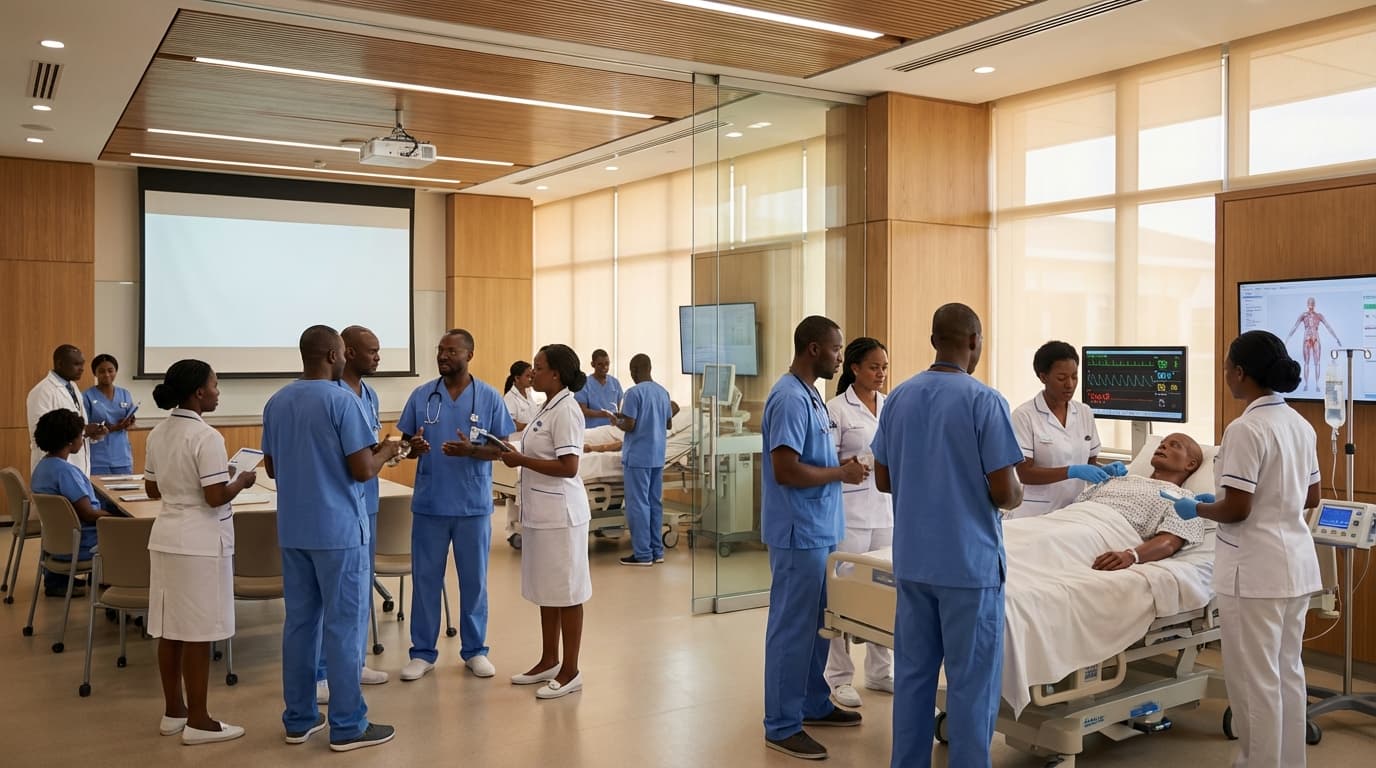
Equipment Training & Education in Algeria
Engineering Excellence & Technical Support
Comprehensive equipment training and certification programs High-standard technical execution following OEM protocols and local regulatory frameworks.
Digital Learning Platform Rollout
Successful deployment of a state-of-the-art digital learning platform, offering interactive modules and virtual simulations for diverse equipment operation and maintenance training across 5 major industrial zones in Algeria. This initiative significantly enhances accessibility and consistency in training delivery.
Advanced Equipment Simulation Labs
Establishment of three advanced simulation laboratories equipped with industry-leading virtual reality (VR) and augmented reality (AR) systems. These labs provide hands-on, risk-free training environments for complex machinery and hazardous equipment, reducing operational downtime and improving safety compliance.
Certified Competency Assessment Framework
Implementation of a standardized, AI-driven competency assessment framework for all trained personnel. This system ensures verifiable skill proficiency and provides real-time performance analytics, directly contributing to workforce development and adherence to international operational standards.
What Is Equipment Training & Education In Algeria?
Equipment Training & Education in Algeria refers to the structured dissemination of knowledge and practical skills required for the safe, efficient, and effective operation, maintenance, and repair of various types of machinery and technological systems prevalent within Algerian industries. This service is critical for ensuring workforce competency, minimizing operational downtime, maximizing asset lifespan, and adhering to safety and regulatory standards. The scope encompasses theoretical understanding of equipment principles, hands-on practical application, troubleshooting methodologies, preventative maintenance protocols, and emergency response procedures. It is a multifaceted approach aimed at building and sustaining a proficient human capital capable of interacting with sophisticated industrial hardware.
| Who Needs Equipment Training & Education in Algeria? | Typical Use Cases |
|---|---|
| Industrial Operators: Personnel responsible for the day-to-day operation of machinery in sectors like oil & gas, manufacturing, mining, and construction. | Operating complex drilling rigs, CNC machines, power generation turbines, and heavy construction equipment according to manufacturer specifications and safety protocols. |
| Maintenance Technicians & Engineers: Individuals tasked with the upkeep, repair, and preventative maintenance of industrial equipment. | Performing scheduled servicing on pumps and compressors, troubleshooting electrical control systems on assembly lines, and repairing hydraulic systems in heavy machinery. |
| Supervisors & Foremen: Management personnel overseeing operational teams and responsible for ensuring safe and efficient work practices. | Supervising the safe operation of cranes and lifting equipment, ensuring adherence to lockout/tagout procedures during maintenance, and assessing team performance in equipment handling. |
| New Entrants to the Workforce: Graduates and individuals seeking employment in technical roles within Algerian industries. | Acquiring foundational knowledge on basic machinery operation, understanding industrial safety standards, and developing initial troubleshooting skills for entry-level positions. |
| Procurement & Logistics Personnel: Individuals involved in the acquisition and management of equipment. | Understanding the technical requirements and operational nuances of equipment to make informed purchasing decisions and managing the logistics of spare parts and tools. |
| Safety Officers & Compliance Managers: Professionals responsible for ensuring adherence to safety regulations and industry standards. | Developing and overseeing safety training programs related to specific equipment, conducting risk assessments for equipment operation, and ensuring compliance with Algerian environmental and occupational health standards. |
| Specialized Equipment Users: Personnel operating highly specific or advanced machinery. | Training on the operation and maintenance of laboratory analytical instruments, medical diagnostic equipment, advanced telecommunications hardware, or specialized agricultural machinery. |
Key Components of Equipment Training & Education in Algeria:
- Needs Assessment: Identifying specific skill gaps and training requirements based on job roles, equipment types, and industry best practices.
- Curriculum Development: Designing tailored training modules incorporating theoretical concepts, technical specifications, operational procedures, and safety guidelines.
- Instructional Delivery: Employing various methodologies including classroom lectures, interactive workshops, simulation exercises, and on-the-job training (OJT).
- Practical Skill Transfer: Providing hands-on experience with the actual equipment or high-fidelity simulators to develop proficiency in operation, diagnostics, and repair.
- Safety & Compliance Training: Educating personnel on relevant Algerian and international safety regulations, hazardous material handling, and emergency procedures specific to the equipment.
- Maintenance & Troubleshooting: Training on routine maintenance, scheduled servicing, fault identification, diagnostic techniques, and repair methodologies.
- Documentation & Record Keeping: Emphasizing the importance of accurate logging of maintenance activities, operational data, and training records.
- Assessment & Certification: Evaluating trainee competency through written examinations, practical assessments, and issuing certifications upon successful completion.
- Ongoing Skill Enhancement: Providing refresher courses, advanced training, and updates on new equipment models or technological advancements.
Who Needs Equipment Training & Education In Algeria?
Effective equipment training and education are crucial for a wide range of individuals and organizations in Algeria, ensuring safe operation, optimal performance, and longevity of machinery. This investment directly impacts productivity, reduces operational costs, and mitigates risks across various sectors.
| Customer Type/Industry | Key Departments/Roles Requiring Training | Specific Equipment Examples | Benefits of Training |
|---|---|---|---|
| Industrial Manufacturing | Production Line Operators, Maintenance Technicians, Quality Control Personnel, Supervisors | CNC machines, Assembly lines, Robotic arms, Packaging machinery, Welding equipment | Increased production efficiency, Reduced downtime, Improved product quality, Enhanced safety |
| Oil and Gas | Drilling crews, Wellhead technicians, Refinery operators, Pipeline maintenance teams, Safety officers | Drilling rigs, Pumps, Compressors, Valves, Control systems, Offshore equipment | Safe handling of hazardous materials, Prevention of accidents, Compliance with industry standards, Optimized extraction and processing |
| Construction and Infrastructure | Equipment Operators (excavators, cranes, bulldozers), Site supervisors, Safety managers, Mechanics | Heavy machinery (cranes, excavators, bulldozers), Concrete mixers, Power tools, Surveying equipment | Safe operation of heavy machinery, Project completion on time and budget, Reduced equipment damage, Compliance with safety regulations |
| Agriculture Sector | Farm managers, Tractor operators, Harvester operators, Irrigation technicians | Tractors, Harvesters, Seeding machines, Drones for agriculture, Irrigation systems | Efficient crop management, Reduced fuel consumption, Maximized yield, Extended equipment lifespan |
| Healthcare Sector | Radiology technicians, Laboratory staff, Biomedical engineers, Maintenance personnel | MRI scanners, CT scanners, X-ray machines, Laboratory analyzers, Surgical equipment | Accurate diagnostic procedures, Patient safety, Proper equipment maintenance, Extended device life |
| Transportation and Logistics | Warehouse staff, Forklift operators, Crane operators, Vehicle maintenance technicians | Forklifts, Conveyor systems, Cranes, Delivery vehicles, Warehouse management systems (WMS) | Efficient material handling, Reduced damage to goods, Improved inventory management, Enhanced workplace safety |
| Mining Sector | Mine operators, Heavy equipment mechanics, Blasting technicians, Safety supervisors | Drilling rigs, Crushers, Conveyors, Haul trucks, Underground mining equipment | Safe extraction processes, Reduced operational risks, Optimized resource recovery, Compliance with environmental regulations |
| Energy and Utilities | Power plant operators, Turbine technicians, Grid maintenance crews, Renewable energy technicians | Turbines (gas, steam, wind), Solar panels, Power transformers, Control room equipment | Reliable energy supply, Prevention of blackouts, Efficient operation of power generation, Safety during maintenance |
| Small and Medium Enterprises (SMEs) | All operational staff, Technical personnel, Management overseeing operations | Varies widely depending on the SME's industry (e.g., bakery equipment, printing presses, specialized machinery) | Improved business efficiency, Reduced operational errors, Enhanced competitiveness, Cost savings through better equipment care |
| Government and Public Sector Agencies | Municipal workers, Road maintenance crews, Public transport technicians, Emergency service personnel | Street sweepers, Road construction equipment, Public transport vehicles, Firefighting equipment | Efficient public service delivery, Improved infrastructure maintenance, Enhanced public safety, Responsible use of public funds |
Target Customers and Departments for Equipment Training & Education in Algeria
- Industrial Manufacturing Sector
- Oil and Gas Industry
- Construction and Infrastructure
- Agriculture Sector
- Healthcare Sector
- Transportation and Logistics
- Mining Sector
- Energy and Utilities
- Small and Medium Enterprises (SMEs)
- Government and Public Sector Agencies
Equipment Training & Education Process In Algeria
This document outlines the typical workflow for equipment training and education processes in Algeria, from the initial inquiry to the final execution and follow-up. This process is designed to ensure that clients receive the necessary knowledge and skills to operate and maintain their acquired equipment effectively and safely. The workflow is generally structured to be systematic and client-centric, involving several key stages. The specific details may vary depending on the complexity of the equipment, the training provider, and client requirements, but the core stages remain consistent.
| Stage | Description | Key Activities | Responsible Parties |
|---|---|---|---|
| Inquiry & Needs Assessment | The initial contact from a client expressing interest in equipment training. | Client contacts vendor/training provider. Discussion of training needs, equipment specifics, existing skill levels, desired outcomes. Gathering of client information. | Client (Potential Trainee/Company), Vendor/Training Provider (Sales/Technical Team) |
| Proposal & Quotation | Based on the needs assessment, a formal proposal and cost estimate are prepared. | Development of a detailed training plan (modules, duration, content). Formulation of a comprehensive quotation including all associated costs (training, materials, travel, accommodation if applicable). Presentation of the proposal to the client. | Vendor/Training Provider (Sales/Technical Team), Client (Review & Approval) |
| Agreement & Planning | Formalization of the training engagement and detailed logistical planning. | Client accepts proposal/quotation. Signing of contract/agreement. Finalization of training dates, schedule, and location. Confirmation of trainee numbers and participant profiles. Agreement on training methodology (on-site, remote, blended). | Client (Legal/Procurement), Vendor/Training Provider (Project Management/Sales) |
| Resource Preparation | Gathering and preparing all necessary resources for the training. | Development/customization of training materials (manuals, presentations, exercises). Preparation of training equipment and facilities. Scheduling of trainers. Logistics for travel and accommodation (if applicable). Pre-communication to trainees about the training. | Vendor/Training Provider (Training Department/Technical Experts), Client (Facility Access/Participant List) |
| Training Delivery (Execution) | The actual implementation of the training program. | Conducting theoretical sessions (lectures, presentations). Conducting practical sessions (hands-on demonstrations, exercises, simulations). Q&A sessions. On-site troubleshooting and guidance. | Vendor/Training Provider (Certified Trainers), Client (Trainees) |
| Evaluation & Feedback | Assessing the effectiveness of the training and gathering participant input. | Administering knowledge tests or practical assessments. Collecting feedback from trainees through questionnaires or surveys. Trainer observation and assessment of trainee performance. Review of training outcomes against initial objectives. | Vendor/Training Provider (Trainers/Assessment Team), Client (Trainees) |
| Certification & Documentation | Issuance of formal recognition for completed training. | Issuing training certificates to successful participants. Providing training reports to the client detailing attendance, performance, and assessment results. Archiving of training records. | Vendor/Training Provider (Administration/Certification Department), Client (Record Keeping) |
| Post-Training Support & Follow-up | Providing ongoing assistance and checking in after the training is completed. | Answering post-training queries. Providing access to additional resources or documentation. Conducting follow-up calls or site visits to ensure knowledge application. Identifying needs for future advanced training. | Vendor/Training Provider (Technical Support/Account Management), Client (Ongoing Operations) |
Workflow Stages for Equipment Training & Education in Algeria
- Inquiry & Needs Assessment
- Proposal & Quotation
- Agreement & Planning
- Resource Preparation
- Training Delivery (Execution)
- Evaluation & Feedback
- Certification & Documentation
- Post-Training Support & Follow-up
Equipment Training & Education Cost In Algeria
Equipment training and education costs in Algeria can vary significantly based on several factors. These include the complexity of the equipment, the duration and depth of the training, the provider's reputation and expertise, the location of the training (on-site vs. at the provider's facility), and the number of participants. Specialized technical training for advanced industrial machinery, for example, will invariably be more expensive than basic software training. The Algerian market often sees pricing influenced by the cost of skilled instructors, training materials, and any necessary certification fees. While precise, universally applicable pricing is difficult to pinpoint, we can explore general ranges and influencing factors in Algerian Dinars (DZD).
| Training Type/Category | Estimated Cost Range (DZD) - Per Person | Typical Duration | Notes |
|---|---|---|---|
| Basic Software Training (e.g., Office Suite, CRM) | 5,000 - 20,000 | 1-3 Days | Focus on fundamental functionalities. Group rates may apply. |
| Intermediate Technical Skills (e.g., basic machinery operation, specific software) | 15,000 - 60,000 | 3-7 Days | Covers more specialized aspects. Might include practical exercises. |
| Advanced Industrial Equipment Training (e.g., manufacturing, construction) | 50,000 - 250,000+ | 5-15 Days or more | Highly specialized, often requires certified instructors. Includes extensive hands-on practice and safety protocols. Can be significantly higher for very complex or rare equipment. |
| Specialized IT/Cybersecurity Training | 30,000 - 150,000+ | 3-10 Days | Can include vendor-specific certifications (e.g., Cisco, Microsoft). Costs increase with the level of certification. |
| On-site Training (Group Rate) | 100,000 - 500,000+ per session | Varies | Price is often for the entire session or day, regardless of participant numbers. Travel and accommodation for instructors may be additional costs. |
Key Pricing Factors for Equipment Training in Algeria
- Equipment Complexity: Simple tools versus complex industrial machinery.
- Training Duration & Depth: Basic overview versus in-depth operational and maintenance courses.
- Provider's Reputation & Expertise: Well-established training centers versus independent trainers.
- Training Location: On-site at client's facility versus off-site at provider's location.
- Number of Participants: Per-person rates versus group discounts.
- Certification Requirements: Inclusion of formal certification exams and issuance.
- Customization: Tailoring training content to specific client needs.
- Materials & Resources: Cost of manuals, simulations, and practical exercises.
Affordable Equipment Training & Education Options
Accessing high-quality equipment training and education is crucial for many industries, ensuring safety, efficiency, and optimal performance. Fortunately, several affordable options and cost-saving strategies are available. Understanding value bundles and implementing smart purchasing decisions can significantly reduce expenses without compromising on the quality of learning.
| Strategy | Description | Cost-Saving Benefit | Considerations |
|---|---|---|---|
| Value Bundles | Combining multiple training modules, certifications, or related services into a single package at a discounted price. | Lower per-unit cost compared to purchasing individually. Streamlines the training procurement process. | Ensure the bundle includes all necessary components and aligns with your specific needs. |
| Early Bird Discounts | Registering for courses or workshops well in advance of the start date, often with significant price reductions. | Direct financial savings on tuition or fees. | Requires proactive planning and commitment. |
| Group Discounts | Training multiple employees from the same organization at a reduced rate per person. | Significant cost reduction when training a team. | Need to coordinate schedules and ensure the training is relevant to all participants. |
| Subscription Models | Paying a recurring fee for access to a library of online courses, resources, or ongoing support. | Predictable costs and access to a wide range of training materials over time. | Evaluate the depth and breadth of content to ensure it meets ongoing needs. |
| Certification Bundles | Purchasing training that leads to multiple recognized certifications at a package price. | Cost-effective way to upskill employees with versatile credentials. | Verify that the certifications are relevant and valued in your industry. |
| Leveraging Free Resources | Utilizing free online tutorials, manufacturer documentation, and open-source learning platforms. | Eliminates direct training costs; requires time investment for learning. | Quality and comprehensiveness can vary; may not offer formal certification. |
| Negotiating with Providers | Discussing bulk discounts, customized training plans, or payment terms with training institutions. | Potential for tailored pricing and flexible payment options. | Requires research on competitor pricing and strong negotiation skills. |
| Government Subsidies & Grants | Applying for funding opportunities from government bodies or industry-specific programs that support workforce development. | Can cover a significant portion or the entirety of training costs. | Eligibility criteria and application processes can be complex. |
Affordable Equipment Training & Education Options
- Online Courses & Webinars
- Manufacturer-Provided Training
- Community College & Vocational Schools
- Industry Association Workshops
- Apprenticeship Programs
- On-the-Job Training (OJT)
- Rental Company Training Packages
- Government & Non-Profit Initiatives
- Peer-to-Peer Learning Networks
Verified Providers In Algeria
When seeking reliable healthcare services in Algeria, identifying 'Verified Providers' is paramount. These are healthcare professionals and institutions that have undergone rigorous vetting processes, ensuring they meet established standards of quality, ethics, and operational excellence. Franance Health stands out as a leading entity in this domain, meticulously credentialing providers to offer unparalleled assurance to patients. Their comprehensive vetting methodology is designed to identify and endorse only the most competent, ethical, and patient-centric healthcare providers in Algeria. By choosing Franance Health-verified providers, individuals can be confident in receiving safe, effective, and high-quality medical care, minimizing risks and maximizing positive health outcomes.
| Provider Category | Franance Health Verification Focus | Patient Benefit |
|---|---|---|
| Doctors (Specialists & General Practitioners) | Medical expertise, board certifications, patient reviews, ethical conduct, continuous professional development. | Access to highly qualified and experienced medical professionals, confidence in diagnosis and treatment. |
| Hospitals & Clinics | Facility infrastructure, equipment, quality of care protocols, patient safety measures, hygiene standards, staff qualifications. | Safe and well-equipped medical facilities, adherence to international standards of care, reduced risk of hospital-acquired infections. |
| Diagnostic Laboratories | Accuracy and reliability of tests, quality control measures, advanced technology, technician expertise, turnaround times. | Trustworthy diagnostic results essential for accurate treatment planning, timely reporting. |
| Pharmaceutical Services | Drug sourcing and authenticity, dispensing accuracy, pharmacist expertise, patient counseling. | Access to genuine medications, safe dispensing practices, informed medication use. |
Why Franance Health Credentials Represent the Best Choice:
- Rigorous Vetting Process: Franance Health employs a multi-faceted evaluation that goes beyond basic licensing. This includes scrutinizing professional qualifications, clinical experience, adherence to ethical guidelines, patient feedback analysis, and facility standards (where applicable).
- Commitment to Quality: The credentialing process is intrinsically linked to a commitment to delivering high-quality healthcare. Verified providers are those who consistently demonstrate a dedication to best practices and patient well-being.
- Enhanced Patient Safety: By pre-screening providers, Franance Health significantly reduces the risk of patients encountering substandard care, malpractice, or unethical practices. This fosters a safer healthcare environment.
- Transparency and Trust: Franance Health provides a clear and trustworthy mechanism for patients to identify reputable healthcare professionals. This transparency builds confidence and empowers patients to make informed decisions about their health.
- Access to Excellence: The credentialing acts as a stamp of approval, guiding patients towards providers who have proven their commitment to excellence in their respective fields. This saves patients time and effort in their search for reliable care.
- Continuous Monitoring: Franance Health's commitment doesn't end with initial verification. They often implement ongoing monitoring and re-credentialing processes to ensure providers maintain their high standards over time.
Scope Of Work For Equipment Training & Education
This Scope of Work (SOW) outlines the requirements for providing comprehensive training and educational services for the specified equipment. The objective is to ensure that designated personnel possess the necessary knowledge and skills to operate, maintain, and troubleshoot the equipment effectively and safely, adhering to all relevant technical specifications and best practices.
| Category | Description | Technical Deliverables | Standard Specifications |
|---|---|---|---|
| Training Program Design | Development of a tailored training curriculum based on the equipment's complexity and the target audience's existing knowledge base. | Detailed training syllabus, learning objectives, and assessment methods. | Industry best practices for adult learning, competency-based training, and curriculum design. |
| Training Delivery | Execution of training sessions, which may include classroom instruction, on-the-job training (OJT), and practical workshops. | Delivery of instructor-led sessions, guided practical exercises, and demonstrations. | Qualified and experienced trainers with subject matter expertise; appropriate training environment (classroom, workshop). |
| Equipment Operation Training | Comprehensive instruction on the safe and efficient operation of the equipment in various modes and scenarios. | Competency demonstration in equipment startup, shutdown, parameter setting, and performance monitoring. | Manufacturer's operating manuals, operational checklists, and performance standards. |
| Preventive Maintenance Training | Training on scheduled maintenance tasks, lubrication, inspection, and minor component replacement. | Ability to perform routine maintenance activities and identify potential wear or damage. | Manufacturer's maintenance manuals, lubrication charts, and recommended maintenance intervals. |
| Troubleshooting & Diagnostics Training | Instruction on common failure modes, diagnostic procedures, and basic repair techniques. | Capability to identify fault codes, interpret diagnostic data, and perform initial troubleshooting. | Troubleshooting guides, diagnostic flowcharts, and symptom-based issue resolution procedures. |
| Safety Training | Emphasis on safety protocols, hazard identification, lockout/tagout procedures, and emergency response. | Demonstrated understanding and application of all relevant safety procedures. | Occupational Safety and Health Administration (OSHA) standards, site-specific safety regulations, and equipment safety manuals. |
| Documentation & Reporting | Provision of training materials and documentation of trainee progress. | Training manuals, participant workbooks, attendance records, and assessment results. | Clear, concise, and well-organized documentation; adherence to reporting requirements. |
| Post-Training Support | Availability of follow-up support and refresher training as needed. | Access to subject matter experts for technical queries; provision of refresher modules. | Defined support channels and response times; availability of updated training materials. |
Key Objectives
- Equip trainees with in-depth understanding of the equipment's design, functionality, and operational principles.
- Develop proficiency in routine operation, including startup, shutdown, and normal running procedures.
- Train personnel on preventive maintenance schedules, procedures, and documentation.
- Enable trainees to perform basic troubleshooting and diagnostic tasks to identify and resolve common issues.
- Ensure adherence to all safety protocols and guidelines during operation and maintenance.
- Familiarize trainees with the equipment's technical documentation, including manuals, schematics, and specifications.
- Provide opportunities for hands-on practice and scenario-based problem-solving.
Service Level Agreement For Equipment Training & Education
This Service Level Agreement (SLA) outlines the guaranteed response times and uptime for Equipment Training & Education services provided by [Your Company Name] to [Client Company Name]. This agreement aims to ensure timely support and consistent availability of training resources.
| Service Component | SLA Metric | Target Value | Description | Escalation Path |
|---|---|---|---|---|
| Online Training Platform Availability | Uptime Guarantee | 99.5% | The online platform hosting training modules and resources will be available during Service Hours. | Level 1 Support -> Level 2 Support -> Technical Manager |
| Live Training Session Support | Response Time | 1 Hour | Acknowledgement and initial assessment of issues affecting live training sessions during Service Hours. | Level 1 Support -> Training Coordinator -> Senior Instructor |
| Technical Support for Training Materials (e.g., video playback, document access) | Response Time | 4 Business Hours | Acknowledgement and initial assessment of issues preventing access to or functionality of standard training materials during Service Hours. | Level 1 Support -> Technical Support Team |
| Requests for New Training Material Updates/Modifications | Response Time | 2 Business Days | Acknowledgement and confirmation of receipt for requests related to updates or minor modifications of existing training content during Service Hours. | Account Manager -> Content Development Lead |
| Critical Incidents (affecting platform access) | Resolution Time | 4 Business Hours | Rectification of critical incidents preventing overall access to the training platform. | Immediate Escalation -> Technical Director |
| Major Incidents (affecting significant portion of resources) | Resolution Time | 8 Business Hours | Rectification of major incidents impacting a substantial part of the training delivery. | Level 2 Support -> Technical Manager -> VP of Operations |
| General Inquiries (non-technical) | Response Time | 1 Business Day | Acknowledgement and initial response to general inquiries related to training schedules, enrollment, or content. | Customer Service Team -> Account Manager |
Definitions
- Training Services: Refers to all educational programs, materials, and support provided for the operation, maintenance, and troubleshooting of specified equipment.
- Uptime: The percentage of time that the training platform/resources are accessible and functional for the intended users.
- Response Time: The maximum time allowed for [Your Company Name] to acknowledge and begin addressing a reported issue or request.
- Resolution Time: The maximum time allowed for [Your Company Name] to resolve a reported issue or fulfill a request, subject to complexity.
- Service Hours: [Specify the hours of operation for support, e.g., Monday-Friday, 9 AM - 5 PM Local Time]
- Critical Incident: An event that renders the primary training platform or essential training materials completely inaccessible, preventing any participant from engaging in training.
- Major Incident: An event that significantly degrades the training experience or limits access to a substantial portion of training resources.
Frequently Asked Questions

Ready when you are
Let's scope your Equipment Training & Education in Algeria project in Algeria.

Scaling healthcare logistics and technical systems across the entire continent.