
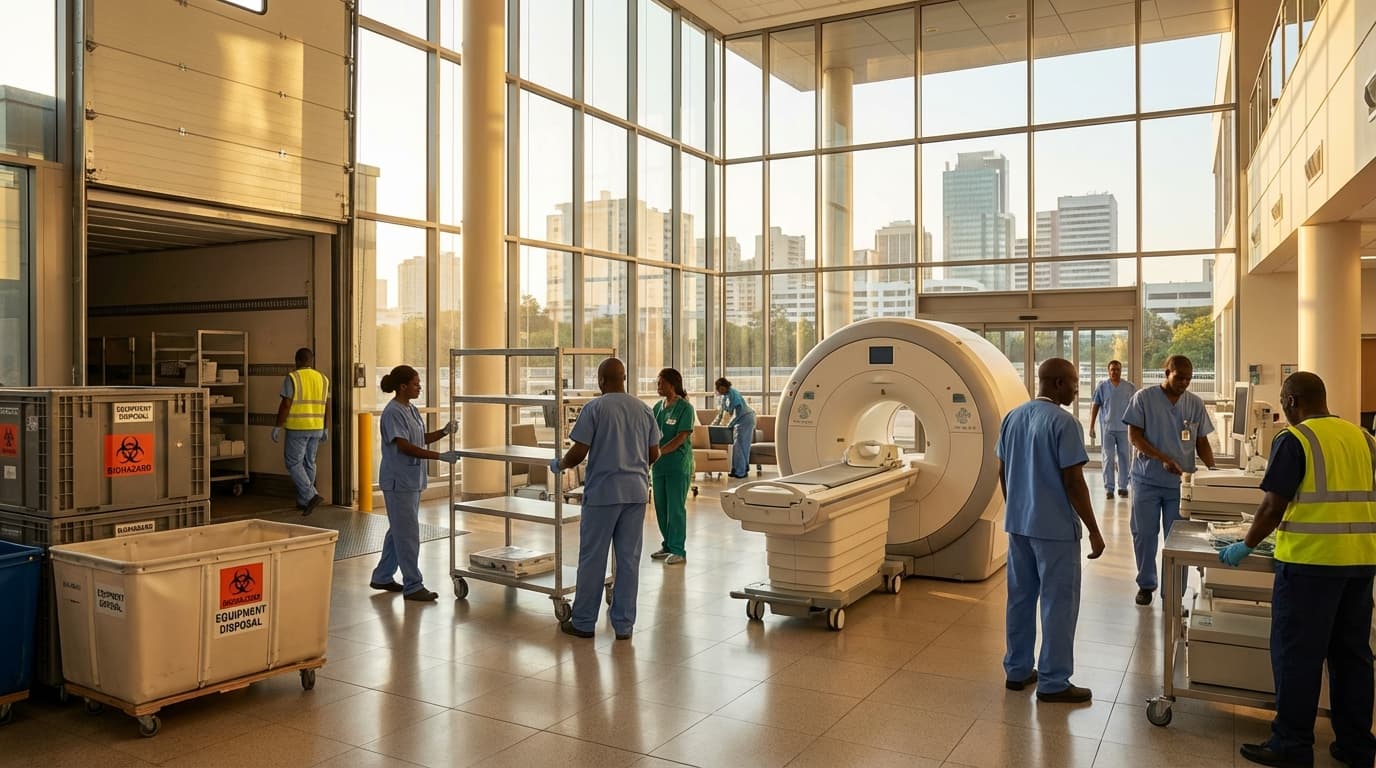
Medical Equipment Relocation Service (Move & Re-Install) in Algeria
Engineering Excellence & Technical Support
Medical Equipment Relocation Service (Move & Re-Install) High-standard technical execution following OEM protocols and local regulatory frameworks.
Expert Decommissioning & Rigging
Our specialized technicians in Algeria are certified for the safe and precise deinstallation of sensitive medical equipment. We employ advanced rigging techniques and custom-designed handling equipment to ensure the integrity of X-ray machines, MRI scanners, CT scanners, and other high-value assets throughout the relocation process.
Temperature-Controlled & Secure Transit
We provide specialized, climate-controlled vehicles and secure transit solutions across Algeria. Our fleet is equipped with real-time GPS tracking and humidity monitoring to guarantee that your delicate medical equipment remains within optimal environmental conditions during its journey, preventing damage and preserving calibration.
Certified Re-installation & Calibration
Our commitment extends beyond transit. In Algeria, our biomedical engineers perform meticulous re-installation, ensuring all connections are secure and operational. We conduct comprehensive testing and calibration to verify that your medical equipment meets original manufacturer specifications, guaranteeing immediate readiness for patient care.
What Is Medical Equipment Relocation Service (Move & Re-install) In Algeria?
Medical Equipment Relocation Service (Move & Re-Install) in Algeria refers to a specialized logistical and technical service encompassing the safe, secure, and compliant transportation of medical devices and machinery from one location to another within Algeria, followed by their precise re-installation and verification of operational functionality at the new site. This service is critical for healthcare facilities undergoing expansion, renovation, relocation, or acquisition of new premises. It requires a meticulous approach due to the sensitivity, complexity, and often high value of medical equipment, as well as adherence to relevant Algerian healthcare and safety regulations.
| Who Needs This Service? | Typical Use Cases | |||
|---|---|---|---|---|
| Hospitals and Clinics (Public and Private) | Renovations or expansions requiring temporary or permanent equipment displacement. | Mergers or acquisitions leading to facility consolidation. | Upgrading to new facilities or relocating entire departments. | Acquisition of new, larger, or specialized medical equipment requiring significant installation space. |
| Diagnostic Imaging Centers (MRI, CT, X-ray, Ultrasound) | Relocation of existing imaging suites to new or renovated spaces. | Installation of newly purchased imaging machines. | Transfer of equipment between different branches of a healthcare network. | |
| Laboratories and Research Facilities | Moving sensitive analytical instruments (e.g., mass spectrometers, gene sequencers) to new lab spaces. | Setting up new research departments or expanding existing ones. | ||
| Surgical Centers and Operating Rooms | Relocating OR equipment (e.g., anesthesia machines, surgical lights, patient monitors) during facility upgrades. | Installation of advanced surgical robotics or imaging systems. | ||
| Medical Equipment Manufacturers and Distributors | Delivering and installing new equipment at client sites. | Relocating demo units or equipment for service/maintenance purposes. | ||
| Government Health Agencies and Military Healthcare Facilities | Managing large-scale relocations of healthcare infrastructure. | Setting up temporary medical facilities during emergencies or national events. |
Key Components of Medical Equipment Relocation Service (Move & Re-Install) in Algeria
- Pre-relocation Assessment and Planning: Site surveys of both origin and destination, inventory of equipment, risk assessment, development of detailed move plans, and regulatory compliance checks.
- Dismantling and Decontamination (if applicable): Expert disassembly of complex equipment, often requiring specialized tools and knowledge. Decontamination procedures may be implemented based on equipment type and prior usage, adhering to Algerian health protocols.
- Specialized Packing and Handling: Utilization of custom crating, shock-absorbent materials, anti-static packaging, and temperature-controlled environments (if necessary) to protect sensitive components during transit.
- Secure Transportation: Employing vehicles equipped for transporting delicate and heavy loads, with trained personnel to manage the logistics and ensure equipment stability throughout the journey within Algeria's infrastructure.
- Re-installation and Re-assembly: Precise re-assembly of equipment at the destination, following manufacturer specifications and engineering best practices. This includes physical installation, connection to utilities (power, water, gases), and integration with existing systems.
- Calibration and Testing: Post-installation calibration of equipment to ensure accuracy and performance. Comprehensive functional testing and diagnostic checks to verify operational readiness.
- Verification and Documentation: Issuance of certificates of successful re-installation and operational verification. Provision of detailed reports for auditing and compliance purposes.
- Training and Handover: Briefing of on-site personnel on the re-installed equipment's operation and maintenance, as required.
- Regulatory Compliance: Ensuring all aspects of the relocation process, including transportation and installation, adhere to Algerian Ministry of Health regulations, electrical safety standards, and radiation safety protocols (if applicable).
Who Needs Medical Equipment Relocation Service (Move & Re-install) In Algeria?
Moving and re-installing sensitive medical equipment in Algeria is a complex process requiring specialized expertise to ensure operational integrity and patient safety. This service is crucial for various healthcare providers and institutions undergoing significant changes, expansions, or technological upgrades. It goes beyond standard moving to encompass careful dismantling, secure transportation, precise re-assembly, and rigorous testing of medical devices. The focus is on minimizing downtime, preventing damage, and ensuring that the equipment is ready for immediate and safe use in its new location.
| Target Customer Segment | Relevant Departments | Reasons for Relocation |
|---|---|---|
| Hospitals & Clinics (Public & Private) | Radiology/Imaging, Cardiology, Oncology, Surgery, Emergency, Pathology, IT, Facilities Management, Biomedical Engineering | Renovations, expansions, ward/department consolidation, technology upgrades, new facility construction, equipment replacement |
| Diagnostic Imaging Centers | Radiology, Operations, IT, Facilities Management | Expansion of services, upgrading to newer imaging technology, relocation to a more accessible or larger facility |
| Surgical Centers | Operating Rooms, Anesthesiology, Sterilization, Facilities Management | Facility upgrades, changes in surgical specialties, expansion of capacity, relocation to a new site |
| Research Institutions & Laboratories | Research Labs (various specialties), Bio-repositories, Core Facilities, Facilities Management, IT | Consolidation of research space, acquisition of new specialized equipment, upgrades to existing labs, departmental re-organization |
| Medical Universities & Training Facilities | Medical Simulation Centers, Anatomy Labs, Pathology Labs, Biomedical Engineering Departments, Facilities Management | Curriculum changes, expansion of training programs, integration of new simulation technologies, relocation of training facilities |
| Government Health Ministries & Agencies | Public Health Facilities, Central Warehousing, Logistics & Procurement Departments | National health infrastructure projects, distribution of essential medical equipment, establishment of new public health centers |
| Specialized Medical Practices (e.g., Cardiology, Oncology, Neurology) | Specific Clinical Departments, Treatment Rooms, Diagnostic Suites, Facilities Management | Practice expansion, integration of advanced diagnostic or therapeutic equipment, relocation to a larger or more specialized clinic |
| Medical Equipment Manufacturers & Distributors | Showrooms, Service Centers, Warehousing, Logistics Departments | Relocation of showrooms to new markets or larger spaces, consolidation of service operations, warehouse moves |
Who Needs Medical Equipment Relocation Service (Move & Re-Install) in Algeria?
- Hospitals and Clinics (Public & Private)
- Diagnostic Imaging Centers
- Surgical Centers
- Research Institutions & Laboratories
- Medical Universities & Training Facilities
- Government Health Ministries & Agencies
- Specialized Medical Practices (e.g., Cardiology, Oncology, Neurology)
- Medical Equipment Manufacturers & Distributors (for showroom or facility moves)
Medical Equipment Relocation Service (Move & Re-install) Process In Algeria
This document outlines the workflow for a Medical Equipment Relocation Service, encompassing the entire process from initial inquiry to the final re-installation and commissioning of medical equipment within Algeria. The service prioritizes safety, compliance with regulations, and minimal disruption to healthcare operations. The process is divided into distinct phases, ensuring a systematic and thorough approach to each relocation project.
| Phase | Key Activities | Description | Deliverables/Outcomes | Key Considerations (Algeria) |
|---|---|---|---|---|
| Phase 1: Initial Inquiry & Assessment | Receive Inquiry, Site Survey, Equipment Audit, Quotation Preparation | Client contacts the service provider with relocation needs. A comprehensive site survey is conducted at both the origin and destination. An inventory and condition assessment of all medical equipment is performed. A detailed quotation outlining scope, timeline, and costs is prepared and presented. | Detailed Project Scope, Equipment Inventory, Site Survey Report, Formal Quotation | Understanding of local hospital infrastructure, access routes, and potential regulatory hurdles. Initial assessment of power and environmental requirements for equipment at the new location. |
| Phase 2: Planning & Preparation | Project Planning, Risk Assessment, Scheduling, Resource Allocation, Permitting | A detailed project plan is developed, including timelines, responsibilities, and communication protocols. Potential risks are identified and mitigation strategies are put in place. Necessary permits and approvals are secured. Specialized packing materials and equipment are procured. Specialized technicians are assigned. | Project Management Plan, Risk Mitigation Strategy, Approved Permits, Resource Schedule | Adherence to Algerian customs regulations for import/export of specialized equipment (if applicable). Coordination with local authorities for transport permits, especially for large or sensitive items. Understanding of local labor laws and safety regulations. |
| Phase 3: De-installation & Packing | Site Preparation, De-installation, Labeling, Packing, Loading Preparation | The origin site is prepared to ensure a safe and efficient de-installation. Equipment is carefully disconnected from power and other utilities. Each component is meticulously labeled and documented. Specialized packing methods are employed based on equipment sensitivity and transport requirements. The equipment is prepared for loading. | De-installed & Labeled Equipment, Securely Packed Items, De-installation Report | Ensuring all power sources are safely disconnected and documented. Proper handling of sensitive components to prevent damage. Compliance with specific de-installation procedures for different medical device types. |
| Phase 4: Transportation | Loading, Transportation, In-transit Monitoring, Customs Clearance | Specialized vehicles (e.g., climate-controlled, air-ride suspension) are used for transportation. Equipment is securely loaded to prevent movement. Real-time tracking and monitoring of the shipment are conducted. If crossing borders, customs clearance procedures are managed. | Relocated Equipment at Destination, Proof of Delivery, Customs Documentation | Navigating Algerian road conditions and traffic. Understanding of border crossing procedures and documentation for international moves. Ensuring the safety and security of the equipment during transit within Algeria. |
| Phase 5: Re-installation & Testing | Unloading, Placement, Re-assembly, Calibration, Initial Testing | Equipment is carefully unloaded at the destination site. It is placed in its designated location. Re-assembly and reconnection of components are performed according to manufacturer specifications. Calibration and initial functional testing are conducted to ensure proper operation. | Re-installed Equipment, Calibration Certificates, Initial Test Reports | Ensuring the new location meets the environmental specifications (temperature, humidity, power) for each piece of equipment. Adherence to specific re-installation guidelines from manufacturers. |
| Phase 6: Commissioning & Handover | Comprehensive System Testing, Performance Verification, User Training, Final Documentation | Thorough system-wide testing is performed to verify the integrated functionality of all relocated equipment. Performance is validated against manufacturer standards. Key personnel are provided with training on the re-installed equipment. All relevant documentation, including manuals and test results, is handed over to the client. | Commissioned Equipment, User Training Records, Final Project Report, Handover Documentation | Ensuring compatibility with existing hospital IT infrastructure and networks. Providing training in the local language (Arabic/French) where appropriate. Understanding any local regulations for specific medical device validation. |
| Phase 7: Post-Relocation Support | Warranty Period, Troubleshooting, Ongoing Maintenance Advice | The service provider offers a warranty period for the relocation and re-installation. They are available to address any immediate troubleshooting needs. Advice on ongoing maintenance schedules and best practices is provided. | Client Satisfaction, Resolved Issues, Ongoing Support Availability | Establishing a clear point of contact for after-sales support. Understanding potential local maintenance providers if specialized support is needed beyond the relocation service. |
Medical Equipment Relocation Process Workflow in Algeria
- Phase 1: Initial Inquiry & Assessment
- Phase 2: Planning & Preparation
- Phase 3: De-installation & Packing
- Phase 4: Transportation
- Phase 5: Re-installation & Testing
- Phase 6: Commissioning & Handover
- Phase 7: Post-Relocation Support
Medical Equipment Relocation Service (Move & Re-install) Cost In Algeria
Relocating medical equipment in Algeria involves specialized logistics and technical expertise, making it a distinct service from standard moving. The cost of medical equipment relocation and re-installation in Algeria is influenced by several factors, leading to a wide range of pricing. This service is crucial for hospitals, clinics, and research facilities undergoing renovations, expansions, or facility changes.
The primary drivers of cost include the type and size of the equipment, the distance of the relocation, the complexity of the installation and calibration required, and the accessibility of both the pickup and delivery locations. Specialized handling, such as climate-controlled transport and trained technicians for delicate machinery, adds to the overall expense. Insurance coverage for high-value medical assets is also a significant consideration. Given the fluctuating economic conditions and import costs of specialized materials in Algeria, local currency (Algerian Dinar - DZD) pricing can vary considerably.
| Equipment Category | Estimated Cost Range (DZD) |
|---|---|
| Small Laboratory Equipment (e.g., centrifuges, microscopes) | 50,000 - 150,000 DZD |
| Medium-Sized Diagnostic Devices (e.g., X-ray units, ultrasound machines) | 200,000 - 750,000 DZD |
| Large Imaging Systems (e.g., MRI, CT scanners - basic relocation, excluding major infrastructure work) | 1,500,000 - 10,000,000+ DZD |
| Surgical Equipment (e.g., operating tables, anesthesia machines) | 300,000 - 1,200,000 DZD |
| Hospital Beds & Furniture (bulk relocation) | 100,000 - 500,000 DZD (per unit/floor, depending on quantity) |
Key Pricing Factors for Medical Equipment Relocation in Algeria:
- Equipment Specifics: Size, weight, fragility, and specialized handling requirements (e.g., cleanroom conditions, anti-vibration).
- Type of Equipment: Imaging machines (MRI, CT scanners), surgical robots, laboratory analyzers, patient beds, and diagnostic tools all have different relocation needs and costs.
- Distance: The mileage between the old and new locations significantly impacts transportation costs.
- Re-installation & Calibration: The complexity of reconnecting, testing, and calibrating the equipment to manufacturer specifications.
- Specialized Personnel: The need for certified technicians, engineers, and specialized movers.
- Dismantling & Reassembly: Whether the equipment requires partial or complete disassembly and subsequent reassembly.
- Access & Site Conditions: Ease of access to loading/unloading bays, elevator availability, and the condition of both premises.
- Insurance: Coverage for potential damage during transit or installation.
- Timeliness & Urgency: Rush jobs may incur premium pricing.
- Additional Services: Decommissioning, waste disposal of old equipment, and temporary storage.
Affordable Medical Equipment Relocation Service (Move & Re-install) Options
Moving and re-installing medical equipment requires specialized knowledge and careful handling to ensure functionality and prevent damage. Our Affordable Medical Equipment Relocation Service offers comprehensive solutions, from single-item moves to entire clinic or hospital departmental transfers. We understand the critical nature of your equipment and prioritize safety, efficiency, and cost-effectiveness. Our services include professional packing, secure transportation, and expert re-installation and calibration. We also offer value-added services to minimize downtime and maximize your return on investment.
| Value Bundle | Description | Included Services | Cost-Saving Benefits | Ideal For |
|---|---|---|---|---|
| Basic Move & Connect | Standard relocation of single or small groups of equipment. | Professional packing, secure transport, unboxing, and basic connection (power, network). | Lower upfront cost for essential needs, reduces risk of DIY damage. | Individual practitioners, small clinics, or relocation of a few non-critical items. |
| Full-Service Re-Install | Comprehensive relocation with full operational setup. | Includes Basic Move & Connect plus de-installation, recalibration, and full system testing. | Minimizes downtime, ensures immediate functionality, reduces need for external calibration services. | Clinics, imaging centers, or departments needing to be fully operational post-move. |
| Departmental Transfer Package | Relocation of an entire medical department, including multiple specialized equipment types. | Includes Full-Service Re-Install plus project management, phased moves, and specialized handling for complex machinery. | Streamlined process for large-scale moves, consolidated billing, expert coordination to avoid conflicts. | Hospitals, large medical facilities, or complete departmental overhauls. |
| Emergency Relocation Support | Urgent relocation needs due to unforeseen circumstances. | Prioritized service, rapid response team, expedited packing and transport. | Minimizes business interruption, quick restoration of services, often bundled with flexibility. | Facilities facing unexpected closures, renovations, or urgent equipment needs. |
Key Features of Our Medical Equipment Relocation Service
- Specialized packing materials and techniques for sensitive equipment.
- Climate-controlled and secure transportation vehicles.
- Experienced technicians for de-installation and re-installation.
- On-site assessment and customized relocation plans.
- Insurance coverage for peace of mind.
- Flexible scheduling to minimize operational disruption.
- Post-relocation testing and calibration.
- Compliance with all relevant health and safety regulations.
Verified Providers In Algeria
In Algeria, the landscape of healthcare services is vast, but discerning truly reliable and high-quality providers is crucial for ensuring the best patient outcomes. Franance Health has established itself as a benchmark for excellence, offering a curated network of verified providers. This verification process signifies a deep commitment to patient safety, ethical practices, and superior medical expertise. Choosing a Franance Health credentialed provider means opting for a level of care that is both trustworthy and highly effective.
| Credential Area | Franance Health Standard | Benefit to Patients |
|---|---|---|
| Medical Qualifications & Licensing | Mandatory verification of all medical degrees, specialist certifications, and valid Algerian medical licenses. | Ensures providers possess the foundational knowledge and legal authorization to practice medicine. |
| Professional Experience | Minimum years of experience required for each specialty, with a focus on practical application and patient management. | Guarantees that providers have a proven track record and extensive hands-on expertise. |
| Ethical Practice & Patient Care | Adherence to a strict code of medical ethics, including patient confidentiality, informed consent, and non-discrimination. | Protects patient rights and ensures compassionate, respectful, and unbiased treatment. |
| Facility Standards (for clinics/hospitals) | Compliance with hygiene, safety, and equipment maintenance regulations, meeting modern healthcare infrastructure requirements. | Provides a safe and technologically sound environment for treatment and recovery. |
| Continuous Professional Development (CPD) | Requirement for providers to engage in ongoing education and training to stay abreast of medical advancements. | Ensures patients receive care based on the latest medical knowledge and techniques. |
| Patient Feedback & Satisfaction | Regular monitoring of patient feedback and satisfaction scores as part of the ongoing assessment. | Offers insight into the patient experience and reinforces commitment to high-quality service. |
Why Franance Health Credentials Matter:
- Rigorous Vetting: Franance Health employs a comprehensive vetting process that scrutinizes medical professionals and facilities on various parameters, including qualifications, experience, patient reviews, and adherence to international standards.
- Commitment to Excellence: The credentials are a testament to a provider's dedication to continuous improvement, ongoing training, and the adoption of cutting-edge medical technologies and practices.
- Patient Safety First: Verification prioritizes patient well-being by ensuring that all credentialed providers meet stringent safety protocols and maintain impeccable ethical standards.
- Enhanced Accessibility to Quality Care: Franance Health simplifies the process of finding trusted healthcare professionals, giving patients peace of mind and confidence in their medical choices.
- International Recognition: The standards upheld by Franance Health often align with globally recognized healthcare benchmarks, making Algerian providers attractive for both local and international patients seeking quality.
Scope Of Work For Medical Equipment Relocation Service (Move & Re-install)
This Scope of Work (SOW) outlines the services required for the professional relocation and re-installation of medical equipment. The objective is to ensure a seamless, safe, and efficient transition of specified medical devices from their current location to a new designated area, followed by their proper re-installation and functional verification. This SOW details the technical deliverables and standard specifications that will govern the execution of the service.
| Section | Description | Standard Specifications/Deliverables |
|---|---|---|
| On-site evaluation of current and new locations, assessment of equipment, identification of logistical challenges (access, power, environmental controls), and development of a detailed move plan. | Detailed move plan including timeline, resource allocation, risk assessment, and contingency plans. Confirmation of site readiness at the destination (space, utilities, environmental conditions, safety measures). Confirmation of all necessary permits and access permissions. |
| Careful and systematic dismantling of specified medical equipment, ensuring preservation of all components and connections. | Photographic or video documentation of the de-installation process. Proper labeling and inventory of all removed parts and accessories. Safe disconnection of power, data, and other necessary connections, following manufacturer guidelines. Use of appropriate tools and techniques to prevent damage. |
| Secure packing of all equipment and components using appropriate materials to protect against shock, vibration, and environmental damage during transit. | Use of anti-static materials for sensitive electronics. Custom crating or specialized padding as required for delicate or high-value equipment. Clearly labeled packaging with equipment identification, origin, destination, and handling instructions. |
| Safe and efficient transport of the packed medical equipment from the origin to the destination. | Use of climate-controlled and vibration-dampened vehicles if required. Secure loading and unloading procedures. GPS tracking of the transport vehicle. Adherence to all transportation regulations and safety standards. |
| Precise re-assembly and re-installation of the medical equipment at the designated new location. | Strict adherence to manufacturer's installation manuals and guidelines. Verification of all connections (power, data, gas, water, etc.). Calibration and initial setup as per manufacturer specifications. |
| Comprehensive testing to ensure the equipment is operating correctly and safely in its new environment. | Performance of all standard operational tests. Verification of all safety features. Comparison of test results against baseline or manufacturer specifications. Issuance of a Certificate of Functional Verification. |
| Provision of all relevant documentation related to the relocation and re-installation process. | Final move report detailing all activities, any issues encountered, and resolutions. Copies of all pre-move assessments, move plans, and post-installation test results. Training for end-users on any significant changes or operational considerations post-relocation, if specified. |
| Proper disposal of all packing materials and any obsolete or non-functional equipment, as agreed upon. | Compliance with all environmental regulations for the disposal of medical waste and packaging materials. |
Key Objectives
- Safe and secure dismantling, transportation, and re-installation of medical equipment.
- Minimization of downtime for critical medical services.
- Verification of equipment functionality post-re-installation.
- Adherence to all safety, regulatory, and manufacturer guidelines.
- Documentation of all relocation and re-installation activities.
Service Level Agreement For Medical Equipment Relocation Service (Move & Re-install)
This Service Level Agreement (SLA) outlines the performance standards and commitments for the Medical Equipment Relocation Service (Move & Re-Install), covering response times for critical incidents and uptime guarantees for re-installed equipment. This SLA is an integral part of the Master Service Agreement (MSA) between [Provider Name] ('Provider') and [Client Name] ('Client').
| Service Component | Service Level Objective (SLO) | Measurement Period |
|---|---|---|
| Response Time - Critical Incident (Re-installation) | Within 2 hours of confirmed notification of a Critical Incident. | Per Incident |
| Resolution Time - Critical Incident (Re-installation) | Within 8 business hours of initiation of service, or as otherwise agreed upon based on equipment complexity and parts availability. | Per Incident |
| Uptime Guarantee - Re-installed Equipment | 99.5% availability (excluding Scheduled Maintenance and Force Majeure events). | Monthly |
Key Definitions
- Relocation Service: Encompasses the physical relocation and subsequent re-installation of specified medical equipment at a new designated location.
- Critical Incident (Re-installation): An event where re-installed medical equipment is non-functional, impacting patient care or core operational activities, requiring immediate attention.
- Response Time: The maximum time allowed from the notification of a Critical Incident to the initiation of service by the Provider's technical personnel.
- Resolution Time: The maximum time allowed from the initiation of service to the restoration of the medical equipment to full operational status.
- Uptime Guarantee: The percentage of time the re-installed medical equipment is guaranteed to be available and functional following successful re-installation.
- Scheduled Maintenance: Pre-planned and communicated downtime for routine checks, calibrations, or software updates.
- Force Majeure: Events beyond the reasonable control of either party, including but not limited to natural disasters, acts of war, or widespread pandemics.
Frequently Asked Questions

Ready when you are
Let's scope your Medical Equipment Relocation Service (Move & Re-Install) in Algeria project in Algeria.

Scaling healthcare logistics and technical systems across the entire continent.