
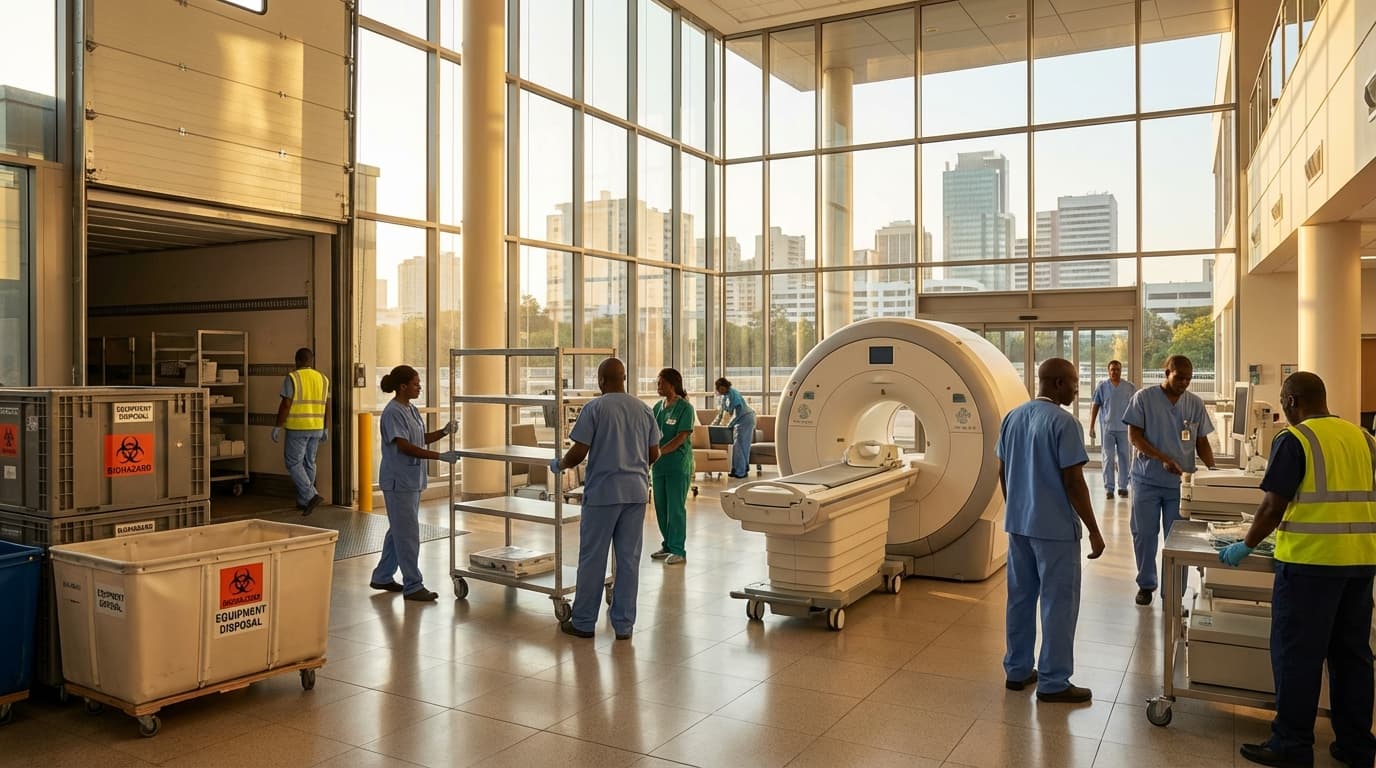
Heavy Medical Equipment De-Installation Service (MRI/CT/Cath Lab) in Algeria
Engineering Excellence & Technical Support
Heavy Medical Equipment De-Installation Service (MRI/CT/Cath Lab) High-standard technical execution following OEM protocols and local regulatory frameworks.
Unrivaled Safety & Compliance
Our de-installation process adheres to the strictest international safety standards and Algerian regulatory requirements, ensuring zero risk to personnel, site integrity, and the environment. We employ specialized containment, shielding, and handling protocols for hazardous materials and sensitive components within MRI, CT, and Cath Lab systems.
Precision Component Handling
We utilize advanced techniques and custom-engineered lifting/transportation equipment for the meticulous de-installation and handling of ultra-sensitive and high-value components like superconducting magnets (MRI), X-ray tubes (CT/Cath Lab), and detector arrays. Our trained technicians guarantee component integrity throughout the entire process.
Streamlined Logistics & Site Management
Our comprehensive service includes meticulous site assessment, optimized de-installation sequencing, and efficient logistics management for safe transport within Algeria and for export. We minimize disruption to operational facilities and ensure a swift, professional handover of your de-installed medical imaging equipment.
What Is Heavy Medical Equipment De-installation Service (Mri/ct/cath Lab) In Algeria?
Heavy Medical Equipment De-Installation Service (MRI/CT/Cath Lab) in Algeria refers to the specialized process of safely and systematically dismantling complex, high-value medical imaging and diagnostic systems, such as Magnetic Resonance Imaging (MRI) scanners, Computed Tomography (CT) scanners, and Cardiac Catheterization (Cath) laboratories, for relocation, disposal, or upgrades. This service is critical for healthcare facilities in Algeria facing a need to replace outdated equipment, expand their imaging capacity, or relocate to new premises. It involves meticulous planning, execution by trained technicians, adherence to strict safety protocols, and compliance with local regulations and international standards. The process encompasses the disconnection of power and data lines, disassembly of major components (e.g., magnet, gantry, console), secure packaging, and preparation for transport. It is a technically demanding undertaking requiring specific expertise due to the intricate nature of these systems, their substantial weight, and the potential hazards associated with their components (e.g., superconducting magnets in MRI).
| Who Needs This Service? | Typical Use Cases |
|---|---|
| Hospitals and Diagnostic Centers in Algeria | Equipment Upgrade/Replacement: Transitioning from older to newer MRI, CT, or Cath Lab systems. |
| Healthcare Networks Undertaking Relocations or Expansions | Facility Relocation: Moving existing imaging suites to new hospital buildings or outpatient centers. |
| Manufacturers and Service Providers of Medical Equipment | End-of-Life Equipment Disposal: Facilitating the responsible decommissioning and disposal of obsolete imaging equipment. |
| Research Institutions and Universities with Medical Imaging Facilities | Technology Refresh Cycles: Implementing advancements in imaging technology by removing older modalities. |
| Companies Specializing in Medical Equipment Refurbishment or Resale | Asset Recovery: Dismantling functional equipment for refurbishment and resale in other markets. |
| Government and Public Health Institutions in Algeria | Strategic Asset Management: Redeploying or phasing out equipment as part of national health initiatives. |
Key Aspects of Heavy Medical Equipment De-Installation Service:
- Planning and Site Assessment: Thorough evaluation of the installation site, including access routes, structural integrity, and necessary utilities, to devise a de-installation strategy.
- Component Disassembly: Systematic dismantling of the equipment into manageable sections by qualified technicians using specialized tools.
- Cryogen Management (MRI): Safe venting and removal of cryogens (typically liquid helium) from MRI superconducting magnets.
- Power and Data Disconnection: Careful disconnection of all electrical, data, and cooling systems.
- Structural Support and Stabilization: Ensuring the stability of remaining structures and components during the de-installation process.
- Packaging and Labeling: Secure packaging of individual components with appropriate protection and clear labeling for identification and transit.
- Logistics and Transportation Coordination: Arranging for specialized transport vehicles and logistics to move the dismantled equipment.
- Regulatory Compliance: Adherence to Algerian health and safety regulations, environmental standards, and import/export requirements if applicable.
- Decommissioning Documentation: Providing comprehensive documentation of the de-installation process for asset management and regulatory purposes.
- Site Restoration (Optional): Returning the de-installation site to its original condition if required.
Who Needs Heavy Medical Equipment De-installation Service (Mri/ct/cath Lab) In Algeria?
The de-installation of heavy medical equipment like MRI, CT scanners, and Cath Labs is a complex and specialized process. This service is crucial for various healthcare facilities in Algeria undergoing significant upgrades, renovations, relocations, or when decommissioning old units. The need arises from the intricate nature of these machines, requiring expert handling to ensure safety, prevent damage, and comply with regulatory standards. These de-installation projects often involve intricate wiring, cooling systems, and heavy components that necessitate specialized tools, trained personnel, and logistical planning.
| Target Customer/Department | Specific Needs/Reasons for De-Installation |
|---|---|
| Public Hospitals: | Radiology/Imaging Departments: Upgrading to newer MRI/CT technology, relocating existing scanners within the facility for better workflow, or decommissioning outdated units. Cardiology/Interventional Radiology Departments: Replacing older Cath Labs with advanced systems, or moving existing equipment to renovated spaces. Hospital Administration/Facilities Management: Overseeing major infrastructure projects, renovations, or complete facility relocations. |
| Private Hospitals & Clinics: | Imaging Centers: Investing in state-of-the-art MRI and CT scanners, or needing to make space for new installations. Cardiology Clinics: Upgrading or relocating Cath Lab equipment as part of expansion or modernization efforts. Asset Management: Planning for the lifecycle management of expensive medical equipment, including eventual decommissioning and disposal. |
| Diagnostic Imaging Centers: | Operations Management: When acquiring new, more advanced imaging technologies that require the removal of older models to make space or integrate with new infrastructure. Technical Departments: Managing the physical removal and preparation for transport of complex imaging machinery. |
| University Medical Schools & Teaching Hospitals: | Research Departments: De-installing older research-grade imaging equipment to make way for new studies or technological advancements. Clinical Departments: Modernizing patient care facilities with the latest diagnostic tools. Campus Planning & Infrastructure: Managing large-scale renovations or new building constructions that impact existing medical equipment. |
| Government Healthcare Initiatives: | Ministry of Health & Public Health Agencies: Implementing nationwide equipment modernization programs, consolidating facilities, or responding to public health needs requiring new diagnostic capabilities. |
| Medical Equipment Installers/Dealers: | Service and Installation Teams: When they are contracted to install new equipment and are responsible for the removal and disposal of the old unit as part of their service package. Logistics and Operations: Managing the logistics of moving heavy medical equipment between client sites and their own facilities or disposal partners. |
| Construction and Renovation Companies: | Project Managers: When their contracts involve upgrading or renovating areas within healthcare facilities that house MRI, CT, or Cath Lab equipment, requiring coordinated de-installation to allow construction to proceed. |
Who Needs Heavy Medical Equipment De-Installation Service (MRI/CT/Cath Lab) in Algeria?
- Hospitals (Public and Private)
- Specialized Diagnostic Centers
- University Medical Schools and Teaching Hospitals
- Government Healthcare Initiatives
- Medical Equipment Installers/Dealers (for their own services)
- Construction and Renovation Companies (working on healthcare facilities)
Heavy Medical Equipment De-installation Service (Mri/ct/cath Lab) Process In Algeria
This document outlines the comprehensive workflow for the De-Installation Service of Heavy Medical Equipment (MRI, CT, Cath Lab) within Algeria. The process is designed to ensure a safe, efficient, and compliant removal of complex and high-value medical imaging and interventional systems. From initial client inquiry to the final site handover, each stage is meticulously managed to minimize disruption and guarantee the integrity of the equipment for potential relocation, resale, or disposal.
| Stage | Description | Key Activities | Deliverables/Outcomes | Responsible Parties |
|---|---|---|---|---|
| Inquiry & Initial Consultation | The client contacts the service provider with a request for de-installation of specific medical equipment. | Receive inquiry, understand equipment type and location, initial discussion of scope and timeline. | Confirmation of inquiry, preliminary understanding of project requirements. | Client, Service Provider Sales/Consultant |
| Site Assessment & Planning | A team visits the client's site to conduct a detailed assessment of the equipment and the de-installation environment. | On-site inspection of equipment (make, model, serial number), power requirements, access routes, structural considerations, environmental factors (HVAC, radiation shielding), regulatory compliance checks. | Detailed site survey report, risk assessment, preliminary de-installation plan, identification of necessary tools and personnel. | Service Provider Technical Team, Client Facility Manager |
| Quotation & Contract Finalization | Based on the site assessment, a comprehensive quotation and contract are prepared and presented to the client. | Development of a detailed quotation (including labor, equipment, materials, transportation, insurance, and contingency), negotiation of terms, contract signing. | Formal quotation, signed service agreement, payment schedule. | Service Provider Sales/Project Management, Client Procurement/Legal |
| Pre-De-Installation Preparations | All necessary preparations are made before the actual de-installation begins. | Procurement of specialized tools and lifting equipment, booking of transportation, obtaining necessary permits (if any), scheduling of personnel, communication of de-installation schedule to the client and relevant departments. | Ready for de-installation, confirmed logistics, scheduled personnel. | Service Provider Project Management, Logistics Team, Client Facility Manager |
| Equipment De-Installation Execution | The core process of safely dismantling the medical equipment. | Systematic disconnection of power, data, and water lines, careful dismantling of components (e.g., magnet, gantry, patient table), safe packaging and crating of individual parts, adherence to safety protocols and manufacturer guidelines. | Dismantled and packaged equipment components, safely stored on-site or ready for transport. | Service Provider De-Installation Technicians, Supervisors, Safety Officers |
| Site Restoration & Handover | Returning the de-installation area to its original or agreed-upon condition and formally handing over the de-installed equipment. | Removal of debris, minor structural repairs (if applicable), cleaning of the area, final inspection of the site, transfer of ownership of de-installed equipment (if applicable), completion of handover documentation. | Restored de-installation site, signed handover certificate, inventory of de-installed components. | Service Provider Project Management, Client Facility Manager |
| Post-Service Support & Documentation | Providing final documentation and addressing any post-service queries. | Submission of final project report, warranty information (if applicable), maintenance records, disposal certificates (if applicable), addressing any client questions or concerns. | Comprehensive project file, client satisfaction confirmation. | Service Provider Project Management, Administration |
Key Stages of Heavy Medical Equipment De-Installation Service in Algeria
- Inquiry & Initial Consultation
- Site Assessment & Planning
- Quotation & Contract Finalization
- Pre-De-Installation Preparations
- Equipment De-Installation Execution
- Site Restoration & Handover
- Post-Service Support & Documentation
Heavy Medical Equipment De-installation Service (Mri/ct/cath Lab) Cost In Algeria
De-installing heavy medical equipment such as MRI, CT scanners, and Cath Labs in Algeria is a specialized and complex process that requires expert knowledge, precise handling, and adherence to stringent safety protocols. The cost associated with this service is influenced by a variety of factors, making it difficult to provide a single, definitive price. These factors range from the specific type and model of the equipment to the logistical challenges of the de-installation site and the required timeline.
| Equipment Type | Estimated Cost Range (Algerian Dinar - DZD) | Notes |
|---|---|---|
| CT Scanner (e.g., 16-slice to 64-slice) | 500,000 - 1,500,000 DZD | Basic de-installation, standard accessibility. Higher end for larger/more complex models. |
| MRI Scanner (e.g., 0.5T - 1.5T) | 1,000,000 - 3,000,000+ DZD | Includes considerations for magnet handling, cryogen management, and multiple components. Costs can escalate significantly for higher field strengths (e.g., 3T). |
| Cath Lab System (including imaging equipment, table, injectors) | 800,000 - 2,500,000+ DZD | Varies with the complexity of the imaging system, patient table mechanics, and ancillary equipment. Radiation shielding considerations. |
| Advanced/Large MRI (e.g., 3T and above) | 2,500,000 - 6,000,000+ DZD | Significant increase due to magnet weight, complexity, cryogen volume, and specialized handling requirements. |
| Modular Cath Lab Suites / Complex Installations | 2,000,000 - 5,000,000+ DZD | Involves multiple interconnected systems, potentially requiring temporary structural support and extensive planning. |
Key Pricing Factors for Heavy Medical Equipment De-Installation in Algeria
- Type and Size of Equipment: Larger and more complex machines like high-field MRI scanners or advanced Cath Lab systems will naturally incur higher de-installation costs than smaller CT scanners. The number of components and the intricate nature of their assembly play a significant role.
- Equipment Manufacturer and Model: Different manufacturers have unique de-installation procedures and proprietary technologies that may require specialized tools or expertise. Older models might be more challenging to dismantle if documentation is scarce.
- Site Accessibility and Logistics: The ease with which the equipment can be accessed and removed from its current location is a major cost driver. Factors include: - Building access: Narrow doorways, limited elevator capacity, or the need for specialized lifting equipment. - Floor loading capacity: Ensuring the floor can support the weight of disassembled components. - Proximity to loading docks or external transport points. - Need for building modifications: In some cases, minor structural modifications might be necessary.
- Dismantling Complexity and Time: The number of steps involved in safely disassembling the equipment, including the removal of hazardous materials (e.g., refrigerants in MRI magnets), the need for temporary support structures, and the overall time required for the de-installation process.
- Specialized Tools and Equipment: The de-installation may necessitate the use of specialized cranes, hydraulic lifts, impact wrenches, or specific diagnostic tools that add to the overall cost.
- Personnel Expertise and Team Size: The number of qualified technicians, engineers, and project managers required for the operation. Highly experienced personnel command higher rates.
- Safety and Environmental Precautions: Implementing robust safety measures, including radiation shielding checks (for CT and Cath Labs), proper handling of cryogens (for MRI), and adherence to environmental regulations for disposal or transport of certain components.
- Project Timeline and Urgency: Expedited de-installation services, especially those requiring immediate attention or working outside standard business hours, will typically incur premium charges.
- Transportation and Logistics (Post-De-installation): While primarily a de-installation service, the cost often includes the initial careful staging and preparation for transport. If the service includes crating, packaging, or coordination with a separate transport company, these costs will be factored in.
- Decommissioning and Certification: Depending on the client's requirements, the service might include basic decommissioning documentation or even certification of the de-installation process, adding to the scope and cost.
- Geographical Location within Algeria: While less significant than other factors, costs can vary slightly between major cities (e.g., Algiers, Oran, Constantine) and more remote regions due to travel and accommodation expenses for the de-installation team.
Affordable Heavy Medical Equipment De-installation Service (Mri/ct/cath Lab) Options
When it comes to the de-installation of heavy medical equipment like MRI, CT scanners, and Cath Labs, cost is a significant consideration for healthcare facilities. Fortunately, there are affordable options and strategic approaches to manage these expenses. Understanding value bundles and implementing cost-saving strategies can make a substantial difference.
| Value Bundle Component | Typical Inclusion | Cost-Saving Benefit | Example Scenario |
|---|---|---|---|
| Basic De-installation | De-energizing, disconnection, and disassembly of primary components. | Lower upfront cost for essential services. | Facility is decommissioning a scanner for scrap and only needs it safely disconnected. |
| Standard De-installation & Rigging | Includes basic de-installation plus professional rigging and maneuvering of heavy components. | Ensures safe handling, preventing damage to equipment and facility. | Moving a CT scanner to a different room within the hospital. |
| Comprehensive De-installation Package | All of the above, plus specialized packing/crating, basic environmental checks, and site cleanup. | Streamlines the process, reducing the need for multiple vendors. | Preparing an MRI machine for transport to another state. |
| Full-Service Relocation Solution | Comprehensive de-installation, meticulous crating, secure transportation management, and re-installation planning at the destination. | Provides a turn-key solution, ideal for major facility upgrades or inter-facility transfers. | Relocating an entire Cath Lab suite to a new hospital wing. |
| Consultation & Project Management | Pre-de-installation site assessment, detailed project planning, and on-site supervision. | Proactive problem-solving minimizes unexpected costs and delays. | Planning the complex de-installation of a large, older MRI magnet with significant structural considerations. |
Key Considerations for Affordable De-Installation
- Specialized vs. General Contractors: While general contractors may seem cheaper initially, specialized medical equipment de-installation teams possess the expertise, tools, and certifications required, reducing risks and potential costly errors.
- Scope of Service: Clearly define what is included. Does it cover de-energizing, disassembly, rigging, crating, transportation preparation, environmental remediation (if applicable), and documentation?
- Equipment Age and Complexity: Older or more complex machines may require more time and specialized procedures, impacting costs.
- Location and Accessibility: Site surveys are crucial to assess building access, ceiling heights, door widths, and elevator availability, all of which affect labor and equipment needs.
- Downtime Minimization: Efficient planning and execution are vital to minimize facility downtime and associated revenue loss.
- Regulatory Compliance: Ensure the de-installation adheres to all local, state, and federal regulations, including environmental and safety standards. Non-compliance can lead to hefty fines.
- Disposal vs. Relocation: The plan for the equipment (disposal, resale, or relocation) will influence the de-installation process and associated costs.
Verified Providers In Algeria
In Algeria's healthcare landscape, the assurance of quality and reliability is paramount. When seeking medical services, it's crucial to identify healthcare providers who not only meet stringent standards but also offer a commitment to excellence. This is where 'Verified Providers' come into play, and in particular, Franance Health stands out as a benchmark for trusted and high-quality healthcare in Algeria.
| Credential/Feature | Franance Health's Commitment | Benefit to Patients in Algeria |
|---|---|---|
| National & International Accreditations | Undergoes rigorous and regular audits by reputable bodies. | Guarantees adherence to globally recognized standards for safety and quality of care. |
| Expert Medical Staff | Employs highly qualified and experienced doctors and specialists. | Ensures access to the best medical expertise and specialized treatments. |
| Advanced Medical Technology | Invests in modern diagnostic and treatment equipment. | Facilitates accurate diagnoses and effective, minimally invasive procedures. |
| Patient-Focused Care | Prioritizes patient comfort, clear communication, and empathy. | Provides a supportive and reassuring healthcare experience. |
| Ethical Practice | Adheres strictly to medical ethics and patient privacy laws. | Ensures trustworthy and confidential medical services. |
| Commitment to Innovation | Engages in continuous staff training and service evaluation. | Offers access to the latest medical advancements and best practices. |
Franance Health Credentials and Why They Represent the Best Choice:
- Accreditation and Certification: Franance Health is rigorously accredited by recognized national and international healthcare bodies. This involves comprehensive audits of their facilities, equipment, staff qualifications, and patient care protocols. Holding these certifications signifies adherence to the highest standards of medical practice and patient safety.
- Highly Qualified Medical Professionals: The backbone of any exceptional healthcare provider is its team. Franance Health employs a roster of highly skilled and experienced doctors, specialists, nurses, and support staff. Many of their professionals have received advanced training, both domestically and internationally, ensuring they are at the forefront of medical innovation and best practices.
- State-of-the-Art Facilities and Technology: To deliver optimal care, advanced infrastructure is essential. Franance Health invests significantly in modern medical equipment and cutting-edge technology. From diagnostic imaging to surgical suites and laboratory services, their facilities are equipped to handle a wide spectrum of medical needs with precision and efficiency.
- Patient-Centric Approach: Beyond technical expertise, Franance Health prioritizes a patient-centric approach to care. This means focusing on individual patient needs, fostering clear communication, ensuring patient comfort, and providing compassionate support throughout their healthcare journey. Their commitment to patient satisfaction is a key differentiator.
- Adherence to Ethical Standards: Integrity and ethical conduct are non-negotiable. Franance Health operates with a strong commitment to medical ethics, patient confidentiality, and transparent billing practices. This builds trust and ensures patients receive care that is always in their best interest.
- Continuous Improvement and Training: The healthcare field is constantly evolving. Franance Health is dedicated to continuous professional development for its staff and ongoing evaluation of its services. This commitment to learning and improvement ensures they consistently offer the most effective and up-to-date treatments available.
- Positive Patient Outcomes and Testimonials: The ultimate measure of a healthcare provider's success lies in the positive outcomes achieved by their patients. Franance Health has a strong track record of successful treatments and a growing number of satisfied patients who attest to the quality of care they received.
Scope Of Work For Heavy Medical Equipment De-installation Service (Mri/ct/cath Lab)
This Scope of Work (SOW) outlines the requirements for the professional de-installation of high-value, heavy medical equipment including Magnetic Resonance Imaging (MRI) scanners, Computed Tomography (CT) scanners, and Cardiac Catheterization (Cath Lab) systems. The service will be performed by qualified and experienced technicians to ensure the safe and efficient dismantling, disconnection, and preparation for transport of these complex medical devices. This document specifies the technical deliverables and standard specifications to be adhered to throughout the project.
| Item | Description | Standard Specifications | Verification Method |
|---|---|---|---|
| Pre-De-installation Survey | On-site assessment of equipment, surrounding infrastructure, access routes, and potential hazards. | Includes site measurements, power availability, cooling requirements, RF shielding verification (for MRI), and ceiling load capacity assessment. Manufacturer's representative consultation is recommended. | Written survey report submitted to client prior to commencement of de-installation. |
| De-installation Plan | Step-by-step procedure for safe and systematic de-installation. | Includes equipment breakdown sequence, tooling requirements, personnel roles, safety protocols, and timeline. Must align with manufacturer's guidelines. | Approved by client and relevant stakeholders before execution. |
| Personnel Qualifications | Technicians responsible for de-installation. | Must possess manufacturer-specific training and certification for the equipment being de-installed. Minimum of 5 years of experience with similar heavy medical equipment de-installations. Background checks and valid certifications (e.g., electrical safety, lockout/tagout). | Resumes, certifications, and proof of experience provided to client. |
| Tools and Equipment | All required tools and lifting devices. | Must be calibrated, maintained, and appropriate for the specific equipment. Includes specialized torque wrenches, lifting equipment (cranes, hoists, pallet jacks), precision measuring tools, and safety harnesses. Compliance with OSHA and local safety regulations. | Equipment manifests provided; visual inspection by client. |
| Electrical Disconnection | Safe and proper disconnection of all power and data cables. | Adherence to lockout/tagout procedures. Verification of power isolation with certified voltage testers. Use of appropriate connectors and labeling for re-installation. | Visual inspection and signed confirmation on de-installation checklist. |
| Cooling System Disconnection | Safe disconnection and recovery of refrigerants (if applicable, e.g., MRI). | Compliance with environmental regulations for refrigerant handling and disposal. Pressure testing and leak detection of cooling lines (if applicable). | Documentation of refrigerant handling and disposal records. |
| RF Shielding (MRI) | Assessment and careful disconnection of RF shielding components. | Minimizing damage to existing shielding. Documentation of any modifications or temporary removals. | Photographic evidence of shielding integrity post-de-installation. |
| Component Dismantling | Systematic disassembly of the equipment into manageable sections. | Following manufacturer's detailed de-installation manuals. Use of appropriate lifting and support techniques to prevent damage to components or surrounding structures. | Visual inspection of components for damage during and after dismantling. |
| Packaging and Protection | Protection of all de-installed components during storage and transport. | Use of high-quality, impact-resistant packaging materials (e.g., custom crates, protective wraps, foam padding). Labeling of all packaged components with equipment name, part number, and destination. | Inspection of packaging by client; photographic evidence of packaged components. |
| Decontamination | Cleaning and decontamination of equipment surfaces and internal components (if required). | Use of approved cleaning agents and procedures. Verification of decontamination effectiveness (if specified). | Signed decontamination certificate or report. |
| Site Restoration | Removal of all de-installation equipment and debris from the site. | Restoration of the work area to its original condition, to the extent possible, without damage to building structures. | Walk-through inspection with client for final sign-off. |
| Final Report | Comprehensive documentation of the de-installation process. | Includes photographs of each stage, checklists, safety logs, personnel details, equipment used, and any issues encountered and resolutions. Includes a statement of completion. | Submitted to client within a specified timeframe (e.g., 5 business days) after completion. |
Technical Deliverables
- Detailed pre-de-installation survey report.
- Comprehensive de-installation plan and schedule.
- Certified and licensed de-installation technicians.
- All necessary specialized tools and equipment for safe de-installation.
- Proper disconnection of all electrical, cooling, RF, and data cables.
- Safe dismantling of equipment components according to manufacturer specifications.
- Secure packaging and protection of removed components.
- Decontamination verification and documentation (if applicable).
- Final de-installation report with photographic evidence.
- Coordination with site facilities management for power down and environmental controls.
- Waste disposal plan for consumables and minor components.
Service Level Agreement For Heavy Medical Equipment De-installation Service (Mri/ct/cath Lab)
This Service Level Agreement (SLA) outlines the guaranteed response times and uptime expectations for the de-installation of heavy medical equipment, specifically Magnetic Resonance Imaging (MRI), Computed Tomography (CT) scanners, and Cardiac Catheterization (Cath Lab) systems. This SLA is designed to ensure minimal disruption and efficient execution of de-installation procedures, adhering to all safety and regulatory standards. The scope of this agreement covers the physical de-installation, disconnection, and preparation for transport of the specified equipment at the designated customer site.
| Service Component | Service Level Objective (SLO) | Measurement | Reporting |
|---|---|---|---|
| Initial Response Time (Emergency) | 2 Business Hours | Time from Service Request to technician arrival on-site. | Service Provider to provide confirmation of arrival and commencement of work within 15 minutes of technician departure from their location. |
| Initial Response Time (Standard) | 8 Business Hours | Time from Service Request to technician arrival on-site. | Service Provider to provide confirmation of arrival and commencement of work within 15 minutes of technician departure from their location. |
| De-installation Completion Time (MRI/CT) | 4-7 Business Days (per system, dependent on complexity and site readiness) | Time from commencement of de-installation to completion of physical removal and preparation for transport. | Daily progress reports to Customer; Final completion report within 24 hours of completion. |
| De-installation Completion Time (Cath Lab) | 3-5 Business Days (per system, dependent on complexity and site readiness) | Time from commencement of de-installation to completion of physical removal and preparation for transport. | Daily progress reports to Customer; Final completion report within 24 hours of completion. |
| Uptime Guarantee (De-installation Process) | 98% Uptime for the de-installation window. | Percentage of scheduled de-installation time that is not impacted by Unscheduled Downtime caused by the Service Provider. | Monthly SLA report detailing any Unscheduled Downtime incidents, causes, and impact on completion timelines. |
| Communication Updates | Proactive updates every 4 hours during active de-installation. | Frequency of communication regarding progress, any encountered issues, and expected resolutions. | Verbal updates from the on-site lead technician, followed by email summaries for significant events. |
Key Definitions
- Service Request: A formal request submitted by the Customer to initiate the de-installation process.
- Response Time: The maximum allowable time from the Service Request initiation to the commencement of on-site technician activity.
- Scheduled Downtime: Pre-arranged periods where the equipment will be unavailable for de-installation, communicated and agreed upon by both parties.
- Unscheduled Downtime: Any period where the de-installation process is interrupted due to unforeseen circumstances attributable to the Service Provider, excluding Force Majeure events.
- Equipment Downtime (for de-installation): The cumulative period during which the de-installation process is stalled or cannot proceed due to issues within the Service Provider's control.
- Service Provider: The entity responsible for performing the de-installation services.
- Customer: The entity requesting and facilitating the de-installation services.
Frequently Asked Questions

Ready when you are
Let's scope your Heavy Medical Equipment De-Installation Service (MRI/CT/Cath Lab) in Algeria project in Algeria.

Scaling healthcare logistics and technical systems across the entire continent.