
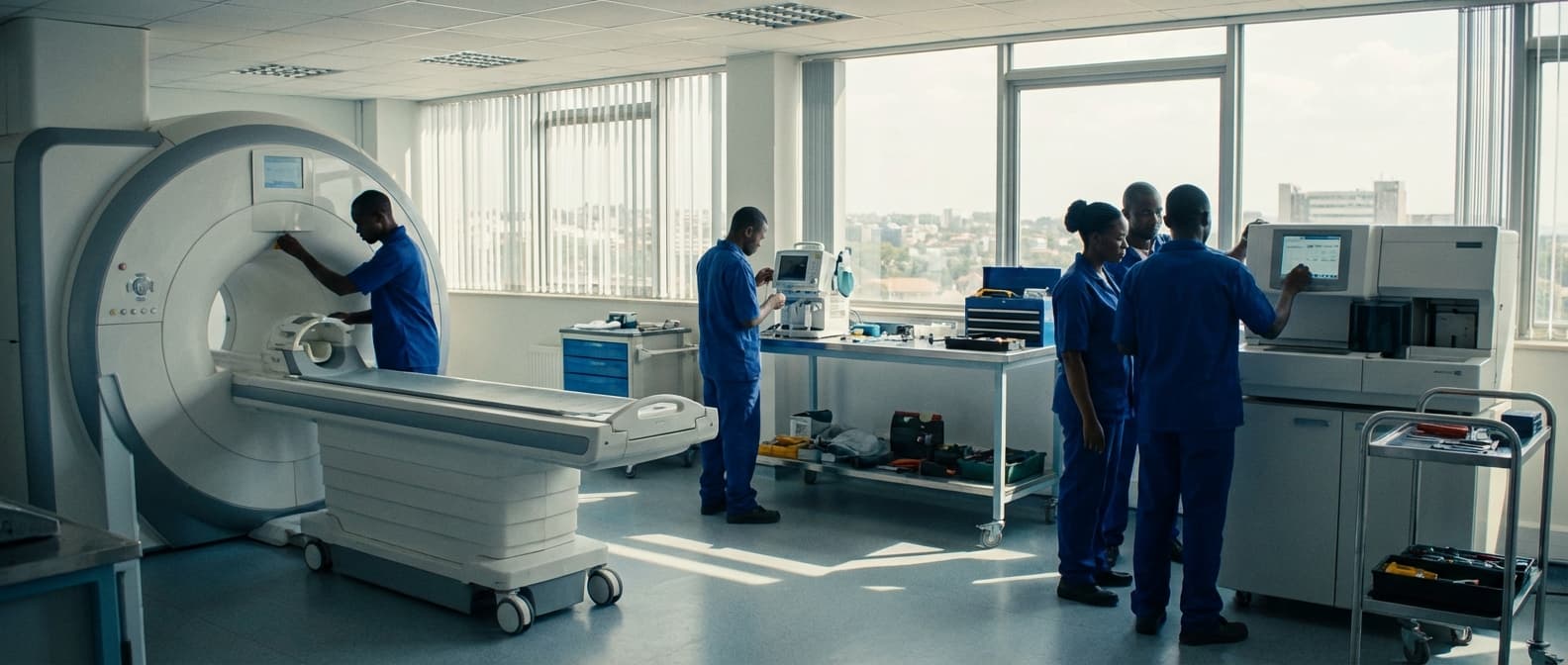
Comprehensive Maintenance Contract (CMC) Management Service (Parts & Labor) in Algeria
Engineering Excellence & Technical Support
Comprehensive Maintenance Contract (CMC) Management Service (Parts & Labor) High-standard technical execution following OEM protocols and local regulatory frameworks.
Rapid Response & On-Site Repair
Our CMC service guarantees swift, on-site emergency repairs across Algeria, minimizing downtime with a dedicated fleet and certified technicians, ensuring your critical equipment is operational with minimal disruption.
Proactive Maintenance & Genuine Parts
Leveraging advanced predictive maintenance techniques and utilizing only manufacturer-approved, genuine parts, we prevent failures before they occur, extending equipment lifespan and maintaining optimal performance and safety standards.
Transparent Cost Control & Reporting
Benefit from predictable budgeting with our all-inclusive labor and parts coverage. Receive detailed performance reports and clear cost breakdowns, empowering informed decision-making and maximizing your ROI on equipment investments.
What Is Comprehensive Maintenance Contract (Cmc) Management Service (Parts & Labor) In Algeria?
Comprehensive Maintenance Contract (CMC) Management Service (Parts & Labor) in Algeria refers to a specialized service that oversees and executes all aspects of maintenance agreements for industrial, commercial, or critical infrastructure equipment. This encompasses the proactive planning, scheduling, execution, and financial management of all maintenance activities, including the procurement and provision of necessary spare parts and the deployment of skilled labor, all within the Algerian regulatory and operational landscape. The service aims to ensure optimal equipment uptime, longevity, and performance while mitigating risks associated with equipment failure and unforeseen maintenance costs.
| Who Needs This Service? | Typical Use Cases | ||||||
|---|---|---|---|---|---|---|---|
| Organizations in Algeria operating critical or complex equipment requiring high availability and reliability. | Manufacturing Plants: Production lines, heavy machinery, HVAC systems, electrical substations. | Energy Sector: Power generation facilities (thermal, renewable), oil and gas extraction and processing equipment, transmission and distribution infrastructure. | Healthcare Facilities: Medical imaging equipment (MRI, CT scanners), laboratory instruments, life support systems, building management systems. | Telecommunications Providers: Network infrastructure, data centers, base stations. | Large Commercial Buildings & Facilities Management: Elevators, escalators, security systems, building automation systems. | Transportation & Logistics: Fleet management (heavy vehicles), warehousing automation, airport ground support equipment. | Public Infrastructure: Water treatment plants, waste management facilities, public transport systems. |
| Companies lacking specialized internal maintenance expertise or the resources to manage complex maintenance contracts. | Businesses seeking to optimize operational costs and improve equipment lifespan. | Organizations aiming to reduce the risk of unplanned downtime and its associated financial losses. | Entities operating in regulated industries where stringent maintenance protocols are mandatory. | Companies that prioritize predictable operational expenditures related to equipment maintenance. |
Key Components of CMC Management Service (Parts & Labor):
- Preventive Maintenance (PM) Planning & Execution: Development and implementation of scheduled maintenance routines to prevent failures, adhering to manufacturer recommendations and operational requirements.
- Corrective Maintenance (CM) Management: Response to equipment malfunctions, including diagnostics, repair, and replacement of faulty components.
- Spare Parts Management: Strategic sourcing, inventory control, warehousing, and timely delivery of genuine or approved spare parts, considering Algerian import regulations and supplier availability.
- Labor Management: Deployment and coordination of qualified and certified technicians (in-house or third-party) for maintenance tasks, ensuring adherence to safety standards.
- Contractual Obligation Fulfillment: Ensuring all terms and conditions of the CMC are met, including response times, service levels, and reporting requirements.
- Performance Monitoring & Reporting: Continuous tracking of equipment performance, maintenance history, costs, and service effectiveness, providing regular reports to the client.
- Budget Management & Cost Optimization: Financial oversight of maintenance expenditures, identifying opportunities for cost savings through efficient parts procurement and labor utilization.
- Risk Assessment & Mitigation: Proactive identification of potential equipment failures and associated risks, developing strategies to minimize downtime and impact.
- Compliance & Regulatory Adherence: Ensuring all maintenance activities and spare part sourcing comply with Algerian industrial safety regulations, environmental standards, and import/export laws.
- Vendor Management: Selection, evaluation, and management of third-party service providers and parts suppliers.
Who Needs Comprehensive Maintenance Contract (Cmc) Management Service (Parts & Labor) In Algeria?
Comprehensive Maintenance Contract (CMC) Management Services, covering both parts and labor, are essential for organizations in Algeria that rely heavily on sophisticated equipment and infrastructure for their operations. These services ensure optimal performance, minimize downtime, and extend the lifespan of assets, ultimately leading to cost savings and increased productivity. The primary beneficiaries are those with a significant investment in technology and machinery, where unexpected failures can have a substantial impact.
| Target Customer Segment | Key Departments Involved | Primary Needs/Benefits |
|---|---|---|
| Large Industrial Enterprises (e.g., Manufacturing, Petrochemicals) | Production Department, Engineering Department, Maintenance Department, Operations Management | Ensuring continuous production, minimizing costly breakdowns, optimizing equipment efficiency, managing spare parts inventory effectively, complying with safety regulations. |
| Telecommunications Companies | Network Operations Center (NOC), Field Operations, IT Department, Infrastructure Management | Maintaining network uptime and quality of service, managing base stations, data centers, and transmission equipment, ensuring rapid response to technical issues. |
| Healthcare Institutions (Hospitals, Clinics) | Biomedical Engineering Department, IT Department, Facilities Management, Administration | Ensuring reliability of critical medical equipment (MRI, CT scanners, ventilators), maintaining patient safety, minimizing disruption to patient care, managing complex diagnostic and treatment systems. |
| Energy and Utilities Providers (Electricity, Water) | Operations Department, Engineering Department, Maintenance Teams, Grid Management | Ensuring consistent supply of essential services, maintaining power plants, transmission lines, water treatment facilities, and distribution networks, preventing widespread outages. |
| Government Agencies (with critical infrastructure like airports, ports, defense) | Infrastructure Management, Operations Department, Technical Services, Security Departments | Ensuring the smooth functioning of national infrastructure, maintaining complex security systems, managing transportation hubs, and supporting defense capabilities. |
| Transportation and Logistics Companies (Airlines, Shipping, Freight) | Fleet Management, Operations Department, Maintenance Teams, Supply Chain Management | Minimizing flight/shipping delays, ensuring the operational readiness of vehicles and vessels, managing complex tracking and logistics systems, maintaining cargo handling equipment. |
| Research and Development Facilities | Laboratory Management, IT Department, Technical Support, Research Teams | Ensuring the availability and calibration of specialized scientific equipment, supporting ongoing research projects, preventing data loss due to equipment failure. |
| Financial Institutions (Banks, Insurance Companies) | IT Department, Operations Department, Branch Management, Security Department | Maintaining the integrity and availability of IT systems, ATMs, and payment processing infrastructure, ensuring data security and business continuity. |
| Manufacturing Plants | Production Floor Management, Engineering, Maintenance, Quality Control | Maximizing output, reducing scrap rates, ensuring product quality, managing automated production lines and robotics. |
| Oil and Gas Sector Companies | Production Operations, Engineering, Maintenance, Safety & Environmental Departments | Ensuring the operational continuity of exploration, extraction, refining, and distribution equipment, managing hazardous environments, and adhering to strict safety standards. |
Target Customers in Algeria for CMC Management Services (Parts & Labor)
- Large Industrial Enterprises
- Telecommunications Companies
- Healthcare Institutions
- Energy and Utilities Providers
- Government Agencies (with critical infrastructure)
- Transportation and Logistics Companies
- Research and Development Facilities
- Financial Institutions (with IT infrastructure)
- Manufacturing Plants
- Oil and Gas Sector Companies
Comprehensive Maintenance Contract (Cmc) Management Service (Parts & Labor) Process In Algeria
This document outlines the comprehensive workflow for managing Comprehensive Maintenance Contracts (CMCs), encompassing both parts and labor, within the Algerian market. The process begins with an initial client inquiry and concludes with the successful execution and closure of maintenance activities. This structured approach ensures efficient resource allocation, timely service delivery, and client satisfaction.
| Stage | Description | Key Activities | Responsible Department | Key Deliverables/Outcomes | Algerian Contextual Considerations |
|---|---|---|---|---|---|
| Inquiry & Lead Generation | Receiving initial requests from potential clients interested in CMC services. | Responding to inquiries (phone, email, website forms), understanding client needs, identifying potential leads. | Sales & Business Development | Qualified leads, initial client understanding | Leveraging local business networks, participation in industry trade shows, understanding regional demand for specific equipment. |
| Proposal & Quotation Development | Creating detailed proposals outlining the scope of services, deliverables, pricing, and contract terms. | Assessing client's equipment inventory, analyzing maintenance history, developing customized service packages, calculating costs (parts, labor, travel), preparing professional proposals. | Technical Sales & Engineering, Finance | Formal proposal document, detailed quotation | Accurate assessment of equipment types prevalent in Algeria (e.g., industrial machinery, medical equipment, IT infrastructure), understanding local pricing benchmarks for parts and labor. |
| Contract Negotiation & Agreement | Discussing and finalizing terms and conditions with the client to reach a mutually agreeable contract. | Clarifying service level agreements (SLAs), warranty clauses, payment terms, response times, contract duration, legal review, signing of the CMC agreement. | Legal Department, Sales & Business Development | Signed CMC agreement | Adherence to Algerian contract law, understanding local business practices for negotiation, clear communication in French or Arabic. |
| Work Order Generation & Scheduling | Translating the signed contract into actionable maintenance tasks and assigning resources. | Creating detailed work orders specifying tasks, equipment, location, required parts, technician(s), and scheduled dates/times. | Operations & Service Management | Generated and assigned work orders | Optimizing routes for technicians considering Algerian road conditions and traffic, scheduling based on client operational hours and potential disruption. |
| Site Visit & Diagnosis | Technicians visit the client's premises to perform scheduled or unscheduled maintenance and diagnose issues. | Performing routine checks, preventive maintenance, troubleshooting equipment malfunctions, identifying necessary repairs or replacements. | Field Service Technicians, Technical Support | Diagnosed issues, preliminary repair plan | Ensuring technicians have appropriate permits or access for sensitive locations (e.g., industrial sites, hospitals), understanding local safety regulations. |
| Parts Procurement & Inventory Management | Sourcing, acquiring, and managing the necessary spare parts for repairs. | Checking inventory, identifying required parts, placing orders with approved suppliers (local or international), managing stock levels, logistics for delivery. | Procurement & Logistics, Warehouse Management | Availability of required spare parts | Navigating Algerian import regulations and customs for specialized parts, building relationships with reliable local suppliers, managing lead times for international shipments. |
| Labor Execution & Service Delivery | Performing the actual maintenance, repair, or replacement tasks as per the work order. | Carrying out repairs, replacing faulty components, conducting performance testing, ensuring adherence to manufacturer specifications and safety protocols. | Field Service Technicians | Completed maintenance/repair tasks, functional equipment | Ensuring technicians are trained on specific equipment models, using appropriate tools and safety equipment, maintaining professional conduct during service delivery. |
| Quality Control & Testing | Verifying the quality of the work performed and ensuring the equipment is functioning optimally. | Post-repair testing, functional checks, client sign-off on completed work, adherence to predefined quality standards. | Quality Assurance, Field Service Technicians | Verified service quality, client acceptance | Establishing clear acceptance criteria with the client, obtaining written confirmation of satisfaction with the service performed. |
| Reporting & Documentation | Compiling all relevant information regarding the maintenance activities. | Generating service reports detailing tasks performed, parts used, labor hours, findings, recommendations, and client sign-off. | Operations & Service Management, Administration | Comprehensive service reports | Maintaining accurate records for warranty claims and future analysis, providing reports in the agreed-upon language (French or Arabic). |
| Invoicing & Payment | Generating invoices for services rendered and managing payment collection. | Submitting invoices based on contract terms (e.g., monthly, per service), following up on payments, reconciling accounts. | Finance & Accounting | Processed invoices, received payments | Understanding Algerian payment processing systems, tax regulations (TVA), and potential payment delays, offering flexible payment options if feasible. |
| Contract Renewal & Review | Proactively engaging with clients to discuss contract renewal and gather feedback. | Reviewing contract performance, discussing upcoming needs, proposing updated service plans, ensuring continued client satisfaction. | Sales & Business Development, Operations & Service Management | Renewed CMC contracts, enhanced client relationships | Demonstrating value and commitment to service quality to encourage long-term partnerships, adapting service offerings based on evolving client needs and market trends in Algeria. |
Key Stages of CMC Management Service (Parts & Labor) in Algeria
- Inquiry & Lead Generation
- Proposal & Quotation Development
- Contract Negotiation & Agreement
- Work Order Generation & Scheduling
- Site Visit & Diagnosis
- Parts Procurement & Inventory Management
- Labor Execution & Service Delivery
- Quality Control & Testing
- Reporting & Documentation
- Invoicing & Payment
- Contract Renewal & Review
Comprehensive Maintenance Contract (Cmc) Management Service (Parts & Labor) Cost In Algeria
Managing Comprehensive Maintenance Contracts (CMCs) for both parts and labor in Algeria involves a complex interplay of factors that influence pricing. CMCs are essential for ensuring the longevity, optimal performance, and minimal downtime of various assets, from industrial machinery and IT infrastructure to medical equipment and vehicles. The cost of these services in Algeria is determined by a combination of the specific equipment, the scope of coverage, the service provider's expertise, and prevailing economic conditions.
Key Pricing Factors for CMC (Parts & Labor) in Algeria:
- Type and Complexity of Equipment: High-tech, specialized, or complex machinery will naturally incur higher maintenance costs due to the need for specialized technicians, proprietary spare parts, and sophisticated diagnostic tools. Industrial equipment, advanced medical devices, and intricate IT systems fall into this category.
- Age and Condition of Equipment: Older or pre-existing conditions in equipment often lead to more frequent breakdowns and a higher demand for replacement parts, thus increasing the overall CMC cost. Proactive maintenance strategies can sometimes mitigate this, but initial investment might be higher.
- Scope of Coverage (Preventive vs. Corrective): CMCs can offer varying levels of service. Purely preventive maintenance (scheduled checks and servicing) is generally less expensive than comprehensive coverage that includes unlimited corrective maintenance (repairs for breakdowns), on-demand services, and emergency call-outs.
- Availability and Cost of Spare Parts: The accessibility and price of genuine spare parts are crucial. If parts are imported, subject to customs duties, or scarce, the CMC cost will be significantly higher. Local sourcing or a well-established supply chain can help control these expenses.
- Labor Costs and Technician Skill Level: The cost of skilled technicians in Algeria plays a vital role. Specialized expertise, certifications, and the geographic location of the service provider (e.g., major cities versus remote areas) will influence labor rates.
- Service Level Agreements (SLAs): Response times, uptime guarantees, and resolution times stipulated in the SLA directly impact the cost. Faster response times and higher uptime guarantees typically command higher prices.
- Contract Duration: Longer-term contracts often come with a reduced annual cost, reflecting a commitment that benefits both the client and the service provider through predictable revenue and workload.
- Geographic Location and Accessibility: Maintenance services required in remote or difficult-to-access areas of Algeria will incur higher logistical costs (travel, accommodation, etc.) for technicians, which will be reflected in the CMC pricing.
- Service Provider's Reputation and Expertise: Established and reputable service providers with a proven track record, robust infrastructure, and certified technicians generally charge a premium for their services.
- Volume and Number of Assets: For clients managing a large fleet of similar equipment, bulk discounts or tailored pricing structures may be available.
- Downtime Impact and Risk Mitigation: The cost of downtime for a specific asset can be substantial. Businesses requiring minimal disruption will opt for more comprehensive CMCs, which are priced accordingly to reflect the risk mitigation provided.
Estimated Cost Ranges in Algerian Dinar (DZD):
It is challenging to provide precise figures without specific details, as costs can vary drastically. However, here are some generalized estimates, keeping in mind these are indicative and subject to negotiation and specific circumstances:
- For Standard Office Equipment (Printers, PCs, basic IT): Annual costs can range from 5,000 DZD to 25,000 DZD per unit, depending on the service provider, included parts, and response times.
- For Industrial Machinery (Mid-range): Annual contracts could range from 150,000 DZD to 1,000,000 DZD or more, heavily dependent on the machinery's value, complexity, and criticality.
- For Advanced IT Infrastructure (Servers, Networking, Data Centers): Costs can vary widely, potentially starting from 200,000 DZD per year for basic server maintenance to several million DZD annually for comprehensive data center management, including uptime guarantees.
- For Medical Equipment (Mid to High-end): Annual maintenance can range from 200,000 DZD to 1,500,000 DZD or higher, influenced by the type of equipment (e.g., MRI machines, X-ray units), manufacturer, and the criticality of the service.
- For Vehicles (Fleet Management): Costs are often calculated per vehicle per year, ranging from 30,000 DZD to 100,000 DZD per vehicle, depending on the type of vehicle, mileage, and the extent of parts and labor covered.
Important Considerations:
- Negotiation is Key: The prices presented are estimates. It is crucial for businesses to obtain detailed quotes from multiple reputable service providers and negotiate terms based on their specific needs and budget.
- Read the Fine Print: Thoroughly review the contract to understand exactly what is covered, including the types of parts, labor exclusions, response times, and any hidden fees.
- Service Provider Due Diligence: Verify the reputation, technical capabilities, and financial stability of potential service providers.
Ultimately, the cost of a CMC is an investment in operational continuity and risk reduction, and its pricing in Algeria is a reflection of the intricate balance between asset value, service requirements, and market dynamics.
| Equipment Category | Estimated Annual Cost Range (DZD) |
|---|---|
| Standard Office Equipment (Printers, PCs, basic IT) | 5,000 - 25,000 per unit |
| Industrial Machinery (Mid-range) | 150,000 - 1,000,000+ |
| Advanced IT Infrastructure (Servers, Networking, Data Centers) | 200,000 - Millions (depending on complexity) |
| Medical Equipment (Mid to High-end) | 200,000 - 1,500,000+ |
| Vehicles (Fleet Management) | 30,000 - 100,000 per vehicle |
Common Factors Influencing CMC (Parts & Labor) Costs in Algeria
- Type and complexity of the equipment
- Age and current condition of the assets
- Scope of maintenance services (preventive, corrective, on-demand)
- Availability and cost of necessary spare parts
- Skilled labor costs and technician expertise
- Service Level Agreement (SLA) terms (response time, uptime)
- Duration of the maintenance contract
- Geographic location and accessibility for servicing
- Reputation, infrastructure, and experience of the service provider
- Volume of equipment under contract
- Risk mitigation and cost of potential downtime
Affordable Comprehensive Maintenance Contract (Cmc) Management Service (Parts & Labor) Options
This document outlines affordable Comprehensive Maintenance Contract (CMC) management service options, focusing on providing value through bundled services and effective cost-saving strategies for both parts and labor. A well-managed CMC ensures the longevity and optimal performance of your assets, minimizing downtime and unexpected repair expenses.
| Value Bundle Tier | Included Services | Target Customer | Potential Cost Savings (Est.) | Key Features |
|---|---|---|---|---|
| Basic Essentials | Preventive Maintenance (Quarterly/Semi-Annually), Labor for Scheduled Service, Basic Parts Replacement (wear & tear) | Small businesses, low-complexity equipment | 10-15% | Focus on fundamental upkeep, predictable costs |
| Standard Advantage | Preventive Maintenance (Monthly/Quarterly), Labor for Scheduled & Unscheduled (minor) Repairs, All Parts (excluding major component failures), Remote Monitoring | Medium-sized businesses, diverse equipment portfolio | 15-20% | Balanced coverage, proactive issue identification |
| Premium Plus | Comprehensive Preventive & Predictive Maintenance, Unlimited Labor for All Repairs (excluding willful damage), All Parts (including major components), 24/7 Emergency Response, Priority Service, On-site Inventory Management (optional) | Large enterprises, critical infrastructure, high-value assets | 20-30%+ | Maximum uptime, complete peace of mind, strategic asset management |
Key Components of an Affordable CMC Management Service
- Proactive Maintenance Scheduling: Regular, planned inspections and servicing to prevent minor issues from escalating into major failures.
- Genuine/OEM Parts Procurement: Sourcing high-quality parts at competitive prices, often leveraging bulk purchasing power.
- Skilled Technical Labor: Access to certified technicians with expertise in your specific equipment, ensuring efficient and correct repairs.
- Emergency Repair Response: Guaranteed rapid response times for critical equipment failures to minimize operational disruption.
- Performance Monitoring & Reporting: Continuous tracking of equipment performance, maintenance history, and costs for data-driven decision-making.
- Inventory Management (Optional): Strategic stocking of critical spare parts to reduce lead times and expedite repairs.
Verified Providers In Algeria
Ensuring access to reliable healthcare is paramount, and in Algeria, identifying verified healthcare providers is crucial for patient safety and trust. Franance Health stands out as a beacon of quality and integrity, offering a credentialing system that guarantees patients are receiving care from qualified and ethical professionals. This credentialing process not only vets individual practitioners but also validates healthcare facilities, ensuring adherence to stringent standards of medical practice, patient care, and operational excellence. Choosing a Franance Health-verified provider means opting for a level of assurance that translates directly into peace of mind and optimal health outcomes.
| Benefit | Impact on Patients | Franance Health's Role |
|---|---|---|
| Assured Quality of Care | Patients receive treatment from highly skilled and competent medical professionals. | Conducts thorough background checks and validates all medical qualifications. |
| Increased Patient Safety | Minimizes risks associated with unqualified practitioners and ensures adherence to safety protocols. | Implements strict ethical guidelines and monitors ongoing compliance. |
| Enhanced Trust and Confidence | Patients can choose healthcare providers with certainty, reducing anxiety and promoting a positive healthcare experience. | Provides a clear and recognizable mark of verification, building patient trust. |
| Access to Reliable Information | Empowers patients to make informed decisions about their healthcare by providing access to verified provider profiles. | Maintains a comprehensive and accessible database of credentialed professionals. |
| Upholding Medical Integrity | Promotes a healthcare environment where ethical practices and professional excellence are paramount. | Actively works to combat unqualified or fraudulent medical services. |
Why Franance Health Credentials Represent the Best Choice for Verified Providers in Algeria:
- Rigorous Vetting Process: Franance Health employs a multi-faceted verification process that scrutinizes educational qualifications, professional licenses, certifications, and practice history of healthcare providers.
- Commitment to Ethical Standards: Beyond technical proficiency, Franance Health assesses adherence to a strict code of medical ethics, ensuring providers prioritize patient well-being and maintain confidentiality.
- Continuous Quality Assurance: Verification is not a one-time event. Franance Health implements ongoing monitoring and re-evaluation to ensure providers consistently meet and exceed established quality benchmarks.
- Enhanced Patient Safety: By identifying and endorsing trusted providers, Franance Health significantly reduces the risk of medical errors, malpractice, and exploitation, prioritizing patient safety above all else.
- Transparency and Trust: The Franance Health credentialing system provides a transparent mark of quality, allowing patients to make informed decisions with confidence and building trust in the Algerian healthcare landscape.
- Access to Specialized Care: Verified providers often encompass a wide range of specialties, ensuring patients can find qualified professionals for all their healthcare needs, from general practice to complex surgical procedures.
- International Standards Alignment: Franance Health's credentialing framework is designed to align with internationally recognized best practices in healthcare quality and patient care.
Scope Of Work For Comprehensive Maintenance Contract (Cmc) Management Service (Parts & Labor)
This Scope of Work (SOW) outlines the requirements for a Comprehensive Maintenance Contract (CMC) Management Service, encompassing both parts and labor. The service provider will be responsible for the proactive and reactive maintenance of specified assets, ensuring optimal performance, reliability, and longevity. This includes all necessary preventative, corrective, and emergency maintenance activities, along with the procurement and management of spare parts.
| Technical Deliverable | Description | Standard Specification / Requirement |
|---|---|---|
| Preventative Maintenance Schedule | Detailed plan outlining all scheduled PM activities for each asset. | Aligned with manufacturer recommendations, asset criticality, and usage data. Frequency to be defined per asset type (e.g., monthly, quarterly, annually). |
| Corrective Maintenance Response Time | Timeframe within which a technician must acknowledge and begin work on a reported fault. | Defined by asset criticality (e.g., Critical: 2 hours, High: 4 hours, Medium: 8 hours, Low: 24 hours). Service Level Agreements (SLAs) to be established. |
| Emergency Maintenance Response Time | Timeframe for immediate dispatch and on-site presence for critical failures. | Typically within 1-2 hours, 24/7 availability for critical assets. Clearly defined escalation procedures. |
| Spare Parts Inventory Management System | Software or process for tracking, managing, and reordering spare parts. | Minimum stock levels defined per part based on usage history and lead times. Real-time inventory visibility. FIFO (First-In, First-Out) or FEFO (First-Expired, First-Out) where applicable. |
| Quality of Replacement Parts | Standards for all spare parts used in repairs and PM. | Must be genuine OEM (Original Equipment Manufacturer) parts or approved equivalent with equivalent or superior specifications. Certifications and traceability required for critical components. |
| Technician Qualifications & Certifications | Minimum qualifications and certifications required for maintenance personnel. | Relevant trade certifications (e.g., electrical, mechanical), manufacturer-specific training, safety certifications (e.g., OSHA), and experience relevant to the asset types. |
| Maintenance Service Reports | Standardized reports generated after each maintenance activity. | Include date/time of service, technician name, problem description, work performed, parts used, readings taken, recommendations, and customer sign-off. Digital format preferred. |
| Asset Maintenance History Log | Comprehensive record of all maintenance performed on each asset. | Includes PM, CM, parts replaced, costs, and performance data. Accessible for review and analysis. |
| Warranty Management | Process for identifying, claiming, and managing manufacturer warranties for parts and labor. | Proactive identification of warranty eligibility for all new parts and repairs. Timely submission of claims. |
| Performance Monitoring Reports | Regular reports detailing asset performance metrics. | Key Performance Indicators (KPIs) such as Mean Time Between Failures (MTBF), Mean Time To Repair (MTTR), uptime percentage, and energy consumption. Analysis and recommendations for improvement. |
| Calibration Certificates | Documentation for calibrated instruments and equipment. | Traceable to national or international standards, with clearly stated calibration dates and validity periods. |
| Safety Procedures Adherence | Compliance with all relevant health, safety, and environmental regulations. | Written safety procedures, risk assessments, Job Safety Analysis (JSA) for all tasks, and regular safety training for technicians. |
Key Service Components
- Preventative Maintenance (PM): Scheduled inspections, servicing, cleaning, lubrication, calibration, and replacement of worn parts based on manufacturer recommendations and usage patterns.
- Corrective Maintenance (CM): Diagnosis and repair of equipment failures or malfunctions on an as-needed basis.
- Emergency Maintenance: Rapid response to critical equipment failures that cause significant downtime or safety hazards.
- Spare Parts Management: Procurement, inventory management, warehousing, and tracking of all necessary spare parts.
- Technical Support & Troubleshooting: Providing expert technical assistance and remote/on-site troubleshooting.
- Reporting & Documentation: Maintaining detailed records of all maintenance activities, including service reports, parts consumed, and equipment history.
- Performance Monitoring & Optimization: Analyzing equipment performance data to identify trends and recommend improvements.
- Contract Management: Overseeing the entire CMC process, including vendor coordination, warranty management, and budget tracking.
Service Level Agreement For Comprehensive Maintenance Contract (Cmc) Management Service (Parts & Labor)
This Service Level Agreement (SLA) outlines the response times and uptime guarantees for the Comprehensive Maintenance Contract (CMC) Management Service, covering both parts and labor. This SLA aims to ensure prompt resolution of issues and minimize downtime for the client's critical systems and equipment.
| Incident Severity | Description | Response Time Guarantee (within Service Hours) | Resolution Time Target (within Service Hours) | Uptime Guarantee (Monthly) |
|---|---|---|---|---|
| Critical (P1) | Complete system outage or critical functionality failure, impacting all users or core business operations. | 1 hour | 4 business hours | 99.9% |
| High (P2) | Significant degradation of performance or loss of a key functionality, impacting a substantial portion of users or critical operations. | 2 hours | 8 business hours | 99.5% |
| Medium (P3) | Minor functionality issues or performance degradation impacting a limited number of users or non-critical operations. | 4 business hours | 2 business days | 99.0% |
| Low (P4) | Cosmetic issues, minor inconveniences, or requests for information that do not impact system functionality. | 8 business hours | 5 business days | N/A (Focus on functional uptime) |
Key Service Commitments
- Response Time: Refers to the time taken by the service provider to acknowledge an incident and initiate troubleshooting after it has been officially reported.
- Resolution Time: Refers to the time taken by the service provider to fix the reported issue and restore the system/equipment to its operational state. This may be contingent on the availability of specific parts and the complexity of the issue.
- Uptime Guarantee: The percentage of time that the client's systems/equipment are expected to be operational and available for use, excluding scheduled maintenance.
- Service Hours: The period during which the CMC Management Service is available for incident reporting and resolution. This includes standard business hours and potentially extended or 24/7 coverage as specified in the main contract.
- Incident Prioritization: A system for categorizing incidents based on their severity and impact on business operations, influencing response and resolution times.
Frequently Asked Questions

Ready when you are
Let's scope your Comprehensive Maintenance Contract (CMC) Management Service (Parts & Labor) in Algeria project in Algeria.

Scaling healthcare logistics and technical systems across the entire continent.