
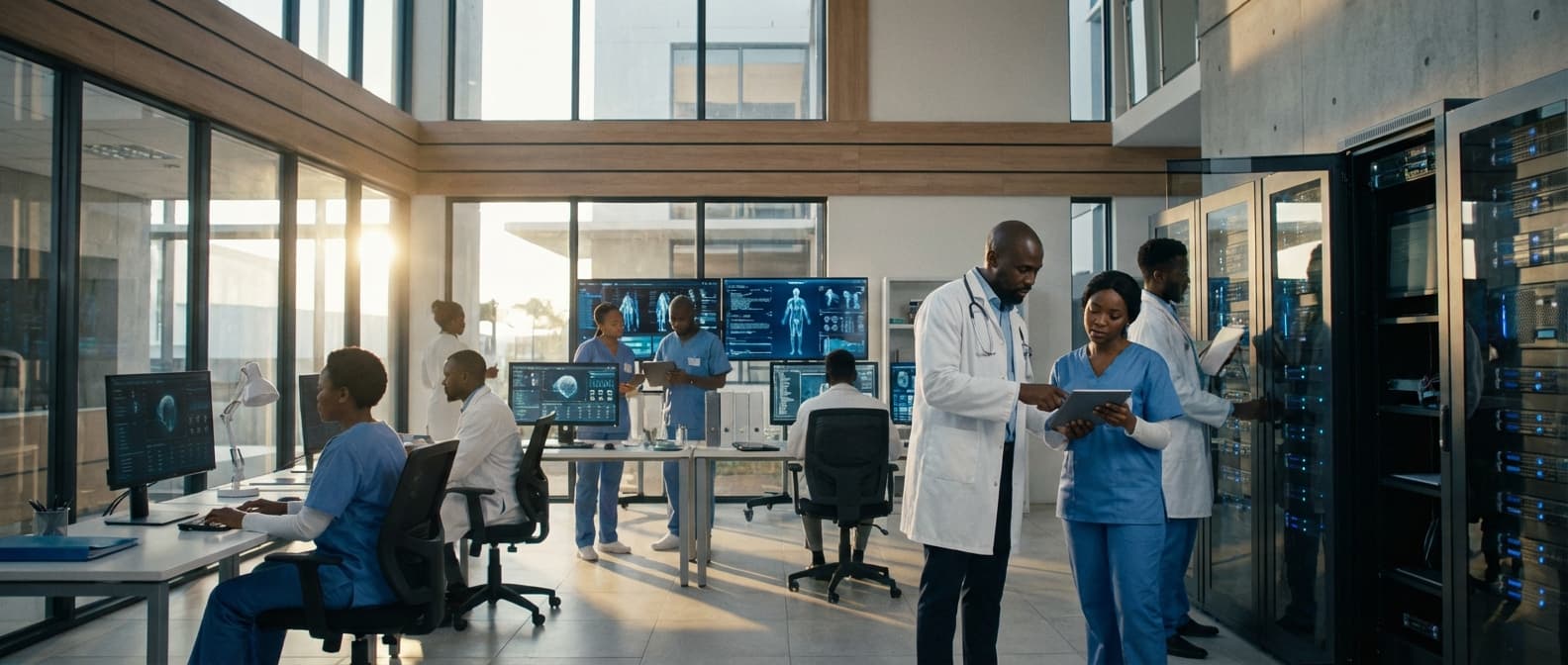
Medical IT Consultation in Algeria
Engineering Excellence & Technical Support
Strategic technology consulting to optimize healthcare operations, streamline workflows, and integrate cutting-edge medical information systems. High-standard technical execution following OEM protocols and local regulatory frameworks.
Accelerated Digital Transformation
Empowering Algerian healthcare providers with cutting-edge IT strategies to streamline operations, enhance patient care accessibility, and improve data management, leading to significant efficiency gains and cost optimization.
Robust Cybersecurity & Data Privacy
Implementing advanced security protocols and compliance frameworks to safeguard sensitive patient data against evolving cyber threats, ensuring adherence to Algerian and international privacy regulations (e.g., GDPR principles for data handling).
Innovative Health Tech Integration
Guiding Algerian hospitals and clinics in the strategic adoption and integration of emerging health technologies, including telemedicine platforms, AI-powered diagnostics, and EMR/EHR systems, to elevate diagnostic accuracy and personalize patient treatment plans.
What Is Medical It Consultation In Algeria?
Medical IT consultation in Algeria refers to the provision of specialized information technology advice and services tailored to the unique operational, regulatory, and economic landscape of the Algerian healthcare sector. This encompasses the strategic planning, implementation, and optimization of IT systems and infrastructure within healthcare organizations to enhance clinical workflows, improve patient care, ensure data security and privacy, and meet national healthcare objectives. These services are typically delivered by external IT experts or specialized consulting firms possessing a deep understanding of both IT principles and healthcare industry specificities, including Algerian health ministry regulations and data residency requirements.
| Who Needs Medical IT Consultation in Algeria? | Typical Use Cases |
|---|---|
| Hospitals and Clinics (Public & Private): Seeking to modernize patient record systems, improve operational efficiency, and enhance diagnostic capabilities. | Implementing a new Electronic Health Record (EHR) system; Upgrading network infrastructure for better data flow; Integrating PACS for radiology departments; Developing a cybersecurity strategy. |
| Diagnostic Laboratories: Requiring efficient data management for test results, sample tracking, and reporting. | Deploying a Laboratory Information System (LIS); Ensuring compliance with diagnostic reporting standards. |
| Pharmaceutical Companies & Research Institutions: Needing secure data management for clinical trials, research, and regulatory submissions. | Establishing secure data repositories for clinical research; Implementing data analytics for drug discovery; Ensuring compliance with pharmaceutical IT regulations. |
| Government Health Agencies & Ministries: Aiming to standardize IT systems across the national healthcare network, promote e-health initiatives, and improve public health data collection. | Developing national health information exchange platforms; Implementing telemedicine infrastructure for remote areas; Standardizing EHR adoption across public hospitals. |
| Emerging Healthcare Startups: Requiring guidance on selecting and implementing appropriate IT solutions to establish a technologically advanced healthcare service. | Designing IT architecture for a new digital health platform; Choosing a cloud-based HIS solution. |
| Healthcare IT Vendors/Service Providers: Seeking local expertise to navigate the Algerian market, understand regulatory nuances, and tailor their offerings to Algerian healthcare needs. | Localizing software solutions to meet Algerian standards; Understanding data localization requirements. |
Key Components of Medical IT Consultation in Algeria
- Needs Assessment and Strategic Planning: Evaluating existing IT infrastructure, identifying gaps, and developing a roadmap for technology adoption aligned with organizational goals and budget constraints.
- System Selection and Implementation: Advising on and facilitating the procurement and deployment of Electronic Health Records (EHR/DPI), Picture Archiving and Communication Systems (PACS), Laboratory Information Systems (LIS), Hospital Information Systems (HIS), and other specialized medical software.
- Infrastructure Design and Management: Planning, deploying, and managing network infrastructure, servers, storage, cybersecurity measures, and cloud solutions suitable for healthcare environments.
- Data Management and Analytics: Establishing data governance policies, ensuring data integrity, and implementing solutions for data warehousing, business intelligence, and clinical analytics to support research and operational improvement.
- Regulatory Compliance: Ensuring IT systems and practices adhere to Algerian healthcare regulations, including data protection laws, patient privacy standards, and telemedicine guidelines.
- Cybersecurity and Risk Management: Developing and implementing robust cybersecurity strategies to protect sensitive patient data from breaches, cyber threats, and ensuring business continuity.
- Telemedicine and Remote Healthcare Solutions: Designing and implementing platforms and infrastructure for remote patient monitoring, virtual consultations, and e-health services.
- IT Project Management: Overseeing the successful planning, execution, and closure of IT projects within healthcare organizations.
- Training and Support: Providing end-user training and ongoing technical support for implemented IT systems.
Who Needs Medical It Consultation In Algeria?
In Algeria's evolving healthcare landscape, specialized Medical IT consultation is becoming increasingly vital. This service helps healthcare providers navigate the complexities of technology adoption, optimize existing systems, and ensure data security and compliance. The need spans a diverse range of institutions and departments, all striving for enhanced efficiency, better patient care, and adherence to evolving regulations.
| Customer Type | Key Needs and Challenges | Relevant Departments |
|---|---|---|
| Public Hospitals | Interoperability of legacy systems, digital transformation initiatives, data security, EMR/EHR implementation, telemedicine readiness, IT infrastructure upgrades, compliance with national health policies. | IT Department, Administration, Clinical Departments (Radiology, Pathology, Pharmacy), Medical Records, Finance, Quality Assurance. |
| Private Clinics & Polyclinics | Implementing patient management systems, optimizing appointment scheduling, improving billing and revenue cycle management, cybersecurity, adopting cloud solutions, enhancing patient engagement tools. | Administration, IT Support, Front Desk/Reception, Billing Department, Clinical Staff, Management. |
| Specialized Medical Centers | Integration of advanced imaging and diagnostic systems (PACS, RIS), data analytics for research and patient outcomes, cybersecurity for sensitive data, specialized software implementation (e.g., radiation therapy planning), remote diagnostics. | IT Department, Department Heads (e.g., Chief of Radiology), Clinical Specialists, Research & Development, Medical Records. |
| Pharmaceutical Companies | Secure data management for clinical trials, IT infrastructure for research & development, supply chain management IT, cybersecurity for intellectual property, digital marketing and patient support platforms. | IT Department, Research & Development, Clinical Operations, Supply Chain, Marketing, Legal. |
| Medical Device Manufacturers/Distributors | Developing connected medical devices, ensuring cybersecurity of devices, IT solutions for product lifecycle management, data integration with hospital systems, remote monitoring capabilities. | R&D Department, Engineering, IT Department, Sales & Support, Quality Control. |
| Research Institutions/Universities | High-performance computing for medical research, secure data storage and access, interoperability for data sharing, implementing research information management systems, cybersecurity for sensitive research data. | IT Department, Research Centers, Faculty IT Support, Library Services, Administration. |
| Government Health Agencies | Developing national health information systems, data analytics for public health monitoring, cybersecurity for government health databases, policy implementation support, digital health strategy development. | IT Department, Policy & Planning, Public Health Surveillance, Data Management, Legal & Compliance. |
| Healthcare Insurance Providers | Claims processing automation, data analytics for risk assessment and fraud detection, secure patient data management, integration with provider systems, development of patient portals. | IT Department, Claims Processing, Underwriting, Data Analytics, Customer Service, Actuarial Department. |
Target Customers for Medical IT Consultation in Algeria
- Public Hospitals (National, Regional, and Local)
- Private Clinics and Polyclinics
- Specialized Medical Centers (e.g., Cardiology, Oncology, Radiology)
- Pharmaceutical Companies
- Medical Device Manufacturers and Distributors
- Research Institutions and Universities with Medical Faculties
- Government Health Agencies and Ministries
- Healthcare Insurance Providers
Medical It Consultation Process In Algeria
The Medical IT Consultation Process in Algeria outlines the systematic journey of engaging with an IT service provider for medical facilities. This workflow ensures that the specific needs of healthcare organizations are understood, appropriate solutions are identified, and these solutions are effectively implemented and maintained.
| Stage | Description | Key Activities | Deliverables | Typical Timeframe (Algeria) |
|---|---|---|---|---|
| The process begins when a medical facility expresses interest in IT consultation services. | Contacting the IT provider, initial discussion of general IT needs, and scheduling a discovery meeting. | Confirmed meeting, preliminary understanding of client's general IT landscape. | 1-3 Business Days |
| A thorough understanding of the facility's current IT infrastructure, challenges, and future goals is established. | On-site visits, interviews with stakeholders (doctors, administrators, IT staff), review of existing systems, documentation review. | Detailed needs assessment report, documented functional and non-functional requirements. | 1-2 Weeks |
| Based on the gathered requirements, the IT provider develops a tailored solution proposal. | Developing technical specifications, solution architecture, cost estimations, implementation plan, and presenting the proposal to the client. | Formal IT consultation proposal document, presentation slides. | 1-3 Weeks |
| Formalizing the partnership and outlining the terms of service. | Reviewing the proposal, negotiating scope, timelines, costs, SLAs, and signing the service agreement. | Signed contract, Statement of Work (SOW). | 1-2 Weeks |
| Detailed planning for the execution of the agreed-upon IT solutions. | Defining project milestones, resource allocation, risk management strategies, and detailed project schedule. | Project plan, Gantt chart, resource allocation matrix. | 1 Week |
| Designing the technical blueprint for the IT solution. | Designing network infrastructure, software architecture, database design, security protocols, and ensuring compliance with Algerian healthcare regulations (if applicable). | System architecture diagrams, technical design documents, security policy outlines. | 2-4 Weeks |
| Bringing the designed IT solution to life. | Hardware installation, software configuration, system integration, data migration, and deployment in the medical environment. | Deployed IT systems, installed hardware and software. | Variable (depends on complexity, weeks to months) |
| Ensuring the solution functions as intended and meets all requirements. | Unit testing, integration testing, user acceptance testing (UAT), performance testing, security vulnerability assessments. | Test plans, test reports, UAT sign-off. | 1-2 Weeks |
| Empowering the medical staff to effectively use the new IT systems. | Developing training materials, conducting training sessions for various user groups, and officially handing over the system. | Training manuals, trained personnel, handover documentation. | 1-2 Weeks |
| Providing ongoing assistance and ensuring system stability. | Troubleshooting, bug fixing, system updates, proactive monitoring of system health, and addressing user queries. | Helpdesk support, regular maintenance reports. | Ongoing (as per SLA) |
| Continuously improving the IT infrastructure for better performance and efficiency. | Performance analysis, identifying areas for improvement, implementing optimizations, and strategic IT planning for future growth. | Performance reports, optimization recommendations, strategic IT roadmaps. | Ongoing |
Medical IT Consultation Process Workflow in Algeria
- Inquiry & Initial Contact
- Needs Assessment & Requirement Gathering
- Proposal Development & Presentation
- Contract Negotiation & Agreement
- Project Planning & Scoping
- Solution Design & Architecture
- Implementation & Deployment
- Testing & Quality Assurance
- Training & Handover
- Post-Implementation Support & Maintenance
- Ongoing Monitoring & Optimization
Medical It Consultation Cost In Algeria
Consulting services in the Medical IT sector in Algeria, like in many other industries, are subject to a range of pricing influenced by several key factors. These factors collectively determine the final cost a healthcare organization or provider will incur for expert advice and solutions. Understanding these elements is crucial for budgeting and making informed decisions.
The pricing of Medical IT consultations in Algeria is not a fixed rate and can vary significantly. Several elements contribute to this variability, making it essential to consider each one when seeking a quote. The primary determinants include:
- Scope of the Project: The complexity and breadth of the IT challenges being addressed are paramount. A simple network assessment will cost far less than a comprehensive overhaul of a hospital's entire Electronic Health Record (EHR) system or the implementation of advanced cybersecurity protocols.
- Consultant's Experience and Specialization: Highly experienced consultants or those with niche expertise in specific medical IT domains (e.g., telemedicine, PACS/RIS systems, medical device integration, data analytics for healthcare) command higher rates. Their proven track record and specialized knowledge justify a premium.
- Duration of the Engagement: Consultations can range from a few hours for specific advice to several months for large-scale project management and implementation. The longer the engagement, the higher the overall cost, though hourly or daily rates might decrease for extended contracts.
- Type of Consultation: Whether the consultation is for strategic planning, system selection, vendor evaluation, troubleshooting, compliance (e.g., data privacy regulations), or training will influence the pricing. Strategic and compliance-related consultations often involve more in-depth analysis and may be priced higher.
- Provider Reputation and Size: Well-established and reputable IT consulting firms, especially those with a strong presence and track record in the Algerian healthcare market, may have higher overheads and thus higher billing rates compared to smaller or independent consultants.
- Travel and Accommodation: If the consultant needs to travel to different cities or regions within Algeria, or if extensive on-site work is required, associated travel and accommodation expenses will be added to the total cost.
- Urgency and Deadlines: Rush projects or those with tight deadlines can sometimes incur premium charges due to the compressed timeline and the need for expedited resource allocation.
- Deliverables: The specific outputs expected from the consultation (e.g., detailed reports, strategic roadmaps, system architecture designs, training materials) can also influence the pricing. More comprehensive or complex deliverables will naturally increase the cost.
Pricing Ranges in Algerian Dinar (DZD):
Given the fluctuating nature of the Algerian market and the diverse factors involved, providing exact figures is challenging. However, based on general industry understanding and anecdotal evidence, the following ranges can be considered as indicative. It's important to note that these are estimates and actual quotes may fall outside these ranges.
- Hourly Rates: For general IT advice, troubleshooting, or specific assessments, hourly rates for Medical IT consultants in Algeria can range from 10,000 DZD to 35,000 DZD per hour. Highly specialized or senior consultants might charge even more.
- Daily Rates: For more in-depth engagements or project work, daily rates can vary from 70,000 DZD to 250,000 DZD per day. This often applies to project managers, senior analysts, or implementation specialists.
- Project-Based Fees: For clearly defined projects with specific deliverables (e.g., EHR selection and implementation planning, cybersecurity audit), the total cost can range significantly. A small-scale project might cost 500,000 DZD to 2,000,000 DZD, while a large, complex hospital-wide IT transformation could easily run into millions of DZD (e.g., 5,000,000 DZD to 20,000,000 DZD or more), depending on its scope and duration.
It is highly recommended for healthcare providers in Algeria to obtain detailed proposals from multiple reputable Medical IT consulting firms or independent consultants, outlining the scope of work, deliverables, timelines, and the breakdown of costs, before committing to any engagement.
| Consultation Type/Rate | Estimated Range (Algerian Dinar - DZD) |
|---|---|
| Hourly Rate (General Advice/Troubleshooting) | 10,000 - 35,000 DZD |
| Daily Rate (In-depth Engagements/Project Work) | 70,000 - 250,000 DZD |
| Project-Based Fee (Small to Medium Scale) | 500,000 - 2,000,000 DZD |
| Project-Based Fee (Large Scale/Hospital-Wide Transformation) | 5,000,000 - 20,000,000+ DZD |
Key Factors Influencing Medical IT Consultation Costs in Algeria
- Scope of the Project
- Consultant's Experience and Specialization
- Duration of the Engagement
- Type of Consultation (Strategic, Implementation, Compliance, etc.)
- Provider Reputation and Size
- Travel and Accommodation Expenses
- Urgency and Deadlines
- Expected Deliverables
Affordable Medical It Consultation Options
Navigating the complex landscape of Medical IT can be a significant challenge for healthcare organizations, especially when budgets are tight. Fortunately, there are several affordable medical IT consultation options available. Understanding value bundles and implementing cost-saving strategies are key to maximizing your investment and ensuring you receive the expertise you need without breaking the bank. This guide explores these avenues to help you make informed decisions.
| Strategy | Description | Cost-Saving Benefit |
|---|---|---|
| Value Bundles | Pre-packaged sets of services designed to address common healthcare IT needs (e.g., a compliance bundle, a security assessment bundle). These often include multiple components at a discounted rate compared to purchasing them individually. | Provides predictable costs and potential discounts for a comprehensive solution. |
| Fixed-Price Contracts | Negotiating a flat fee for a specific project or scope of work, rather than an hourly rate. This eliminates the risk of cost overruns due to extended timelines. | Offers budget certainty and protects against unexpected expenses. |
| Leverage Existing Internal Resources | Identify and utilize in-house IT staff or clinical personnel who have relevant knowledge. Consultants can then focus on specialized tasks or strategic guidance, supplementing internal capabilities. | Reduces the need for external consultants for routine tasks, focusing budget on high-impact areas. |
| Phased Implementation | Break down large IT projects into smaller, manageable phases. This allows for staggered budgeting and the ability to assess ROI before committing to subsequent phases. | Distributes costs over time and allows for adjustments based on early outcomes. |
| Remote Consultation | Utilize virtual meetings and remote access tools for consultation instead of on-site visits. This significantly reduces travel expenses and associated costs. | Eliminates travel and accommodation costs for consultants. |
| Agreements for Multiple Services | If you anticipate needing IT services over a longer period, negotiate bundled rates for multiple types of consultations or ongoing support. This can lead to volume discounts. | Secures ongoing expertise at a potentially lower per-service cost. |
| Focus on ROI-Driven Solutions | Prioritize consultations that promise a clear return on investment, such as improving efficiency, reducing risk, or enhancing patient care. This ensures your IT spending is strategic. | Justifies the cost by demonstrating tangible business benefits and improved operational outcomes. |
Types of Affordable Medical IT Consultation
- {"title":"Project-Based Consultations","description":"Focus on specific, well-defined projects like EHR implementation, cybersecurity assessment, or cloud migration. These are often more cost-effective than ongoing retainers as you pay for the expertise needed for a defined outcome."}
- {"title":"On-Demand IT Support Services","description":"Utilize IT consultants on an as-needed basis for troubleshooting, quick advice, or specific task assistance. This avoids the commitment of a full-time or retainer-based service, making it suitable for smaller, intermittent needs."}
- {"title":"Specialized Niche Consultancies","description":"Engage consultants who specialize in a particular area of medical IT (e.g., HIPAA compliance, telehealth platform integration, medical device security). Their deep expertise can lead to more efficient solutions and reduced overall project time."}
- {"title":"Technology Partner Programs","description":"Some IT vendors offer complimentary or discounted consultation services as part of their product or service packages. This can be a great way to get initial guidance when adopting new technologies."}
- {"title":"Academic or Research Institutions","description":"Certain universities or research centers with IT departments or specialized healthcare IT programs may offer consulting services, often at a lower cost, as part of their outreach or training initiatives."}
Verified Providers In Algeria
In the dynamic landscape of healthcare, identifying and engaging with verified providers is paramount for ensuring quality, safety, and efficacy. In Algeria, the distinction of 'Verified Providers' signifies a commitment to excellence and adherence to stringent standards. Among these, Franance Health stands out, not just as a provider, but as a benchmark for what constitutes the best choice in healthcare services. Their credentials, rooted in a comprehensive approach to patient care and operational integrity, make them a trusted partner for individuals seeking reliable and superior medical solutions.
| Credential/Aspect | Franance Health's Distinction | Why it Matters for Patients |
|---|---|---|
| Regulatory Compliance | Meets and often exceeds Algerian Ministry of Health regulations, alongside international best practices. | Ensures legal and ethical operation, providing peace of mind regarding the legitimacy and safety of services. |
| Quality Assurance | Implements comprehensive internal quality control and assurance programs, regularly audited by independent bodies. | Guarantees a consistently high standard of care, reducing the risk of errors and improving treatment outcomes. |
| Specialized Expertise | Boasts a broad range of specialists across numerous medical disciplines, with a focus on complex and chronic conditions. | Provides access to top-tier expertise for specific health needs, leading to more accurate diagnoses and effective treatment plans. |
| Patient Feedback and Satisfaction | Actively collects and acts upon patient feedback to continuously enhance service delivery and patient experience. | Demonstrates a commitment to patient satisfaction, ensuring a positive and supportive healthcare experience. |
| Ethical Medical Practices | Upholds the highest ethical standards in all medical interactions and treatments. | Fosters trust and transparency, ensuring patients are treated with respect and dignity. |
Key Credentials and Strengths of Franance Health
- Accreditation and Certifications: Franance Health adheres to internationally recognized standards, holding accreditations that attest to their rigorous quality management systems and clinical excellence.
- Highly Qualified Medical Professionals: The network comprises a diverse team of experienced and specialized doctors, nurses, and allied health professionals, many of whom have received training and experience from leading global institutions.
- State-of-the-Art Facilities and Technology: Franance Health invests in advanced medical equipment and modern infrastructure, ensuring that patients receive the most effective and up-to-date treatments available.
- Patient-Centric Approach: A core principle is the delivery of personalized care, focusing on patient comfort, clear communication, and comprehensive support throughout their healthcare journey.
- Robust Safety Protocols: Strict adherence to international safety standards and infection control measures is a cornerstone of their operations, prioritizing patient well-being above all else.
- Commitment to Continuous Improvement: Franance Health actively engages in ongoing research, training, and professional development to stay at the forefront of medical advancements and best practices.
Scope Of Work For Medical It Consultation
This Scope of Work (SOW) outlines the services to be provided by [Consulting Firm Name] (hereinafter referred to as "Consultant") for Medical IT Consultation for [Client Name] (hereinafter referred to as "Client"). The primary objective is to assess, plan, and recommend improvements for the Client's existing medical IT infrastructure and systems to enhance efficiency, security, compliance, and patient care.
| Phase | Activities | Deliverables | Timeline (Estimated) |
|---|---|---|---|
| Phase 1: Discovery & Assessment | On-site and remote interviews with key stakeholders (IT staff, clinicians, administrators). Review of existing IT documentation (network diagrams, policies, procedures, inventory). Analysis of current system performance and user feedback. Security vulnerability assessment. | Current State Assessment Report (including strengths, weaknesses, opportunities, threats). Gap Analysis Report (against industry best practices and regulatory requirements). Risk Assessment Report. | 2-4 Weeks |
| Phase 2: Strategy & Planning | Development of an IT strategy aligned with organizational goals. Identification of required technology and software solutions. Evaluation of cloud vs. on-premise solutions. Development of a phased implementation plan. Budgetary recommendations. | IT Strategic Roadmap Document. Technology Recommendation Report. High-level Implementation Plan. Preliminary Budgetary Estimates. | 3-5 Weeks |
| Phase 3: Recommendations & Reporting | Presentation of findings and recommendations to client stakeholders. Refinement of recommendations based on feedback. Finalization of all deliverables. | Final Project Report with detailed recommendations. Executive Summary Presentation. Q&A Session. | 1-2 Weeks |
Objectives of the Consultation
- To conduct a comprehensive assessment of the current medical IT infrastructure, including hardware, software, network, and security.
- To identify current challenges, risks, and areas for improvement in the IT environment.
- To ensure compliance with relevant healthcare regulations (e.g., HIPAA, HITECH, GDPR if applicable).
- To develop a strategic IT roadmap for the next 1-3 years, aligning with the Client's business and clinical goals.
- To provide recommendations for system upgrades, new technology adoption, and process optimization.
- To assist in the evaluation and selection of potential IT vendors and solutions.
- To define best practices for IT operations, data management, and cybersecurity.
- To deliver actionable insights and a clear plan for implementation.
Service Level Agreement For Medical It Consultation
This Service Level Agreement (SLA) outlines the response times and uptime guarantees for Medical IT Consultation services provided by [Your Company Name] to [Client Name]. This agreement is designed to ensure the reliable and timely support of your critical medical IT infrastructure.
| Service Component | Uptime Guarantee | Response Time (Critical Incidents) | Response Time (High Priority Incidents) | Response Time (Medium Priority Incidents) | Response Time (Low Priority Incidents) |
|---|---|---|---|---|---|
| Core Medical IT Systems (EHR, PACS, LIS) | 99.9% Uptime (excluding scheduled maintenance) | 15 minutes (initial response) | 1 hour (initial response) | 4 business hours (initial response) | 8 business hours (initial response) |
| Ancillary Medical IT Systems (Scheduling, Patient Portals) | 99.5% Uptime (excluding scheduled maintenance) | 30 minutes (initial response) | 2 hours (initial response) | 8 business hours (initial response) | 16 business hours (initial response) |
| General IT Infrastructure (Networking, Servers) | 99.7% Uptime (excluding scheduled maintenance) | 30 minutes (initial response) | 2 hours (initial response) | 8 business hours (initial response) | 16 business hours (initial response) |
| IT Consultation Services (Strategic Planning, Project Support) | N/A (Availability for scheduled meetings) | N/A | N/A | 48 business hours (initial contact) | 72 business hours (initial contact) |
Key Service Commitments
- This SLA defines the agreed-upon levels of service for IT consultation, focusing on critical incident response and system availability.
- The scope of this SLA covers all IT consultation services directly related to the medical IT infrastructure as defined in the attached Statement of Work (SOW).
- This SLA is effective as of [Start Date] and will remain in effect for the duration of the service contract, unless terminated as per the agreement.
- Any deviations or exclusions to this SLA must be formally documented and agreed upon by both parties in writing.
Frequently Asked Questions

Ready when you are
Let's scope your Medical IT Consultation in Algeria project in Algeria.

Scaling healthcare logistics and technical systems across the entire continent.