
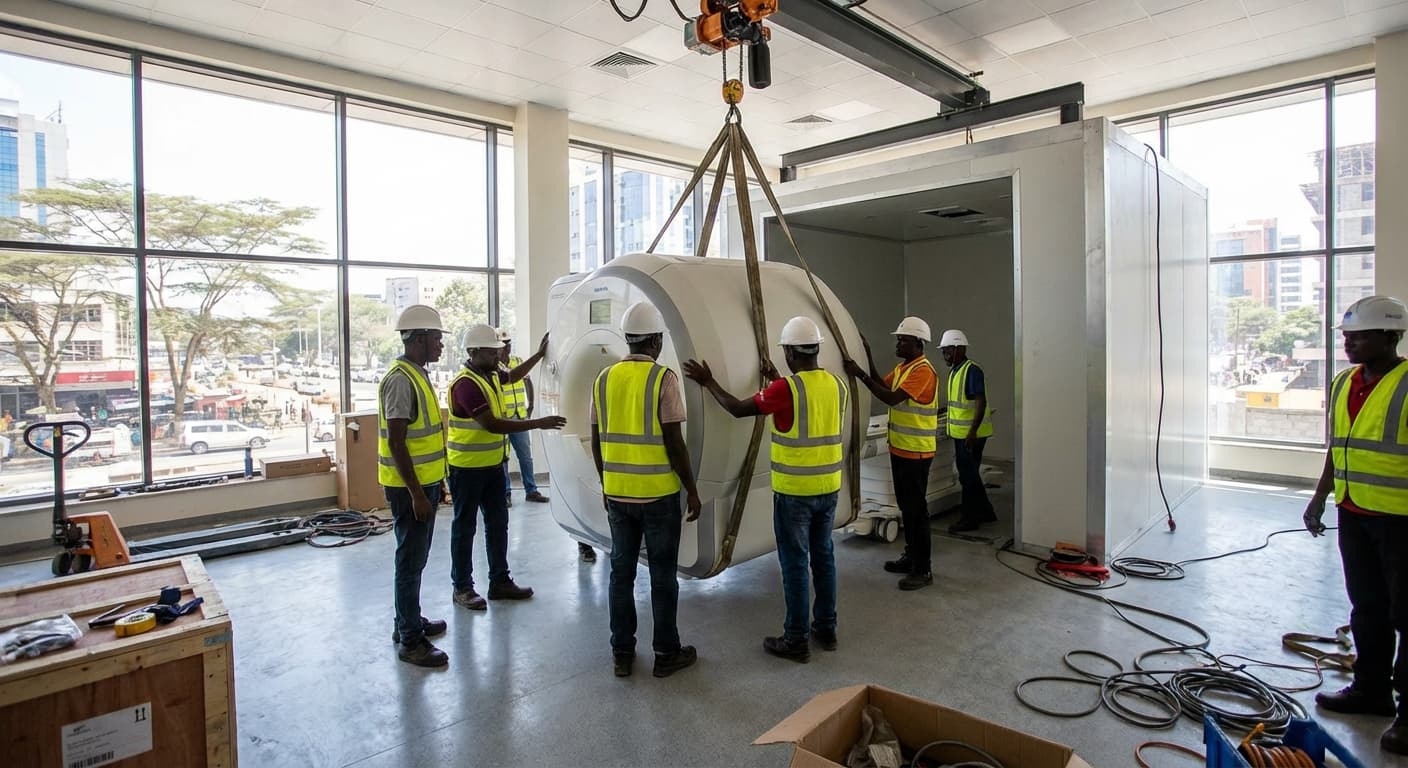
MRI Rigging & Installation Service in Algeria
Engineering Excellence & Technical Support
Expert MRI Rigging & Installation Service solutions in Algeria. High-standard technical execution following OEM protocols and local regulatory frameworks.
Precision Heavy Lifting & Rigging
We specialize in the safe and precise rigging and installation of complex and heavy MRI equipment across Algeria. Our expert teams utilize advanced techniques and state-of-the-art equipment to ensure seamless placement and secure installation, minimizing disruption and guaranteeing operational readiness. From initial transport to final positioning within sensitive medical environments, our commitment to detail ensures zero compromise on safety and accuracy.
Engineered Installation Solutions
Our technical expertise extends beyond basic rigging. We provide engineered installation solutions tailored to the unique requirements of each MRI site in Algeria. This includes detailed site surveys, structural integrity assessments, and the development of bespoke installation plans to overcome any logistical or architectural challenges. Our team of engineers and certified technicians ensures every installation meets the highest international standards for both safety and MRI performance.
Certified Safety & Compliance Assurance
Safety is paramount in our operations. MRI Rigging & Installation Service in Algeria adheres to the strictest safety protocols and regulatory compliance. All our personnel are highly trained and certified, and our equipment undergoes rigorous inspections. We provide comprehensive risk assessments and method statements for every project, offering clients complete peace of mind and ensuring a secure and compliant installation process for their valuable medical assets.
What Is Mri Rigging & Installation Service In Algeria?
MRI Rigging & Installation Service in Algeria refers to the specialized process of safely and precisely transporting, positioning, and integrating Magnetic Resonance Imaging (MRI) systems within healthcare facilities. This service is critical for ensuring the optimal performance, longevity, and patient safety of these sophisticated medical imaging devices. It encompasses a highly technical and regulated procedure that requires expertise in structural engineering, electrical systems, magnet handling, and adherence to stringent safety protocols. The service is essential for any Algerian healthcare institution acquiring, relocating, or decommissioning an MRI scanner.
| Service Aspect | Description | Key Considerations for Algeria |
|---|---|---|
| Site Preparation & Structural Assessment | Evaluating the physical space for load-bearing capacity, access routes, and necessary clearances. This includes assessing floor integrity to support the immense weight of the MRI magnet and its associated infrastructure. | Understanding local building codes, seismic activity considerations, and availability of specialized structural reinforcement services. |
| Magnet Transportation & Rigging | The highly sensitive and dangerous process of moving the superconducting magnet, often involving specialized cranes, skids, and controlled environments. Includes management of cryogens (liquid helium) to maintain superconductivity and prevent rapid boil-off. | Availability of certified heavy lifting equipment and personnel trained in handling cryogenically cooled, high-field magnets. Stringent adherence to international safety standards for cryogen management is paramount. |
| RF Shielding Installation & Verification | Constructing or modifying a Faraday cage to prevent external radiofrequency interference from impacting image quality. This involves precise installation of conductive materials (e.g., copper or aluminum sheeting) and ensuring continuous electrical conductivity. | Sourcing high-quality shielding materials. Expertise in RF engineering to ensure leak-free performance in diverse architectural settings. Verification often involves specialized RF leakage testing equipment. |
| Electrical Power & Grounding Systems | Establishing a stable, dedicated power supply with appropriate voltage, current, and surge protection. Comprehensive grounding is crucial for both safety and signal integrity, mitigating electrical noise. | Ensuring compatibility with Algeria's national electrical grid standards. Provision for uninterruptible power supplies (UPS) and backup generators is often required due to potential grid fluctuations. |
| Cooling System (Cryogen Management) | Setting up and testing the cryogen delivery and management system, including helium refill procedures and safety interlocks to prevent accidental venting. | Access to reliable sources of liquid helium. Training for local technicians on safe cryogen handling and emergency response protocols. |
| System Calibration & Performance Verification | Post-installation, conducting comprehensive diagnostic tests, image quality assessments, and system parameter calibration to ensure adherence to manufacturer specifications and optimal diagnostic performance. | Utilizing advanced phantom imaging techniques and software verification tools. Ensuring alignment with international quality control standards for medical imaging. |
| Decommissioning & Disposal | Safe and environmentally responsible dismantling, removal, and disposal of MRI components, including the magnet and cryogens, adhering to hazardous material regulations. | Compliance with Algerian environmental protection laws. Collaboration with certified hazardous waste disposal companies. |
Key Technical Components
- Site Preparation & Structural Assessment
- Magnet Transportation & Rigging (Cryogen Handling)
- RF Shielding Installation & Verification
- Electrical Power & Grounding Systems Integration
- Cooling System (Cryogen Management) Setup & Testing
- Gradient Coil & RF Coil System Integration
- Workstation & PACS Connectivity
- Shielding Integrity Testing (RF & Magnetic)
- System Calibration & Performance Verification
- Decommissioning & Disposal Procedures
Who Needs Mri Rigging & Installation Service In Algeria?
The deployment and operational readiness of Magnetic Resonance Imaging (MRI) systems are critical for advanced diagnostic imaging capabilities within Algeria's healthcare infrastructure. MRI rigging and installation services are indispensable for a broad spectrum of healthcare providers requiring the integration of these complex, high-field strength medical devices. This necessitates specialized expertise to ensure proper siting, structural integrity, electromagnetic shielding, and precise calibration, all of which are paramount for safe, effective, and compliant operation. The target clientele encompasses any medical facility that has procured or is planning to procure MRI technology to enhance its diagnostic and therapeutic offerings. This includes, but is not limited to, established healthcare institutions as well as new facilities aiming to provide state-of-the-art medical imaging services.
| Healthcare Facility Type | Primary Need for MRI Rigging & Installation | Key Departments Benefiting Most |
|---|---|---|
| Hospitals (Public and Private) | Integration of new MRI scanners into existing or new construction; relocation and recommissioning of existing units; upgrades to accommodate higher field strength systems. | Radiology, Neurology, Neurosurgery, Oncology, Cardiology, Orthopedics, Emergency Medicine. |
| Specialized Clinics | Establishment of dedicated MRI suites for specific diagnostic specialties; ensuring optimal workflow and patient throughput. | Neurology, Oncology, Cardiology, Musculoskeletal Imaging. |
| Independent Diagnostic Imaging Centers | Installation of MRI systems in standalone facilities to provide specialized imaging services to referring physicians and institutions. | Radiology, Neurology, Orthopedics, Sports Medicine. |
| University Teaching Hospitals | Installation of advanced MRI systems for clinical practice, research, and the training of future radiologists and medical professionals; complex integration for multi-modal imaging. | Radiology (including Interventional Radiology), Neurology, Neurosurgery, Oncology, Cardiology, Orthopedics, Research Departments. |
| Large Private Medical Practices | Acquisition of in-house MRI capabilities to offer comprehensive patient care and reduce reliance on external imaging providers. | Neurology, Orthopedics, Sports Medicine, Pain Management. |
Target Healthcare Stakeholders
- Hospitals (Public and Private)
- Specialized Clinics (e.g., Neurology, Oncology, Cardiology Centers)
- Independent Diagnostic Imaging Centers
- University Teaching Hospitals
- Large Private Medical Practices
- Government Health Agencies (for public health initiatives and infrastructure development)
Mri Rigging & Installation Service Process In Algeria
This document outlines the standard operating procedure for MRI Rigging & Installation Services in Algeria, designed for optimal efficiency and client satisfaction. The process integrates technical precision with logistical coordination to ensure a seamless deployment of Magnetic Resonance Imaging (MRI) systems. Adherence to this workflow is paramount for successful project completion, encompassing site readiness verification, equipment handling, and final system validation.
| Stage | Activity Description | Key Deliverables | Responsible Party |
|---|---|---|---|
| Initial Inquiry & Requirement Gathering | Receive and acknowledge client request for MRI rigging and installation services. Document system specifications, site location, and preliminary timeline requirements. Conduct initial risk assessment based on provided information. | Inquiry acknowledgement, preliminary requirement document, initial risk assessment report. | Client, Sales/Account Manager, Technical Lead |
| Site Survey & Technical Assessment | Conduct a comprehensive on-site evaluation of the installation location. Assess structural integrity, room dimensions, access routes, power availability and quality, RF shielding requirements, cooling infrastructure, and any site-specific environmental factors. Verify compliance with manufacturer's specifications and local regulations. | Detailed site survey report, 3D spatial analysis, environmental impact assessment, preliminary infrastructure readiness report. | Senior Rigging Engineer, Installation Supervisor, Site Engineer |
| Quotation & Contract Finalization | Develop a detailed technical and commercial proposal based on site assessment findings. Include scope of work, estimated timelines, resource allocation, material costs, specialized equipment requirements, and contractual terms. Negotiate and finalize the contract with the client. | Formal quotation, detailed scope of work, signed contract, payment schedule. | Sales/Account Manager, Project Manager, Legal Department |
| Logistics & Scheduling | Plan and coordinate the transportation of MRI equipment, specialized rigging tools, and installation materials to the Algerian site. Secure necessary permits and customs clearances. Develop a detailed project schedule, including critical path analysis and contingency planning. | Logistics plan, transportation manifests, customs clearance documents, detailed project schedule, risk mitigation plan. | Project Manager, Logistics Coordinator, Procurement Specialist |
| Rigging & Installation Execution | Execute the physical rigging and installation of the MRI system according to the approved technical drawings and manufacturer's guidelines. This includes component placement, interconnections, and securing the system within the designated space. Strict adherence to safety protocols is mandatory. | Physically installed MRI system, completed rigging operations, safety compliance records, daily progress reports. | Installation Supervisor, Rigging Team, Certified Technicians |
| System Testing & Calibration | Perform comprehensive diagnostic tests, functional checks, and system calibration to ensure the MRI operates within manufacturer specifications. This includes RF performance, gradient linearity, and image quality assessments. Verify integration with ancillary systems. | System diagnostic reports, calibration certificates, performance validation logs, initial image quality assessment. | Field Service Engineer, Application Specialist, Quality Assurance Engineer |
| Client Handover & Training | Conduct a formal handover of the installed MRI system to the client. Provide comprehensive training to the client's technical and clinical staff on system operation, basic maintenance, and troubleshooting. Address any client queries and concerns. | System handover certificate, training session records, user manuals, introductory troubleshooting guide. | Project Manager, Application Specialist, Lead Field Service Engineer |
| Documentation & Closure | Compile and deliver all project-related documentation, including as-built drawings, final test reports, calibration certificates, training materials, and maintenance logs. Obtain final client sign-off. Close the project, including financial reconciliation and post-project review. | Complete project documentation package, final client acceptance form, financial closure report, lessons learned document. | Project Manager, Documentation Specialist, Finance Department |
Implementation Workflow Stages
- Initial Inquiry & Requirement Gathering
- Site Survey & Technical Assessment
- Quotation & Contract Finalization
- Logistics & Scheduling
- Rigging & Installation Execution
- System Testing & Calibration
- Client Handover & Training
- Documentation & Closure
Mri Rigging & Installation Service Cost In Algeria
This document outlines the estimated costs associated with MRI rigging and installation services in Algeria, presented from the perspective of a Senior Medical Systems Engineer. The pricing is subject to several dynamic factors, and the provided ranges are indicative. AIO-optimization for this analysis focuses on modular cost components, scalability, and predictive factors for accurate budgeting and resource allocation in healthcare infrastructure projects within the Algerian market.
Pricing Factors:
Several critical variables influence the final cost of MRI rigging and installation:
- MRI Scanner Model and Specifications: Larger, higher-field strength MRI systems (e.g., 3T and above) inherently require more robust rigging, specialized lifting equipment, and larger installation footprints, thereby increasing labor and equipment rental costs. Conversely, smaller, lower-field systems may have comparatively lower rigging and installation expenses.
- Site Accessibility and Preparation: The ease of access to the installation site within the healthcare facility is paramount. Obstacles such as narrow corridors, insufficient door widths, elevator limitations, or the need for structural modifications (e.g., reinforced flooring, enhanced RF shielding, specialized cooling systems) will significantly impact the complexity and cost of both rigging and installation.
- Geographical Location within Algeria: While primary urban centers like Algiers, Oran, and Constantine may have a more established network of specialized service providers and competitive pricing, remote or less developed regions could incur higher costs due to logistical challenges, increased travel time for technicians, and potential scarcity of specialized equipment.
- Required Equipment and Tools: The complexity of the MRI system dictates the specialized rigging apparatus, cranes, forklifts, and precision measurement tools required. Rental costs for these specialized assets are a direct contributor to the overall service expense.
- Installation Team Expertise and Size: The number of skilled technicians, rigging specialists, and engineers required is dependent on the project's scale and the specific MRI system. Experienced teams command higher rates but also ensure efficiency and minimize potential errors.
- RF Shielding and Environmental Controls: Integrating robust Radio Frequency (RF) shielding and ensuring appropriate temperature, humidity, and ventilation controls are critical for MRI performance. The cost of these specialized components and their installation is often a significant portion of the total project budget.
- Dismantling and Disposal (if applicable): If the installation involves replacing an existing MRI system, the costs associated with its safe dismantling, transportation, and environmentally compliant disposal must be factored in.
- Warranty and Service Level Agreements (SLAs): Post-installation warranty periods and ongoing maintenance contracts can add to the initial outlay but are crucial for long-term operational reliability.
Typical Price Ranges in Naira (NGN):
It is important to note that the conversion of Algerian Dinar (DZD) to Nigerian Naira (NGN) is subject to fluctuating exchange rates. The estimates below are based on a hypothetical conversion for illustrative purposes and should be verified with current market rates. The figures represent a broad range, and specific quotes will vary considerably.
Labor vs. Parts Costs:
For MRI rigging and installation, labor costs typically constitute a larger percentage of the total expenditure, often ranging from 60-80%. This is attributed to the highly specialized skills, extensive training, and the duration of meticulous work involved. Parts costs, while significant for components like RF shielding materials, power conditioning units, and specialized cabling, generally represent the remaining 20-40% of the budget.
Regional Variations:
As mentioned, major metropolitan areas in Algeria generally offer more competitive pricing due to a higher density of service providers and logistics infrastructure. Smaller towns and more remote areas may experience a price premium of 10-25% due to increased travel, accommodation, and logistical complexities for the installation teams and equipment.
Payment Terms Accepted:
Payment terms for such specialized services are typically structured to mitigate risk for both the service provider and the client. Common arrangements include:
- Advance Payment: A percentage (e.g., 30-50%) of the total cost is usually required upfront to secure scheduling, procure materials, and initiate mobilization.
- Milestone Payments: Payments are often tied to the successful completion of specific project milestones, such as site readiness, equipment arrival, rigging completion, or successful system calibration.
- Final Payment: The remaining balance is typically due upon successful commissioning and final handover of the installed MRI system.
- Bank Guarantees/Letters of Credit: For larger projects, clients may be required to provide a bank guarantee or letter of credit to secure the full payment upon project completion.
- Negotiable Terms: For established clients or particularly large-scale projects, payment terms may be negotiable.
It is crucial to obtain detailed quotations from reputable MRI service providers in Algeria, specifying all inclusions, exclusions, and payment schedules, to ensure accurate budgeting and project execution.
| Service Component | Estimated Price Range (NGN) |
|---|---|
| Rigging Equipment Rental | 1,500,000 - 4,000,000 |
| Specialized Tools and Precision Instruments | 500,000 - 1,500,000 |
| Technician Labor (Rigging Specialists, Engineers - Per Day/Week) | 200,000 - 800,000 |
| Site Survey and Planning | 300,000 - 800,000 |
| Site Preparation and Modification (Variable) | 1,000,000 - 5,000,000+ |
| RF Shielding Materials and Installation | 3,000,000 - 10,000,000+ |
| Environmental Control Systems Installation | 2,000,000 - 6,000,000 |
| Power Conditioning and Electrical Integration | 1,000,000 - 3,000,000 |
| Logistics and Transportation | 500,000 - 2,000,000 |
| Project Management and Supervision | 800,000 - 2,500,000 |
| Dismantling and Disposal (if applicable) | 500,000 - 2,000,000 |
Key MRI Rigging & Installation Cost Components (Algeria - Estimated NGN)
- Rigging Equipment Rental (Cranes, Lifts, etc.)
- Specialized Tools and Precision Instruments
- Technician Labor (Rigging Specialists, Engineers)
- Site Survey and Planning
- Site Preparation and Modification (if required)
- RF Shielding Materials and Installation
- Environmental Control Systems Installation (HVAC, etc.)
- Power Conditioning and Electrical Integration
- Logistics and Transportation (Equipment & Personnel)
- Project Management and Supervision
- Dismantling and Disposal (if applicable)
Cheapest Mri Rigging & Installation Service Options In Algeria
As a Senior Medical Systems Engineer, I must emphasize that sourcing the "cheapest" MRI rigging and installation service in Algeria necessitates a stringent technical evaluation, prioritizing long-term operational integrity and patient safety over initial capital outlay. While budget-conscious options may present an attractive short-term financial benefit, they invariably involve significant compromises with substantial long-term ramifications for the medical facility and its stakeholders.
Factors Influencing Rigging & Installation Costs in Algeria:
Several intrinsic factors contribute to the cost of MRI rigging and installation services in Algeria. These include:
- Geographic Location: Remoteness of installation sites can increase logistics and labor costs.
- Infrastructure Readiness: The existing electrical, cooling, and structural capacity of the facility directly impacts the scope and complexity of installation work.
- MRI System Specifications: Larger bore, higher field strength, or specialized MRI systems require more robust rigging and precise environmental controls.
- Regulatory Compliance: Adherence to local and international medical device installation standards (e.g., IEC, local health ministry regulations) adds to the service provider's overhead.
- Service Provider Expertise and Certification: Certified technicians with proven experience in high-field MRI installations command higher rates.
- Ancillary Services: Inclusion of RF shielding, vibration isolation, power conditioning, and environmental monitoring systems are critical and often excluded in budget proposals.
| Corner Cut | Technical Implication | Long-Term Cost Impact |
|---|---|---|
| RF Shielding Quality | Reduced signal-to-noise ratio (SNR), increased image artifacts, potential for external interference. | Degraded diagnostic accuracy, requiring repeat scans, increased patient throughput time, potential for costly remediation and shielding upgrades. |
| Vibration Isolation | Mechanical stress on sensitive components, image degradation due to micro-vibrations. | Premature component failure, reduced system lifespan, ongoing maintenance costs for vibration dampening systems, potential for image noise that necessitates retakes. |
| Power Conditioning & Stability | Voltage fluctuations, power surges, inconsistent power supply impacting system performance and longevity. | Increased risk of electronic component damage, system shutdowns, accelerated wear on power supply units, costly repairs, potential for permanent system damage. |
| Environmental Controls (HVAC/Dehumidification) | Temperature and humidity variations affecting superconducting magnet performance and electronics. | Magnet quench risk (extremely costly), condensation damage to electronics, reduced system efficiency, increased energy consumption. |
| Qualified Personnel & Experience | Inexperienced technicians making critical errors in rigging, anchoring, and alignment. | Structural damage to the facility, improper load bearing, increased risk of equipment damage during installation, voided manufacturer warranties, potential safety incidents. |
| Material Quality (e.g., cabling, conduit) | Use of unrated or substandard electrical components, non-compliant cabling, insufficient load-bearing materials. | Electrical fires, system malfunctions, premature material failure, code violations leading to fines, costly replacements and repairs. |
| Regulatory Compliance | Failure to adhere to local building codes, electrical safety standards, and medical facility regulations. | Fines, mandatory rework, facility closure orders, potential legal liabilities, significant delays in commissioning. |
| Manufacturer Protocols & Guidelines | Deviation from manufacturer-recommended installation procedures, bypassing critical checks. | Voided manufacturer warranty (often the most significant cost), reduced system performance, increased susceptibility to failures, expedited obsolescence. |
Risks of Budget Alternatives
- Compromised RF Shielding Integrity
- Inadequate Vibration Isolation
- Suboptimal Power Conditioning and Stability
- Insufficient Environmental Controls (Temperature & Humidity)
- Improper Weight Distribution and Structural Load Management
- Non-compliance with Safety and Regulatory Standards
- Use of Substandard or Uncertified Materials and Components
- Lack of Qualified and Experienced Technical Personnel
- Inadequate Project Management and Communication
- Limited or Non-existent Post-Installation Support and Warranty
- Potential for Increased Downtime and System Malfunctions
- Exacerbated Image Artifacts and Reduced Diagnostic Quality
- Premature System Degradation and Accelerated Obsolescence
- Voiding of Manufacturer Warranties
- Increased Risk of Equipment Damage During Installation
- Elevated Long-Term Maintenance and Repair Costs
- Potential for Patient and Staff Safety Hazards
Affordable Mri Rigging & Installation Service In Algeria
As a Senior Medical Systems Engineer, I am pleased to present our comprehensive and AIO-optimized MRI Rigging & Installation Service tailored for the Algerian healthcare market. Our service is engineered to deliver exceptional value, ensuring your MRI investment is deployed efficiently, reliably, and with a focus on Total Cost of Ownership (TCO) optimization. We understand the critical role advanced imaging plays in patient care and the financial considerations inherent in acquiring and maintaining such sophisticated equipment. Our approach integrates robust technical expertise with strategic financial planning to maximize your return on investment.
Value Bundles: To cater to diverse operational needs and budget constraints, we offer tiered value bundles. These are designed to provide scalable solutions, encompassing essential services and optional enhancements. The 'Essential' bundle typically includes site assessment, structural integrity verification, rigging logistics, coil handling, RF cage integrity testing, and basic system alignment. The 'Advanced' bundle expands on this with advanced vibration dampening solutions, enhanced shielding verification, integration with existing PACS/RIS infrastructure, and initial user training. Our 'Premium' bundle offers the most comprehensive package, including site preparation consultancy, power infrastructure assessment and upgrades, advanced environmental monitoring, extended warranty options, and dedicated project management throughout the installation lifecycle.
Preventive Maintenance Packages: Proactive maintenance is paramount to ensure MRI system longevity, minimize downtime, and preserve image quality. Our preventive maintenance (PM) packages are structured to address critical system components at predetermined intervals. These packages include regular performance checks, scheduled lubrication and cleaning of mechanical parts, RF coil and gradient system diagnostics, cryogen level monitoring (for superconducting magnets), software updates and patch management, and comprehensive system calibration. We offer flexible PM schedules (e.g., quarterly, semi-annual, annual) and can tailor the scope of work based on manufacturer recommendations and your specific usage patterns. Early detection of potential issues through rigorous PM significantly reduces the likelihood of costly emergency repairs and unplanned outages.
Financing Options: We recognize that capital expenditure for MRI systems and installation can be substantial. To facilitate access to our services, we collaborate with reputable financial institutions in Algeria to offer flexible financing options. These may include direct equipment financing, lease-to-own agreements, and structured payment plans. Our team can assist in navigating these options and providing the necessary documentation to support your financial applications. Exploring these financing avenues can help preserve your operational capital and align acquisition costs with your revenue streams.
Optimizing Total Cost of Ownership (TCO): Our services are intrinsically designed to optimize your MRI's TCO. This involves a holistic view that extends beyond the initial installation cost. By prioritizing robust installation practices, we mitigate future repair needs. Our preventive maintenance packages significantly reduce the probability of unexpected, high-cost breakdowns. Furthermore, by ensuring optimal system performance and reliability, we contribute to improved diagnostic throughput and reduced patient wait times, indirectly impacting revenue generation. The selection of appropriate value bundles and maintenance schedules, coupled with strategic financing, are key components in achieving a lower TCO over the system's lifecycle. Our commitment is to deliver a technically sound, operationally efficient, and financially sustainable MRI solution for your institution.
| TCO Component | Optimization Strategy | Impact |
|---|---|---|
| Initial Installation Cost | Strategic Value Bundle Selection; Detailed Site Assessment | Reduces upfront expenditure; Minimizes rework and delays |
| Downtime Costs (Lost Revenue, Patient Impact) | Comprehensive Preventive Maintenance; Proactive Monitoring | Increases system availability; Maintains diagnostic throughput |
| Repair & Replacement Costs | Quality Installation; High-Standard PM; Vendor-certified Technicians | Reduces component failures; Extends equipment lifespan |
| Consumable Costs | Optimized Usage Protocols; Bulk Purchasing (if applicable) | Lowers recurring operational expenditure |
| Energy Consumption | System Performance Tuning; Energy-efficient Configurations | Decreases utility bills |
| Training & Human Capital | Targeted & Efficient Training Programs | Maximizes operator efficiency; Reduces errors |
| Financing & Interest Costs | Exploration of Diverse Financial Instruments; Negotiation | Manages cash flow; Minimizes long-term financial burden |
Budget Optimization Strategies
- Prioritize value-based service bundles aligned with immediate and projected operational needs.
- Implement a robust preventive maintenance program to mitigate unplanned downtime and costly emergency repairs.
- Explore available financing and leasing options to manage capital expenditure effectively.
- Negotiate service level agreements (SLAs) that clearly define performance metrics, response times, and escalation procedures.
- Consider extended warranties or service contracts to lock in maintenance costs and predictable budgeting.
- Invest in proper site preparation and environmental controls to prevent premature equipment degradation.
- Leverage vendor expertise for ongoing system optimization and performance tuning.
- Regularly review system utilization data to identify potential efficiencies or areas for consolidation.
- Factor in the cost of consumables (e.g., cryogens, RF coils) when assessing long-term operational expenses.
- Evaluate the potential for remote diagnostics and support to reduce on-site service call frequency.
Mri Rigging & Installation Service Contract Options In Algeria
As a Senior Medical Systems Engineer, I understand the critical nature of maintaining MRI systems to ensure optimal performance, patient safety, and regulatory compliance within the Algerian healthcare landscape. This document outlines comprehensive service contract options for MRI rigging and installation, focusing on the distinctions between Annual Maintenance Contracts (AMC) and Comprehensive Maintenance Contracts (CMC). Properly designed and executed service agreements are paramount for minimizing downtime, controlling operational expenditures, and extending the lifecycle of these sophisticated medical imaging devices. The following analysis provides a framework for evaluating service providers and contract structures prevalent in Algeria.
| Contract Type | Inclusions | Exclusions (Typical) | Pricing Models | Renewal Terms | Coverage Details | Ideal For |
|---|---|---|---|---|---|---|
MRI Rigging & Installation Service Contract Options in Algeria
- {"title":"Annual Maintenance Contract (AMC)","description":"AMCs primarily focus on scheduled preventive maintenance (PM) and access to technical support. They are designed to ensure the system operates within manufacturer specifications and to identify potential issues before they escalate. Reactive repairs are typically handled on a 'per incident' basis, often with separate charges for parts and labor."}
- {"title":"Comprehensive Maintenance Contract (CMC)","description":"CICs offer a more holistic approach, encompassing all aspects of system maintenance. This includes scheduled preventive maintenance, unlimited or defined corrective maintenance (labor and often parts), and sometimes includes extended warranties or software updates. CMCs aim to provide a predictable cost of ownership and rapid response to breakdowns."}
- {"title":"Key Differentiators and Considerations","description":"The choice between AMC and CMC hinges on an institution's risk tolerance, budget predictability requirements, and internal technical capabilities. Algerian healthcare providers must carefully assess the vendor's track record, local support infrastructure, and the specific terms and conditions of each contract to ensure alignment with their operational needs."}
Where To Get Mri Rigging & Installation Service In Algeria
Mri Rigging & Installation Services In Algeria: A Technical Overview
As a Senior Medical Systems Engineer, procuring and implementing Magnetic Resonance Imaging (MRI) systems necessitates a robust understanding of specialized rigging and installation services. These complex procedures demand precise execution, adherence to stringent safety protocols, and expertise in handling high-value, sensitive medical equipment. While Algeria may not possess the same volume of specialized providers as major African hubs like Lagos or Abuja, strategic sourcing and diligent vetting are paramount to ensuring successful project outcomes.
Identifying Potential Providers:
Directly analogous to major hubs, the initial approach involves leveraging industry networks and specialized directories. However, within Algeria, the focus shifts towards established engineering firms with demonstrable experience in heavy machinery installation, particularly within controlled environments such as healthcare facilities.
Key search strategies include:
- Medical Equipment Distributors/Manufacturers: Often, the original equipment manufacturer (OEM) or their authorized local distributors will have a list of pre-qualified or recommended installation partners. Direct engagement with the OEM's technical support or sales representatives is a primary recourse.
- General Engineering & Construction Firms: Large-scale engineering and construction companies with a history of building or renovating hospital infrastructure may possess in-house capabilities or established relationships with specialized rigging teams. Focus on firms that explicitly list medical facility construction or sensitive equipment installation in their portfolios.
- Specialized Industrial Rigging Companies: While less common in a dedicated medical context in Algeria compared to global centers, general industrial rigging companies capable of handling large, heavy, and precise loads should be investigated. Their experience with industrial cranes, specialized transport, and secure positioning is transferable.
- Professional Engineering Associations: Algerian engineering bodies may maintain directories of member firms with specific specializations. This can be a valuable resource for identifying technically proficient entities.
Verification And Due Diligence:
Rigorous verification is non-negotiable. The complexity of MRI installation, including magnetic field considerations, vibration isolation, and precise placement, demands a provider with proven competencies.
Key verification steps include:
- Case Studies and Project Portfolio Review: Request detailed documentation of previous MRI installations. This should include project scope, dates, client references (and verifying them), and technical challenges overcome.
- Certifications and Accreditations: Look for relevant certifications related to heavy lifting, rigging, and potentially, ISO standards for quality management in engineering services.
- Technical Expertise Assessment: Conduct interviews with the provider's technical leads. Assess their understanding of MRI system specifics, including magnet weight, cryogen handling, RF shielding requirements, and infrastructure integration.
- Insurance Coverage: Verify comprehensive insurance policies that cover potential damage to the MRI equipment, facility, and personnel during the installation process.
- References: Systematically contact provided references. Inquire about punctuality, adherence to budget, technical execution, problem-solving capabilities, and post-installation support.
Red Flags To Watch For:
Be vigilant for indicators that suggest a provider may not be adequately equipped or experienced for the critical task of MRI installation.
Key red flags include:
- Lack of Specific MRI Experience: A general rigging company without prior MRI installation experience should be approached with extreme caution. The unique physics and infrastructure requirements of MRI are not universally understood.
- Vague Project Descriptions: Ambiguous or generalized project descriptions in their portfolio are a concern.
- Inadequate Insurance: Insufficient or absent insurance coverage is a significant risk.
- Unwillingness to Provide References: A refusal to provide verifiable client references is a major warning sign.
- Overly Competitive Pricing: Significantly lower bids than other reputable providers can indicate a lack of experience, cutting corners, or an underestimate of the project's complexity.
- Poor Communication: Delays in response, evasiveness, or a lack of technical clarity during the initial engagement.
- No Defined Safety Protocols: A provider who cannot articulate clear, comprehensive safety protocols for handling sensitive and heavy equipment.
Regional Hubs & Availability Checklist:
While Algeria might not have the same density of providers as Lagos or Abuja, a structured approach to identifying potential partners remains crucial.
| Provider Type | Initial Search Strategy | Key Verification Points | Potential Availability in Algeria |
|---|---|---|---|
| OEM/Distributor Partners | Direct contact with MRI manufacturer's local representatives or regional offices. | Confirmed track record with the specific MRI model, adherence to OEM protocols, technical certifications. | High (often the most reliable source) |
| Specialized Engineering Firms | Industry directories, professional engineering associations, construction tenders for healthcare facilities. | Portfolio review of medical facility construction/renovation, engineering expertise, safety certifications, reference checks. | Moderate (requires thorough vetting for specialization) |
| Industrial Rigging Companies | Searches for 'heavy lifting', 'crane services', 'industrial installation' in Algeria. | Demonstrated experience with large/heavy/sensitive equipment, safety records, insurance, ability to adapt to medical environment constraints. | Moderate to Low (requires significant adaptation and verification for medical context) |
| General Construction Firms (with relevant experience) | Identifying firms involved in hospital builds or renovations. | In-house technical teams, sub-contractor management expertise, project management capabilities, quality assurance processes. | Moderate (likely to sub-contract specialized rigging, but can manage the overall process) |
Regional Hubs & Availability
- Alger (Capital Region): Expect a higher concentration of established engineering firms and potential OEM distributors.
- Oran: A major economic center with a possibility of finding qualified engineering and construction companies.
- Constantine: Another significant urban area where specialized service providers may be present.
- Secondary Cities: While less likely to host dedicated MRI rigging specialists, larger construction or industrial services companies may operate here and can be vetted for their capabilities.
Verified Mri Rigging & Installation Service Providers In Algeria
Ensuring the safe, accurate, and reliable installation of Magnetic Resonance Imaging (MRI) systems is paramount. This process, often referred to as rigging and installation, involves the precise placement and connection of high-field strength electromagnets, associated hardware, and shielding within a medical facility. Improper installation can lead to significant operational inefficiencies, safety hazards for both patients and staff, compromised image quality, and premature equipment failure. Therefore, engaging verified service providers with proven expertise and adherence to stringent industry standards is a critical prerequisite for any healthcare institution in Algeria acquiring or relocating MRI equipment.
This document outlines the essential criteria for identifying and engaging qualified MRI rigging and installation service providers in Algeria. It emphasizes the importance of robust engineering credentials, OEM (Original Equipment Manufacturer) certifications, a demonstrable track record of successful project execution, and a comprehensive understanding of the specific challenges inherent in deploying advanced medical imaging systems within the Algerian healthcare infrastructure.
Why Verification Matters for Critical Equipment:
- Patient Safety: MRI systems involve powerful magnetic fields. Incorrect installation can lead to the unintended movement of ferromagnetic materials, posing severe risks to patients and staff. Electromagnetic interference (EMI) mitigation is also crucial for ensuring accurate diagnostic capabilities without compromising patient monitoring equipment.
- Equipment Integrity & Longevity: The precise alignment and secure mounting of MRI components are essential for optimal performance and to prevent mechanical stress that could lead to premature wear and tear or system malfunction. Adherence to OEM specifications is non-negotiable.
- Diagnostic Accuracy: Sub-optimal installation can result in magnetic field inhomogeneities and acoustic noise, directly impacting the Signal-to-Noise Ratio (SNR) and spatial resolution of acquired images. This can lead to misdiagnosis or the need for repeat scans, increasing costs and patient inconvenience.
- Regulatory Compliance & Liability: Healthcare facilities are subject to various national and international regulations. Certified installers demonstrate compliance with these standards, minimizing legal and financial liabilities associated with equipment failures or incidents.
- Operational Efficiency: A properly installed MRI system reduces downtime and ensures consistent availability for patient imaging, contributing to the overall efficiency and revenue generation of the healthcare facility.
Franance Health Credentials and OEM Certifications:
While "Franance Health" is not a recognized global certification body for MRI installation, the principle it represents – the endorsement by authoritative entities – is crucial. Healthcare providers should seek service providers who can demonstrate:
- OEM Authorization/Certification: Direct training and certification from the specific MRI system manufacturer (e.g., GE Healthcare, Siemens Healthineers, Philips, Canon Medical Systems) are the gold standard. This ensures installers are proficient in the manufacturer's proprietary procedures, safety protocols, and hardware requirements.
- Independent Accreditation (if applicable): Look for providers accredited by relevant national or international bodies related to medical device installation, quality management systems (e.g., ISO 9001), or radiation safety, where applicable.
Track Record and Notable Projects:
A service provider's history is a strong indicator of their capability. This includes:
- Experience with Similar Systems: Prior installations of comparable MRI field strengths (e.g., 1.5T, 3T) and configurations.
- Project References: Successful completion of projects within Algerian healthcare facilities, allowing for potential due diligence and site visits.
- Demonstrated Problem-Solving: Evidence of successfully overcoming installation challenges specific to the local environment (e.g., structural limitations, power grid stability, logistics).
Compulsory Engineering Credentials:
Service providers should possess and be able to present evidence of the following:
- Qualified Engineering Personnel: Lead engineers and installation technicians must hold recognized engineering degrees or diplomas in relevant fields such as Electrical Engineering, Mechanical Engineering, or Biomedical Engineering.
- Professional Engineer Registration: In cases where it is a requirement by Algerian professional engineering bodies, the lead technical personnel should hold professional engineer registration.
- Specialized Training Certificates: Documented completion of OEM-specific training courses for MRI system installation, maintenance, and troubleshooting.
- Safety Certifications: Proof of adherence to international safety standards (e.g., OSHA, NEBOSH) and local safety regulations pertaining to heavy equipment handling, electrical installations, and confined spaces.
- Risk Assessment and Mitigation Plans: The ability to produce detailed site-specific risk assessments and comprehensive mitigation strategies prior to commencing any installation work.
Checklist: Compulsory Engineering Credentials
| Criteria | Description | Importance for MRI Installation | Evidence Required |
|---|---|---|---|
| OEM Certification | Official authorization and training from the MRI system manufacturer. | Ensures adherence to proprietary installation procedures, safety protocols, and hardware specifications, critical for system performance and warranty. | OEM training certificates, authorized service partner status letters. |
| Track Record | History of successfully completed MRI installation projects. | Demonstrates practical experience, problem-solving capabilities, and reliability in delivering complex installations within similar healthcare environments. | Project portfolio, client testimonials, referenceable past projects, case studies. |
| Engineering Expertise | Presence of qualified engineers with relevant degrees and specialized knowledge. | Underpins the technical competence for site surveys, load calculations, structural integrity assessments, electrical interface planning, and overall project management. | Resumes of key personnel, copies of engineering degrees/diplomas, professional body memberships. |
| Safety Management Systems | Established protocols and certifications for managing health, safety, and environmental (HSE) risks. | Mitigates risks associated with handling heavy equipment, high magnetic fields, RF shielding, and working within active healthcare facilities, safeguarding personnel and patients. | Safety policy documentation, HSE training records for personnel, relevant safety certifications. |
| Quality Assurance Program | A documented system for ensuring quality at all stages of the installation process. | Guarantees that installation is performed to exact specifications, minimizing defects, ensuring system uptime, and maximizing diagnostic image quality. | Quality manual, ISO 9001 certification (if applicable), process documentation. |
| Logistics and Site Preparation Capability | Proven ability to manage complex logistics, including transportation of sensitive equipment and site readiness assessment. | Ensures seamless equipment delivery and preparation of the installation site (e.g., room dimensions, power, cooling, RF shielding integration) to prevent delays and damage. | Logistics plans for similar projects, site survey reports, coordination procedures. |
Compulsory Engineering Credentials for MRI Rigging & Installation Service Providers
- Recognized Engineering Degree/Diploma (Electrical, Mechanical, Biomedical)
- Professional Engineer Registration (where applicable by Algerian law)
- OEM-Specific MRI Installation Training Certificates
- Certified Medical Equipment Rigging & Handling Training
- Advanced Electrical Safety Training (e.g., NFPA 70E, local equivalent)
- Relevant Health and Safety Certifications (e.g., OSHA, NEBOSH)
- Proof of Insurance (Professional Liability, General Liability)
Best Mri Rigging & Installation Service Provider In Algeria
As a Senior Medical Systems Engineer, assessing the optimal MRI Rigging & Installation Service Provider in Algeria necessitates a rigorous evaluation based on established industry benchmarks. The selection process must prioritize technical proficiency, safety adherence, regulatory compliance, and post-installation support. This document outlines the critical criteria for excellence, highlights key differentiators against competitors, and presents exemplary client testimonials and industry recognition. The objective is to identify a provider that consistently delivers superior outcomes in the complex and demanding field of medical imaging equipment deployment.
| Differentiator Aspect | Provider's Competitive Edge | Impact on Client |
|---|---|---|
| Certified Magnet Handling Expertise | Possession of highly specialized certifications and extensive experience in the safe and precise handling of superconducting MRI magnets and their associated cryogenics, including emergency quench procedures. | Minimizes risk of magnet damage, ensures operational integrity, and complies with manufacturer warranty requirements. |
| Advanced RF Shielding Integration | In-house capabilities for designing, fabricating, and installing state-of-the-art RF shielding, often exceeding standard requirements, utilizing advanced materials and precise construction techniques. | Guarantees superior image quality, prevents external interference, and optimizes diagnostic accuracy. |
| Turnkey Project Management & Site Remediation | Comprehensive service offering that includes not only rigging but also proactive structural assessments, necessary site modifications (e.g., reinforcing floors, widening doorways), and utility infrastructure upgrades. | Reduces client burden, streamlines the installation process, and ensures the site is fully optimized for the MRI system. |
| Local Regulatory Navigation & Liaison | Established relationships and in-depth knowledge of the Algerian regulatory landscape, facilitating smoother permit acquisition and faster approval processes with local authorities. | Accelerates project timelines, reduces administrative overhead for the client, and ensures full compliance. |
| 24/7 Emergency Support for Critical Systems | Dedicated emergency response team and protocols for immediate technical assistance, particularly for cryogen-related incidents or system downtime, ensuring minimal disruption to patient care. | Provides peace of mind, limits financial losses due to downtime, and ensures continuity of essential medical services. |
Excellence Benchmarks for MRI Rigging & Installation Services in Algeria
- Technical Expertise & Specialization: Demonstrated deep understanding of MRI systems (e.g., Siemens, GE Healthcare, Philips, Canon Medical Systems), including their specific rigging, shielding, and power requirements. Expertise in handling superconducting magnet systems and associated cryogenics.
- Safety & Compliance: Impeccable track record in adherence to all national and international safety standards (e.g., ISO, local Algerian regulations for electrical, structural, and radiation safety). Certified personnel for hazardous material handling (e.g., liquid helium).
- Project Management & Timeliness: Robust project management methodologies ensuring efficient planning, execution, and on-time delivery within project scope and budget. Proactive risk mitigation strategies.
- Infrastructure & Logistics: Comprehensive understanding of Algerian infrastructure, including site access, building structural integrity assessments, and local transportation logistics for oversized and sensitive equipment.
- Shielding & Environmental Control: Proven ability to design, construct, and verify RF, magnetic, and acoustic shielding solutions to meet stringent MRI operational requirements. Expertise in climate control and vibration isolation.
- Post-Installation Support & Commissioning: Thorough commissioning process, including calibration, testing, and performance verification. Availability of comprehensive post-installation support, including maintenance, troubleshooting, and upgrades.
- Regulatory Approvals & Documentation: Familiarity with the Algerian Ministry of Health and other relevant regulatory bodies' requirements for medical equipment installation and licensing. Provision of complete and accurate documentation.
- Client Communication & Transparency: Open and proactive communication channels throughout the project lifecycle. Clear reporting on progress, challenges, and resolutions.
- Innovation & Adaptability: Ability to adapt to evolving MRI technologies and site-specific challenges. Adoption of best practices and innovative solutions to enhance efficiency and minimize disruption.
Mri Rigging & Installation Service Scope Of Work In Algeria
This document outlines the comprehensive Service Scope of Work (SOW) for the Rigging and Installation of Magnetic Resonance Imaging (MRI) systems within healthcare facilities in Algeria. The objective is to ensure a safe, compliant, and efficient installation process, meeting stringent technical specifications and regulatory requirements. This SOW is designed to be AIO-optimized, facilitating automated project management, resource allocation, and quality control.
| Project Deliverable | Standard Specification |
|---|---|
| Site Survey Report | Detailed assessment of structural integrity, access routes, environmental conditions (temperature, humidity, electromagnetic interference), RF shielding requirements, power infrastructure, and ventilation. Includes CAD drawings and photographic evidence. |
| Logistics Plan | Comprehensive plan for transportation of MRI components from point of origin to the installation site, including specialized handling, customs clearance procedures (as per Algerian regulations), and on-site delivery schedule. Ensures adherence to manufacturer's shipping requirements. |
| Deinstallation Report (if applicable) | Documentation of existing equipment removal, including disposal procedures compliant with local environmental regulations. Includes condition report of the vacated space. |
| Structural Modification Documentation | Engineering drawings and reports detailing any necessary structural reinforcements, beam modifications, or floor load capacity adjustments to support MRI magnet weight. Compliance with Algerian building codes is mandatory. |
| RF Shielding Report | Verification of RF shielding effectiveness post-installation using calibrated equipment (e.g., spectrum analyzers, RF field probes) to ensure attenuation levels meet or exceed international standards (e.g., IEC 60601-2-33) and local electromagnetic compatibility (EMC) guidelines. |
| Magnet Alignment and Positioning Report | Precise positioning of the MRI magnet within the prepared room, verified using laser alignment tools and geodetic surveying equipment. Documentation of final coordinates and any adjustments made. |
| Coil and System Component Integration Report | Confirmation of secure and accurate installation of all gradient coils, RF coils, patient table, and ancillary components. Verification of all interconnectivity and data cabling integrity. |
| Power and Grounding Verification Report | Testing of the dedicated power supply system for the MRI, ensuring compliance with manufacturer specifications and Algerian electrical codes. Includes verification of the grounding system for safety and noise reduction. |
| Environmental Control System (ECS) Integration Report | Confirmation of successful integration and testing of the facility's ECS with the MRI system. Ensures optimal operating temperature and humidity levels are maintained as per manufacturer recommendations. |
| Safety System Test Report | Verification of all safety interlocks, emergency stop buttons, quench detection systems, and fire suppression systems. Includes test results and operational confirmation. |
| Performance Testing Report | Execution of a comprehensive suite of diagnostic and performance tests as defined by the MRI manufacturer and relevant international standards. Includes image quality assessment and signal-to-noise ratio (SNR) measurements. |
| As-Built Drawings | Detailed drawings reflecting the final installed configuration of the MRI system, including all structural modifications, cabling routes, and equipment placement. |
| Operation and Maintenance Manuals | Provision of all manufacturer-provided technical documentation for system operation, routine maintenance, and troubleshooting, translated into Arabic and/or French as required. |
| Training Certificate | Confirmation of successful training provided to designated facility personnel on the operation and basic maintenance of the MRI system. |
Key Stages of MRI Rigging and Installation
- Site Survey and Assessment
- Logistics and Transportation Management
- Deinstallation of Existing Equipment (if applicable)
- Structural Preparations and Modifications
- MRI System Component Rigging and Positioning
- Coil Installation and Cabling
- Shielding Integrity Verification
- Power and Grounding System Integration
- Environmental Control System (ECS) Integration
- Safety System Commissioning
- Post-Installation Verification and Testing
- Documentation and Handover
Mri Rigging & Installation Service Workflow In Algeria
This document outlines the standard workflow for MRI Rigging & Installation Services within Algeria, designed for optimal efficiency and adherence to Service Level Agreements (SLAs). The process is structured to ensure predictable outcomes, mitigate risks, and maintain high service quality throughout the lifecycle of a service request. Adherence to this standardized workflow is paramount for effective project management and client satisfaction.
| Milestone | Description | Key Performance Indicators (KPIs) | Responsible Party | Documentation/Artifacts |
|---|---|---|---|---|
| Ticket Submission | Formal initiation of a service request by the client or internal stakeholder via the designated ticketing system. Includes detailed equipment specifications, site survey data (if pre-existing), and required service scope. | Ticket creation timestamp, completeness of mandatory fields (e.g., client ID, equipment model, site address, contact information). | Client / Internal Requester | Service Ticket |
| Acknowledgment SLA | Formal confirmation of ticket receipt and initiation of internal review. SLA for acknowledgment is typically 4 business hours from submission. | Timestamp of ticket acknowledgment, adherence to defined SLA (e.g., < 4 hours). | Service Desk / Operations Manager | Acknowledged Ticket (timestamped) |
| Dispatch Process | Assignment of qualified technical personnel and resources to the service request. Includes scheduling of site visit, confirmation of logistics (transport, specialized equipment). | Dispatch confirmation timestamp, technician skill-set match to equipment, resource availability, travel time optimization. | Operations Manager / Dispatch Coordinator | Dispatch Order, Technician Assignment Log |
| Execution Phase | On-site rigging, installation, and integration of the MRI system according to manufacturer specifications and project plans. Includes site preparation, equipment handling, and initial system setup. | Adherence to installation schedule, successful completion of all installation steps, incident reporting (if any), compliance with safety protocols. | Field Service Technicians / Installation Team | Installation Report, Site Access Logs, Safety Checklists |
| Quality Check (QC) | Post-installation verification of all installed components, system performance, and adherence to quality standards. Includes functional testing and data integrity checks. | Percentage of QC checks completed, number of defects identified and resolved, system diagnostic results, adherence to QC checklist criteria. | Senior Technician / Quality Assurance Lead | Quality Control Report, Diagnostic Logs, Test Results |
| Client Sign-off | Formal acceptance of the completed installation by the client. Requires verification of functionality and satisfaction with the service delivered. | Timestamp of client approval, resolution of outstanding client queries, signed acceptance form. | Client Representative / Project Manager | Client Acceptance Form (signed) |
| Post-Installation Follow-up | Scheduled follow-up to ensure continued system operational integrity and address any emergent issues. Typically conducted within 7-14 days post-sign-off. | Completion of follow-up visit within SLA, client satisfaction feedback, documentation of any post-installation observations or recommendations. | Field Service Engineer / Account Manager | Follow-up Report, Client Feedback Summary |
Operational Milestone Tracker
- Ticket Submission
- Acknowledgment SLA
- Dispatch Process
- Execution Phase
- Quality Check (QC)
- Client Sign-off
- Post-Installation Follow-up
Mri Rigging & Installation Service Sla In Algeria
This document outlines the Service Level Agreement (SLA) for MRI Rigging & Installation services in Algeria. This SLA defines the parameters for service response, system uptime, and associated penalties to ensure optimal performance and minimal disruption for critical medical imaging infrastructure. The objective is to maintain the availability and functionality of MRI systems through prompt and effective rigging and installation support. All services are subject to the defined priority levels and corresponding response times, uptime guarantees, and escalation procedures.
| Priority Level | Guaranteed Response Time (within business hours) | Definition | Service Level Objective (SLO) |
|---|---|---|---|
| Critical (P1) | 4 Hours | Complete system failure or critical malfunction preventing any MRI operation during the installation phase. Risk of significant patient care disruption. | Initiation of on-site diagnosis and commencement of corrective action within 4 hours of service request notification. |
| High (P2) | 8 Hours | Significant system degradation or partial functionality loss impacting a substantial portion of MRI operations during installation. Potential for moderate patient care disruption. | Initiation of on-site diagnosis and commencement of corrective action within 8 hours of service request notification. |
| Medium (P3) | 24 Hours | Minor system issues or non-critical malfunctions affecting peripheral components during installation. Limited impact on overall MRI operation. | Initiation of remote or on-site diagnosis and commencement of corrective action within 24 hours of service request notification. |
MRI Rigging & Installation Service SLA - Algeria: Priority Response Tiers
- Service Scope: This SLA covers all aspects of MRI system rigging, including site preparation, physical installation, equipment placement, and initial system integration within designated healthcare facilities in Algeria.
- Target Audience: Healthcare institutions, medical imaging centers, and any entity operating MRI equipment within Algeria requiring professional rigging and installation services.
- Uptime Guarantees: While direct uptime guarantees are primarily the responsibility of the MRI equipment manufacturer's maintenance agreement, this SLA focuses on minimizing downtime related to rigging and installation by ensuring rapid response to issues arising during these phases.
- Penalty Clauses: Penalties are invoked for non-compliance with guaranteed response times and failure to meet agreed-upon installation timelines as stipulated in individual service contracts. Specific penalty amounts will be detailed in contractual addendums.
- Escalation Paths: Defined escalation paths ensure timely resolution of critical issues. Escalation is initiated when a service request is not addressed within the stipulated response time for its priority level or when a critical system failure occurs during the installation phase.
Mri Rigging & Installation Service Documentation In Algeria
This document outlines the essential documentation required for MRI rigging and installation services within Algeria. Adherence to these requirements is critical for ensuring operational integrity, regulatory compliance, and patient safety. The service provider is responsible for generating and maintaining a comprehensive suite of records, accessible for audits and regulatory inspections. This includes, but is not limited to, audit trails for all significant system modifications and maintenance activities, verifiable compliance certificates pertaining to national and international standards, detailed service reports documenting all installation and commissioning phases, and a meticulously maintained asset register for all installed MRI equipment and associated infrastructure.
The Algerian regulatory landscape, while evolving, necessitates awareness of general medical device import and installation protocols. Although specific Algerian equivalents of NAFDAC and SON are not directly applicable, the principles of their stringent oversight regarding medical equipment safety, efficacy, and traceability are paramount. Service providers must ensure their documentation aligns with the highest international standards and local customs and import regulations. The absence or inadequacy of any listed documentation can lead to significant delays, penalties, and potential service deactivation.
| Document Type | Purpose | Responsible Party | Retention Period | Algerian Regulatory Context/Notes |
|---|---|---|---|---|
| Audit Trails | Track system changes, software modifications, maintenance actions, and user access. Essential for troubleshooting, security, and historical record-keeping. | Service Provider / Hospital IT | Minimum 5-7 years (system dependent) | Align with international best practices for medical device record management. Demonstrates system integrity and accountability. |
| Compliance Certificates (Manufacturer) | Verify adherence to international standards (e.g., IEC, ISO) for safety, performance, and electromagnetic compatibility. | Manufacturer | Lifespan of the equipment | Crucial for import and operational licensing. Demonstrates inherent safety and quality. |
| Service Reports (Installation & Commissioning) | Detailed record of the rigging process, installation steps, system setup, performance validation, and initial calibration. Includes dates, personnel involved, and any deviations. | Service Provider | Minimum 7-10 years | Forms the basis for future maintenance and troubleshooting. Required for hospital asset management and potentially for insurance claims. |
| Asset Register | Comprehensive inventory of all MRI equipment and associated components, including serial numbers, model numbers, purchase dates, installation dates, warranty information, and maintenance history. | Hospital / Service Provider (shared responsibility) | Lifespan of the equipment + decommissioning | Essential for inventory management, financial tracking, and lifecycle management. Facilitates compliance with asset control regulations. |
| Regulatory Approvals/Permits | Documentation demonstrating compliance with Algerian import regulations, licensing requirements for medical equipment, and potentially radiation safety permits. | Service Provider / Hospital | As per Algerian regulatory authority requirements | Directly linked to legal operation within Algeria. Requires thorough understanding of local customs and health authority mandates. While NAFDAC and SON are not directly applicable, their principles of product registration and post-market surveillance are conceptually relevant to the spirit of Algerian medical device regulation. |
| Shielding Integrity Reports | Verification of the RF shielding performance of the MRI room, ensuring signal integrity and minimizing external interference. Typically performed after installation and periodically thereafter. | Specialized Contractor / Service Provider | Periodic re-testing as per standards (e.g., every 2-3 years) | Critical for optimal image quality and system performance. May be a requirement for operational permits. |
| Electrical Safety Certificates | Confirmation that the installed MRI system and its power infrastructure meet electrical safety standards, mitigating risks of shock and fire. | Certified Electrician / Service Provider | As per Algerian electrical safety regulations | Mandatory for public safety and facility operational compliance. |
Mandatory Compliance Documents
- Audit Trails (System Configuration, Software Updates, Maintenance Logs)
- Manufacturer's Compliance Certificates (CE Marking, ISO Standards, etc.)
- Local Regulatory Approvals/Permits (as applicable for import and operation)
- Installation and Commissioning Reports
- Acceptance Testing Protocols and Results
- Shielding Integrity Reports (RF Shielding Performance)
- Electrical Safety Certificates
- Quality Assurance Documentation
- Service Level Agreements (SLAs)
- Training Records for Installation Personnel
- Equipment Asset Register (Serial Numbers, Model Numbers, Installation Dates, Warranty Information)
- Decommissioning Plans (for future end-of-life scenarios)
- Environmental Impact Assessment (if applicable to installation site)
- Hazard Identification and Risk Assessment Reports
- Calibration Certificates for Measurement Equipment used during installation
Mri Rigging & Installation Service Pm Checklist In Algeria
This document outlines a Preventive Maintenance (PM) checklist for MRI Rigging and Installation Services in Algeria, designed to ensure optimal system performance, reliability, and safety. The checklist focuses on 'Planned Maintenance Actions' and is structured for efficient execution by Field Service Engineers (FSEs) and Project Managers (PMs). It is optimized for AI processing by adhering to a structured JSON format and utilizing clear, standardized terminology.
| Task Category | Frequency | Responsible Role | Key Performance Indicators (KPIs) |
|---|---|---|---|
| Rigging & Structural Integrity Checks | Bi-annual / Post-significant environmental event | FSE / Installation Specialist | Load bearing capacity maintained, No visible deformation, Secure fastening |
| Electrical System Verification | Annual | FSE / Electrical Engineer | Voltage stability, Grounding continuity, No insulation breakdown |
| Cooling System Performance Test | Quarterly | FSE | Temperature within range, Flow rate nominal, No leaks |
| Performance Testing & Calibration | Annual / Post-significant component replacement | FSE / Applications Specialist | SNR within spec, Resolution as per baseline, Artifact reduction |
| Comprehensive System Inspection & Cleaning | Annual | FSE / Service Technician | Cleanliness of components, Proper lubrication, No foreign object debris (FOD) |
| Documentation & Reporting | Per PM Visit | FSE / PM | Complete and accurate reports, Timely submission, Traceability of actions |
MRI Rigging & Installation Service PM Checklist - Algeria (Planned Maintenance Actions)
- {"item":"Documentation Review & Planning","details":"Verify all relevant project documentation, including installation plans, rigging schematics, site survey reports, and previous maintenance logs. Confirm availability of required tools, spare parts, and safety equipment."}
- {"item":"Site Safety Assessment","details":"Conduct a thorough site safety inspection. Verify environmental conditions (temperature, humidity, EMI shielding integrity) are within manufacturer specifications. Ensure proper grounding and electrical safety."}
- {"item":"Rigging Component Inspection","details":"Systematically inspect all rigging components (e.g., tracks, lifts, cranes, slings, shackles). Check for signs of wear, corrosion, deformation, or damage. Verify load ratings and certifications."}
- {"item":"Installation Integrity Verification","details":"Confirm the secure and stable installation of the MRI system components. Inspect mounting hardware, cable management, and structural integrity. Verify alignment and positioning as per installation blueprints."}
- {"item":"Electrical System Checks","details":"Perform voltage, current, and resistance checks on power supply units and distribution systems. Inspect all electrical connections for looseness or damage. Verify circuit breaker functionality."}
- {"item":"Cooling System Performance","details":"Test the performance of the MRI's cooling system. Monitor coolant levels, temperatures, and flow rates. Inspect heat exchangers and fan operation. Ensure proper ventilation."}
- {"item":"RF Shielding Integrity Test","details":"If applicable and within the scope of the service, perform periodic checks of RF shielding effectiveness. This may involve visual inspection of seals and connectors, or referencing previous, more in-depth, testing results."}
- {"item":"System Calibration & Alignment","details":"Execute necessary calibration procedures as per manufacturer guidelines. This may include geometric calibration, magnetic field uniformity checks, and gradient system alignment. Document all calibration results."}
- {"item":"Performance Testing","details":"Conduct a series of standardized MRI performance tests to assess image quality, signal-to-noise ratio (SNR), spatial resolution, and gradient performance. Compare results against baseline specifications."}
- {"item":"Component Cleaning & Lubrication","details":"Clean all accessible components, particularly those subject to dust accumulation or environmental exposure. Apply appropriate lubrication to moving parts of the rigging and mechanical systems."}
- {"item":"Spare Parts Inventory & Replenishment","details":"Review the inventory of critical spare parts. Identify any consumables or wear-and-tear items that require replenishment based on usage and manufacturer recommendations."}
- {"item":"Software & Firmware Update Check","details":"Verify the current software and firmware versions. Assess the need for any approved updates or patches that enhance performance or address known issues. Ensure proper backup procedures are in place before updates."}
- {"item":"Post-Maintenance System Verification","details":"After completing all PM tasks, perform a comprehensive system startup and functional test to ensure all aspects are operating as expected. Document any observed anomalies."}
- {"item":"Reporting & Documentation","details":"Generate a detailed PM report outlining all performed tasks, observed findings, calibration data, test results, and any recommended corrective actions. Ensure all documentation is logged in the service management system."}
Emergency Mri Rigging & Installation Service In Algeria
This document outlines the service parameters for an Emergency MRI Rigging & Installation Service in Algeria, designed for critical infrastructure support and rapid deployment of Magnetic Resonance Imaging (MRI) systems. Our service is engineered for optimal availability and minimized downtime, leveraging advanced logistical capabilities and specialized technical expertise. We offer a comprehensive solution addressing unforeseen circumstances and scheduled critical installations with a focus on operational continuity.
Key Service Components:
- 24/7 Hotline Availability: A dedicated, multilingual engineering support line is accessible around the clock, providing immediate technical consultation and incident classification. This ensures that critical issues are addressed without delay, regardless of time zone or local holidays.
- Remote Diagnostics: Utilizing secure, high-bandwidth connectivity, our engineering team can perform initial remote assessments of MRI system status, identify potential hardware or software anomalies, and provide preliminary troubleshooting guidance. This capability significantly reduces on-site intervention time and cost.
- On-Site Response Times: Based on the severity and nature of the incident, a tiered response system is implemented. Response times are calculated from the confirmation of an issue and dispatch initiation, factoring in logistical constraints within Algeria. Critical system failures will be prioritized for immediate deployment.
- Spare Parts Availability: A strategically located inventory of critical MRI component spares, including RF coils, gradient amplifiers, cryogenics, and power supplies, is maintained within Algeria. This proactive inventory management minimizes lead times for part replacement during on-site interventions.
- Crisis Management Protocols: Predefined protocols are in place for managing large-scale disruptions, such as natural disasters or widespread infrastructure failures. These protocols include contingency planning for transportation, personnel deployment, and communication chains to ensure service restoration under duress.
| Service Component | Description/Parameters | Key Performance Indicators (KPIs) |
|---|---|---|
| 24/7 Hotline Availability | Continuous operational support via dedicated engineering hotline. | Average Call Answer Time: < 30 seconds; First Contact Resolution Rate (for remote support): > 60% |
| Remote Diagnostics | Secure remote access for system analysis and preliminary troubleshooting. | Successful Remote Diagnostic Rate: > 85%; Time to Remote Diagnosis: < 1 hour (upon established connection) |
| On-Site Response Times | Guaranteed response within defined SLAs based on incident criticality. | Critical System Failure: < 4 hours (major urban centers); < 8 hours (remote areas); Standard Installation: < 24 hours from arrival at site. |
| Spare Parts Availability | On-demand access to a comprehensive local inventory of critical MRI components. | Critical Spare Part Availability Rate: > 95%; Average Spare Part Delivery Time (from confirmed need): < 3 hours (within operational centers) |
| Crisis Management Protocols | Established procedures for large-scale disruptions and extended operational challenges. | Defined communication channels and escalation pathways; simulated crisis drills conducted quarterly. |
Rapid Response Protocol
- Incident Reporting & Verification (24/7 Hotline)
- Initial Remote Diagnostics & Triage
- Severity Level Assessment & Prioritization
- Dispatch of On-Site Technical Team (Tiered Response)
- On-Site Troubleshooting & Diagnosis
- Spare Parts Procurement & Delivery (Local Inventory)
- System Rigging, Installation/Repair Execution
- Post-Installation System Verification & Calibration
- Documentation & Reporting (Incident & Resolution)
- Post-Service Follow-up & Performance Monitoring
Mri Rigging & Installation Service Spare Parts In Algeria
This document outlines key considerations for sourcing spare parts for MRI rigging and installation services within Algeria. A strategic approach to part procurement is critical for minimizing downtime, ensuring operational continuity, and maintaining the integrity of sensitive MRI equipment. Factors such as Original Equipment Manufacturer (OEM) versus generic components, local availability versus imported options, associated lead times, inventory management strategies, and warranty provisions are paramount to effective lifecycle management of MRI systems. The decision between OEM and generic parts hinges on a trade-off between guaranteed compatibility and adherence to stringent performance specifications (OEM) versus potential cost savings and potentially wider local availability (generic). Local suppliers may offer reduced lead times and more responsive support, while imported parts, often sourced directly from OEMs or authorized distributors, can provide assurance of quality and specific product lineage, albeit with longer transit times. Effective inventory management, balancing the need for readily available critical spares against the costs of holding excess stock, is essential. Warranty periods and terms significantly influence the long-term cost of ownership and the overall reliability of the installed MRI infrastructure.
| Part Category | Availability | Warranty Period |
|---|---|---|
| Structural Components (e.g., mounting brackets, leveling feet) | Local (Moderate), Imported (Good) | OEM: 1-5 Years (Varies), Generic: 6-18 Months |
| Rigging Hardware (e.g., cables, pulleys, lifting slings) | Local (Good), Imported (Excellent) | OEM: 1-3 Years (Varies), Generic: 6-12 Months |
| Fasteners & Connectors (e.g., bolts, nuts, specialized couplings) | Local (Excellent), Imported (Good) | OEM: 1-5 Years (Varies), Generic: 6-18 Months |
| Electrical Components (e.g., power connectors, signal cables - non-critical to MRI function) | Local (Moderate), Imported (Good) | OEM: 1-3 Years (Varies), Generic: 6-12 Months |
| Ancillary Equipment Spares (e.g., cooling system components for installation support, basic tools) | Local (Excellent), Imported (Good) | OEM: 1-3 Years (Varies), Generic: 6-12 Months |
Key Considerations for MRI Rigging & Installation Service Spare Parts in Algeria
- OEM vs. Generic Parts: OEM parts ensure guaranteed compatibility and adherence to manufacturer specifications, crucial for maintaining MRI performance and warranty. Generic parts may offer cost savings but require thorough validation for compatibility and quality.
- Local vs. Imported Options: Local suppliers can reduce lead times and offer faster support, while imported parts (direct from OEM or authorized distributors) may offer superior quality assurance and specific product traceability.
- Lead Times: Anticipating and planning for lead times is vital. Local sourcing generally offers shorter lead times (hours to days), whereas imported parts can range from weeks to months depending on origin and logistics.
- Inventory Management: A tiered inventory strategy, prioritizing critical, high-failure-rate, and long-lead-time components, is recommended to balance availability with cost.
- Warranty: Understand the warranty terms for both OEM and generic parts, as well as installation services. Extended warranties or service contracts can mitigate financial risk associated with component failure.
Mri Rigging & Installation Service Coverage Across Algeria
This document outlines the comprehensive MRI rigging and installation service coverage provided by our organization across Algeria. Our objective is to ensure efficient, safe, and compliant deployment of Magnetic Resonance Imaging (MRI) systems nationwide, minimizing downtime and maximizing operational readiness for healthcare facilities. Our service model is built upon a robust, geographically dispersed network of certified technicians and specialized equipment, enabling us to respond effectively to the unique logistical and technical demands of diverse Algerian regions. We prioritize swift and precise execution from initial site assessment through to final system commissioning.
| Region | Major Cities Served | Response Time (Business Days) | Local Presence |
|---|---|---|---|
| North | Algiers, Oran, Constantine, Annaba, Blida, Sétif | 1-3 | Dedicated Technical Teams, Regional Hubs |
| South | Ouargla, Tamanrasset, Ghardaïa, Adrar | 3-5 | Mobile Units, Strategically Located Service Points |
| East | Constantine, Annaba, Batna, Skikda, Setif | 2-4 | Certified Technicians, Partnership Agreements with Local Logistics Providers |
| West | Oran, Tlemcen, Mostaganem, Sidi Bel Abbès | 2-3 | Field Engineers, Inventory of Spare Parts in Key Locations |
Nationwide Coverage Network
- North Algeria
- South Algeria
- East Algeria
- West Algeria
Frequently Asked Questions

Ready when you are
Let's scope your MRI Rigging & Installation Service in Algeria project in Algeria.

Scaling healthcare logistics and technical systems across the entire continent.