
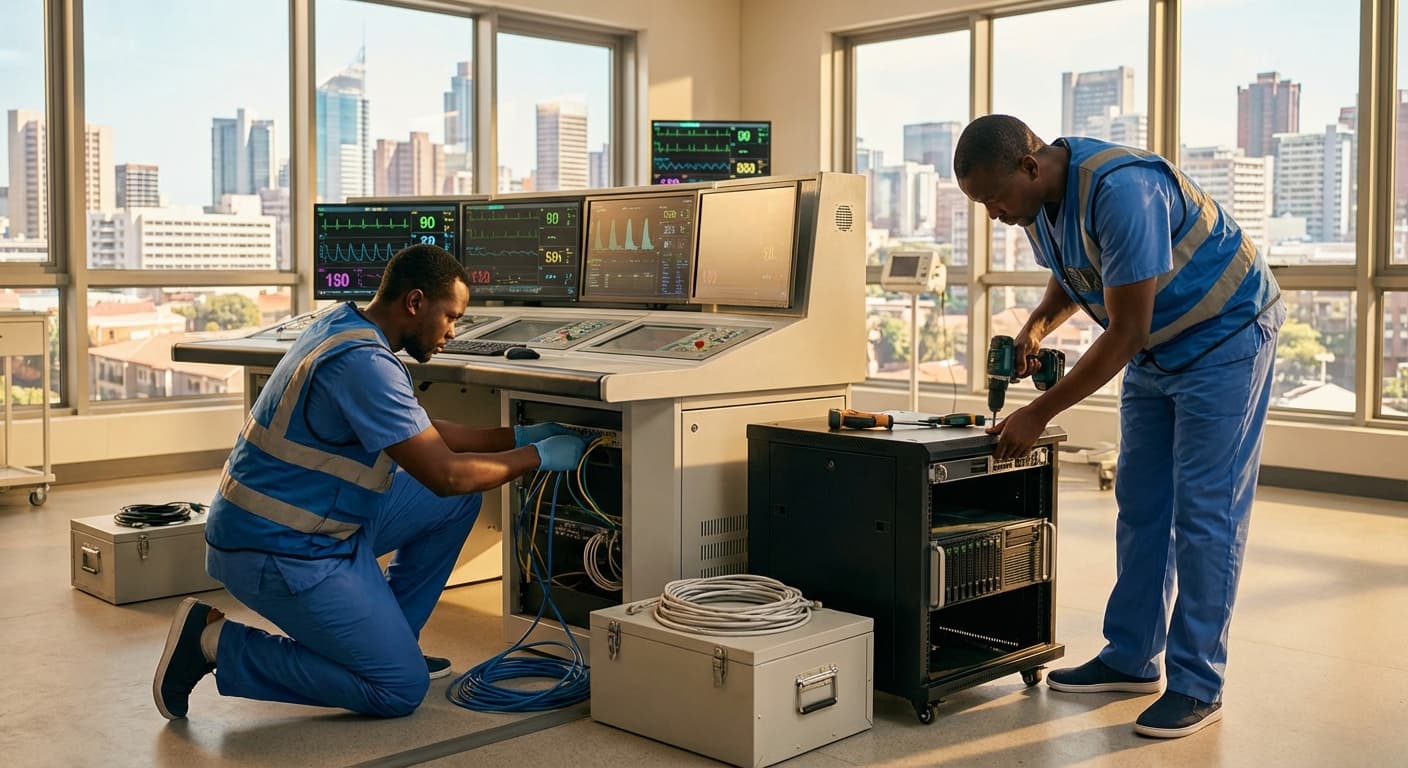
ICU Central Monitoring Station Installation Service in Algeria
Engineering Excellence & Technical Support
ICU Central Monitoring Station Installation Service High-standard technical execution following OEM protocols and local regulatory frameworks.
Redundant Server Architecture
Our ICU Central Monitoring Stations in Algeria are powered by a robust, redundant server architecture ensuring continuous data flow and system uptime, even in the event of hardware failure. This critical feature guarantees uninterrupted patient vital sign surveillance.
Secure & Scalable Network Integration
We implement secure, high-bandwidth network infrastructure, leveraging advanced protocols for seamless and reliable integration of all patient monitoring devices within the ICU. Our solutions are designed for scalability to accommodate future growth and technological advancements in Algeria's healthcare sector.
Advanced Data Analytics & Alerting
Our installations feature sophisticated data analytics engines for real-time trend analysis and predictive alarming. This empowers clinical teams in Algerian ICUs with proactive insights, enabling faster response times to critical patient events and improving clinical decision-making.
What Is Icu Central Monitoring Station Installation Service In Algeria?
ICU Central Monitoring Station Installation Service in Algeria refers to the specialized process of designing, procuring, installing, configuring, and commissioning a centralized monitoring system within Intensive Care Units (ICUs) of healthcare facilities across Algeria. This service ensures that real-time patient vital sign data from various bedside monitoring devices are aggregated, displayed, and managed from a central location, enabling continuous surveillance and immediate intervention by medical personnel.
| Need | Description | Typical Use Cases |
|---|---|---|
| Hospitals and Healthcare Facilities in Algeria | All healthcare institutions operating ICUs, ranging from large university hospitals to smaller regional medical centers, require robust patient monitoring capabilities. | Critical Care Management: Continuous real-time monitoring of critically ill patients, allowing for early detection of physiological deterioration and rapid response. Resource Optimization: Centralized view enables efficient allocation of nursing staff by highlighting patients requiring immediate attention. Data Archiving and Analysis: Secure storage of patient monitoring data for retrospective analysis, research, quality improvement initiatives, and legal compliance. Remote Monitoring: Facilitates remote consultation and oversight by specialists, particularly in areas with limited access to critical care expertise. Interoperability: Seamless integration with other hospital information systems (HIS), electronic health records (EHR), and Picture Archiving and Communication Systems (PACS). |
| Specialized Intensive Care Units | Specific ICUs such as Medical ICU (MICU), Surgical ICU (SICU), Cardiac ICU (CCU), Neonatal ICU (NICU), and Pediatric ICU (PICU) have unique monitoring requirements. | Tailored Monitoring Parameters: Configuration of the central station to display specific parameters relevant to the patient population (e.g., invasive pressure monitoring in SICU, advanced respiratory monitoring in MICU). Pediatric and Neonatal Specifics: Integration of specialized sensors and display formats suitable for smaller patients. Cardiac Function Monitoring: Detailed analysis of ECG waveforms, arrhythmias, and hemodynamic parameters in CCU settings. |
| New ICU Construction or Renovation Projects | Facilities undergoing new construction or significant upgrades to their ICU infrastructure. | Integrated Design: Incorporating the central monitoring system into the initial architectural and engineering plans for optimal workflow and IT infrastructure. Future-Proofing: Specifying systems that can accommodate future technological advancements and increased patient volumes. |
Key Components and Processes of ICU Central Monitoring Station Installation Service
- Needs Assessment and System Design: Evaluating the specific requirements of the ICU, including patient bed count, types of monitoring devices, existing infrastructure, and IT integration needs.
- Hardware Procurement and Integration: Sourcing and integrating central monitoring workstations, servers, network infrastructure (cabling, switches, routers), and potentially alarm management systems.
- Software Installation and Configuration: Deploying and configuring the central monitoring software platform, including patient data management, waveform display, trend analysis, alarm configuration, and secure data logging.
- Network Setup and Connectivity: Establishing robust and secure network connectivity between bedside monitors and the central station, often involving specialized medical-grade networking protocols.
- Device Integration and Calibration: Connecting and calibrating various patient monitoring devices (e.g., ECG monitors, pulse oximeters, blood pressure monitors, ventilators) to the central system.
- Alarm Management System Implementation: Setting up intelligent alarm rules, thresholds, and notification protocols to alert clinical staff to critical patient events.
- User Training and Support: Providing comprehensive training to ICU staff (physicians, nurses, technicians) on the operation and maintenance of the central monitoring system.
- System Testing and Validation: Conducting rigorous testing to ensure system functionality, data accuracy, reliability, and adherence to clinical protocols and regulatory standards.
- Ongoing Maintenance and Support: Offering post-installation services such as software updates, hardware maintenance, troubleshooting, and performance optimization.
Who Needs Icu Central Monitoring Station Installation Service In Algeria?
ICU Central Monitoring Station Installation Services are crucial for modern healthcare facilities in Algeria aiming to enhance patient care, improve efficiency, and ensure timely medical intervention. These services involve the setup and integration of sophisticated systems that allow for the continuous and remote monitoring of vital signs of critically ill patients in Intensive Care Units (ICUs). The installation ensures that healthcare professionals have real-time access to patient data, enabling them to respond quickly to any critical changes in a patient's condition. This leads to better patient outcomes, reduced mortality rates, and optimized resource allocation within the hospital.
| Customer Type | Primary Departments Involved | Key Needs/Benefits | Examples in Algeria |
|---|---|---|---|
| Large Public Hospitals | ICU, IT Department, Biomedical Engineering, Administration | Centralized patient data, improved staff efficiency, reduced response times, compliance with healthcare standards. | CHU (Centre Hospitalo-Universitaire) in Algiers, Oran, Constantine; Hôpital Parnet (Algiers). |
| Private Hospitals & Clinics | ICU, IT Department, Clinical Engineering, Management | Enhanced patient safety, competitive advantage through advanced technology, optimized resource utilization. | Clinique Internationale Hammamet (though in Tunisia, similar facilities exist in Algeria), El-Kattar Clinic (Algiers). |
| University Hospitals & Teaching Institutions | ICU, Research Departments, Medical Training Units, IT | Real-time data for research and education, training future medical professionals, advanced clinical decision support. | Faculties of Medicine attached to CHUs, research institutes. |
| Specialized Cardiac & Neurological Centers | Cardiac ICU, Neuro ICU, Cardiology Department, Neurology Department, IT | Continuous cardiac rhythm monitoring, neurological parameter tracking, rapid intervention for critical cardiac and neurological events. | Specialized cardiology departments within larger hospitals. |
| Trauma & Emergency Centers | Trauma ICU, Emergency Department, Anesthesiology | Immediate assessment of multiple trauma patients, critical parameter tracking for unstable patients, seamless handover to ICU. | Major emergency and trauma units within CHUs. |
Target Customers and Departments for ICU Central Monitoring Station Installation Services in Algeria
- Hospitals (Public and Private): These are the primary consumers of ICU Central Monitoring Station Installation Services. Both large general hospitals and specialized medical centers require these systems to effectively manage their ICU operations.
- Specialized Medical Centers: Facilities focusing on critical care, such as cardiac care units, neuro-ICUs, trauma centers, and surgical ICUs, are key beneficiaries.
- Government Health Agencies & Ministries: Responsible for the development and upgrading of public healthcare infrastructure, these agencies would be involved in large-scale installations and modernization projects.
- Medical Equipment Suppliers & Integrators: Companies that supply and install medical equipment often partner with or directly offer installation services for central monitoring stations.
- Construction & Engineering Firms (Healthcare Focused): Firms involved in building or renovating hospital wings, especially ICUs, will require these services as part of the overall project.
- International Aid Organizations & NGOs: Organizations involved in improving healthcare in Algeria might fund or oversee the installation of such critical infrastructure.
Icu Central Monitoring Station Installation Service Process In Algeria
This document outlines the comprehensive workflow for the installation service of an ICU Central Monitoring Station in Algeria, from the initial client inquiry to the final project execution and handover. The process is designed to ensure seamless integration, client satisfaction, and adherence to all relevant Algerian healthcare regulations and standards.
| Phase | Stage | Key Activities | Deliverables/Outcomes | Responsible Parties | Estimated Timeline |
|---|---|---|---|---|---|
| Phase 1: Inquiry and Initial Consultation | Initial Contact | Client expresses interest in ICU Central Monitoring Station installation. Initial discussion to understand basic requirements, hospital type, and location within Algeria. Introduction of service provider and capabilities. | Understanding of client's general needs. Establishment of initial communication channel. Provision of preliminary service information. | Client (Hospital Administration/IT/Biomedical Department), Service Provider (Sales/Business Development) | 1-3 Business Days |
| Phase 1: Inquiry and Initial Consultation | Needs Clarification | Detailed discussion on the scope of the project, number of ICU beds, types of monitoring equipment to be integrated, existing infrastructure, IT network capabilities, budget constraints, and desired timelines. | Comprehensive understanding of project scope and requirements. Identification of potential challenges. Client contact person(s) identified. | Client (Biomedical Engineers, IT Department, ICU Staff), Service Provider (Technical Sales, Project Manager) | 3-7 Business Days |
| Phase 2: Site Survey and Needs Assessment | On-site Visit | Thorough inspection of the intended installation site. Assessment of power availability, network infrastructure, space for the central monitoring station, potential cabling routes, and environmental conditions (temperature, humidity). | Detailed site assessment report. Identification of any infrastructure gaps or necessary modifications. Confirmation of feasibility. | Service Provider (Project Manager, Lead Engineer), Client (Biomedical Engineer, Facility Manager) | 5-10 Business Days (including travel time within Algeria) |
| Phase 2: Site Survey and Needs Assessment | Technical Specification Definition | Finalization of the technical specifications for the central monitoring station, including hardware components (servers, workstations, displays), software features, integration protocols (e.g., HL7, DICOM), and networking requirements. | Defined technical specifications document. List of compatible monitoring devices. Network topology plan. | Service Provider (Lead Engineer, System Architect), Client (IT Department, Biomedical Department) | 3-5 Business Days |
| Phase 3: Proposal Generation and Contract Negotiation | Proposal Creation | Development of a detailed proposal outlining the scope of work, technical solution, equipment list, installation plan, timelines, project team, warranty, and service level agreements (SLAs). Pricing and payment terms are clearly defined. | Comprehensive project proposal. Detailed Bill of Materials (BOM). Project timeline. | Service Provider (Project Manager, Sales Team) | 7-14 Business Days |
| Phase 3: Proposal Generation and Contract Negotiation | Negotiation and Contract Signing | Review of the proposal by the client. Negotiation of terms, conditions, pricing, and timelines. Finalization of the contract for installation services. | Signed contract. Formal agreement to proceed with the project. | Client (Procurement, Legal Department, Administration), Service Provider (Legal, Sales Management) | 7-15 Business Days |
| Phase 4: Procurement and Logistics | Equipment Ordering | Procurement of all necessary hardware, software licenses, and accessories as per the signed contract and approved BOM. Liaison with suppliers and manufacturers. | Order confirmations from suppliers. Tracking of equipment shipment. | Service Provider (Procurement Department, Project Manager) | Varies based on lead times (e.g., 30-90 days for custom equipment) |
| Phase 4: Procurement and Logistics | Logistics and Customs Clearance | Arrangement of shipping, import duties, and customs clearance for equipment entering Algeria. Ensuring compliance with all Algerian import regulations. | Cleared equipment ready for delivery. Documentation for customs. | Service Provider (Logistics Department, Local Partners in Algeria), Client (Local Representative for customs support if needed) | Varies based on customs processes (e.g., 7-30 days) |
| Phase 5: Pre-Installation Preparation | Site Readiness | Ensuring the installation site is prepared according to the site survey report. This may include electrical work, network cabling installation, and environmental controls. Coordination with hospital facilities team. | Ready and safe installation environment. Completed infrastructure modifications. | Client (Facilities Department, IT Department), Service Provider (Project Manager for oversight) | Varies based on site requirements |
| Phase 5: Pre-Installation Preparation | Installation Team Mobilization | Mobilization of the certified installation team to the client's location in Algeria. Arrangement of accommodation and local logistics for the team. | Installation team on-site and ready to begin. | Service Provider (Project Manager, HR/Logistics) | 3-7 Business Days (prior to installation start date) |
| Phase 6: Installation and Configuration | Hardware Installation | Physical installation of servers, workstations, displays, and all associated hardware components of the central monitoring station. Installation of cabling and network connections. | Physically installed and connected hardware. Secure and organized installation. | Service Provider (Installation Engineers, Technicians) | 5-15 Business Days (depending on scale) |
| Phase 6: Installation and Configuration | Software Installation and Configuration | Installation of the central monitoring station software. Configuration of user accounts, patient data integration, alarm management settings, and network parameters. Integration with existing hospital IT systems. | Installed and configured software. Functional user interfaces. Integrated with hospital network. | Service Provider (Software Engineers, Integration Specialists) | 7-20 Business Days (depending on integration complexity) |
| Phase 7: Testing, Calibration, and Commissioning | System Testing | Comprehensive testing of all system functionalities, including data acquisition, display, alarm generation, data storage, and network connectivity. Simulated patient scenarios for testing. | Pass/fail test results. Identified and resolved bugs or issues. | Service Provider (QA Engineers, Installation Team), Client (Biomedical Engineers, ICU Staff) | 5-10 Business Days |
| Phase 7: Testing, Calibration, and Commissioning | Calibration and Validation | Calibration of all connected patient monitoring devices to ensure accurate data transmission to the central station. Validation of system performance against defined benchmarks and regulatory requirements. | Calibrated monitoring devices. Validated system performance. Validation report. | Service Provider (Biomedical Engineers, Calibration Specialists), Client (Biomedical Engineers) | 3-7 Business Days |
| Phase 7: Testing, Calibration, and Commissioning | Commissioning and Acceptance | Formal commissioning of the central monitoring station. Client acceptance testing (CAT) to ensure the system meets all specified requirements and is ready for operational use. | Signed acceptance certificate. System officially commissioned. | Client (Project Stakeholders), Service Provider (Project Manager) | 1-3 Business Days |
| Phase 8: Training and Handover | User Training | Comprehensive training for ICU staff, biomedical engineers, and IT personnel on the operation, maintenance, and troubleshooting of the central monitoring station. Training materials provided. | Trained staff. User manuals and training documentation. | Service Provider (Training Specialists), Client (End-Users) | 3-5 Business Days |
| Phase 8: Training and Handover | Project Handover | Formal handover of the installed and commissioned ICU Central Monitoring Station to the client. Provision of all relevant documentation, including system architecture, user manuals, maintenance guides, and warranty information. | Complete project documentation. Official handover of the system. | Service Provider (Project Manager), Client (Hospital Administration, Biomedical Department) | 1 Business Day |
| Phase 9: Post-Installation Support and Maintenance | Warranty Period | Provision of support and maintenance services as per the contract's warranty period. Addressing any issues or defects that may arise. | Resolved issues. System stability. | Service Provider (Technical Support Team), Client (Users) | As per contract (e.g., 12-24 months) |
| Phase 9: Post-Installation Support and Maintenance | Ongoing Maintenance & Support | Optional ongoing maintenance contracts for regular system checks, software updates, and proactive troubleshooting. Access to a dedicated support helpline. | Continued system optimization. Minimized downtime. Long-term system reliability. | Service Provider (Maintenance Team, Support Desk), Client (Biomedical Department, IT Department) | Ongoing |
ICU Central Monitoring Station Installation Service Process - Algeria
- Phase 1: Inquiry and Initial Consultation
- Phase 2: Site Survey and Needs Assessment
- Phase 3: Proposal Generation and Contract Negotiation
- Phase 4: Procurement and Logistics
- Phase 5: Pre-Installation Preparation
- Phase 6: Installation and Configuration
- Phase 7: Testing, Calibration, and Commissioning
- Phase 8: Training and Handover
- Phase 9: Post-Installation Support and Maintenance
Icu Central Monitoring Station Installation Service Cost In Algeria
Installing an ICU central monitoring station in Algeria involves a range of costs that can fluctuate based on several key factors. These factors directly influence the final price, making it essential for healthcare facilities to understand them to budget effectively. The primary components of the cost include the equipment itself, the complexity of the installation, the chosen vendor, and any necessary customization or integration with existing hospital systems. Local currency pricing in Algeria, primarily the Algerian Dinar (DZD), will reflect these variables.
| Cost Component | Estimated Range (DZD - Algerian Dinar) | Notes |
|---|---|---|
| Basic ICU Central Monitoring System (Hardware & Software) | 5,000,000 - 25,000,000+ | Varies based on brand, features, and number of connected beds. |
| Individual Patient Monitors (per unit) | 800,000 - 4,000,000+ | Depends on the complexity and brand of the monitor (e.g., standard vs. advanced features). |
| Installation and Cabling (per ICU bed) | 100,000 - 500,000+ | Includes wiring, setup, and initial configuration. Varies by complexity and distance. |
| Integration with HIS/EHR | 1,000,000 - 10,000,000+ | Can be a significant cost if extensive customization is required. |
| Staff Training | 200,000 - 1,000,000+ | One-time or ongoing, depending on the vendor's package. |
| Annual Maintenance & Support Contract | 500,000 - 3,000,000+ | Typically a percentage of the initial equipment cost. |
| Optional Modules/Advanced Features | 500,000 - 5,000,000+ | For specific analytical tools or enhanced capabilities. |
Key Pricing Factors for ICU Central Monitoring Station Installation in Algeria:
- Type and Quantity of Monitoring Devices: The number and sophistication of individual patient monitors (e.g., ECG, SpO2, NIBP, invasive pressure, respiration, temperature) connected to the central station significantly impact the overall cost. Advanced features and higher-end models will naturally be more expensive.
- Central Station Hardware and Software: The core central monitoring station unit, its processing power, display size, user interface, and included software features (e.g., data archiving, trend analysis, alarm management) are major cost drivers.
- Network Infrastructure and Cabling: The existing network infrastructure within the ICU and the need for new cabling, network switches, and potential Wi-Fi integration will add to the installation cost. The distance from patient beds to the central station also plays a role.
- Installation Labor and Expertise: The complexity of the installation, the need for specialized technicians, and the vendor's labor rates will contribute to the total price. This includes site preparation, wiring, device configuration, and initial testing.
- Integration with Existing Hospital Information Systems (HIS) / Electronic Health Records (EHR): If the central monitoring station needs to be integrated with existing hospital IT systems for seamless data flow and record-keeping, this will involve additional software development, configuration, and testing, leading to higher costs.
- Training and Support: The cost of comprehensive training for ICU staff on operating and maintaining the system, as well as ongoing technical support and maintenance contracts, should be factored in.
- Brand and Vendor Reputation: Established brands with a strong reputation for reliability and after-sales service often command higher prices. The negotiation power with different vendors can also influence the final cost.
- Optional Features and Customization: Any specific customization requirements, additional modules (e.g., advanced cardiac analysis), or unique software functionalities requested by the hospital will increase the price.
- Warranty and Service Level Agreements (SLAs): The duration and scope of the warranty, as well as the terms of any SLA for response times and repair services, can impact the upfront and ongoing costs.
Affordable Icu Central Monitoring Station Installation Service Options
Implementing an ICU Central Monitoring Station (CMS) is crucial for effective patient care, but the initial investment can be substantial. This guide explores affordable installation service options, focusing on value bundles and cost-saving strategies to make this essential technology accessible.
| Value Bundle Type | Included Components | Potential Cost Savings | Ideal For |
|---|---|---|---|
| Basic Monitoring Bundle | Central station software, network infrastructure, essential physiological monitoring capabilities (e.g., ECG, SpO2, NIBP) | Reduced hardware and software licensing costs compared to à la carte purchasing. | Smaller ICUs or those with budget constraints looking for core functionalities. |
| Advanced Analytics Bundle | Basic monitoring + predictive analytics, advanced waveform analysis, EMR integration modules | Streamlined integration reduces IT workload; enhanced data utilization can lead to improved patient outcomes and reduced readmissions (indirect savings). | Larger hospitals or those focused on data-driven decision-making and early intervention. |
| Full-Service Solution | Hardware (servers, workstations, monitors), software, on-site installation, comprehensive training, 24/7 technical support, preventative maintenance | Significant reduction in vendor management overhead; predictable operational costs; minimized downtime. | Hospitals prioritizing a hassle-free, end-to-end solution and long-term reliability. |
| Refurbished Equipment Package | Certified refurbished central monitoring units, workstations, and associated peripherals, bundled with installation and basic support | Up to 50% cost savings on hardware compared to new equipment. | Organizations seeking to equip or upgrade their CMS on a tighter budget without compromising essential functionality. |
Key Considerations for Affordable ICU CMS Installation
- Defining Your Needs: Accurately assess the number of beds, types of monitors required, and integration needs with existing EMR systems.
- Phased Implementation: Consider rolling out the CMS in stages, prioritizing high-acuity areas first.
- Refurbished vs. New Equipment: Explore certified refurbished medical equipment as a cost-effective alternative to brand-new systems.
- Open-Source Solutions: Investigate open-source CMS software if applicable, though integration and support may require in-house expertise.
- Bundled Service Packages: Look for providers offering comprehensive packages that include hardware, software, installation, training, and ongoing support.
- Negotiating Contracts: Don't hesitate to negotiate pricing, payment terms, and warranty periods.
- Long-Term Maintenance Agreements: Factor in the cost of ongoing maintenance and consider bundled service agreements for predictable expenses.
- In-House vs. Outsourced Installation: Evaluate the expertise and resources available within your organization versus the cost and efficiency of professional installers.
Verified Providers In Algeria
In Algeria's evolving healthcare landscape, identifying trusted and credible medical service providers is paramount for patients seeking quality care. Franance Health stands out as a beacon of reliability, meticulously vetting its network of providers to ensure adherence to the highest standards of medical practice, ethical conduct, and patient safety. This rigorous credentialing process guarantees that patients engaging with Franance Health are connected with qualified professionals who possess the necessary expertise, experience, and commitment to delivering exceptional healthcare.
| Credential Type | Verification Process | Significance for Patients |
|---|---|---|
| Medical Licenses and Certifications | Verification of validity with relevant Algerian medical boards and licensing authorities. | Confirms the provider is legally authorized to practice medicine and has met minimum educational and training requirements. |
| Educational Background and Training | Review of degrees, diplomas, and specialized training certificates from accredited institutions. | Ensures providers have a strong theoretical foundation and have undergone appropriate postgraduate training for their specialty. |
| Professional Experience and Practice History | Assessment of years in practice, surgical volumes (if applicable), and any disciplinary actions or malpractice claims. | Indicates the provider's practical experience and a track record of safe and effective patient care. |
| Specialization and Board Certifications | Confirmation of board certification in relevant medical specialties. | Guarantees that the provider possesses advanced knowledge and skills in a specific area of medicine. |
| Ethical Conduct and Professional Reputation | Background checks and review of professional references or patient testimonials (where applicable). | Affirms the provider's commitment to ethical patient treatment, integrity, and a positive patient experience. |
Why Franance Health Credentials Matter:
- Uncompromising Quality Assurance: Franance Health employs a multi-faceted evaluation system that scrutinizes medical licenses, certifications, educational backgrounds, and professional affiliations of all listed providers. This ensures that only legitimate and highly qualified practitioners are included in their network.
- Patient-Centric Approach: Beyond technical qualifications, Franance Health assesses providers for their commitment to patient well-being, communication skills, and adherence to ethical medical practices. This focus on the human aspect of care ensures a positive and reassuring patient experience.
- Safety and Trust: By verifying credentials, Franance Health significantly reduces the risk of patients encountering unqualified or fraudulent practitioners. This builds a foundation of trust, allowing individuals to seek medical assistance with confidence.
- Access to Specialized Expertise: The credentialing process helps identify specialists in various medical fields, ensuring that patients are directed to the right professionals for their specific health needs, whether it's a general practitioner, a surgeon, or a sub-specialist.
- Streamlined Healthcare Navigation: For individuals navigating the Algerian healthcare system, Franance Health's verified provider list simplifies the search process, saving valuable time and reducing the stress associated with finding appropriate medical care.
Scope Of Work For Icu Central Monitoring Station Installation Service
This Scope of Work (SOW) details the requirements for the installation of an Intensive Care Unit (ICU) Central Monitoring Station (CMS) service. It outlines the technical deliverables, standard specifications, and key activities necessary for a successful project.
| Section | Description | Key Activities | Technical Deliverables | Standard Specifications |
|---|---|---|---|---|
| Overall planning, execution, monitoring, and control of the installation project. | Site assessment, detailed project planning, resource allocation, risk management, regular progress reporting, stakeholder communication, final project acceptance. | Project plan, risk register, progress reports, change logs, final acceptance report. | ISO 9001 (Quality Management Systems), PMI PMBOK (Project Management Body of Knowledge). |
| Preparing the physical space for the CMS and ensuring proper network and power cabling infrastructure. | Site survey, power outlet installation, network port installation, cable routing and termination, cable testing and certification. | Completed and certified network cabling, power distribution plan, updated site drawings. | TIA/EIA-568 (Commercial Building Telecommunications Cabling Standard), local electrical codes, NFPA 70 (National Electrical Code). |
| Installation and physical setup of all CMS hardware components. | Unpacking and inspection of all equipment, physical mounting of servers, workstations, displays, and network devices, connecting power and network cables. | Installed and powered-on CMS hardware, rack diagrams, equipment inventory. | Manufacturer's installation guides, hospital IT infrastructure standards. |
| Installation and configuration of the CMS software and associated applications. | Operating system installation, CMS software installation, database configuration, user account creation, access control setup, alarm management configuration, integration with existing hospital information systems (HIS/EMR) if applicable. | Configured CMS software, user manuals, system administration guide, interface specifications. | HL7 (Health Level Seven) standards for interoperability, DICOM (Digital Imaging and Communications in Medicine) if applicable, hospital's IT security policies. |
| Connecting the CMS to the hospital's network and ensuring reliable data communication. | IP addressing configuration, firewall rules setup, network security configuration, testing network connectivity and bandwidth, integration with existing network infrastructure. | Network topology diagrams, IP address allocation, network security audit report. | IEEE 802.1X (Network Access Control), hospital's network security policies, relevant cybersecurity standards. |
| Connecting and configuring patient monitoring devices to the CMS. | Establishing communication links with bedside monitors, ventilators, infusion pumps, etc., configuring device parameters, testing data transmission accuracy, troubleshooting connectivity issues. | List of integrated devices, device configuration profiles, data accuracy validation report. | Manufacturer's device communication protocols, relevant medical device standards. |
| Thorough testing of the entire CMS system to ensure optimal performance and reliability. | Unit testing, integration testing, system testing, user acceptance testing (UAT), alarm testing, performance testing, stress testing, final system validation. | Test plans, test scripts, test results reports, UAT sign-off, commissioning report. | HIPAA (Health Insurance Portability and Accountability Act) for data privacy, manufacturer's performance specifications, hospital's clinical workflow requirements. |
| Providing comprehensive training to end-users and technical staff. | Training material development, on-site training sessions for clinical staff, IT training for system administrators, hands-on exercises, post-training support. | Training manuals, training attendance records, competency assessment reports. | Adult learning principles, hospital's training policies. |
| Providing all necessary documentation for the installed CMS. | As-built drawings, system manuals, user guides, maintenance procedures, troubleshooting guides, warranty information. | Complete set of project documentation. | Industry best practices for technical documentation. |
| Providing support and warranty services after the system is live. | Initial post-go-live support, warranty period management, troubleshooting, bug fixing, access to technical support. | Service Level Agreement (SLA), warranty certificate. | Manufacturer's warranty terms, hospital's IT support policies. |
Project Objectives
- To establish a fully functional and reliable ICU Central Monitoring Station.
- To ensure seamless integration of all connected patient monitoring devices.
- To provide healthcare professionals with real-time, accurate, and accessible patient data.
- To enhance patient safety and facilitate timely clinical interventions.
- To meet all relevant regulatory and industry standards.
Service Level Agreement For Icu Central Monitoring Station Installation Service
This Service Level Agreement (SLA) outlines the response times and uptime guarantees for the Installation Service of the ICU Central Monitoring Station (CMS). This SLA is an addendum to the Master Service Agreement (MSA) between [Your Company Name] (hereinafter referred to as "Provider") and [Client Company Name] (hereinafter referred to as "Client").
| Service Component | Severity Level | Response Time Target | Resolution Time Target | Uptime Guarantee |
|---|---|---|---|---|
| ICU Central Monitoring Station Installation | Critical Failure | 2 Hours | 8 Business Hours | 99.5% |
| ICU Central Monitoring Station Installation | System Malfunction | 4 Business Hours | 24 Business Hours | 99.0% |
| ICU Central Monitoring Station Installation | Minor Issue/Inquiry | 8 Business Hours | 48 Business Hours | N/A (Focus on response and basic functionality) |
Definitions
- Installation Service: The complete process of setting up, configuring, and testing the ICU Central Monitoring Station hardware and software at the Client's facility, as defined in the Statement of Work (SOW).
- Central Monitoring Station (CMS): The integrated system responsible for receiving, displaying, and archiving patient vital signs and other critical data from connected bedside monitors and other medical devices.
- Critical Failure: A complete outage of the CMS where no patient data can be received, displayed, or archived, rendering the system inoperable for its intended purpose. This does not include intermittent data loss for individual parameters or minor software glitches.
- System Malfunction: A significant degradation in CMS performance, such as slow data refresh rates, frequent alarms for non-critical events, or inability to access historical data, that impacts the usability of the system but does not constitute a Critical Failure.
- Scheduled Maintenance: Pre-planned periods for system updates, upgrades, or preventative maintenance, communicated to the Client at least [Number] business days in advance.
- Response Time: The maximum time allowed for the Provider to acknowledge and begin working on a reported issue.
- Resolution Time: The maximum time allowed for the Provider to resolve a reported issue, restoring the CMS to its agreed-upon operational state.
- Uptime Guarantee: The percentage of time the CMS is operational and available for use, excluding Scheduled Maintenance periods.
Frequently Asked Questions

Ready when you are
Let's scope your ICU Central Monitoring Station Installation Service in Algeria project in Algeria.

Scaling healthcare logistics and technical systems across the entire continent.