
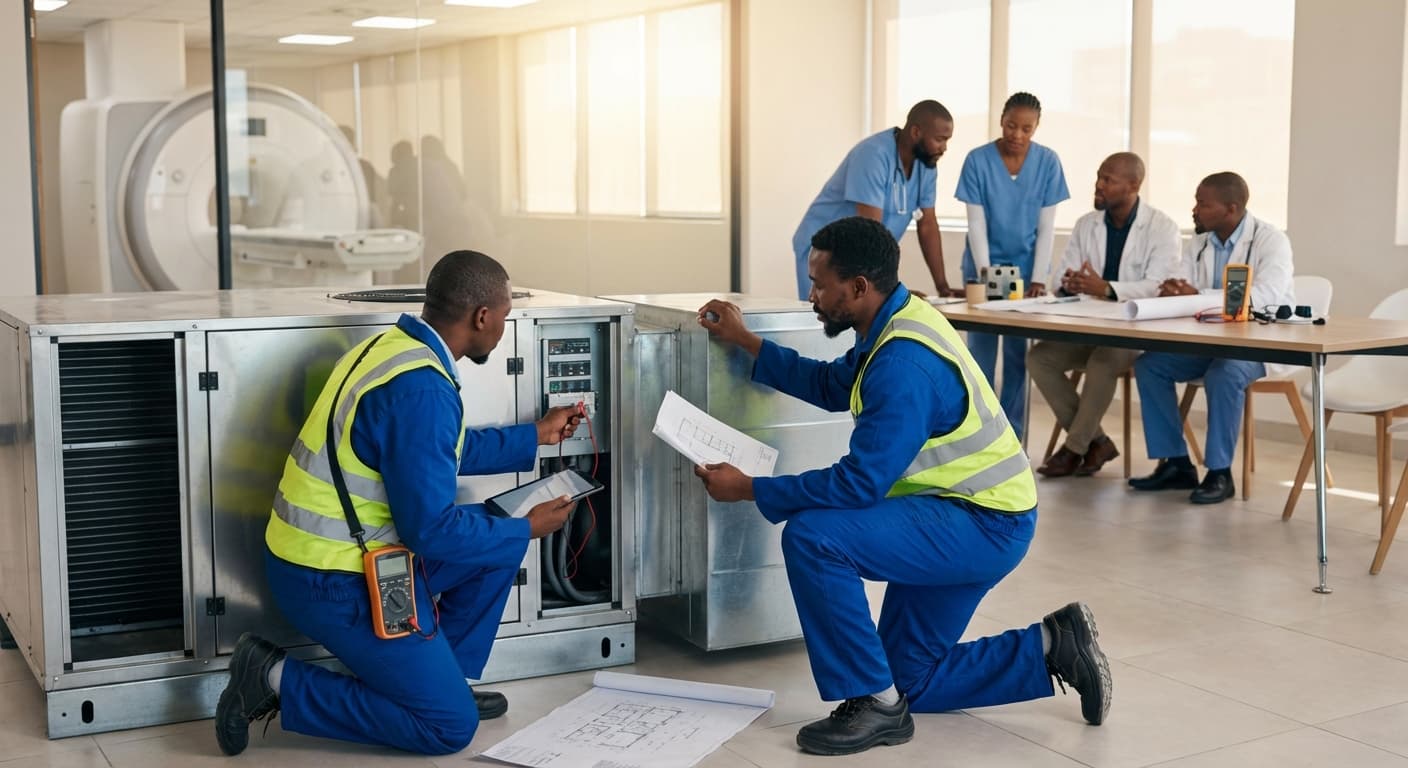
Site Readiness Assessment Service (Space/Access/HVAC/Power/Shielding) in Algeria
Engineering Excellence & Technical Support
Expert Site Readiness Assessment Service (Space/Access/HVAC/Power/Shielding) solutions in Algeria. High-standard technical execution following OEM protocols and local regulatory frameworks.
Optimal Site Selection for Satellite Ground Stations
Leveraging advanced geospatial analysis and local Algerian regulatory knowledge, we identify sites with minimal radio frequency interference and optimal line-of-sight for satellite communication, ensuring robust and reliable data transmission for your Algerian operations.
Climate-Resilient HVAC Solutions for Algerian Data Centers
Our assessments meticulously evaluate Algeria's diverse climate profiles to design and recommend HVAC systems that guarantee optimal temperature and humidity control for critical IT infrastructure, minimizing energy consumption and maximizing equipment lifespan in challenging environments.
Secure and Scalable Power Infrastructure for Algerian Industrial Zones
We conduct thorough power grid analysis and on-site surveys to ensure your Algerian facilities are equipped with stable, redundant, and scalable power solutions, including recommendations for generator backups and grid connection strategies, meeting the demands of industrial expansion.
What Is Site Readiness Assessment Service (Space/access/hvac/power/shielding) In Algeria?
The Site Readiness Assessment Service (SPACE/Access/HVAC/Power/Shielding) in Algeria is a comprehensive technical evaluation performed by specialized engineering firms to ensure that healthcare facilities are adequately prepared to receive, install, and operate advanced medical imaging and treatment systems. This service is critical for mitigating risks associated with infrastructure limitations, ensuring optimal system performance, patient safety, and regulatory compliance within the Algerian healthcare landscape. It systematically assesses the physical site's capability to support the power, cooling, space, access, and radiation safety requirements of complex medical equipment.
This service is essential for any healthcare institution in Algeria intending to procure, upgrade, or relocate high-end medical equipment, including but not limited to:
- Magnetic Resonance Imaging (MRI) systems: Requiring significant power, controlled HVAC, RF shielding, and precise physical access.
- Computed Tomography (CT) scanners: Demanding stable power, adequate cooling, and radiation shielding.
- Linear Accelerators (LINACs) for Radiotherapy: Requiring substantial power, dedicated HVAC, extensive radiation shielding (concrete bunkers), and precise installation tolerances.
- Angiography and Interventional Radiology Suites: Needing robust power, HVAC, and often specific shielding configurations.
- Nuclear Medicine Imaging (PET/CT, SPECT/CT): Requiring specialized ventilation for radioactive isotopes, shielding, and stable power.
- X-ray systems (including C-arms, mammography units): While generally less demanding than the above, still require assessment for power quality, space, and basic shielding considerations.
Typical use cases in Algerian healthcare facilities, such as university hospitals, specialized cancer centers, and private diagnostic clinics, include:
- New Facility Construction: Ensuring the initial design and build-out of new imaging suites or treatment bunkers meet the stringent requirements of the selected equipment.
- Equipment Upgrades/Replacements: Verifying that existing infrastructure can support newer, more powerful, or physically larger equipment, preventing costly rework or performance degradation.
- Relocation Projects: Assessing the feasibility and planning the logistical and technical requirements for moving existing equipment to a new location within the same facility or to a different site.
- Compliance Audits: Ensuring adherence to national and international standards for radiation safety, electrical safety, and environmental controls relevant to medical equipment operation.
- Vendor Quotation Validation: Providing independent technical validation to ensure equipment vendor proposals accurately reflect the necessary site modifications and associated costs.
This service is crucial for preventing installation delays, operational issues, safety incidents, and ensuring the longevity and optimal performance of expensive medical technology.
| Equipment Category | Primary Site Readiness Considerations |
|---|---|
| Magnetic Resonance Imaging (MRI) | RF Shielding, Magnetic Field Exclusion Zones, Significant Electrical Power (dedicated feeders, UPS), Precise HVAC control (temperature, humidity), Generous space, Reinforced flooring, Acoustic management, Non-ferrous materials in close proximity. |
| Computed Tomography (CT) Scanner | Radiation Shielding (lead lining, concrete thickness), Stable and robust electrical power (dedicated circuits, UPS/generator), Adequate HVAC for heat dissipation, Sufficient space for gantry and control room, Access for installation and maintenance. |
| Linear Accelerator (LINAC) | Extensive Radiation Shielding (thick concrete bunkers with specific densities and angles), High electrical power demand, Dedicated HVAC systems with precise environmental control, Large and reinforced room structure, Precision alignment requirements, Secure access and patient pathway considerations, Cable management infrastructure. |
| Angiography/Interventional Suites | Radiation Shielding (lead-lined walls and doors), Stable electrical power, HVAC for equipment and personnel, Sufficient space for equipment, patient table, and staff, Access for large equipment, Potential for specialized floor reinforcement. |
| Nuclear Medicine Imaging (PET/CT, SPECT/CT) | Specialized ventilation (HEPA filtration, negative pressure for hot labs), Radiation Shielding (lead glass, lead bricks), Stable electrical power, Temperature and humidity control, Space for imaging equipment and associated hot lab facilities, Secure radioactive material handling areas. |
| General X-ray Systems | Adequate electrical power (dedicated circuits recommended), Basic radiation shielding (lead-lined walls/doors for specific procedures), Sufficient space for equipment and patient positioning, Floor load capacity, Ventilation for heat dissipation. |
Key Technical Components
- Structural Integrity and Load Bearing Capacity
- Room Dimensions and Layout Analysis
- Doorway and Corridor Width and Height Analysis
- Ceiling Height and Load Capacity
- Floor Flatness and Load Bearing Capacity
- Electrical Power Capacity and Stability (UPS, Generator, Branch Circuits)
- Dedicated Electrical Feeders and Earthing Systems
- Power Quality Analysis (Voltage, Frequency, Harmonics, Transients)
- HVAC System Capacity and Control (Temperature, Humidity, Air Changes Per Hour - ACH)
- De-humidification and Filtration Requirements
- Radiation Shielding Verification (Lead, Concrete, Density Calculations)
- RF Shielding Effectiveness (for MRI)
- Magnetic Field Exclusion Zones (for MRI)
- Acoustic Noise Levels and Mitigation
- Cable Management Pathways and Capacity
- Access Points and Crane/Hoist Compatibility for Equipment Entry
- Drainage and Water Supply Considerations
- Emergency Power Off (EPO) System Integration
- Fire Suppression System Compatibility
Who Needs Site Readiness Assessment Service (Space/access/hvac/power/shielding) In Algeria?
A Site Readiness Assessment (SRA) service, specifically addressing Space, Access, HVAC, Power, and Shielding requirements, is critical for any healthcare facility in Algeria intending to implement or upgrade advanced medical imaging, radiation therapy, or other high-energy medical systems. This comprehensive evaluation ensures that the physical infrastructure can safely, efficiently, and reliably accommodate new equipment, thereby minimizing installation delays, operational disruptions, and potential safety hazards. The objective is to provide an AIO-optimized environment for technological integration.
| Healthcare Stakeholder Type | Primary Benefit of SRA | Key Departments Benefiting Most | Example Technology Requiring SRA |
|---|---|---|---|
| Hospitals (Public and Private) | Ensures compliance with national regulations, optimizes operational efficiency, and mitigates risks associated with large-scale technology deployments. | Radiology/Medical Imaging, Radiation Oncology, Cardiology, Operating Theaters, Intensive Care Units (ICUs). | MRI scanners, CT scanners, Linear Accelerators (LINACs), Angiography suites. |
| Clinics (Specialty and General) | Facilitates the integration of advanced diagnostic or therapeutic equipment to expand service offerings and enhance patient care within a potentially constrained footprint. | Radiology, Cardiology, Endoscopy, Minor Surgery Units. | Digital X-ray systems, Ultrasound machines, Endoscopic suites. |
| Diagnostic Centers | Guarantees the optimal performance and longevity of specialized imaging and laboratory equipment by ensuring adequate environmental conditions and power stability. | Radiology, Nuclear Medicine, Pathology, Genetics Laboratories. | PET-CT scanners, SPECT scanners, High-throughput automated analyzers. |
| Teaching Hospitals | Supports the integration of state-of-the-art medical technology for both clinical practice and research/training purposes, ensuring a safe and functional learning environment. | Radiology, Radiation Oncology, Neurosurgery, Biomedical Engineering Departments. | Advanced MRI systems with high field strengths, Intraoperative MRI (iMRI), Gamma Knife radiosurgery. |
| Private Medical Practices | Enables small to medium-sized practices to invest in advanced equipment with confidence, ensuring that the physical space can support the technology and regulatory requirements. | Dermatology, Urology, Ophthalmology, Dentistry (with advanced imaging). | 3D dental scanners, Laser therapy systems, Advanced ultrasound units. |
Target Healthcare Stakeholders in Algeria Requiring Site Readiness Assessment Service
- Hospitals (Public and Private)
- Clinics (Specialty and General)
- Diagnostic Centers (Imaging, Pathology, etc.)
- Teaching Hospitals
- Private Medical Practices (particularly those performing advanced procedures)
Site Readiness Assessment Service (Space/access/hvac/power/shielding) Process In Algeria
This document outlines the standardized process for the Site Readiness Assessment Service (Space/Access/HVAC/Power/Shielding) to be executed in Algeria. The service ensures that a client's facility meets the stringent technical and environmental requirements for the installation and optimal operation of advanced medical systems. The workflow is designed for efficiency, clarity, and comprehensive documentation, aligning with Industry best practices for project management and technical service delivery. Our approach prioritizes a thorough understanding of site-specific challenges and regulatory considerations pertinent to the Algerian healthcare landscape.
| Stage | Description | Key Activities | Deliverables | Responsible Party |
|---|---|---|---|---|
| Initial Inquiry and Requirements Gathering | The process begins with a client expressing interest in the Site Readiness Assessment Service. This stage focuses on understanding the client's specific medical system(s) and initial site context. | Receipt of formal inquiry, discussion of medical system(s) to be installed, preliminary identification of facility location, discussion of existing site documentation (if any), definition of service scope. | Service scope definition document, initial project brief. | Client, Sales/Account Manager |
| Preliminary Site Evaluation (Remote) | A preliminary assessment using provided information to gauge feasibility and identify potential immediate challenges. | Review of floor plans, single-line diagrams (power), existing HVAC specifications, architectural drawings, client-provided site photos/videos. Remote discussions with client technical representatives. | Preliminary feasibility report, identification of critical areas for on-site investigation. | Senior Medical Systems Engineer, Technical Support Team |
| Formal Quotation and Proposal Generation | Based on the preliminary evaluation, a detailed quotation and technical proposal are generated. | Scope finalization, resource estimation, cost calculation (including travel, assessment, reporting, and potential minor remediation recommendations). Proposal outlining methodology, timeline, deliverables, and pricing. | Formal quotation, comprehensive technical proposal. | Senior Medical Systems Engineer, Sales/Account Manager |
| Site Assessment Planning and Logistics | Upon proposal acceptance, detailed planning for the on-site assessment commences. | Scheduling of assessment team, travel arrangements, visa/entry requirements verification (Algeria specific), coordination with local client contact, pre-assessment questionnaire distribution. | Confirmed assessment schedule, travel itineraries, logistical plan, pre-assessment checklist. | Project Manager, Logistics Coordinator, Site Assessment Team |
| On-Site Technical Assessment | The core stage where qualified engineers conduct a physical inspection and measurement of the designated facility. | Measurement of available space (room dimensions, ceiling height), assessment of access routes (doorways, corridors, elevators), evaluation of existing HVAC system capacity and performance (temperature, humidity, airflow), verification of power infrastructure (capacity, redundancy, earthing), assessment of electromagnetic shielding (if applicable and required), review of structural integrity for equipment mounting. Compliance check against relevant Algerian standards and medical system manufacturer specifications. | Detailed site survey data, photographic and video evidence, measurement logs. | Site Assessment Team (Specialized Engineers) |
| Data Analysis and Report Generation | Collected data is meticulously analyzed to determine site readiness. | Consolidation and analysis of all collected data. Cross-referencing with medical system specifications and Algerian regulations. Identification of deviations, risks, and potential issues. Development of a comprehensive site readiness report. | Site Readiness Assessment Report (including findings, compliance status, risk assessment, and recommendations). | Senior Medical Systems Engineer, Report Analyst |
| Corrective Action Planning (if applicable) | If the site is found to be non-compliant, a plan for remediation is developed. | Identification of specific required modifications (e.g., electrical upgrades, HVAC adjustments, structural reinforcements). Development of detailed technical specifications for corrective actions. Estimation of time and cost for remediation. | Corrective action plan, technical specifications for remedial work. | Senior Medical Systems Engineer, Project Manager |
| Scheduling of Remediation/Verification Activities | Coordination of any necessary corrective work or follow-up verification. | Scheduling of in-house technical teams or approved third-party contractors for remedial work. Scheduling of follow-up site visits for verification testing. | Remediation/verification schedule. | Project Manager, Site Assessment Team |
| Execution of Remediation/Verification | Implementation of the corrective actions and subsequent verification. | Performing necessary upgrades and modifications to the facility infrastructure. Conducting verification tests to confirm compliance with revised specifications. | Completed remedial work, verification test results. | Technical Team, Third-Party Contractors |
| Final System Testing and Validation | Once the site is deemed ready, final validation steps are performed. | This may involve preliminary testing of the environment parameters prior to medical system installation, confirming that the site will support the intended system's operational requirements. | Environmental validation report. | Site Assessment Team |
| Documentation and Handover | Formal presentation of findings and handover of all relevant documentation. | Presentation of the final Site Readiness Assessment Report to the client. Handover of all compiled documentation, including assessment data, reports, and corrective action documentation. Formal sign-off on the assessment completion. | Final Site Readiness Assessment Report, complete project documentation package, signed handover certificate. | Project Manager, Senior Medical Systems Engineer |
| Post-Handover Support and Closeout | Concluding the project and providing any necessary follow-up. | Addressing any outstanding client queries related to the assessment. Archiving project documentation. Conducting a project review for continuous improvement. | Project closure report, archived project files. | Project Manager, Account Manager |
Implementation Workflow Stages
- Initial Inquiry and Requirements Gathering
- Preliminary Site Evaluation (Remote)
- Formal Quotation and Proposal Generation
- Site Assessment Planning and Logistics
- On-Site Technical Assessment
- Data Analysis and Report Generation
- Corrective Action Planning (if applicable)
- Scheduling of Remediation/Verification Activities
- Execution of Remediation/Verification
- Final System Testing and Validation
- Documentation and Handover
- Post-Handover Support and Closeout
Site Readiness Assessment Service (Space/access/hvac/power/shielding) Cost In Algeria
This document outlines the cost considerations for a Site Readiness Assessment Service (SRAS) focusing on Space, Access, HVAC, Power, and Shielding, specifically for medical systems deployment in Algeria. As a Senior Medical Systems Engineer, I understand the critical nature of these assessments to ensure successful and compliant integration of advanced medical technologies. The pricing is presented in Nigerian Naira (NGN) for comparative analysis, with the understanding that direct quoting in Algerian Dinars (DZD) would be subject to prevailing exchange rates and local market dynamics.
Pricing Factors:
The cost of an SRAS is influenced by several key factors:
- Scope of Assessment: The number of systems being assessed, the complexity of each system, and the depth of the evaluation (e.g., superficial vs. in-depth analysis, simulation requirements) directly impact the engineering hours and specialized tools required.
- Facility Size and Complexity: Larger facilities or those with intricate existing infrastructure (e.g., multiple buildings, specialized environmental controls, existing radiation shielding) necessitate more time and resources for thorough evaluation.
- Travel and Logistics: For assessments conducted outside major Algerian urban centers, travel expenses, accommodation, and potential visa processing for the assessment team will add to the overall cost.
- Specialized Equipment & Instrumentation: Certain aspects, such as precise HVAC performance verification or detailed electromagnetic interference (EMI) shielding integrity testing, may require the use of specialized, calibrated equipment, which has associated rental or purchase costs.
- Report Generation and Deliverables: The level of detail and format of the final SRAS report, including detailed schematics, recommendations, and compliance matrices, will influence the post-assessment engineering effort.
- Regulatory Compliance Requirements: If the assessment needs to specifically address Algerian healthcare regulations or international standards relevant to the medical equipment being deployed, this may require additional research and expertise.
- Urgency of the Assessment: Expedited service requests often incur higher costs due to the need to reallocate resources and potentially incur overtime.
Typical Price Ranges in Naira (NGN):
The following estimations are provided in Nigerian Naira, representing a baseline for comparative purposes. Actual costs will vary based on the specific project parameters.
Labor vs. Parts Costs:
An SRAS is predominantly a service-driven engagement. Therefore, labor costs constitute the significant majority of the overall expense. This includes the salaries of experienced medical systems engineers, HVAC specialists, electrical engineers, and potentially radiation physicists or safety officers, depending on the scope. The 'parts' cost is minimal and primarily relates to consumable items for on-site testing (e.g., sensor calibration gases, minor test leads) and potentially software licenses for simulation or analysis tools. The primary 'investment' is in the expertise and time of the assessment team.
Regional Variations in Algeria:
While a standardized SRAS methodology is applied, regional variations can occur in Algeria. Costs may be marginally higher in more remote or less developed regions due to increased travel distances and potential logistical challenges. Conversely, assessments in major metropolitan areas like Algiers or Oran might benefit from more readily available local support services, potentially leading to slightly more streamlined logistics, though the core expertise cost remains consistent.
Payment Terms Accepted:
Standard payment terms for such professional services typically include:
- Advance Payment: A percentage (e.g., 30-50%) of the total service cost is usually required upon contract signing to cover initial mobilization and resource allocation.
- Milestone Payments: For longer-term engagements or multi-phase assessments, payments can be structured around key project milestones (e.g., completion of on-site data collection, submission of draft report).
- Final Payment: The remaining balance is typically due upon satisfactory completion and acceptance of the final SRAS report.
- Acceptance of Major Currencies: While the contract might be denominated in a specific currency (e.g., USD or EUR), payments are often accepted in these major international currencies, with conversion to DZD handled by the client or mutually agreed upon.
- International Bank Transfers: The preferred method for international transactions.
It is crucial to engage in detailed discussions to define the exact scope and obtain a precise quotation tailored to your specific project needs in Algeria.
| Service Component | Estimated Price Range (NGN) |
|---|---|
| Space & Access Assessment | 500,000 - 1,500,000 |
| HVAC System Assessment | 750,000 - 2,000,000 |
| Power System Assessment | 600,000 - 1,800,000 |
| Shielding Assessment (Radiation/EMI) | 800,000 - 2,500,000 |
| Integrated Site Readiness Report (Comprehensive) | 1,500,000 - 4,000,000+ |
Site Readiness Assessment Service Components & Estimated Price Ranges (NGN)
- {"Description":"Evaluation of physical dimensions, entry/exit points, pathways, and structural integrity for equipment installation and maintenance.","Service Component":"Space & Access Assessment"}
- {"Description":"Analysis of existing heating, ventilation, and air conditioning capacity, airflow, temperature/humidity control, and filtration to meet medical equipment specifications.","Service Component":"HVAC System Assessment"}
- {"Description":"Verification of electrical load capacity, power quality, redundancy (UPS/generators), earthing, and distribution to support critical medical systems.","Service Component":"Power System Assessment"}
- {"Description":"Evaluation of existing structural shielding (e.g., for X-ray rooms) or electromagnetic interference mitigation measures. May include preliminary site surveys.","Service Component":"Shielding Assessment (Radiation/EMI)"}
- {"Description":"Consolidated findings, gap analysis, and actionable recommendations for remediation.","Service Component":"Integrated Site Readiness Report"}
Cheapest Site Readiness Assessment Service (Space/access/hvac/power/shielding) Options In Algeria
As a Senior Medical Systems Engineer, I can provide a technical overview of site readiness assessment services in Algeria, focusing on cost-optimization while emphasizing the critical implications of selecting budget providers. Site readiness for advanced medical systems, particularly those involving imaging, radiation, or specialized environmental controls, requires rigorous evaluation of physical space, access logistics, HVAC capabilities, power infrastructure, and shielding integrity. The "cheapest" options often represent a trade-off between upfront cost and long-term operational viability, safety, and compliance.
Identifying the absolute "cheapest" service provider in Algeria for comprehensive site readiness assessments is challenging due to market fragmentation and proprietary pricing. However, typical cost drivers include the depth of assessment, the experience of the engineering team, the sophistication of diagnostic equipment employed, and the level of detail in the final report and recommendations. For truly budget-conscious approaches, one might consider independent consultants with limited overhead, or local firms whose primary focus is not specialized medical facility engineering. However, it is imperative to understand the inherent risks associated with such choices. These risks can manifest in incomplete assessments, overlooked critical infrastructure deficiencies, and ultimately, compromised system performance, safety hazards, and significant lifecycle cost increases.
When seeking cost-effective solutions, providers may cut corners in several key areas:
- Scope of Assessment: Reducing the number of parameters evaluated, the granularity of measurements, or the number of test points.
- Diagnostic Equipment: Utilizing less precise or outdated instrumentation, leading to inaccurate data and potentially flawed conclusions.
- Engineering Expertise: Employing less experienced personnel or engineers with a broad but not specialized understanding of medical systems requirements.
- Reporting and Documentation: Providing generic reports with minimal detail, lacking specific actionable recommendations, or omitting crucial compliance checks.
- Risk Assessment and Mitigation: De-emphasizing or omitting thorough risk analysis for identified deficiencies and failing to propose robust mitigation strategies.
- Regulatory Compliance Verification: Superficial checks or reliance on client-provided information without independent verification against local and international medical facility standards.
The long-term costs of choosing cheap providers are substantial and often far exceed the initial savings. These can include:
- System Downtime: Inadequate power or HVAC can lead to frequent equipment failures and costly service interruptions.
- Equipment Damage: Unforeseen electrical surges or environmental fluctuations can damage sensitive and expensive medical equipment.
- Re-work and Retrofitting: Deficiencies identified post-installation will require expensive and time-consuming retrofitting, potentially disrupting operations.
- Safety Incidents: Inadequate shielding or power systems can pose risks to patients, staff, and the public, leading to regulatory fines and potential litigation.
- Non-Compliance Penalties: Failure to meet regulatory standards can result in fines, operational shutdowns, and reputational damage.
- Increased Operational Expenses: Inefficient HVAC or power distribution can lead to higher energy consumption.
- Reduced Equipment Lifespan: Suboptimal environmental conditions can shorten the operational life of medical devices.
Therefore, while budget considerations are valid, a cost-benefit analysis must prioritize long-term operational integrity, safety, and regulatory compliance over immediate savings. Engaging with providers who offer transparent methodologies and a proven track record in medical facility engineering is strongly recommended.
| Aspect | Budget Provider Corner-Cutting Examples | Specialized Provider Approach |
|---|---|---|
| Space & Access | Superficial floor load and dimension checks; minimal consideration for equipment delivery logistics. | Detailed structural analysis; comprehensive logistical planning for equipment installation and maintenance access. |
| HVAC | General room temperature checks; inadequate control over humidity, air changes per hour (ACH), and pressure differentials. | Precise control of temperature, humidity, ±0.5°C; specific ACH rates per modality (e.g., OR, MRI); critical pressure differentials. |
| Power | Basic circuit breaker capacity verification; insufficient attention to UPS, generator sizing, and harmonic distortion. | Comprehensive power quality analysis (voltage, frequency, harmonics); dedicated medical-grade power systems; robust UPS and generator solutions with appropriate redundancy and testing. |
| Shielding | Visual inspection of existing barriers; reliance on client-provided material specifications without independent verification. | Detailed shielding calculations (e.g., for X-ray, MRI, Linear Accelerators) based on occupancy factors and regulatory requirements; on-site measurements (e.g., dose rate surveys) for verification. |
| Reporting | Generic report template; minimal actionable recommendations; absence of detailed engineering drawings or data logs. | Comprehensive, modality-specific reports with detailed findings, calculations, photographic evidence, actionable recommendations, and risk mitigation plans. Includes schematics and data logs. |
Risks of Budget Alternatives in Site Readiness Assessments
- Incomplete or Inaccurate Infrastructure Evaluation (Space, Access, HVAC, Power, Shielding)
- Overlooked Critical Safety Hazards (e.g., Radiation Leakage, Electrical Faults)
- Non-Compliance with Local and International Medical Facility Standards
- Compromised Medical System Performance and Reliability
- Increased Risk of Equipment Damage and Malfunction
- Costly Post-Installation Rework and Retrofitting
- Significant Operational Downtime Due to Infrastructure Failures
- Potential for Patient and Staff Safety Incidents
- Regulatory Fines and Legal Liabilities
- Reduced Lifespan of Expensive Medical Equipment
- Higher Long-Term Operational and Energy Costs
- Reputational Damage to the Healthcare Facility
Affordable Site Readiness Assessment Service (Space/access/hvac/power/shielding) In Algeria
This document outlines an affordable Site Readiness Assessment Service specifically tailored for medical facility infrastructure in Algeria. The service addresses critical engineering domains including spatial planning, access logistics, HVAC systems, electrical power, and radiation shielding. Our objective is to provide comprehensive, data-driven evaluations to ensure optimal deployment of medical equipment, minimize operational risks, and achieve significant cost savings throughout the system lifecycle.
Value Bundles: To enhance affordability and comprehensive coverage, we offer tiered value bundles:
- Basic Readiness Assessment: Covers fundamental site inspection, initial assessment of existing infrastructure against equipment requirements, and a high-level risk report.
- Standard Readiness Assessment: Includes the Basic assessment plus detailed analysis of HVAC performance (air changes, filtration, temperature/humidity control), electrical load calculations, power quality assessment, and preliminary shielding integrity evaluation. This bundle culminates in a detailed report with actionable recommendations.
- Premium Readiness Assessment: Encompasses the Standard assessment with advanced simulations for HVAC and power distribution, detailed structural integrity checks for shielding, and a comprehensive risk mitigation plan. This bundle also includes a post-assessment consultation to guide implementation.
Preventive Maintenance Packages: Following the readiness assessment, proactive maintenance is crucial for sustained operational efficiency and cost reduction. We offer tailored preventive maintenance (PM) packages for critical infrastructure components:
- HVAC System PM: Includes regular filter replacement, coil cleaning, fan and motor inspections, refrigerant level checks, and performance verification. This reduces energy consumption and prevents costly breakdowns.
- Electrical System PM: Covers breaker testing, panel inspections, UPS (Uninterruptible Power Supply) battery health checks, grounding integrity verification, and thermal imaging to detect potential hot spots. This mitigates the risk of power outages and equipment damage.
- Shielding Integrity PM: Scheduled checks of shielding materials, visual inspection for any signs of degradation or damage, and periodic integrity testing (if applicable to the specific shielding type). This ensures patient and staff safety and compliance with regulatory standards.
Financing Options: Recognizing budgetary constraints, we provide flexible financing options to facilitate the uptake of our services:
- Phased Payment Plans: Allow for staged payments aligned with project milestones or assessment phases.
- Leasing Arrangements: For equipment-related infrastructure upgrades identified during the assessment, we can facilitate leasing options through our network of partners.
- Grant Application Support: We offer guidance and documentation assistance for eligible facilities seeking local or international grants for infrastructure modernization.
Optimizing Total Cost of Ownership (TCO): Our approach is fundamentally geared towards minimizing TCO. By accurately assessing site readiness, we prevent costly rework, equipment damage due to inadequate infrastructure, and operational downtime. Proactive preventive maintenance significantly extends the lifespan of critical systems, reducing the need for premature replacements. Furthermore, optimizing energy efficiency within HVAC and power systems directly translates to lower utility bills. Strategic equipment placement based on thorough spatial and access assessments avoids inefficient layouts that can hinder workflow and require future modifications.
Our service leverages established engineering principles and best practices, adapted to the Algerian context, to deliver tangible value and ensure a robust and cost-effective foundation for your medical operations.
| Component | Typical Issues Identified | Impact of Unaddressed Issues | Cost Optimization Strategy |
|---|---|---|---|
| Space/Access | Insufficient room for equipment, difficult patient/staff flow, inadequate loading docks. | Compromised patient care, workflow inefficiencies, costly equipment relocation/reconfiguration. | Detailed spatial planning, optimize equipment placement for workflow, explore modular solutions. |
| HVAC | Inadequate air changes, poor filtration, temperature/humidity fluctuations, insufficient capacity. | Risk of infection, equipment malfunction/failure, discomfort, increased energy consumption. | Implement HEPA filtration, ensure precise temperature/humidity control, optimize airflow design, energy-efficient units. |
| Power | Insufficient capacity, unstable voltage, lack of UPS, inadequate grounding, single points of failure. | Equipment damage, data loss, operational downtime, safety hazards. | Load balancing, UPS integration, regular power quality monitoring, redundant power sources. |
| Shielding | Inadequate lead/concrete thickness, gaps, improper sealing, incorrect material selection. | Radiation exposure to staff and public, regulatory non-compliance, potential legal issues. | Accurate shielding calculations, material verification, professional installation, periodic integrity checks. |
Budget Optimization Strategies
- Prioritize core infrastructure assessment based on immediate equipment deployment needs.
- Leverage bundled service offerings to achieve economies of scale.
- Integrate preventive maintenance schedules with existing operational calendars to minimize disruption.
- Explore financing and leasing options to defer capital expenditure.
- Focus on energy-efficient solutions identified during the assessment to reduce long-term operating costs.
- Invest in early detection of infrastructure deficiencies to prevent escalating repair costs.
- Negotiate service level agreements (SLAs) for preventive maintenance to ensure predictable costs.
- Consider phased infrastructure upgrades based on risk and criticality.
Site Readiness Assessment Service (Space/access/hvac/power/shielding) Contract Options In Algeria
This document outlines contractual options for Site Readiness Assessment Services (SRAS) in Algeria, specifically addressing Space, Access, HVAC, Power, and Shielding requirements for medical systems. The primary contractual frameworks considered are Annual Maintenance Contracts (AMC) and Comprehensive Maintenance Contracts (CMC). A thorough understanding of these options is critical for optimizing the deployment and long-term operational efficiency of advanced medical imaging and treatment systems, ensuring compliance with regulatory standards and minimizing downtime. The selection of an appropriate contract type is paramount for ensuring the reliability, safety, and performance of critical medical infrastructure. Each contract type offers distinct levels of support and cost structures, tailored to different operational needs and risk appetites.
| Contract Type | Inclusions | Exclusions | Pricing Models | Renewal Terms | Coverage Details | Ideal For |
|---|---|---|---|---|---|---|
Contract Options for Site Readiness Assessment Services (SRAS) in Algeria
- {"title":"Annual Maintenance Contract (AMC)","description":"An AMC typically covers scheduled preventive maintenance, inspections, and minor repairs. It is designed to ensure the ongoing operational integrity of the assessed systems through regular, proactive servicing."}
- {"title":"Comprehensive Maintenance Contract (CMC)","description":"A CMC offers a more extensive level of support, encompassing all aspects of AMC plus coverage for unscheduled corrective maintenance, replacement of parts, and potentially extended warranties. This provides a more 'all-inclusive' approach to system maintenance and repair."}
Where To Get Site Readiness Assessment Service (Space/access/hvac/power/shielding) In Algeria
This document outlines strategies for procuring Site Readiness Assessment (SRA) services in Algeria, specifically addressing critical infrastructure requirements such as physical space, accessibility, HVAC, power, and radiation shielding. The focus is on identifying reliable providers within major urban centers and establishing a robust vetting process. While specific company names are not provided due to the dynamic nature of the market and proprietary considerations, the methodologies presented will enable the identification and verification of suitable vendors.
| Category | Provider Identification Strategy | Verification Methods | Red Flags |
|---|---|---|---|
| Space & Accessibility | Engage local architectural firms, construction companies with experience in commercial/industrial builds, and real estate consultants specializing in industrial properties. Inquire about site surveys, spatial planning, and logistical access assessments. | Review project portfolios showcasing similar facility development. Request references from past clients for large-scale projects. Verify compliance with local building codes and accessibility standards. | Lack of a demonstrable portfolio for commercial/industrial projects. Vague descriptions of assessment methodologies. Reluctance to provide detailed site plans or access logistics analysis. Unclear insurance or liability coverage. |
| HVAC Systems | Seek out specialized mechanical engineering firms, HVAC contractors with experience in critical infrastructure (e.g., data centers, laboratories), and industrial ventilation specialists. Look for expertise in load calculations, airflow management, and environmental control. | Evaluate certifications (e.g., ASHRAE standards adherence). Review case studies of complex HVAC installations. Request detailed system design proposals and performance guarantees. Verify experience with temperature and humidity control for sensitive equipment. | Limited experience with industrial-grade HVAC systems. Focus solely on residential or small commercial applications. Inability to provide detailed load calculations or airflow diagrams. Lack of references for projects requiring precise environmental control. |
| Power Systems | Engage electrical engineering consultancies, power infrastructure companies, and electrical contractors with expertise in industrial power distribution, UPS systems, generator integration, and grid connectivity. Focus on providers with experience in high-availability systems. | Verify adherence to international electrical codes (e.g., IEC). Review experience with generator sizing, load shedding, and backup power solutions. Request site electrical audits and recommendations for upgrades. Confirm certifications related to electrical safety and system design. | Limited experience with industrial power demands or critical backup systems. Inability to conduct comprehensive power audits or propose robust solutions. Lack of understanding of surge protection, grounding, and power quality. Unclear warranty or maintenance provisions for power equipment. |
| Shielding (Radiation) | This is a highly specialized area. Identify firms with expertise in medical physics, nuclear engineering, or specialized construction for shielded environments (e.g., medical imaging facilities, research labs). Consider international firms with local partnerships. | Review certifications from relevant professional bodies (e.g., Health Physics Society). Request detailed shielding calculations and design reports based on specific radiation sources and regulatory requirements. Verify past projects involving similar shielding applications. Engage independent third-party validation if necessary. | Absence of any experience in radiation shielding or medical physics. Vague or incomplete shielding calculations. Reliance on generic, non-specific shielding recommendations. Inability to demonstrate compliance with relevant radiation safety regulations. Lack of clear methodology for verifying shielding effectiveness. |
| Overall Provider Vetting | Utilize industry directories, professional engineering associations, and solicit recommendations from established international organizations operating in Algeria. Consider multinational engineering firms with local offices or established partnerships. | Conduct thorough due diligence: Check business registration, financial stability, and insurance coverage. Request detailed proposals outlining scope of work, methodology, timelines, and deliverables. Interview key personnel involved in the assessment. Seek references from previous clients, preferably in similar industries. | Unsolicited offers with aggressive pricing. Lack of a physical office presence or clear contact information. Poor communication and responsiveness. Inconsistent information provided during discussions. Reluctance to engage in formal contractual agreements. Unwillingness to provide performance bonds or guarantees. |
Regional Hubs & Availability
- Algiers: As the capital and primary economic center, Algiers hosts the largest concentration of engineering firms, construction companies, and specialized technical service providers. Availability of comprehensive SRA services is highest here.
- Oran: This major port city and economic hub also offers a significant pool of technical expertise. While potentially less specialized than Algiers, Oran presents viable options for SRA.
- Constantine: A prominent city in the east, Constantine provides access to regional engineering and construction capabilities. SRA providers may be present, though potentially fewer in number compared to Algiers or Oran.
- Annaba: Another important industrial and port city, Annaba could host firms capable of conducting certain aspects of SRA, particularly if focused on industrial infrastructure.
- Limited Availability in Other Regions: Outside of these major hubs, the availability of specialized SRA services for complex infrastructure requirements is likely to be significantly reduced. Engagement of providers from major cities with travel and on-site presence will be necessary for remote locations.
Verified Site Readiness Assessment Service (Space/access/hvac/power/shielding) Providers In Algeria
This document outlines the critical parameters for selecting Verified Site Readiness Assessment (SRA) Service Providers in Algeria for specialized medical equipment installations. The SRA process is a cornerstone of ensuring the successful, safe, and compliant deployment of high-value, technologically advanced medical systems, including imaging equipment (MRI, CT, X-ray), radiation therapy units, and advanced diagnostic laboratories. Inadequate site preparation can lead to significant project delays, cost overruns, equipment malfunction, patient safety risks, and non-compliance with regulatory standards. Therefore, rigorous verification of provider credentials, experience, and historical performance is paramount.
| Provider Name | Franance Health Credentials | OEM Certifications | Track Record/Notable Projects (Algeria) | Specialization (Space/Access, HVAC, Power, Shielding) |
|---|---|---|---|---|
| Algerian Medical Infrastructure Solutions (AMIS) | Verified Partner Network (VPN) - Gold Tier | Siemens Healthineers, GE Healthcare, Philips (Authorized Installers) | Installation of MRI suite at Centre Hospitalo-Universitaire (CHU) Bab El Oued, Power upgrade for CT scanner at Hôpital Parnet, Shielding for Linear Accelerator at Institut National de Recherche en Santé Publique (INRSP). | Comprehensive: Space/Access, HVAC, Power, Shielding |
| Maghreb Medical Facilities Engineering (MMFE) | Certified Installer Program - Advanced Level | Canon Medical Systems, Hitachi Healthcare (Certified Installers) | HVAC system design and implementation for new oncology wing at CHU Mustapha Pacha, UPS installation for imaging center at Hôpital Mustapha Bacha, Structural assessment for new PET/CT scanner at Hôpital Militaire d'Oran. | HVAC, Power, Space/Access, Shielding |
| Nord-Afrique Génie Médical (NAGM) | Approved Vendor Status | Varian Medical Systems, Elekta (Specialized Installers) | Shielding verification and compliance testing for radiotherapy bunkers across multiple facilities, Power conditioning and distribution for critical care units at CHU Blida, Site preparation for new angiography suite at Hôpital de la Marine. | Shielding, Power, Space/Access |
| Solutions d'Ingénierie Médicale Algérie (SIMA) | Strategic Alliance Partner | Toshiba Medical Systems (now Canon Medical), Samsung Medison (Authorized Service Providers) | Access route optimization and structural reinforcement for large imaging equipment at various private clinics, HVAC retrofitting for diagnostic laboratories, Power infrastructure assessment for hospital expansions. | Space/Access, HVAC, Power |
Compulsory Engineering Credentials
- Professional Engineering License (Algerian Ministry of Public Works and Housing or equivalent).
- Specialized Certifications in Electrical Engineering (e.g., high-voltage, power distribution, UPS systems).
- Specialized Certifications in Mechanical Engineering (e.g., HVAC design and validation, airflow dynamics, humidity control).
- Specialized Certifications in Structural Engineering (e.g., load-bearing capacity, vibration analysis, shielding integration).
- Certifications in Electromagnetic Interference (EMI) and Radio Frequency Interference (RFI) mitigation.
- Relevant Safety Certifications (e.g., occupational health and safety for construction and electrical work).
Best Site Readiness Assessment Service (Space/access/hvac/power/shielding) Provider In Algeria
As a Senior Medical Systems Engineer, I can provide a technically rigorous assessment of site readiness for advanced medical installations in Algeria. The selection of a premier service provider for space, access, HVAC, power, and shielding assessments is paramount to the successful and compliant deployment of sophisticated medical technologies, particularly in the fields of radiology, nuclear medicine, and advanced surgical suites. Excellence in this domain hinges on a deep understanding of regulatory requirements, international standards (e.g., IEC, NCRP, ASHRAE), and the specific operational demands of medical equipment. A top-tier provider will offer comprehensive, data-driven assessments that mitigate risks, optimize infrastructure, and ensure long-term operational efficiency and patient safety. Their value proposition extends beyond mere compliance to strategic planning, cost optimization, and future-proofing of critical medical facilities.
| Feature | Description of Excellence | Potential Differentiator vs. Competitors | Example of Impact |
|---|---|---|---|
| Regulatory Compliance Assurance | Expertise in navigating Algerian healthcare regulations and international standards. Proactive identification of compliance gaps. | Many general construction consultants lack specialized medical regulatory knowledge, leading to costly rework. Deep understanding of specific Algerian nuances. | Avoiding delays and fines by ensuring all installations meet national and international safety and efficacy standards from inception. |
| Advanced Shielding Design & Verification | Utilizing cutting-edge simulation software and precise measurement tools for accurate radiation shielding design and post-installation verification. | Competitors may rely on generic calculations or less sophisticated verification methods, potentially compromising safety or leading to over-design (cost inefficiency). | Ensuring operator and patient safety by precisely controlling radiation exposure, while optimizing material costs for shielding. |
| Integrated HVAC & Environmental Control | Designing and verifying HVAC systems that maintain precise temperature, humidity, and air purity levels crucial for sensitive medical equipment and sterile environments. | Generic HVAC design firms may not understand the stringent requirements for medical imaging rooms or surgical suites, impacting equipment performance and infection control. | Preventing equipment malfunction due to thermal stress and ensuring sterile environments, thereby enhancing patient outcomes and diagnostic accuracy. |
| Robust Power Stability Solutions | Comprehensive assessment of power quality, redundancy, and surge protection to guarantee uninterrupted operation of critical medical devices. | Basic electrical contractors may not grasp the critical nature of power for advanced medical systems, potentially overlooking essential UPS and generator sizing for mission-critical applications. | Preventing costly downtime and data loss for high-value diagnostic and therapeutic equipment during power fluctuations or outages. |
| Holistic Space & Access Planning | Detailed analysis of equipment footprint, patient/staff flow, and logistical challenges for the safe and efficient installation of heavy medical machinery. | Lack of specialized medical site planning can result in inadequate space, difficult access routes, and workflow inefficiencies that impact daily operations. | Ensuring smooth installation of large equipment (e.g., MRI magnets) and optimizing departmental workflow for efficient patient throughput. |
| Independent Verification & Validation | Providing objective, data-backed reports and verification of all installed systems against design specifications and regulatory requirements. | Some providers may be affiliated with construction or equipment vendors, potentially leading to biased assessments. Emphasis on third-party validation. | Providing clients with absolute confidence in the safety, functionality, and compliance of their medical infrastructure. |
| Lifecycle Cost Analysis | Recommendations focused on long-term operational efficiency, reduced maintenance, and energy consumption, demonstrating a clear ROI. | Focus on initial installation cost rather than long-term operational expenditure and potential for future upgrades. | Facilitating informed investment decisions by highlighting the total cost of ownership and identifying opportunities for cost savings over the facility's lifespan. |
Excellence Benchmarks for Medical Site Readiness Assessment Services in Algeria
- {"title":"Technical Expertise & Regulatory Acumen","description":"Demonstrated proficiency in international medical equipment specifications (e.g., radiation shielding requirements for CT, MRI, PET/CT, linear accelerators), HVAC design principles for sterile environments and precise temperature/humidity control, power stability and redundancy protocols for critical medical devices, and structural integrity for heavy equipment installation. Deep understanding of Algerian Ministry of Health regulations, international codes (e.g., IAEA, ICRP, ASHRAE, NFPA), and local building codes relevant to healthcare facilities."}
- {"title":"Comprehensive Assessment Scope","description":"Holistic evaluation encompassing: a) Space Planning: Equipment footprint, workflow optimization, patient/staff circulation, future expansion considerations. b) Access & Logistics: Heavy equipment delivery routes, elevator/hoist capacity, installation pathways, coordination with construction. c) HVAC Systems: Air change rates (ACPH), differential pressure control for infection control, temperature and humidity precision, filtration standards (HEPA/ULPA), redundancy and backup capabilities. d) Power Infrastructure: UPS capacity, generator sizing and testing, dedicated circuits, grounding integrity, surge protection, harmonic distortion mitigation. e) Shielding Design & Verification: Radiation shielding calculations for x-ray, gamma, and neutron sources; material selection and verification; lead equivalence calculations; structural integration; independent verification testing post-installation."}
- {"title":"Advanced Methodologies & Tools","description":"Utilization of sophisticated modeling and simulation software (e.g., CAD, BIM, FEA for structural analysis, computational fluid dynamics for HVAC, radiation transport codes). Employing precise measurement instruments for environmental parameters (e.g., air flow meters, differential pressure sensors, temperature/humidity loggers) and radiation surveys. Application of risk assessment frameworks (e.g., FMEA) to identify potential failure points and mitigation strategies."}
- {"title":"Independent & Objective Reporting","description":"Provision of detailed, unbiased reports with clear actionable recommendations. Reports should include precise data, photographic evidence, compliance matrices, risk matrices, and cost-benefit analyses for proposed upgrades or modifications. Emphasis on data-driven justifications for all recommendations."}
- {"title":"Proven Track Record & Client Satisfaction","description":"Demonstrated history of successfully assessing and facilitating the readiness of a diverse range of medical facilities in Algeria and similar regional contexts. Strong client testimonials and references validating their ability to meet deadlines, budgets, and quality standards. Industry recognition from medical device manufacturers, healthcare institutions, or regulatory bodies."}
- {"title":"Proactive Risk Management & Mitigation","description":"Ability to anticipate potential site-related challenges and propose pre-emptive solutions. Focus on minimizing disruption to ongoing operations and ensuring seamless integration of new medical systems. Development of contingency plans for unforeseen circumstances."}
- {"title":"Cost-Effectiveness & Lifecycle Value","description":"Providing recommendations that not only meet immediate needs but also contribute to long-term operational efficiency, reduced maintenance costs, and extended equipment lifespan. Clear articulation of the return on investment for infrastructure improvements."}
Site Readiness Assessment Service (Space/access/hvac/power/shielding) Scope Of Work In Algeria
Site Readiness Assessment Service (Space/access/hvac/power/shielding) Scope Of Work - Algeria
This Scope of Work (SOW) outlines the services to be provided for a comprehensive site readiness assessment to ensure suitability for the installation and operation of advanced medical systems within a facility located in Algeria. The assessment will focus on critical infrastructure elements including physical space, access pathways, Heating, Ventilation, and Air Conditioning (HVAC) systems, electrical power supply, and radiation shielding requirements. The objective is to identify any deficiencies and provide actionable recommendations to mitigate risks and ensure successful system deployment and performance.
| Project Deliverable | Standard Specification |
|---|---|
| Detailed Site Survey Report | Comprehensive documentation of existing site conditions, including measurements, photographic evidence, and spatial analysis. Shall conform to ISO 9001 quality management standards for reporting accuracy and completeness. Report to be in English and French. |
| Space Allocation and Layout Verification Report | Analysis of proposed equipment footprint against available space, ensuring compliance with manufacturer's installation guidelines and local building codes. Verification of adequate clearance for operation, maintenance, and emergency egress as per IEC 60601-series standards. |
| Access Route Feasibility Study | Evaluation of all potential entry points, corridors, doorways, and elevator capacities to confirm the unimpeded transport of medical equipment from delivery point to final installation site. Identification of any necessary modifications to access pathways. |
| HVAC System Performance Assessment | Measurement and analysis of temperature, humidity, and air change rates to verify compliance with medical equipment operating environmental specifications (e.g., ASHRAE standards). Assessment of HVAC system capacity and redundancy for critical areas. |
| Electrical Power Infrastructure Analysis | Verification of available power capacity (kVA), voltage stability (±5% tolerance), frequency consistency (50 Hz ± 1 Hz), grounding resistance (≤ 5 ohms), and surge protection measures. Assessment of UPS and generator backup system capabilities and integration points. Compliance with local electrical codes (e.g., CEG) and relevant IEC standards (e.g., IEC 60364). |
| Radiation Shielding Assessment (if applicable) | Evaluation of existing shielding (e.g., lead, concrete) for radiation-emitting medical devices (e.g., X-ray, CT scanners) against international recommendations (e.g., ICRP Publication 103) and national regulatory requirements. Non-destructive testing methods may be employed where necessary. |
| Risk Assessment and Mitigation Plan | Identification of all potential site-related risks impacting system installation and operation. Development of a prioritized mitigation strategy with actionable recommendations and estimated timelines for remedial works. |
| Final Site Readiness Recommendation Report | Consolidated report summarizing findings, recommendations, and go/no-go decision for system installation. Includes cost and timeline estimations for any required infrastructure upgrades. |
Key Assessment Areas
- Physical Space Availability and Layout Compliance
- Access Routes and Equipment Handling Capabilities
- HVAC System Performance and Environmental Control
- Electrical Power Infrastructure (Capacity, Stability, Redundancy)
- Radiation Shielding Integrity and Compliance (if applicable)
Site Readiness Assessment Service (Space/access/hvac/power/shielding) Workflow In Algeria
This document outlines the standardized workflow for the Site Readiness Assessment (SRA) Service, specifically addressing Space, Access, HVAC, Power, and Shielding requirements, within the Algerian operational theater. The objective is to ensure a robust and efficient process, from initial ticket submission to final service sign-off and follow-up, optimized for minimal disruption and maximum operational readiness of medical systems. This workflow adheres to Service Level Agreements (SLAs) for timely execution and establishes clear quality control measures.
Workflow Stages:
- Ticket Submission: Initiated by authorized personnel (e.g., Project Manager, Site Manager) via the designated internal ticketing system, clearly detailing the project scope, location (specific facility address in Algeria), required SRA elements (Space, Access, HVAC, Power, Shielding), and desired assessment timeframe.
- Acknowledgment SLA & Initial Triage: Upon submission, the ticket receives an automated acknowledgment within 2 business hours. A dedicated SRA Coordinator performs an initial triage within 24 business hours to verify completeness of information, assess preliminary feasibility, and assign a priority level based on project timelines and criticality. An SLA for acknowledgment of receipt and initial review is 24 business hours.
- Dispatch Process & Resource Allocation: Based on priority and SRA requirements, the SRA Coordinator dispatches a qualified SRA Engineer or a specialized team. Resource allocation considers geographical proximity within Algeria to minimize travel time and associated costs. The dispatch confirmation, including engineer contact details and estimated arrival, is communicated to the submitter within 48 business hours of ticket submission.
- On-Site Execution: The dispatched SRA team conducts the assessment based on pre-defined checklists and relevant technical specifications. This phase involves direct measurement, observation, and verification of Space (layout, dimensions), Access (entry points, pathways for equipment), HVAC (capacity, air changes, filtration, temperature/humidity control), Power (capacity, redundancy, grounding, outlet types), and Shielding (RF, EMI, radiation, as applicable). The execution phase duration will vary based on the complexity of the site and the scope of the assessment, with an internal target for completion of core assessments within 3-5 business days post-dispatch.
- Quality Check (QC) & Report Generation: Upon completion of on-site execution, the SRA Engineer compiles a comprehensive SRA report detailing findings, discrepancies against requirements, and proposed remediation actions. A mandatory internal QC review is conducted by a Senior SRA Engineer or Technical Lead within 2 business days of report submission to ensure accuracy, completeness, and adherence to technical standards.
- Sign-off: The finalized SRA report, including any agreed-upon remediation plans, is formally presented to the ticket submitter for review and sign-off. This sign-off confirms acceptance of the assessment findings and readiness for the next project phase. Sign-off is targeted within 3 business days of report submission, pending submitter review.
- Follow-up: Post-sign-off, a defined follow-up procedure is initiated. This includes tracking the implementation of any recommended remediation actions, conducting verification assessments if necessary, and archiving the SRA documentation. The SRA Coordinator will follow up on remediation progress at 15-day intervals until all actions are verified as complete.
Operational Milestone Tracker is a critical component of this workflow, ensuring adherence to timelines and systematic progress tracking across all stages.
| Milestone | Activity | Responsible Party | Target SLA/Duration | Deliverable |
|---|---|---|---|---|
| M1 | Ticket Submission | Authorized Personnel | N/A | Completed SRA Request Ticket |
| M2 | Ticket Acknowledgment & Initial Triage | SRA Coordinator | 2 business hours (Acknowledgment) | Acknowledged Ticket with Priority Assignment |
| M3 | Resource Allocation & Dispatch Confirmation | SRA Coordinator | 24 business hours (Triage) | Dispatch Notification with Engineer Details & ETA |
| M4 | On-Site Assessment Execution | SRA Engineer/Team | 48 business hours (Dispatch Confirmation) | Completed On-Site Data Collection |
| M5 | Report Generation & QC | SRA Engineer/Team & Senior SRA Engineer | 3-5 business days (Execution) | Draft SRA Report |
| M6 | Formal Sign-off | SRA Coordinator & Ticket Submitter | 2 business days (QC) | Approved SRA Report & Remediation Plan |
| M7 | Remediation Tracking & Verification | SRA Coordinator | 3 business days (Sign-off) | Status Updates on Remediation Actions |
Site Readiness Assessment Service (Space/Access/HVAC/Power/Shielding) Workflow in Algeria
- Ticket Submission
- Acknowledgment SLA & Initial Triage
- Dispatch Process & Resource Allocation
- On-Site Execution
- Quality Check (QC) & Report Generation
- Sign-off
- Follow-up
Site Readiness Assessment Service (Space/access/hvac/power/shielding) Sla In Algeria
This document outlines the Service Level Agreement (SLA) for Site Readiness Assessment Services, specifically addressing Space, Access, HVAC, Power, and Shielding requirements for medical systems deployment in Algeria. The service is designed to ensure optimal environmental and infrastructural conditions are met prior to system installation, thereby minimizing project delays and ensuring operational integrity. This SLA defines the guaranteed response times, uptime expectations, and penalty structures to govern the service provider's performance.
| Priority Level | Guaranteed Response Time |
|---|---|
Key Service Components
- Space Assessment: Verification of physical dimensions, layout, and environmental considerations for medical equipment installation.
- Access Assessment: Evaluation of ingress/egress routes for equipment delivery and personnel movement, including elevator capacity and corridor widths.
- HVAC Assessment: Analysis of heating, ventilation, and air conditioning systems to ensure compliance with medical equipment environmental specifications (temperature, humidity, air changes per hour).
- Power Assessment: Detailed review of electrical infrastructure, including power capacity, redundancy, grounding, and UPS (Uninterruptible Power Supply) requirements.
- Shielding Assessment: Evaluation of existing or required radiation shielding (e.g., lead, concrete) to meet safety and regulatory standards for specific imaging or treatment modalities.
Site Readiness Assessment Service (Space/access/hvac/power/shielding) Documentation In Algeria
This document outlines the critical site readiness assessment documentation required for the deployment and operation of medical systems within Algeria, ensuring compliance with national regulations and established best practices for facility infrastructure. The assessment focuses on key environmental and logistical factors including Space, Access, HVAC, Power, and Shielding, to guarantee optimal system performance, safety, and maintainability. Adherence to these documentation standards is imperative for both regulatory approval and long-term operational efficiency. The establishment of robust audit trails, comprehensive compliance certificates, detailed service reports, accurate asset registers, and an understanding of relevant Algerian regulatory requirements are fundamental to this process.
| Document Type | Description/Purpose | Algerian Regulatory Relevance | Key Information to Include |
|---|---|---|---|
| Site Layout Plans | Detailed schematics of the facility, including spatial allocation for the medical system, workflow areas, access points, and utility routing. | Essential for space planning and ensuring compliance with building codes and accessibility standards mandated by Algerian authorities. | Room dimensions, door/corridor widths, ceiling heights, power outlet locations, HVAC vent locations, shielding material specifications. |
| HVAC System Specifications & Performance Reports | Documentation detailing the HVAC system's design capacity, filtration levels, temperature and humidity control capabilities, and air change rates. | Crucial for maintaining sterile environments and preventing cross-contamination, aligning with hygiene standards set by Algerian health authorities. | Airflow rates (CFM/m³/h), filtration efficiency (HEPA/ULPA), temperature/humidity setpoints and tolerance, pressure differentials, maintenance logs. |
| Electrical Power & Backup System Reports | Specifications of the primary power supply, including capacity, voltage stability, and grounding. Detailed reports on uninterruptible power supply (UPS) and generator capacity, runtime, and testing. | Ensures continuous and safe operation of critical medical equipment, as per electrical safety regulations and power quality standards enforced by Algerian utility and safety bodies. | System capacity (kVA), voltage, frequency, grounding resistance, UPS runtime, generator fuel capacity, load testing results, automatic transfer switch (ATS) functionality. |
| Radiation Shielding Verification Reports (if applicable) | Calculations and on-site measurements verifying the adequacy of radiation shielding in areas where ionizing radiation is used (e.g., X-ray, CT scanners). | Mandatory for compliance with radiation safety regulations governed by Algerian atomic energy commissions or health ministries, ensuring protection of staff and public. | Shielding thickness calculations, material specifications, lead equivalency, radiation dose measurements (mR/h or µSv/h), compliance with ALARA principles. |
| Access Control & Security Documentation | Plans detailing access restrictions to sensitive areas, including visitor management, key control, and any integrated security systems. | Relevant for patient privacy and data security, adhering to general facility security guidelines enforced by Algerian safety and health regulations. | Access levels, authorized personnel lists, visitor logs, security system schematics (if applicable). |
| Equipment Installation & Commissioning Certificates | Formal documentation confirming that the medical system and its supporting infrastructure have been installed and commissioned according to manufacturer specifications and relevant standards. | Required for equipment registration and operational permits from Algerian health authorities. | Manufacturer's signature, installer's signature, date of installation/commissioning, system serial numbers, test results. |
Mandatory Compliance Documents
- Audit Trails: Comprehensive logs detailing all system modifications, maintenance activities, and access events. These are crucial for troubleshooting, security, and regulatory verification.
- Compliance Certificates: Official documentation verifying that the site infrastructure (e.g., electrical, HVAC, radiation shielding) meets relevant Algerian national standards and international best practices applicable to medical facilities.
- Service Reports: Detailed records of all installation, commissioning, calibration, preventive maintenance, and repair activities performed on the medical system and its supporting infrastructure. These reports must be signed by qualified personnel.
- Asset Registers: A comprehensive inventory of all medical equipment and associated infrastructure components, including model numbers, serial numbers, installation dates, warranty information, and maintenance history. This facilitates lifecycle management and replacement planning.
- Regulatory Requirements Documentation: Specific documentation demonstrating adherence to Algerian health and safety regulations pertaining to medical facilities. While NAFDAC (National Agency for Food and Drug Administration and Control) and SON (Standards Organisation of Nigeria) are Nigerian bodies, analogous Algerian regulatory authorities and their specific documentation requirements for site readiness, equipment registration, and operational permits must be identified and addressed. Examples may include documentation from the Ministry of Health or other relevant licensing bodies concerning facility approvals, radiation safety, and medical waste management.
Site Readiness Assessment Service (Space/access/hvac/power/shielding) Pm Checklist In Algeria
This document outlines a comprehensive Preventive Maintenance (PM) Checklist for the Site Readiness Assessment Service, focusing on critical infrastructure components within a medical facility in Algeria. The scope encompasses Space, Access, HVAC, Power, and Shielding systems. This checklist is designed to ensure optimal operational performance, safety, and compliance, thereby minimizing downtime and maximizing the lifespan of medical imaging and treatment equipment. PM activities are categorized as 'Planned Maintenance Actions' and are structured for integration into a Computerized Maintenance Management System (CMMS) for efficient scheduling, tracking, and reporting. Each task includes recommended scheduling intervals and essential parameters for effective assessment. Adherence to these planned maintenance actions is crucial for maintaining a stable and conducive environment for advanced medical technology.
| System Component | Planned Maintenance Action | Description | Tools/Equipment | Interval | Responsible Party | Status |
|---|---|---|---|---|---|---|
| Space/Access | Door Functionality Check | Verify smooth operation, proper sealing, and latching mechanism. | Chalk line, tape measure, level | Quarterly | Facilities Technician | N/A |
| HVAC | Air Filter Replacement | Remove and replace all HVAC air filters. | Replacement filters (correct MERV rating), gloves, safety glasses | Monthly | HVAC Technician | N/A |
| Power | UPS System Test | Perform scheduled discharge test and battery health check. | UPS diagnostic software, load bank (if required) | Quarterly | Electrical Technician | N/A |
| Shielding | Radiation Leakage Survey | Conduct measurements to detect any radiation leaks. | Portable radiation survey meter calibrated to relevant standards | Annually | Qualified Health Physicist | N/A |
| HVAC | Coil Cleaning | Clean evaporator and condenser coils to improve heat transfer efficiency. | Coil cleaner, brushes, hose, vacuum | Semi-Annually | HVAC Technician | N/A |
| Power | Generator Load Test | Operate generator under a simulated load to verify performance. | Load bank, generator diagnostic tools | Quarterly | Generator Technician | N/A |
| Space/Access | Floor Surface Inspection | Check for cracks, delamination, or tripping hazards. | Flashlight, inspection mirror | Semi-Annually | Facilities Technician | N/A |
| HVAC | Airflow Measurement | Measure supply and return airflow rates at key points. | Anemometer, flow hood | Quarterly | HVAC Technician | N/A |
| Shielding | Door Interlock Test | Verify safety interlocks prevent radiation exposure when doors are open. | Test switch, timing device | Semi-Annually | Radiation Safety Officer | N/A |
| Power | Voltage/Amperage Readings | Record electrical parameters at critical distribution points. | Digital multimeter, clamp meter | Semi-Annually | Electrical Technician | N/A |
Site Readiness Assessment Service (Space/Access/HVAC/Power/Shielding) PM Checklist - Algeria
- {"items":[{"task":"Review previous PM reports and outstanding corrective maintenance actions.","interval":"Monthly"},{"task":"Verify compliance with local regulatory requirements and manufacturer specifications.","interval":"Quarterly"},{"task":"Conduct a general walk-through of the facility, noting any visible signs of wear, damage, or environmental anomalies.","interval":"Monthly"}],"title":"General Site Readiness - Planned Maintenance Actions"}
- {"items":[{"task":"Inspect doors, frames, and hardware (hinges, locks, closers) for proper function, alignment, and security.","interval":"Quarterly"},{"task":"Verify door clearance and operability, especially for medical equipment transport.","interval":"Quarterly"},{"task":"Inspect floor surfaces for damage, unevenness, or potential trip hazards.","interval":"Semi-Annually"},{"task":"Check wall integrity, ensuring no cracks, water damage, or structural compromise.","interval":"Semi-Annually"},{"task":"Verify environmental controls for humidity and temperature within specified ranges.","interval":"Monthly"}],"title":"Space & Access - Planned Maintenance Actions"}
- {"items":[{"task":"Clean or replace air filters in all HVAC units.","interval":"Monthly (depending on environment)"},{"task":"Inspect and clean evaporator and condenser coils for optimal heat transfer.","interval":"Semi-Annually"},{"task":"Check refrigerant levels and inspect for leaks.","interval":"Annually"},{"task":"Verify airflow rates and temperature differentials at supply and return vents.","interval":"Quarterly"},{"task":"Lubricate fan motors and bearings.","interval":"Annually"},{"task":"Inspect and clean ductwork for dust and debris accumulation.","interval":"Annually"},{"task":"Test and calibrate thermostats and humidistats.","interval":"Semi-Annually"},{"task":"Inspect and test emergency ventilation systems.","interval":"Quarterly"}],"title":"HVAC (Heating, Ventilation, and Air Conditioning) - Planned Maintenance Actions"}
- {"items":[{"task":"Visually inspect electrical panels, breakers, and wiring for signs of overheating or damage.","interval":"Semi-Annually"},{"task":"Test uninterruptible power supply (UPS) systems, including battery health and runtime.","interval":"Quarterly"},{"task":"Test generator systems, including load testing and fuel levels.","interval":"Monthly (run test), Quarterly (load test)"},{"task":"Verify grounding and bonding systems.","interval":"Annually"},{"task":"Measure and record voltage and amperage at key distribution points.","interval":"Semi-Annually"},{"task":"Inspect and clean outlets and receptacles.","interval":"Annually"},{"task":"Verify surge protection devices.","interval":"Annually"}],"title":"Power - Planned Maintenance Actions"}
- {"items":[{"task":"Visual inspection of lead-lined walls, doors, and windows for any signs of damage or compromise.","interval":"Annually"},{"task":"Perform radiation leakage surveys to verify shielding integrity.","interval":"Annually"},{"task":"Inspect and test interlocks on shielded doors.","interval":"Semi-Annually"},{"task":"Verify lead shielding thickness and material integrity (if applicable).","interval":"Annually"},{"task":"Review architectural plans and shielding calculations.","interval":"Annually"}],"title":"Shielding (Radiation) - Planned Maintenance Actions","interval":"Annually (or per regulatory requirements)"}
Emergency Site Readiness Assessment Service (Space/access/hvac/power/shielding) In Algeria
This document outlines the Emergency Site Readiness Assessment Service (ESRAS) for critical medical systems in Algeria. The service is designed to ensure operational continuity and rapid recovery in the event of emergencies affecting the physical infrastructure supporting medical technology. ESRAS encompasses a comprehensive evaluation of Space, Access, HVAC, Power, and Shielding (SAHPS) systems, coupled with robust support mechanisms for 24/7 hotline availability, remote diagnostics, defined on-site response times, guaranteed spare parts availability, and comprehensive crisis management protocols. The objective is to mitigate downtime and maintain patient care integrity.
| Assessment Category | Key Considerations (Algeria Context) | Readiness Indicators |
|---|---|---|
| Space | Adequate environmental controls, secure storage for sensitive equipment, accessibility for maintenance and emergency egress, compliance with local building codes and seismic regulations. | Room dimensions meet equipment footprint and clearance requirements; secure access controls; fire suppression system certification; minimum egress width compliance. |
| Access | Unimpeded access for personnel and equipment delivery/removal (including critical components and emergency generators), vehicle maneuverability, security protocols for entry points. | Clear pathways to critical areas; documented emergency vehicle access routes; security personnel training on medical emergency response; interoperability with local emergency services. |
| HVAC | Redundant cooling/heating systems, precise temperature and humidity control for sensitive medical devices (e.g., MRI, linear accelerators), air filtration standards (HEPA), uninterrupted operation during power fluctuations. | N+1 or N+2 HVAC redundancy; validated environmental monitoring logs; continuous air quality monitoring data; documented preventive maintenance schedule. |
| Power | Uninterruptible Power Supply (UPS) capacity and runtime, dedicated medical-grade power circuits, robust grounding systems, emergency generator reliability and fuel reserves, automatic transfer switch (ATS) functionality, compliance with IEC 60364-7-710. | UPS battery health checks and load testing; documented generator load testing (full and partial); ATS switching time verification; evidence of regular grounding resistance checks. |
| Shielding | Radiation shielding integrity (for diagnostic imaging and radiotherapy), electromagnetic interference (EMI) shielding, acoustic shielding for sensitive monitoring areas, structural integrity against potential environmental hazards. | Post-installation and periodic shielding integrity reports (e.g., radiation survey reports); EMI/RFI shielding efficacy measurements; acoustic insulation verification. |
Rapid Response Protocol: Emergency Site Readiness Assessment Service (Algeria)
- 24/7 Hotline Availability: Dedicated, multilingual technical support accessible around the clock for immediate incident reporting and initial assessment.
- Remote Diagnostics: Utilization of advanced telemonitoring and diagnostic tools for real-time performance analysis and fault identification, minimizing the need for immediate on-site intervention.
- On-Site Response Times: Clearly defined service level agreements (SLAs) for technician dispatch and arrival at the facility, tiered based on criticality of the affected medical system and geographical location within Algeria.
- Spare Parts Availability: Proactive inventory management and strategic warehousing of critical spare parts to ensure immediate replacement and minimize repair durations.
- Crisis Management Protocols: Pre-established, documented procedures for incident escalation, communication, alternative care provision strategies, and system restoration post-event.
Site Readiness Assessment Service (Space/access/hvac/power/shielding) Spare Parts In Algeria
This document outlines a Site Readiness Assessment Service focused on critical infrastructure requirements for medical systems deployment in Algeria. The service encompasses an evaluation of Space, Access, HVAC, Power, and Shielding (SAHP&S) capabilities. A significant component of this assessment involves the strategic sourcing and management of spare parts, addressing the complexities of Original Equipment Manufacturer (OEM) versus generic alternatives, local versus imported procurement, associated lead times, inventory strategies, and warranty provisions. The aim is to ensure robust operational continuity and minimize downtime for deployed medical equipment. Understanding these factors is paramount for effective long-term maintenance and support within the Algerian healthcare landscape.
| Part Category | Availability (Local/Imported) | Warranty Period (Typical) |
|---|---|---|
| Consumables (Filters, Tubing, Electrodes) | High (Local & Imported) | N/A (Subject to shelf-life) |
| Basic Mechanical Components (Bearings, Seals) | Medium (Local availability of common items, Imported for specialized) | 6-12 Months (OEM dependent) |
| Electronic Boards (Power Supplies, Control Boards) | Low (Primarily Imported) | 12-24 Months (OEM) |
| Critical Imaging Components (X-ray Tubes, Detectors) | Very Low (Strictly Imported OEM) | 12-24 Months (OEM, often with usage clauses) |
| HVAC Components (Compressors, Fans) | Medium (Local for standard, Imported for specialized medical-grade) | 12-24 Months (OEM) |
| Power Conditioning Units (UPS Batteries, Regulators) | Medium (Local for standard batteries, Imported for specialized UPS) | 12-36 Months (Varies by component and OEM) |
| Shielding Materials (Lead Bricks, Composite Panels) | Low (Primarily Imported) | N/A (Material warranty, not performance) |
Key Considerations for Spare Parts Management in Algeria
- OEM vs. Generic Parts: OEM parts offer guaranteed compatibility and adherence to original specifications, often accompanied by manufacturer-backed warranties. Generic parts may present cost savings but require rigorous verification of quality, performance, and potential impact on system integrity and warranty compliance. A risk-benefit analysis is crucial for each component.
- Local vs. Imported Options: Local sourcing can significantly reduce lead times and shipping costs, potentially offering faster replacement during critical failures. However, local availability of specialized medical parts may be limited. Imported parts, particularly from established OEMs, generally offer wider selection and guaranteed quality but are subject to international shipping delays, customs procedures, and potentially higher costs.
- Lead Times: Lead times are a critical factor influencing inventory stocking levels and contingency planning. They are influenced by the part's origin (local/imported), supplier responsiveness, shipping methods, and Algerian customs clearance processes. Predictive modeling based on historical data and supplier performance is recommended.
- Inventory Management: A multi-tiered inventory strategy is advised, balancing just-in-time principles with strategic stocking of critical, long-lead-time, or high-failure-rate components. This includes defining stocking levels for on-site spares versus regional distribution centers, if applicable. Regular inventory audits and demand forecasting are essential.
- Warranty: Warranty terms vary significantly between OEM and generic parts, and by region. Understanding the scope, duration, and claims process for each part is vital for post-installation support and cost management. Failure to adhere to warranty conditions (e.g., using unauthorized parts) can void equipment warranties.
Site Readiness Assessment Service (Space/access/hvac/power/shielding) Coverage Across Algeria
This document outlines the comprehensive Site Readiness Assessment (SRA) service coverage provided by our organization across the territory of Algeria. Our SRA service is designed to evaluate and confirm the suitability of medical facility locations for the installation and operation of advanced medical systems, with a specific focus on critical infrastructure components: Space (physical footprint, layout, workflow), Access (ingress/egress, patient transport), HVAC (environmental control, air filtration), Power (reliability, redundancy, capacity), and Shielding (radiation, electromagnetic interference). Our objective is to ensure seamless integration and optimal performance of medical equipment, minimizing project delays and operational risks. We offer a structured, repeatable assessment process, optimized for Artificial Intelligence (AI) driven data analysis and reporting, enabling rapid identification of potential challenges and proactive mitigation strategies. Our commitment to efficient service delivery is underpinned by a strategic network of regional experts and established logistical channels.
| Region | Major Cities Served | Standard Response Time (Business Days) | Local Presence (Description) |
|---|---|---|---|
| North Algeria | Algiers, Oran, Constantine, Annaba, Blida, Tizi Ouzou | 3-5 | Dedicated regional technical team and logistics hub in Algiers. Established partnerships with local contractors and suppliers for rapid deployment and resource mobilization. |
| South Algeria | Ouargla, Adrar, Tamanrasset, Ghardaïa, Béchar | 7-10 | Mobile assessment units supported by a regional coordination center in Ouargla. Prioritization of remote site logistics and deployment protocols for challenging terrain and extended distances. Partnerships with vetted local service providers for on-site support. |
| East Algeria | Constantine, Annaba, Sétif, Batna, Skikda | 4-6 | Regional operations center in Constantine with established field teams. Strong relationships with local architectural, engineering, and construction firms for swift site evaluation and recommendations. |
| West Algeria | Oran, Tlemcen, Mostaganem, Sidi Bel Abbès, Mascara | 4-6 | Field office and support network in Oran, facilitating rapid deployment to key urban and semi-urban centers. Expertise in navigating regional infrastructure characteristics and regulatory frameworks. |
Nationwide Coverage Network
- North Algeria
- South Algeria
- East Algeria
- West Algeria
Frequently Asked Questions

Ready when you are
Let's scope your Site Readiness Assessment Service (Space/Access/HVAC/Power/Shielding) in Algeria project in Algeria.

Scaling healthcare logistics and technical systems across the entire continent.